Questions

MCQ (1 Marks)

Take a timed test

28 questions · auto-graded multiple-choice test.

MCQ 11 Mark
Iron pillar near the Qutab Minar in Delhi is famous for the following facts. Which of these facts is responsible for its long stability?
  • A
    It is more than 7 m high
  • B
    It weighs about 6000 kg
  • C
    It was built more than 1600 years ago
  • It has not rusted after such a long period
Answer
Correct option: D.
It has not rusted after such a long period
D
View full question & answer
MCQ 21 Mark
Paheli's mother made a concentrated sugar syrup by dissolving sugar in hot water. On cooling, crystals of sugar got separated.
This indicates a
  • physical change that can be reversed
  • B
    chemical change that can be reversed
  • C
    physical change that cannot be reversed
  • D
    chemical change that cannot be reversed
Answer
Correct option: A.
physical change that can be reversed
A
View full question & answer
MCQ 31 Mark
A man painted his main gate made up of iron, to
(i) prevent it from rusting.
(ii) protect it from the Sun.
(iii) make it look beautiful.
(iv) make it dust free.
Which of the above statements is/are correct?
  • A
    (i) and (ii)
  • B
    (ii) and (iii)
  • C
    Only (ii)
  • (i) and (iii)
Answer
Correct option: D.
(i) and (iii)
D
View full question & answer
MCQ 41 Mark
Which of the following statements is incorrect for a chemical reaction?
  • Heat may be given out, but never absorbed
  • B
    Sound may be produced
  • C
    A colour change may take place
  • D
    A gas may be evolved
Answer
Correct option: A.
Heat may be given out, but never absorbed
A
View full question & answer
MCQ 51 Mark
Which of the following are true when milk changes into curd?
(i) Its state is changed from liquid to semi-solid.
(ii) It changes colour.
(iii) It changes taste.
(iv) The change cannot be reversed.
Choose the correct option.
  • A
    (i) and (ii)
  • B
    (ii) and (iii)
  • (i), (iii) and (iv)
  • D
    (i) and (iv)
Answer
Correct option: C.
(i), (iii) and (iv)
C
View full question & answer
MCQ 61 Mark
Which of the following is a physical change?
  • A
    Rusting of iron
  • B
    Combustion of magnesium ribbon
  • C
    Burning of candle
  • Melting of wax
Answer
Correct option: D.
Melting of wax
D
View full question & answer
MCQ 71 Mark
Two drops of dilute sulphuric acid were added to 1g of copper sulphate powder and then small amount of hot water was added to dissolve it
(Step 1). On cooling, beautiful blue coloured crystals got separated (Step II). Step I and Step II are
  • A
    physical and chemical changes, respectively
  • B
    chemical and physical changes, respectively
  • both physical change
  • D
    both chemical change
Answer
Correct option: C.
both physical change
C
View full question & answer
MCQ 81 Mark
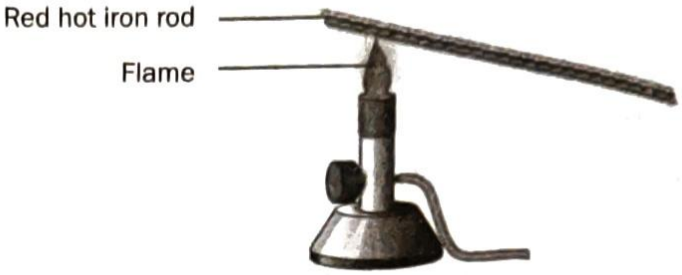
An iron rod is heated till it becomes red hot.
Image
Is heating of iron rod a chemical change?
Select the correct response.
  • No, because no new substance is formed
  • B
    No, because the rod does not change it's state
  • C
    Yes, because the iron rod turns red when heated
  • D
    Yes, because heat is absorbed by the iron rod
Answer
Correct option: A.
No, because no new substance is formed
A
View full question & answer
MCQ 91 Mark
Which of these can never happen in physical change?
  • A
    Change in size of object
  • B
    Change in state of matter
  • C
    Change in shape of object
  • Change in composition of matter
Answer
Correct option: D.
Change in composition of matter
D
View full question & answer
MCQ 101 Mark
Which of these is a physical change?
  • A
    A flower turning into a fruit
  • A lizard changing it's skin colour
  • C
    A plant making food
  • D
    A butterfly larva changing into cocoon
Answer
Correct option: B.
A lizard changing it's skin colour
B
View full question & answer
MCQ 111 Mark
Anaerobic bacteria digest animal waste and produce biogas (change A). The biogas is then burnt as fuel (change B). The following statements certain to these changes. Choose the correct one.
  • A
    Process A is a chemical change
  • B
    Process B is a chemical change
  • Both processes A and B are chemical changes
  • D
    None of the above processes is a chemical change
Answer
Correct option: C.
Both processes A and B are chemical changes
(C) Both processes A and B are chemical changes.
Bacteria acts on waste and converts it to biogas (change A). During biogas production it works as fuel(change B) and produces $CO _2$and heat. Hence, A and B both are chemical changes.
View full question & answer
MCQ 121 Mark
The gas we use in the kitchen is called Liquified Petroleum Gas (LPG). In the cylinder, it exist as a liquid. When it comes out from the cylinder, it becomes a gas (change A). Then, it burns (change B).
The following statements pertain to these changes. Choose the correct one.
  • A
    Process A is a chemical change
  • Process B is a chemical change
  • C
    Both processes A and B are chemical changes
  • D
    None of these processes is a chemical change
Answer
Correct option: B.
Process B is a chemical change
(B) Process B is a chemical change Process B, i.e. burning of gas is a chemical change. Process A is a physical change. The LPG in cylinder is in liquid form because of high pressure. When it comes from cylinder, it turns into gas which is a physical change.
View full question & answer
MCQ 131 Mark
Which of the following cannot be obtained by crystallisation?
  • A
    Sugar from sugar solution
  • B
    Salt from sea water
  • Crushed coffee powder
  • D
    Copper sulphate
Answer
Correct option: C.
Crushed coffee powder
C
View full question & answer
MCQ 141 Mark
In the crystallisation process, solution is first heated and then allowed to cool. We let the solution be cold to
  • A
    dissolve impurities in the solution
  • B
    make handling of beaker easy
  • let the crystals form
  • D
    allow impurities to solidify in the solution
Answer
Correct option: C.
let the crystals form
C
View full question & answer
MCQ 151 Mark
Galvanisation is a process used to prevent the rusting of which of the following?
  • Iron
  • B
    Zinc
  • C
    Aluminium
  • D
    Copper
Answer
Correct option: A.
Iron
A
View full question & answer
MCQ 161 Mark
How do you prevent the rusting of iron?
  • A
    By cleaning it with water
  • B
    By rubbing it with sand paper
  • By painting it
  • D
    By keeping it in moist soil
Answer
Correct option: C.
By painting it
C
View full question & answer
MCQ 171 Mark
It is monsoon season. It rains everyday. You left your iron pan outside. What will happen to it after one month?
  • A
    It will remain same
  • B
    It will be clean and shiny
  • It will form rust $\left( Fe _2 O _3\right)$
  • D
    It reacts with water to form Iron hydroxide $Fe ( OH )_3$.
Answer
Correct option: C.
It will form rust $\left( Fe _2 O _3\right)$
C
View full question & answer
MCQ 181 Mark
Which of these will not affect the rusting of iron?
  • A
    Oxygen gas
  • B
    Moisture
  • C
    Salts
  • Hydrogen gas
Answer
Correct option: D.
Hydrogen gas
D
View full question & answer
MCQ 191 Mark
You brought some fruits from the market. Some days later, they rotted. What change did occur there?
  • A
    Physical change as it is reversible
  • B
    Physical change as the colour changed
  • Chemical change because it cannot be reversed
  • D
    Chemical change because shape changed
Answer
Correct option: C.
Chemical change because it cannot be reversed
C
View full question & answer
MCQ 201 Mark
When a piece of magnesium ribbon is burnt, a bright white flame glows. It, then turns into a white ash.
Choose the correct statement.
  • Magnesium ribbon heats up and disintegrates into smaller particles
  • B
    Pure magnesium bonds with oxygen in air to form a new substance
  • C
    Magnesium changes it's state from solid to gas and gas to solid
  • D
    Ash can be converted to magnesium by heating
Answer
Correct option: A.
Magnesium ribbon heats up and disintegrates into smaller particles
A
View full question & answer
MCQ 211 Mark
A woman wants to make tea. The steps in the process are
Step 1: Boil water
Step 2: Add tea and sugar to boiling water.
What type of changes to each of these steps represent?
  • 1: Physical change, 2: Chemical change
  • B
    1: Physical change, 2: Physical change
  • C
    1: Chemical change, 2: Chemical change
  • D
    1: Chemical change, 2: Physical change
Answer
Correct option: A.
1: Physical change, 2: Chemical change
A
View full question & answer
MCQ 221 Mark
Which of the following does not classify as a chemical change?
  • Switching on a fan
  • B
    Cooking food
  • C
    Depletion of ozone layer
  • D
    Making of paneer
Answer
Correct option: A.
Switching on a fan
A
View full question & answer
MCQ 231 Mark
A chemical change may involve
  • A
    change in colour only
  • B
    change in temperature only
  • C
    evolution of gas only
  • All of the above
Answer
Correct option: D.
All of the above
D
View full question & answer
MCQ 241 Mark
Which one of the following is a chemical change?
  • A
    Twinkling of stars
  • Cooking of vegetables
  • C
    Cutting of fruits
  • D
    Boiling of water
Answer
Correct option: B.
Cooking of vegetables
B
View full question & answer
MCQ 251 Mark
A student collects wax from a burning candle. He melts the wax and adds a new wick to it and leaves it to cool. What type of change is the cooling of wax to get back original candle?
  • Physical change as it is a reversible change
  • B
    Chemical change as it is an irreversible change
  • C
    Chemical change as it is an reversible change
  • D
    Physical change as it is a irreversible change
Answer
Correct option: A.
Physical change as it is a reversible change
A
View full question & answer
MCQ 261 Mark
Which of the following is the formula of ozone?
  • A
    $Fe _2 O _3$
  • B
    $O _2$
  • $O _3$
  • D
    $H _2 O$
Answer
Correct option: C.
$O _3$
C
View full question & answer
MCQ 271 Mark
Formation of a substance is
  • A
    temporary change
  • B
    physical change
  • chemical change
  • D
    reversible change
Answer
Correct option: C.
chemical change
C
View full question & answer
MCQ 281 Mark
Which property among the following will stay the same during physical and chemical changes?
  • A
    Density
  • B
    Shape
  • Mass
  • D
    Arrangement of particles
Answer
Correct option: C.
Mass
C
View full question & answer