Questions

1 Marks Question

Take a timed test

83 questions · self-marked practice — reveal the answer and mark yourself.

Question 11 Mark
Find the odd one out in the following:
Gamete, budding, fragmentation, regeneration.
Answer
Gamete is the odd-one out as it is responsible for sexual reproduction while the remaining three are methods of asexual reproduction.
View full question & answer
Question 21 Mark
Why reproduction is essential life process?
Answer
Reproduction is essential for continuation of the species from generation to generation.
View full question & answer
Question 31 Mark
What is regeneration?
Answer
The ability of living things to repair themselves or grow lost parts is called regeneration.
View full question & answer
Question 41 Mark
Hooks and spines are present in seeds or fruits dispersed by animals. Give reasons.
Answer
Hooks and spines help seeds and fruits to stick to the bodies of animals and be safely dispersed or transported to far off places.
View full question & answer
Question 51 Mark
Spores are covered by a hard covering. Give reasons.
Answer
Spores are covered by a hard covering to provide protection from harsh conditions.
View full question & answer
Question 61 Mark
What is pollination?
Answer
The transfer of pollen grains of a flower to the stigma of same flower or that of a different flower of the same kind is called pollination.
View full question & answer
Question 71 Mark
If the filament of Spirogyra is broken into fragments. What will you observe?
Answer
If the filament of Spirogyra are broken into fragments, then each fragment will develop into a new plant.
View full question & answer
Question 81 Mark
Bryophyllum leaves reproduce using which mode of reproduction?
Answer
Asexually by vegetative propagation.
View full question & answer
Question 91 Mark
How Pollen grains transfer from one flower to another?
Answer
By pollinating agents like wind, water and animals.
View full question & answer
Question 131 Mark
Why is the process of reproduction necessary?
Answer
The process of reproduction is necessary for the perpetuation and preservation of species and to increase the number of members of species.
View full question & answer
Question 141 Mark
What is unisexual flower?
Answer
A flower may have either male or female reproductive parts. Such a flower is called unisexual flowers.
View full question & answer
Question 161 Mark
How does an algae reproduce?
Answer
Algae reproduce by a method known as fragmentation. The breaking down of filaments into fragments that grow into young ones is called fragmentation.
View full question & answer
Question 181 Mark
Fill in the blanks:Seed dispersal takes place by means of _____________, _____________ and _____________.
Answer
Seed dispersal takes place by means of wind, water and animals.
View full question & answer
Question 191 Mark
What is a mould?
Answer
Mould is a type of fungus that grows on moist organic surfaces like leather shoes and moist walls.
View full question & answer
Question 201 Mark
‘Spores’ as a means of asexual reproduction are used by which plants?
Answer
Spores are produced by fungi, ferns and mosses during unfavourable conditions.
View full question & answer
Question 211 Mark
Fill in the blanks:The fusion of male and female gametes is termed as _____________.
Answer
The fusion of male and female gametes is termed as fertilisation.
View full question & answer
Question 241 Mark
Why do farmers leave space between the seeds while sowing them?
Answer
This is done to avoid overcrowding and to avoid scarcity of nutrients, light, air and space for the seeds.
View full question & answer
Question 261 Mark
Flowers are colourful and fragrant. Give reason supporting the statement.
Answer
Flowers are so colourful because they absorb and reflect light energy. Fragrance results from production of volatile chemicals which evaporate.
View full question & answer
Question 271 Mark
Write the male and female reproductive parts present on the flowers.
Answer
The male reproductive part is stamen and the female reproductive part is pistil.
View full question & answer
Question 291 Mark
Fill in the blanks: Production of new individuals from the vegetative part of parent is called _____________.
Answer
Production of new individuals from the vegetative part of parent is called vegetative propagation.
View full question & answer
Question 301 Mark
Classify the following as motion along a straight line, circular or oscillatory motion:

Motion of the hammer of an electric bell.

Answer
Oscillatory motion.
View full question & answer
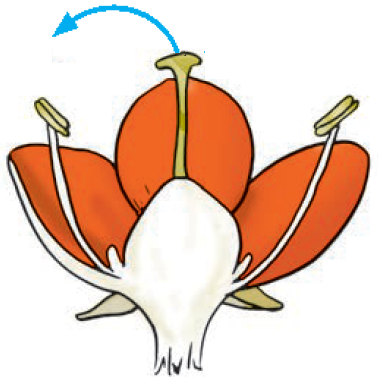
Question 311 Mark
Which type of pollination does the given figure indicate?

Answer
The given figure shows self-pollination, as the pollen grains from anther of flower are transferred to the stigma of same flower.
View full question & answer
Question 321 Mark
Fill in the blanks:
The transfer of pollen grains from the anther to the stigma of the same or of another flower of the same kind is known as _____________.
Answer
The transfer of pollen grains from the anther to the stigma of the same or of another flower of the same kind is known as pollination.
View full question & answer
Question 331 Mark
Fill in the blanks: A flower may have either male or female reproductive parts. Such a flower is called _____________.
Answer
A flower may have either male or female reproductive parts. Such a flower is called unisexual.
View full question & answer
Question 341 Mark
Define grafting.
Answer
Grafting is an artificial method of vegetative propagation in which the desired plant is obtained from two different individual plants called stock (root portion from one plant) and Scion (stem portion from another plant).
View full question & answer
Question 361 Mark
Classify the following as motion along a straight line, circular or oscillatory motion:Motion of a child in a merry - go - round.
Answer
Circular motion.
View full question & answer
Question 371 Mark
What is fragmentation?
Answer
The breaking of the body into two or more parts is called fragmentation. It can be seen in Spirogyra.
View full question & answer
Question 381 Mark
The anther of flower contains pollen sacs that produce ____________.
Answer
The anther of flower contains pollen sacs that produce Pollen grains.
View full question & answer
Question 401 Mark
Name any three agencies for dispersal of seeds.
Answer
  1. Wind.
  2. Water.
  3. Man and animals, birds, bats, squirrels.
View full question & answer
Question 421 Mark
Fruit is the ripened ovary of a flower. Explain.
Answer
After fertilisation, the ovary of a flower develops and becomes a fruit with seeds present inside.
View full question & answer
Question 431 Mark
Can a unisexual flower be self-pollinated?
Answer
Unisexual flower can self-pollinate where both male and female flowers are present on the same plant. The stigma of the female flower can be pollinated by the pollen of the male flower present on the same plant.
View full question & answer
Question 451 Mark
Wind pollinated flowers produce large number of pollen grains. Give reasons.
Answer
During wind pollination many pollen grains are lost. So to ensure that at least some pollens reach the stigma, a large number of pollen grains are produced.
View full question & answer
Question 461 Mark
A flower consists of different parts. Name these parts of a flower.
Answer
The four main parts of a flower are:
  1. Sepals.
  2. Petals.
  3. Stamen.
  4. Pistil.
View full question & answer
Question 491 Mark
Classify the following as motion along a straight line, circular or oscillatory motion:

Motion of a train on a straight bridge.

Answer
Straight line motion.
View full question & answer
Question 501 Mark
A yellow powdery substance is present in the anther which participates in reproduction process. Name this substance.
Answer
Pollen grains.
View full question & answer
Question 511 Mark
In which part of flower does fertilisation occur?
Answer
Ovary is the part where male and female gametes fuse together.
View full question & answer
Question 521 Mark
Define tissue culture.
Answer
Tissue culture is an artificial method of vegetative propagation in which tissue from the plant tip is grown in an artificial nutrient medium to produce callus which can produce new plants.
View full question & answer
Question 541 Mark
Find the odd one out in the following: Cutting, grafting, layering, binary fission.
Answer
Binary fission is the odd-one out as it a method of asexual reproduction while the rest three are artificial methods of vegetative propagation.
View full question & answer
Question 551 Mark
Name the different modes of asexual reproduction.
Answer
There are different methods by which plants reproduce asexually. They are vegetative propagation, budding, fragmentation and spore formation.
View full question & answer
Question 561 Mark
What is vegetative propagation?
Answer
Vegetative propagation is defined as the production of a new individual from a body part like leaves, stems and roots.
View full question & answer
Question 591 Mark
Formation of new but similar individuals from parents is characteristic feature of which process?
Answer
Reproduction is the process of production of new similar organisms from their parents.
View full question & answer
Question 611 Mark
Why flowers are generally so colourful and fragrant?
Answer
Flowers are generally attract insects and other living organisms for pollination.
View full question & answer
Question 621 Mark
Classify the following as motion along a straight line, circular or oscillatory motion:Motion of a child on a see - saw.
Answer
Oscillatory motion.
View full question & answer
Question 641 Mark
What are the bulb-like projections forming in yeasts?
Answer
The bulb-like projections formed during reproduction are called buds.
View full question & answer
Question 661 Mark
Explain the term fertilisation.
Answer
The fusion of male nucleus (male gamete) with that of egg cell (female gamete) is known as fertilisation.
View full question & answer
Question 671 Mark
What would happen if seeds are not able to disperse?
Answer
If seeds are not able to disperse, they will clutter on one place and would not be able to grow properly because of lack of nutrients.
View full question & answer
Question 681 Mark
Seed dispersal helps the plant. Give reasons.
Answer
To avoid growing of the plants at one place leading to scarcity of nutrients and ensure survival of the plants, seeds are dispersed.
View full question & answer
Question 691 Mark
Banana is a fruit without seeds. Give reason.
Answer
Banana forms from one parent only. There is no seed production.
View full question & answer
Question 701 Mark
Classify the following as motion along a straight line, circular or oscillatory motion: Motion of a horse pulling a cart on a straight road.
Answer
Straigght line motion.
View full question & answer
Question 741 Mark
Pollen grains are present inside anthers for long time yet they do not die. Why?
Answer
Pollen grains have a tough protective coat which presents them from drying up.
View full question & answer
Question 751 Mark
Insect pollinated flowers are brightly coloured and sweet smelling. Give reasons.
Answer
Insect pollinated flowers are brightly coloured and sweet smelling to attract insects to itself.
View full question & answer
Question 761 Mark
Write two ways in which pollination may occur in plants.
Answer
The two ways in which pollination may occur in plants are:
  1. Self-pollination.
  2. Cross-pollination.
View full question & answer
Question 771 Mark
What is a bud? Which organism reproduce by budding? Given the diagrammatic representation of budding in a plant.
Answer
Buds are small bulb-like projections of yeast cell. These are asexual reproducing bodies of yeast.
View full question & answer
Question 781 Mark
What happens in sexual reproduction?
Answer
In sexual reproduction, the male and the female gametes fuse to form seeds that eventually develop into new plants.
View full question & answer
Question 801 Mark
Mention the mode of reproduction in the following plants:
  1. Spirogyra.
  2. Yeast.
  3. Money plants.
Answer
  1. Spirogyra – fragmentation.
  2. Yeast – budding.
  3. Money plant – Vegetative propagation.
View full question & answer
Question 821 Mark
What is dispersal? List the agents of dispersal.
Answer
Dispersal is the scattering of seeds to far away places. The agents of dispersal are wind, water, insects and animals.
View full question & answer
Question 831 Mark
Name two plants where vegetative reproduction takes place by roots.
Answer
Sweet potato and dahlia develops new plants through their roots by the process of vegetative reproduction.
View full question & answer