Questions

2 Marks Questions

Take a timed test

31 questions · self-marked practice — reveal the answer and mark yourself.

Question 12 Marks
Explain cellular respiration.
Answer
The air we breathe in transported to every parts of body and ultimately it is transported to each cell, in the cells, oxygen in the air helps in the breakdown of food, this process of breakdown of food in the cell with the release of energy is called cellular respiration. Cellular respiration occurs in the cells of all organisms.
View full question & answer
Question 22 Marks
What facilitates opening and closing of stomatal pores?
Answer
The stomatal pores are enclosed by two guard cells, which are surrounded by several subsidiary cells. All these three, namely stomatal pores, guard cells and subsidiary cells together constitute stomatal apparatus. The flow of the water into and out of guard cells facilitates closing and opening of stomatal pores. This results in the exchange of gases.
View full question & answer
Question 32 Marks
Why does an athlete breathe faster and deeper than usual after finishing the race?
Answer
Our body needs energy for all activities. While doing heavy exercises like running, there is larger demand of energy to perform those activities. Hence more oxygen is required to meet extra demand of energy. Therefore an athlete breathe faster and deeper than usual after finishing the race.
Also during running, due to lack of oxygen, some muscles may respire anaerobically and form lactic acid. Extra oxygen is also required to burn this lactic acid into carbon dioxide.
View full question & answer
Question 42 Marks
Explain the process of breathing in fish.
Answer
Fish gulps water through mouth and forces it between the gills. The oxygen in it gets diffused into the blood circulating in gills and carbon dioxide in the bloodstream diffuses into the water which is carried out through a gap between fish’s body and the gill cover.
View full question & answer
Question 52 Marks
After we work hard or perform physical activity, we feel hungry. Explain why.
Answer
When we work hard or perform physical activity (like running, swimming, cycling), we need mdre energy. To fulfil the energy requirement, we breathe faster. Fast breathing helps in supply of more oxygen to our cells. Due to this, rate of breakdown of food increases and more energy is released. The rapid breakdown of food makes us to feel more hungry.
View full question & answer
Question 62 Marks
A food stall owner was preparing dough for making bhaturas. He added a pinch of yeast and sugar to the dough and left it in a warm place. After few hours, the dough had risen. There was a sour smell too. What would have happened if the dough was kept in the refrigerator, soon after it was prepared?
Answer
If the dough was kept in the refrigerator soon after it was prepared, then dough will neither rise nor become sour. Yeast requires high temperature to grow, multiply and to respire. At low temperature, the yeast will not multiply or respire and therefore, no $\mathrm{CO}_2$ or alcohol would be formed.
View full question & answer
Question 72 Marks
Explain respiration in insects.
Answer
A cockroach has a small opening on the side of its body, these openings are called spiracles. Oxygen rich air rushes through spiracles into the tracheal tubes diffuses into the body tissue and reaches every cell of body. In the same way carbon dioxide from the cells goes into the tracheal tube and moves out through spiracles.
View full question & answer
Question 82 Marks

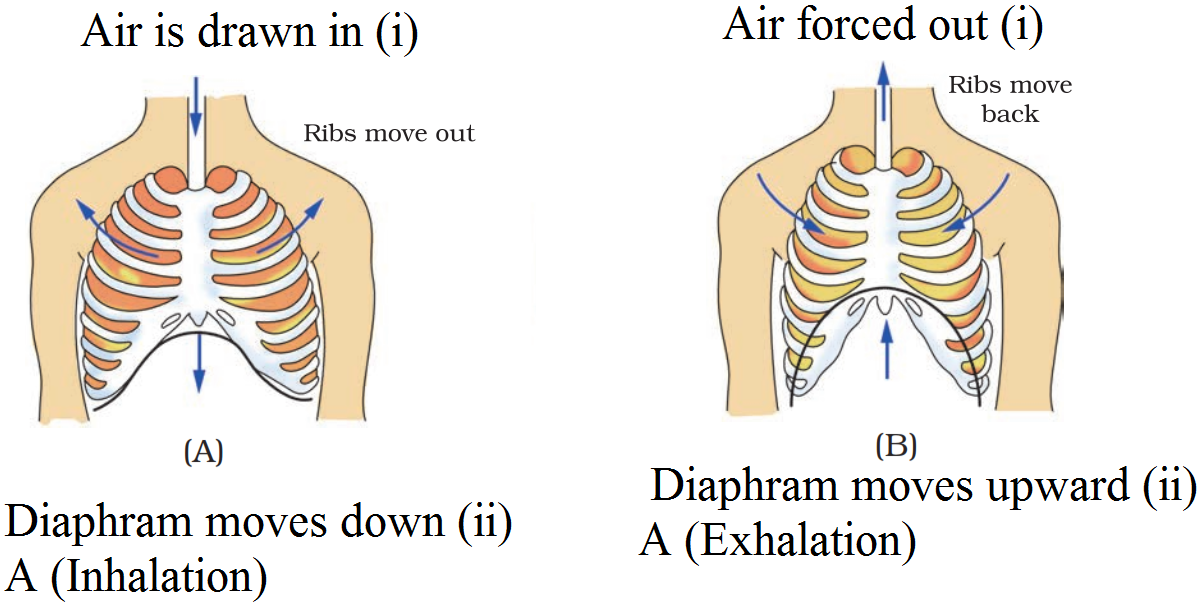
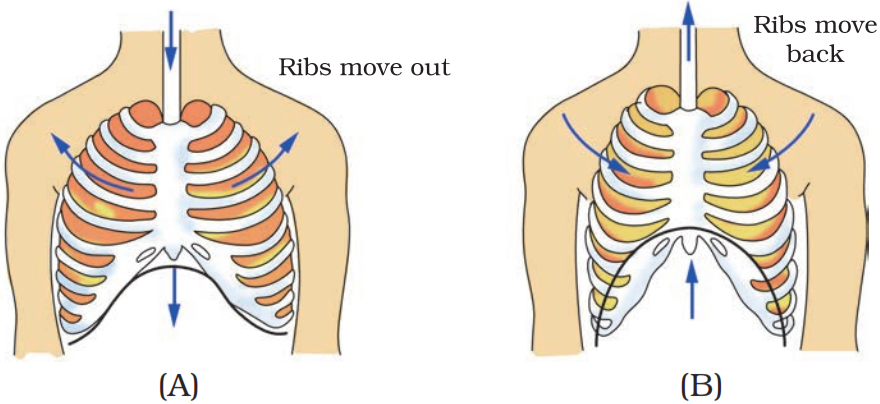
Observe the figures given as Figure (A) and (B) and answer the following.
  1. Which of the figures A or B indicates the process of inhalation and which the process of exhalation?
  2. In the figure label the arrows and indicate the direction of:
  1. Movement of air
  2. Movement of diaphragm
  3. Movement of ribs

Answer
  1. Figure A indicates inhalation and figure 6 indicates exhalation. During inhalation, the ribs contract to move outward and upward, while during exhalation, the movement reverses, i.e. ribs relaxes to move inward and downward.

View full question & answer
Question 92 Marks
Define the term breathing rate.
Answer
The number of times a person breathes, in a minute is called as breathing rate. An adult human being can inhale or exhale $15-18$ times in a minute. It is the average breathing rate of an adult human being. Breathing rate is not constant always.
View full question & answer
Question 102 Marks
Humans use yeast every day. What is yeast?
Answer
If we want to make our own bread, we can buy yeast in the grocery store. This yeast consists of little brown grains. The little brown grains of yeast may not seem to be alive, but if we put them in water with sugar, the yeast will carry out cellular respiration and grow. We can grow yeast in a test tube filled with water and sealed with a balloon. Under anaerobic conditions, yeast carries out alcoholic fermentation, so it produces lactic acid and energy.
View full question & answer
Question 112 Marks
Name the end products of anaerobic respiration in yeast.
Answer
The end product formed during anaerobic respiration in yeast are:
  • Ethyl alcohol.
  • Carbon dioxide.
  • Energy.
View full question & answer
Question 122 Marks
Why do we respire?
Answer
We respire to use the oxygen, to oxidise our food and release energy. This is similar like burning but a slower process. it also needs respiratory enzymes .Respiration is a slower process than burning and energy released can be stored for later use. $\mathrm{C}_6 \mathrm{H}_{12} \mathrm{O}_6+\mathrm{O}_2 \rightarrow \mathrm{H}_2 \mathrm{O}+\mathrm{CO}_2+$ energy.
View full question & answer
Question 132 Marks
Why do we often sneeze when we inhale a lot of dust-laden air?
Answer
When we inhale dust-laden air, dirt particles are captured within the nostrils. Sometimes they get past the nostril hair in the nasal cavity and irritate the lining of the cavity. As a result we sneeze. Sneezing expels these foreign particles from the inhaled air and a dust free, clean air enters our body.
View full question & answer
Question 142 Marks
Distinguish between the following. Respiration in plants and Respiration in animals.
Answer
S.No.
Respiration in plants
Respiration in animals
$(i)$
Transport of air occurs through stomata.
Transport of air occurs through nose.
$(ii)$
Carbon dioxide is absorbed and oxygen is released out.
Oxygen is absorbed and carbon dioxide is released out.
View full question & answer
Question 152 Marks
Respiratory process occurs in two phases, what are those two major steps of respiration? Describe each one.
Answer
Respiration is the process of breakdown of food to produce energy for performing various functions. It involves two major steps:
  • Inhalation is the process of taking in of air which is rich in oxygen, inside our body.
  • Exhalation is the process of giving out of air which is rich in carbon dioxide from our body to the external environment.
View full question & answer
Question 162 Marks
Explain the process of breathing in insects and fishes.
Answer
A cockroach has a small opening on the side of its body, these openings are called spiracles. Oxygen rich air rushes through spiracles into the tracheal tubes diffuses into the body tissue and reaches every cell of body. In the same way carbon dioxide from the cells goes into the tracheal tube and moves out through spiracles.
Water animals have gills that help them to use oxygen dissolved in water. Gills are projections of the skin which are well supplied with blood vessels for exchange of gases.
View full question & answer
Question 172 Marks
Why do we often sneeze when we inhale a lot of dust laden air?
Answer
When we inhale a lot of dust laden air, the dust particles get trapped in the hair present in our nasal cavity. However, sometimes these particles may get past the hair in the nasal cavity. Then they irritate the lining of the cavity, as a result of which we sneeze. Sneezing expels these foreign particles from the inhaled air and a dust free, clean air enters our body.
View full question & answer
Question 182 Marks
Paheli participated in a $400m$ race competition held at her school and won the race. When she came home she had mixed feelings of joy and pain as she had cramps in her leg muscles. After a massage she was relieved of the pain.
Answer the following questions related to the situation.
Why did she feel comfortable after a massage?
Answer
The massage or hot water bath gives relief from muscle cramps or pain, because it improves the circulation of blood leading to increased supply of oxygen to the muscle cells. It helps in complete breakdown of lactic acid into carbon dioxide and water.
View full question & answer
Question 192 Marks
Which gas present in air is essential for aerobic respiration? What is the role of oxygen during respiration?
Answer
Oxygen gas present in air is essential for aerobic respiration. It breaks down food and releases energy during respiration. $\text{Glucose}\xrightarrow{\text{Oxygen}}\text{CO}_2+\text{H}_2\text{O}+\text{Energy}$
View full question & answer
Question 202 Marks
The plant roots being underground respire by using which mechanism?
Answer
Roots of the plants respire under the ground. Root cells get oxygen from the air present in the space between the soil particles. There are several root hairs present on the roots of a plant. The oxygen from the air (between soil particle) diffuses into root hair and reaches to the cells of the roots. This oxygen is utilised for respiration.
View full question & answer
Question 212 Marks

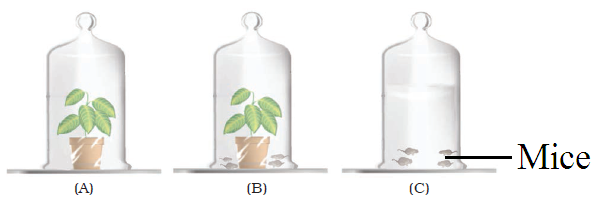
Observe the given figures carefully.and answer the following Questions.
  1. The amount of $\mathrm{CO}_2$ be the highest in which jar. Why?
  2. The amount of $\mathrm{CO}_2$ be the lowest in which one and why?
Answer
  1. The amount of $\mathrm{CO}_2$ will be the highest in jar $C$. It is because the mice kept under the jar will breathe out $\mathrm{CO}_2$ continuously increasing its amount in the jar.
  2. The amount of $\mathrm{CO}_2$ will be the lowest in jar $A$. It is because in jar $A$, $\mathrm{CO}_2$ released during respiration is used by the plants, i.e. during the process of photosynthesis.
View full question & answer
Question 222 Marks
Plants lack a specialised respiratory system. How do they carry out respiratory process? Explain.
Answer
The plants do not possess any respiratory system still plants respire. The various parts of the plants like leaves, roots, etc., carry out respiration independently. These parts take in oxygen from air in different manner and utilise it to obtain energy and give out $\mathrm{CO}_2$. The leaves of plants possess tiny pores on their surface which is called as stomata. The gaseous exchange during respiration takes place through their stomata.
View full question & answer
Question 232 Marks
Explain respiration in yeast.
Answer
Yeast is single celled organism that respires anaerobically and during this process yield alcohol. Yeast get energy through anaerobic respiration, in the absence of oxygen, glucose breaks down into oxygen and carbon dioxide, The equation for the reaction is as follow: Glucose in absence of oxygen → alcohol + carbon dioxide + energy
View full question & answer
Question 242 Marks
A food stall owner was preparing dough for making bhaturas. He added a pinch of yeast and sugar to the dough and left it in a warm place. After few hours, the dough had risen. There was a sour smell too. Why was sugar added to the dough?
Answer
Sugar is added into the dough, because it acts as a food for yeast. Yeast on incomplete breakdown of sugar or food produces $\mathrm{CO}_2$, alcohol and energy (in less amount).
View full question & answer
Question 252 Marks
What happens to the air we breathe in?
Answer
The air we breathe in transported to every parts of body and ultimately it is transported to each cell, in the cells, oxygen in the air helps in the breakdown of food, this process of breakdown of food in the cell with the release of energy is called cellular respiration.
View full question & answer
Question 262 Marks
Why we get muscle cramps after heavy exercise?
Answer
During heavy exercise the demand for energy is high. But the supply of oxygen to produce energy is limited. Then anaerobic respiration takes place in the muscle cells to fulfil the demand of energy. Glucose in absence of oxygen → Lactic Acid + Energy. The cramps occur only when the muscle cells respire anaerobically. The partial breakdown of glucose produces lactic acid. The accumulation of lactic acid causes muscle cramps.
View full question & answer
Question 272 Marks
There are three animals named $A, B$ and $C$. Among them $A$ can stay on land as well as in water. When it stays at land is respire through lungs but when it goes into water, it respires through its moist skin. Animal $B$ has specific organs to respire in the water which is not found in any other water animal. While animal $C$ is a water animal which respires through nostrils and lungs. Now give the name of animal $A, B$ and $C$.
Answer
Animal $A$ can live on land as well as in water and can respire through lungs as well as moist skin.
The animal is frog.
Animal $B$ lives in water and respires through a specific organ called gills. These are found in the tadpoles besides fishes. The animal $B$ is a fish.
Animal $C$ is also an aquatic animal which lives in sea water and respires through nostrils and lungs not by the gills. The animal is whale.
View full question & answer
Question 282 Marks
What happens to the air we breathe in, once it reaches the lungs?
Answer
When the air breathed in reaches the lungs it enters the alveoli. The alveoli are lined with blood capillaries and exchange of gases occurs. The oxygen from the alveoli is taken up by the capillaries and carbon dioxide from the blood is transferred to alveoli.
View full question & answer
Question 292 Marks
Explain respiration in cockroach.
Answer
A cockroach has a small opening on the side of its body, these openings are called spiracles. Oxygen rich air rushes through spiracles into the tracheal tubes diffuses into the body tissue and reaches every cell of body. In the same way carbon dioxide from the cells goes into the tracheal tube and moves out through spiracles.
View full question & answer
Question 302 Marks
Explain all body parts involved in respiration.
Answer
We take in air through our nostrils, when we inhale air, it passes through our nostril into nasal cavity and from there it reaches our lungs through the wind pipe. Lungs are present in chest cavity which is surrounded by ribs on the sides, diaphragm forms the floor of chest cavity. Breathing involves the movement of diaphragm and the rib cage.
View full question & answer
Question 312 Marks
Explain the role of the diaphragm in the process of breathing.
Answer
When diaphragm contracts and moves downwards, the chest cavity enlarges and the pressure in lungs decreases. The air is breathed in to equalise pressure. When diaphragm relaxes and moves upwards, the lungs push out the air.
View full question & answer