Questions

3 Marks Question

Take a timed test

7 questions · self-marked practice — reveal the answer and mark yourself.

Question 13 Marks
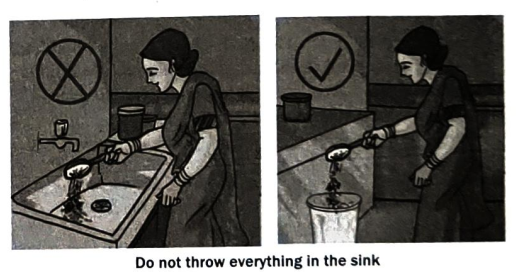
Recall and enlist some better housekeeping practices.
Answer
We must minimise and manage waste at our houses before its disposal in the following manner:
(i)Cooking oil and fats should not be thrown down the drain. They can harden and block the pipes. In an open drain, the fats clog the soil pores and reduce its effectiveness in filtering water. Throw oil and fats in the dustbin.
(ii)Used tea leaves, solid food remains, soft toys, cotton, sanitary towels, etc. should also be thrown in the dustbin. These wastes choke the drains. They do not allow free flow of oxygen and hamper the degradation process.
(iii)Chemicals like paints, solvents, insecticides, medicines and motor oils should not be thrown in drains as they may kill microbes that help to purify water.
Image
View full question & answer
Question 23 Marks
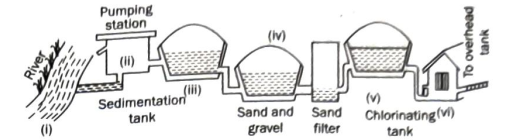
Observe the given figure and answer the following
(a) What does this figure show?
(b) State the functions of each part of the figure.
Image
Answer
(i) This figure shows the supply of drinking water, its processing and the source of water. Functions of each part of the figure.
(ii) • River It is the source of water.
• Pumping station Pump the water to collect it in reservoir.
• Sedimentation tank Impurities settle in the bottom of tank.
• Sand and gravel and sand filter Remove the dirt from the water.
• Chlorinating tank Chlorine is mixed in water to disinfect the water and kill the germs.
• To overhead tank Purified water is stored in this tank for supply to households for drinking.
View full question & answer
Question 33 Marks
Outline your role as an active citizen in relation to sanitation.
Answer
In our country, fairs are organised periodically. A large number of people participate in them. In the same way, railway stations, bus depots, airports and hospitals are very busy places. Thousands of people visit these place daily which generate a large amount of waste. It must be disposed off properly otherwise epidemics could break out. The government has laid down certain standards of sanitation, but unfortunately, they are not strictly enforced. We should not scatter litter anywhere. If there is no dustbin in sight, we should carry the litter home and throw it in the dustbin.
Conclusion
We all must contribute in keeping our environment clean and healthy. We must realise our responsibility to maintain the water sources in a healthy state. Adopting good sanitation practices should be our way of life. As agents of change, our individual initiative will make a great difference. We should be able to influence others with our energy ideas and optimism. A lot can be done if people work together. There is great power in collective action.
As active citizens, we have many responsibilities regarding sanitation. These can be listed as follows
(i) To ensure that our surroundings are clean.
(ii) To ensure that the sewerage system in our house is properly managed.
(iii) If any leakage or any open drain in the sewerage system is present, then it should be reported to the Municipality or the
Gram Panchayats to insist that the open drain must be covered properly so that several air and water-borne diseases can be prevented.
View full question & answer
Question 43 Marks
What is sewage? Explain, why it is harmful to discharge untreated sewage into rivers or sea?
Answer
Sewage is the wastewater containing both liquid and solid wastes (suspended solids) produced by human activities in homes, industries, hospitals, offices, etc.
Sewage contains various contaminants including disease causing bacteria and other microbes. If untreated sewage is discharged into rivers or sea, then the water in the rivers or sea would get contaminated.
If this contaminated water is used for drinking, it can cause diseases such as cholera, typhoid, dysentery, etc. which may lead to death. That is why, it is harmful to discharge untreated sewage into rivers or the sea.
View full question & answer
Question 53 Marks
List the ways in which wastewater present in sewage is generated and the kind of contaminants present in each.
Answer
Wastewater present in sewage is generated from various sources, each containing specific contaminants:
1.Domestic wastewater:
Comes from kitchens, bathrooms, and toilets.Contains organic matter (food waste, human excreta), soaps, detergents, and pathogens.
2.Industrial wastewater:
Comes from factories and industries.Contains chemicals, heavy metals, dyes, and toxic substances.
3.Stormwater or rainwater runoff:
Water from roads and open areas.Contains dust, sand, oils, and other inorganic impurities.
View full question & answer
Question 63 Marks
Discuss the primary stage of sewage treatment.
Answer
The primary stage of sewage treatment is the first step in cleaning wastewater and involves removal of large and suspended solid particles.
Sewage is first passed through screens to remove large objects like sticks, rags, and plastics.
It then enters sedimentation tanks (primary settling tanks), where the heavier organic solids settle down as sludge.
The liquid portion (supernatant) moves to the next stage for further treatment, while the sludge is collected for decomposition or further processing.
View full question & answer
Question 73 Marks
Mention one way of overcoming the problem of the lack of sewage systems in villages.
Answer
One way to overcome the problem of lack of sewage systems in villages is to use septic tanks or individual household-level sewage treatment systems.
In a septic tank, wastewater is collected and partially treated on-site, allowing solids to settle and liquids to flow out safely.
This method is affordable, simple, and does not require a centralized sewage system, making it suitable for rural areas.
View full question & answer
3 Marks Question - Science STD 7 Questions - Vidyadip