Questions

1 Marks Question

🎯

Test yourself on this topic

17 questions · timed · auto-graded

Question 11 Mark
Fill in the blanks.
For a convex polygon of $n$ sides, we have:
Sum of all exterior angles = ______.
Answer
Sum of all exterior angles $= 360^\circ .$
View full question & answer
Question 21 Mark
Write $'T'$ for true and $'F'$ for false for the following: The diagonals of a rectangle are perpendicular to each other.
Answer
False. Solution: The diagonals of a rectangle are not perpendicular to each other.
View full question & answer
Question 31 Mark
Fill in the blanks. For a convex polygon of $n$ sides, we have: Sum of all interior angles $=$ ______.
Answer
Sum of all interior angles $= (n - 2) \times 180^\circ .$
View full question & answer
Question 41 Mark
Fill in the blanks. For a regular polygon of $n$ sides, we have: Sum of all interior angles $=$ ______.
Answer
Sum of all interior angles $= (n - 2) \times 180^\circ .$
Solution: Sum of all exterior angles of a regular polygon is $360^\circ .$
View full question & answer
Question 51 Mark
Fill in the blanks. For a regular polygon of n sides, we have: Sum of all exterior angles $=$ ______.
Answer
Sum of all exterior angles $= 360^\circ .$
Solution: Sum of all exterior angles of a regular polygon is $360^\circ .$
View full question & answer
Question 61 Mark
Fill in the blanks. Each exterior angle of a regular polygon is $60^\circ .$ This polygon is a ______.
Answer
Each exterior angle of a regular polygon is $60^\circ .$ This polygon is a $6.$
Solution: Each exterior angle of a regular polygon is $60^\circ .$
$\therefore\frac{360}{60}=6$
​​​​​​​Therefore, the given polygon is a hexagon.
View full question & answer
Question 71 Mark
Fill in the blanks. A pentagon has ______ diagonals.
Answer
A pentagon has $5$ diagonals.
Solution: If n is the number of sides,
the number of diagonals $=\frac{\text{n}(\text{n}-3)}{2}$
$=\frac{5(5-3)}{2}$
$=5$
View full question & answer
Question 81 Mark
Define the terms: Open curve.
Answer
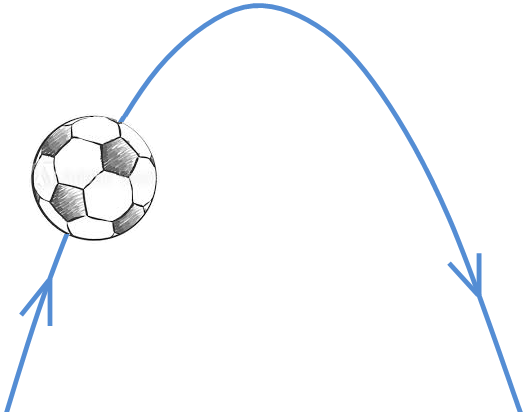
Open curve: An open curve is a curve where the beginning and end points are different. Example: Parabola.
View full question & answer
Question 91 Mark
Define the terms: Simple closed curve.
Answer
Simple closed curve: A closed curve that does not intersect itself.
View full question & answer
Question 101 Mark
Write $'T'$ for true and $'F'$ for false for the following:
Every rhombus is a kite.
Answer
Adjacent sides of a kite are equal and this is also true for a rhombus. Additionally, all the sides of a rhombus are equal to each other.
View full question & answer
Question 111 Mark
Fill in the blanks. For a convex polygon of $n$ sides, we have: Number of diagonals $=$ ______.
Answer
Number of diagonals $=\frac{\text{n}(\text{n}-3)}{2}.$
View full question & answer
Question 121 Mark
Define the terms: Closed curve.
Answer
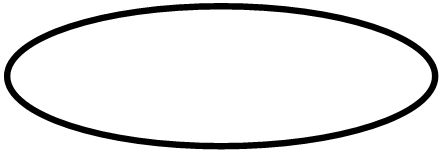
Closed Curve: A curve that joins up so there are no end points. Example: Ellipse.
View full question & answer
Question 131 Mark
Fill in the blanks. The sum of all interior angles of a regular hexagon is $($_____$)^\circ .$
Answer
The sum of all interior angles of a regular hexagon is $(720)^\circ .$
Solution:
Sum of the interior angles of a regular hexagon $= (6 - 2) \times 180^\circ = 720^\circ .$
View full question & answer
Question 141 Mark
Fill in the blanks. Each interior angle of a regular polygon is $108^\circ .$ This polygon is a ______.
Answer
Each interior angle of a regular polygon is $108^\circ .$ This polygon is a $360^\circ .$ ​​​​​​​
Solution:
If the interior angle is $108^\circ ,$
 then the exterior angle will be $72^\circ .$ (interior and exterior angles are supplementary) Sum of the exterior angles of a polygon is $360^\circ .$
$72\text{n}=360$
$\text{n}=\frac{360}{72}$
$\text{n}=5$
​​​​​​​Since it has $5$ sides, the polygon is a pentagon.
View full question & answer
Question 151 Mark
Write $'T'$ for true and $'F'$ for false for the following: The diagonals of a parallelogram are equal.
Answer
The diagonals of a parallelogram need not be equal in length.
View full question & answer
Question 161 Mark
Fill in the blanks. Each interior angle of a regular octagon is $($_____$)^\circ .$
Answer
Each interior angle of a regular octagon is $(135)^\circ .$
 Solution: Octgon has $8$ sides.
$\therefore$ Interior angle $=\frac{180^\circ\text{n}-360^\circ}{\text{n}}$
Interior angle $=\frac{(180^\circ\times8)-360^\circ}{{8}}=135^\circ$
View full question & answer
Question 171 Mark
Write $'T'$ for true and $'F'$ for false for the following: The diagonals of a rhombus bisect each other at right angles.
Answer
True. 
View full question & answer
1 Marks Question - MATHS STD 8 Questions - Vidyadip