Questions

4 Mark Question

🎯

Test yourself on this topic

5 questions · timed · auto-graded

Question 14 Marks
Which of the following are perfect cubes?
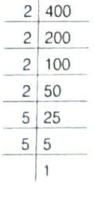
(i) 400 $\qquad~~$ (ii) 3375 $\quad$ (iii) 8000
(iv) 15625 $\quad$ (v) 9000 $\quad$ (vi) 6859
(vii) 2025 $\quad~$ (viii) 10648
View full question & answer
Question 24 Marks
Check which of the following are perfect cubes :
16000
Answer
We have, 16000
Resolving 16000 into prime factors,
we get
216000
28000
24000
22000
21000
2500
2250
5125
525
55
1
$16000=\underline{2 \times 2 \times 2} \times \underline{2 \times 2 \times 2} \times 2\times \underline{5 \times 5 \times 5}$
Clearly, the prime factor 2 does not appear in group of three (triples).
So, 16000 is not a perfect cube.
View full question & answer
Question 34 Marks
Find the smallest number by which each of the following number must be multiplied to obtain a perfect cube :
256
Answer
Given number is 256.
Resolving 256 into prime factors, we get
2256
2128
264
232
216
28
24
22
1
$256=\underline{2 \times 2 \times 2} \times \underline{2 \times 2 \times 2} \times 2 \times 2$
The prime factor 2 does not appear in a group of three (triples).
Therefore, 256 is not a perfect cube.
To make it a cube, we need one more prime number 2.
In that case,
$\begin{aligned} 256 \times 2 & =\underline{2 \times 2 \times 2} \times \underline{2 \times 2 \times 2} \times \underline{2 \times 2 \times 2} \\ & =512\end{aligned}$
which is a perfect cube.
Hence, the smallest number by which 256 should be multiplied to make a perfect cube is 2.
View full question & answer
Question 44 Marks
Find the smallest number by which each of the following number must be multiplied to obtain a perfect cube :
243
Answer
Given number is 243.
Resolving 243 into prime factors, we get
3243
381
327
39
33
1
$243=\underline{3 \times 3 \times 3} \times 3 \times 3$
The prime factor 3 does not appear in a group of three triples.
Therefore, 243 is not a perfect cube.
To make it a cube, we need one more prime number 3.
In that case,
$243 \times 3=\underline{3 \times 3 \times 3} \times \underline{3 \times 3 \times 3}=729$, which is a perfect cube.
Hence, the smallest number by which 243 should be multiplied to make a perfect cube is 3.
View full question & answer
Question 54 Marks
Which of the following numbers are not perfect cubes?
(i) 216$\qquad$(ii) 128$\quad$(iii) 1000
(iv) 100$\quad~~$(v) 46656
Answer
(i) We have, 216
Resolving 216 into prime factors, we get
2216
2108
254
327
39
33
1
$216=\underline{2 \times 2 \times 2} \times \underline{3 \times 3 \times 3}$
Clearly, prime factors of 2 and 3 occurs in a group of three (triples).
So, 216 is a perfect cube.
(ii) We have, 128
Resolving 128 into prime factors, we get
2128
264
232
216
28
24
22
1
$128=\underline{2 \times 2 \times 2} \times \underline{2 \times 2 \times 2} \times 2$
Clearly, the prime factor of 2 does not appear in group of three (triples).
So, 128 is not a perfect cube.
(iii) 1000 is a perfect cube.
(iv) 100 is not a perfect cube.
(v) 46656 is a perfect cube.
View full question & answer
4 Mark Question - MATHS STD 8 Questions - Vidyadip