Questions

2 Marks Questions

Take a timed test

20 questions · self-marked practice — reveal the answer and mark yourself.

Question 12 Marks
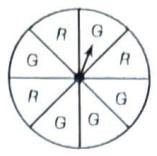
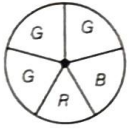
Suppose you spin the wheel
Image
(i) List the number of outcomes of getting a green sector and not getting a green sector on this wheel (in the above figure).
(ii) Find the probability of getting a green sector.
(iii) Find the probability of not getting a green sector.
Answer
(i) On the wheel, there are three sectors of red colour and five sectors of green colour.
Number of outcomes of getting a green sector on this wheel =5
Number of outcomes of not getting a green sector on this wheel = Number of outcomes of getting a red sector on this wheel = 3
(ii) Total number of outcomes
= Total number of green and red sectors
= 5 + 3 = 8
Number of outcomes of getting a green sector = 5
Probability of getting a green sector
$=\frac{\text { Number of outcomes of getting a green sector }}{\text { Total number of outcomes }}$
$=\frac{5}{8}$
(iii) Total number of outcomes = 8
Number of outcomes of not getting a green sector = 3
$\therefore$ Probability of not getting a green sector
$=\frac{\text { Number of outcomes of not getting a green sector }}{\text { Total number of outcomes }}$
$=\frac{3}{8}$
View full question & answer
Question 22 Marks
Find the probabilities of the events given in
(i) (a) a prime number.
$\quad$(b) not a prime number.
(ii) (a) a number grater than 5.
$\quad$(b) a number not greater than 5.
Answer
We know that a die marked six numbers 1, 2, 3, 4, 5 and 6 on its face, so one number can be selected in 6 ways.
$\therefore$ Total outcomes = 6
(i) (a) Since, there are 3 prime numbers (i.e. 2, 3 and 5) and one prime number can be selected in 3 ways.
So, favourable outcomes = 3
$\therefore$ Probability of getting a prime number
$\begin{array}{l}=\frac{\text { Favourable outcomes }}{\text { Total possible outcomes }} \\ =\frac{3}{6}=\frac{1}{2}\end{array}$
(b) There are 3 non-prime numbers (ie. 1, 4 and 6) and one non-prime number can be selected in 3 ways.
So, favourable outcomes = 3
$\therefore$ Probability of getting a non-prime number
$\begin{array}{l}=\frac{\text { Favourable possible outcomes }}{\text { Total possible outcomes }} \\ =\frac{3}{6}=\frac{1}{2}\end{array}$
(ii) (a) There is only one number greater than 5 which is 6 and 6 can be selected in only one way.
So, favourable outcomes = 1
$\therefore$ Probability of getting a number greater than 5
$\begin{array}{l}=\frac{\text { Favourable outcomes }}{\text { Total possible outcomes }} \\ =\frac{1}{6}\end{array}$
(b) There are 5 numbers which are not greater than 5 i.e. less than or equal to 5 which are 1, 2, 3, 4 and 5 and out of these numbers can be selected in 5 ways.
So, favourable outcomes = 5
$\therefore$ Probability of getting a number which is not greater than 5
$\begin{array}{l}=\frac{\text { Favourable outcomes }}{\text { Total possible outcomes }} \\ =\frac{5}{6}\end{array}$
View full question & answer
Question 32 Marks
If you have a spinning wheel with 3 green sectors, 1 blue sector and 1 red sector, then what is the probability of getting a green sector? What is the probability of getting a non-blue sector?
Answer
There are 5 sectors in a spinning wheel in which 3 green sectors, 1 blue sector and 1 red sector.
Image
$\therefore$ So, total possible outcomes $=5$
Now, we can get a green sector in 3 ways
So, favourable outcomes $=3$
$\therefore$ Probability of getting a green sector
$=\frac{\text { Favourable outcomes }}{\text { Total possible outcomes }}=\frac{3}{5}$
Again, there are 4 non-blue sectors (3 green and 1 red sectors) and one sector can be obtained in 4 ways.
So, favourable outcomes = 4
$\therefore$ Probability of getting a non-blue sector
$=\frac{\text { Favourable outcomes }}{\text { Total possible outcomes }}=\frac{4}{5}$
View full question & answer
Question 42 Marks
Numbers 1 to 10 are written on ten separate slips (one number on one slip), kept in a box and mixed well. One slip is chosen from the box without looking into it. What is the probability of
(i) getting a number 6?
(ii) getting a number less than 6?
(iii) getting a number greater than 6?
(iv) getting a one-digit number?
Answer
There are ten separate slips having 1 to 10 numbers (one number on one slip) out of which one slip can be chosen in 10 ways.
So, total number of outcomes = 10
(i) Here, a slip containing the number 6 can be chosen in one way only.
So, favourable outcomes = 1
$\therefore$ Probability of getting the number 6
$\begin{array}{l}=\frac{\text { Favourable outcomes }}{\text { Total number of outcomes }} \\ =\frac{1}{10}\end{array}$
(ii) We have, 5 numbers less than 6, which are 1, 2, 3, 4 and 5. So, one slip having number less than 6 can be chosen in 5 ways.
So, favourable outcomes = 5
$\therefore$ Probability of getting a number less than 6
$\begin{array}{l}=\frac{\text { Favourable outcomes }}{\text { Total number of outcomes }} \\ =\frac{5}{10}=\frac{1}{2}\end{array}$
(iii) Here, the numbers greater than 6 are 7, 8, 9 and 10. So. one slip having number greater than 6 can be chosen in 4 ways.
So, favourable outcomes = 4
$\therefore$ Probability of getting a number greater than 6
$\begin{array}{l}=\frac{\text { Favourable outcomes }}{\text { Total number of outcomes }} \\ =\frac{4}{10}=\frac{2}{5}\end{array}$
(iv) There are 9, one-digit number which are 1, 2, 3, 4, 5, 6, 7, 8 and 9. So, one slip having one-digit number can be chosen in 9 ways.
So, favourable outcomes = 9
$\therefore$ Probability of getting a one-digit number
$\begin{array}{l}=\frac{\text { Favourable outcomes }}{\text { Total number of outcomes }} \\ =\frac{9}{10}\end{array}$
View full question & answer
Question 52 Marks
Answer
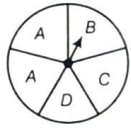
(i) In spinning a wheel, there are five possible outcomes,
[since, wheel has five sectors]
So, total outcomes = 5
The pointer can stop on D only in one way.
[since, angle only one sector has D]
So, outcomes that make the event = 1
$\therefore$ Probability of the pointer stopping on D
$=\frac{\text{Possíble outcomes that make the event}}{\text{Total outcomes}}$
$=\frac{1}{5}$
(ii) There are 52 cards in a deck of playing cards out of which one card can be drawn in 52 ways.
$\therefore$ Total number of outcomes = 52
There are 4 aces in a deck of 52 cards, out of which one ace can be drawn in 4 ways.
So, favourable number of outcomes = 4
$\therefore$ Probability of getting an ace
$=\frac{\text { Favourable number of outcomes }}{\text { Total number of outcomes }}$
$=\frac{4}{52}=\frac{1}{13}$
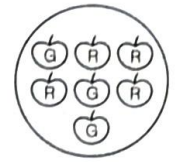
(iii) In the given figure, there are 7 apples. Out of 7 apples, one apple can be drawn in 7 ways.
$\therefore$ Total number of outcomes = 7
There are 4 red apples and 3 green apples. Red apple out of 4 apples can be drawn in 4 ways.
So, favourable number of outcomes = 4
$\therefore$ Probability of getting a red apple
$=\frac{\text { Favourable number of outcomes }}{\text { Total number of outcomes }}$
$=\frac{4}{7}$
View full question & answer
Question 62 Marks
When a die is thrown, list the outcomes of an event of getting
(i) (a) a prime number.
$\quad$(b) not a prime number.
(ii) (a) a number greater than 5.
$\quad$ (b) a number not greater than 5.
Answer
We know that a die has numbers $1,2,3,4,5$ and 6 on ita faces.
(i) (a) Here, prime numbers are 2, 3 and 5, So, outcomes of getting a prime numbers are 2,3 and 5 ,
$\quad$(b) Outcomes of not getting a prime numbers are 1, 4 and 6.
(ii) (a) Here, only 6 is greater than 5. So, outcomes of getting a number greater than 5 is 6.
$\quad$ (b) Here, a number not greater than 5 means number less than or equal to 5, which are 1, 2, 3, 4 and 5. So, outcomes of getting a number not greater than 5 are $1,2,3,4$ and $5.$
View full question & answer
Question 72 Marks
List the outcomes you can see in these experiments.
Image
(i) Spinning a wheel.
(ii) Tossing two coins together.
Answer
(i) Here, spinning a wheel have 5 sectors represented by A, A, B, C and D, so possible outcomes are A, B, C and D. Here, A comes twice on wheel but in outcomes, it will be taken as single.
(ii) We know that possible outcomes for tossing a coin are H (Head) and T (Tail). If we toss two coins together, the possible outcomes are HH, HT, TH, TT, where, HT shows head on first coins and tail on second coins. Similarly, HH, TH and TT shows head on both coins tail on first coin and head on second coin, tail on both coins, respectively.
View full question & answer
Question 82 Marks
The number of students in a hostel, speaking different languages are given below
LanguageNumber of students
Hindi40
English12
Marathi9
Tamil7
Bengali4
Total72
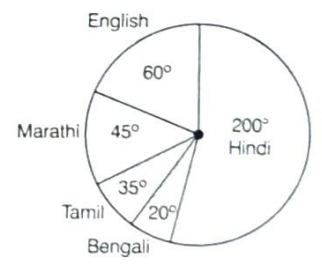
Display the data in a pie chart.
Answer
Here, total number of student of different languages are 72.
(i) Since, for 72 students, central angle $=360^{\circ}$
Then, for 40 student of Hindi,
Central angle $=\frac{40}{72} \times 360^{\circ}=200^{\circ}$
(ii) Similarly, for 12 student of English,
Central angle $=\frac{12}{72} \times 360=60^{\circ}$
(iii) For 9 student of Marathi,
Central angle $=\frac{9}{72} \times 360=45^{\circ}$
(iv) For 7 student of Tamil,
Central angle $=\frac{7}{72} \times 360=35^{\circ}$
(v) For 4 student of Bengali,
Central angle $=\frac{4}{72} \times 360=20^{\circ}$
Now, draw a circle and divide into sectors with the corresponding central angle. Thus, we get the adjacent pie chart
Image
View full question & answer
Question 92 Marks
Draw a pie chart showing the following Information. The table shows the colours preferred by a group of people.
ColoursNumber of people
Blue18
Green9
Red6
Yellow3
Total36
Answer
Here, total number of people = 36
Fraction part for blue colour
$=\frac{\text { Number of people preferred the colour blue }}{\text { Total number of people }}$
$=\frac{18}{36}=\frac{1}{2}$
Fraction part for green colour $=\frac{9}{36}=\frac{1}{4}$
Fraction part for red colour $=\frac{6}{36}=\frac{1}{6}$
and fraction part for yellow colour $=\frac{3}{36}=\frac{1}{12}$
Now, central angle of the sector corresponding to blue colour $=$ Fraction part for blue colour $\times 360^{\circ}$
$=\frac{1}{2} \times 360^{\circ}=180^{\circ}$
Central angle of the sector corresponding to the green colour $=$ Fraction part for green colour $\times 360^{\circ}$
$=\frac{1}{4} \times 360^{\circ}=90^{\circ}$
Central angle of the sector corresponding to the red colour $=$ Fraction part for red colour $\times 360^{\circ}$
$=\frac{1}{6} \times 360^{\circ}=60^{\circ}$
and central angle of the sector corresponding to the yellow colour $=$ Fraction part for yellow colour $\times 360^{\circ}$
$=\frac{1}{12} \times 360^{\circ}=30^{\circ}$
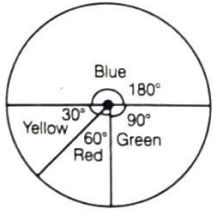
Now, draw a circle and divide it into sectors with corresponding central angle. Thus, we get the required pie chart given below :
Image
View full question & answer
Question 102 Marks
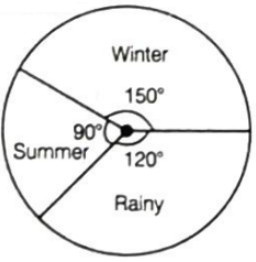
A group of 360 people were asked to vote for their favourite season from the three seasons rainy, winter and summer.
(i) Which season got the most votes?
(ii) Find the central angle of each sector.
(iii) Draw a pie chart to show this information.
SeasonNumber of votes
Summer90
Rainy120
Winter150
Total360
Answer
(i) Here, number of votes in winter season are maximum i.e. 150 votes.
(ii) Here, total number of people $=360$
Fraction part for summer season
$=\frac{\text { Number of votes }}{\text { Total number of people }}=\frac{90}{360}=\frac{1}{4}$
Fraction part for rainy season $=\frac{120}{360}=\frac{1}{3}$
and fraction part for winter season $=\frac{150}{360}=\frac{15}{36}=\frac{5}{12}\quad$
[dividing both numerator and denominator by 3]
Now, central angle of the sector for summer season
$=\frac{1}{4} \times 360^{\circ}=90^{\circ}$
Central angle of the sector for rainy season
$=\frac{1}{3} \times 360^{\circ}=120^{\circ}$
and central angle of the sector for winter season
$=\frac{5}{12} \times 360^{\circ}=150^{\circ}$
(iii) Now, draw a circle and divide it into sectors with corresponding central angle. Thus, we get the adiacent pie chart:
Image
View full question & answer
Question 112 Marks
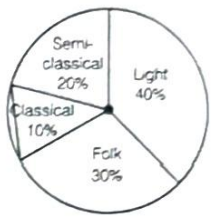
A survey was made to find the type of music that a certain group of young people liked in a city.
Following pie chart shows the findings of this survey.
From the pie chart given below, answer the following:
Image
(i) If 20 people liked classical music, how many young people were surveyed?
(ii) Which type of music is liked by the maximum number of people?
(iii) If a cassette company were to make 1000 CD's, how many of each type would they make?
Answer
(i) Suppose x young people were surveyed, then the number of young people, who liked classical music $=10 \%$ of x
According to the question,
$10 \%$ of $x=20 \Rightarrow \frac{10}{100} \times x=20 \Rightarrow \frac{x}{10}=20$
$\Rightarrow \quad x=\frac{20 \times 10}{1} \quad$ [multiplying both sides by 10 ]
$\Rightarrow \quad x=200$ people
(ii) Here, greatest sector represent $40 \%$ of whole circle, so maximum number of people like light music.
(iii) Total number of CD's $=1000$
$\therefore$ Number of semi-classical music CD's $=20 \%$ of 1000
$=\frac{20}{100} \times 1000=200$
Number of classical music CD's $=10 \%$ of 1000
$=\frac{10}{100} \times 1000=100$
Number of folk music CD's $=30 \%$ of 1000
$=\frac{30}{100} \times 1000=300$
and number of light music CD's $=40 \%$ of 1000
$=\frac{40}{100} \times 1000=400$
View full question & answer
Question 122 Marks
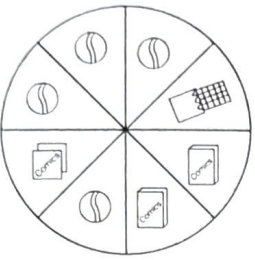
At a birthday party, the children spin a wheel to get a gift.
Find the probability of
Image
(i) getting a ball
(ii) getting a comics
(iii) any gift except a chocolate.
Answer
(i) The probability of getting a ball
$=\frac{\text { Number of events of getting a ball }}{\text { Total number of events }}=\frac{4}{8}=\frac{1}{2}$

(ii) The probability of getting a comics
$=\frac{\text { Number of events of getting a comics }}{\text { Total number of events }}=\frac{3}{8}$

(iii) The probability of getting any gift except a chocolate
Number of events of getting any gift
$=\frac{\text { except a chocolate }}{\text { Total number of events }}=\frac{7}{8}$
View full question & answer
Question 132 Marks
Shubham draws a ball from a bag that contains white and yellow balls. The probability of choosing a white ball is $\frac{2}{9}.$ If the total number of balls in the bag is 36, find the number of yellow balls.
Answer
Let number of yellow balls $x$.
$\therefore$ Number of white balls $=(36-x)\quad$ [since, total number of balls is 36]
$\therefore$ Probability of choosing a white ball $=\frac{36-x}{36}$
But, $\quad \frac{36-x}{36}=\frac{2}{9}$
$\Rightarrow (36-x) \times 9=2 \times 36$
$\Rightarrow 36-x=\frac{2 \times 36}{9}$
$\Rightarrow 36-x=8$
$\Rightarrow x=36-8=28$
Hence, the number of the yellow balls is 28.
View full question & answer
Question 142 Marks

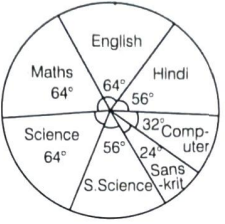
In the time table of a school, periods allotted per week to different teaching subjects are given below

SubjectsHindiEnglishMathsScienceSocial ScienceComputerSanskrit
Periods allotted7888743

Draw a pie chart for this data.

Answer
We have,
Total number of periods $=7+8+8+8+7+4+3=45$
Now, central angle made by 45 periods $=360^{\circ}$
$\therefore$ Central angle made by 1 period $=\frac{360^{\circ}}{45}=8^{\circ}$
Central angle made by 7 periods $=7 \times 8=56^{\circ}$
Central angle made by 8 periods $=8 \times 8=64^{\circ}$
Central angle made by 4 periods $=4 \times 8=32^{\circ}$
Central angle made by 3 periods $=3 \times 8=24^{\circ}$
Thus, from the above data. You can draw following pie chart.
Image
View full question & answer
Question 152 Marks
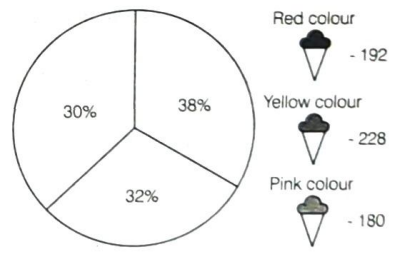
Identify which symbol should appear in each sector.
Image
Answer
Total quantity of red, yellow and pink colour
$=192+228+180=600$
Also, $600=100 \%$
or $\quad 1=\frac{100 \%}{600}=\frac{1}{6} \% \quad$ or $\quad 192=\frac{1}{6} \times 192=32 \%$
or $\quad 228=\frac{1}{6} \times 228=38 \%$ or $180=\frac{1}{6} \times 180=30 \%$
$\therefore$ Red colour $\rightarrow 32 \%$
Yellow colour $\rightarrow 38 \%$
Pink colour $\rightarrow 30 \%$
View full question & answer
Question 162 Marks
Marble Game
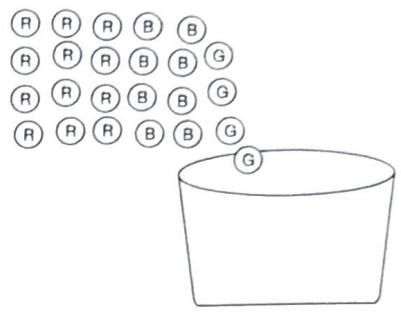
Pramod is babysitting his little sister Monika and her two friends, Puja and Jyoti. Monika is wearing red, Puja is wearing blue and Jyoti is wearing green coloured clothes.
Pramod fills a bucket with 12 red (R) marbles. 8 blue (B) marbles and 4 green (G) marbles. He tells the giris that they will play a game. He will reach into the bucket and pull out a marble at random. The girl whose clothes match the colour of the marble scores 1 point.
Image
(i) What is the probability of each girl scoring 1 point on the first draw?
Monika:
Puja:
Jyoti :
(ii) What is the probability of not drawing a green marble on the first draw?
(iii) If two marbles of each colour are added to the bucket, do the probabilities in part (a) change? Explain your answer.
(iv) If the number of each colour is doubled, do the probabilities in part (a) change? Explain why or why not.
Answer
self
View full question & answer
Question 172 Marks
Fun Activity
Take a packet which has different colours of toffees/candies in it. Count the number of toffees of each colour and fill the data in the table given below. Also draw a pie chart to depict the data.
Colour of candiesNumberFractionFraction of $360^{\circ}$
Red
Green
Answer
self
View full question & answer
Question 182 Marks
Complete the table given below.
Sum of dots on both the diceNumber of outcomesProbability
1  
2  
3  
4  
5  
6  
7  
8  
9  
10  
11  
12  

Two dice are rolled together, using the above table find the probability of-
(i) sum of digits to be more than 6.
(ii) sum of digits to be less than 3.
(iii) sum of digits to be either 5 or 6.
(iv) sum of digits to be 12.
(v) sum of digits to be less than 9 but more than 5.

Answer
(i) $\frac{7}{12}\quad$ (ii) $\frac{1}{36}\quad$ (iii) $\frac{1}{4}\quad$ (iv) $\frac{1}{36}\quad$ (v) $\frac{4}{9}$
View full question & answer
Question 192 Marks
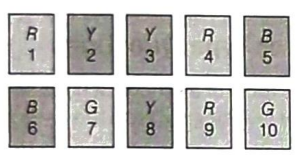
Swapnish picks up a card from the given cards. Caiculate the probability of getting
Image
(i) an odd number$\quad$ (ii) a Y card
(iii) a G card $\qquad\quad$ (iv) B card bearing number > 7
Answer
(i) The probability of getting an odd number
$\begin{array}{l}=\frac{\text { Number of events getting an odd number }}{\text { Total number of events }} \\=\frac{5}{10}=\frac{1}{2}\end{array}$

(ii) The probability of getting $\text{Y}$ card
$\begin{array}{l}=\frac{\text { Number of events getting a } \text{Y} \text { card }}{\text { Total number of events }} \\=\frac{3}{10}\end{array}$

(iii) The probability of getting a $\text{G}$ card
$\begin{array}{l}=\frac{\text { Number of events getting a } \text{G} \text { card }}{\text { Total number of events }} \\=\frac{2}{10}=\frac{1}{5}\end{array}$

(iv) The probability of getting a $\text{B}$ card bearing number $>7$
Number of events getting a $\text{B}$ card
$\begin{array}{l}=\frac{\text { bearing number }>7}{\text { Total number of events }} \\=\frac{0}{10}=0\end{array}$
View full question & answer
Question 202 Marks
From a pack of well-shuffled cards, find the probability of getting
(i) a picture card$\qquad$(ii) a 4 of spade
(iii) an ace of club $\quad$(iv) a card of diamond
Answer
We know that in a pack of well-shuffled cards, total cards $=52$
Also, number of picture cards $=3 \times 4=12$
Number of 4 of spade cards $=1$
Number of ace of club $=1$
Number of diamond $=13$
(i) The probability of getting a picture card $=\frac{12}{52}=\frac{3}{13}$
(ii) The probability of getting a 4 of spade $=\frac{1}{52}$
(iii) The probability of getting an ace of club $=\frac{1}{52}$
(iv) The probability of getting a card of diamond $=\frac{13}{52}=\frac{1}{4}$
View full question & answer
2 Marks Questions - MATHS STD 8 Questions - Vidyadip