Questions

3 Marks Question

Take a timed test

25 questions · self-marked practice — reveal the answer and mark yourself.

Question 13 Marks
Observe the following tables and find which pair of variables (here, $x$ and $y$ ) are in inverse proportion?
(i)
x50403020
y5678
(ii)
x100200300400
y60302015
(iii)
x90604530205
y101520253035
Answer
(i) When $x_1=50, y_1=5$, then $x_1 y_1=50 \times 5=250$
When $x_2=40, y_2=6$, then $x_2 y_2=40 \times 6=240$
When $x_3=30, y_3=7$, then $x_3 y_3=30 \times 7=210$
When $x_4=20, y_4=8$, then $x_4 y_4=20 \times 8=160$
It is clear that $250 \neq 240 \neq 210 \neq 160$
i.e. $x_1 y_1 \neq x_2 y_2 \neq x_3 y_3 \neq x_4 y_4$
So, $x$ and $y$ are not in inverse proportion.
(ii) When $x_1=100, y_1=60$, then $x_1 y_1=100 \times 60=6000$
When $x_2=200, y_2=30$, then $x_2 y_2=200 \times 30=6000$
When $x_3=300, y_3=20$, then $x_3 y_3=300 \times 20=6000$
When $x_4=400, y_4=15$, then $x_4 y_4=400 \times 15=6000$
Here, all the values of $x$ and $y$ are equal to 6000 .
i.e. $x_1 y_1=x_2 y_2=x_3 y_3=x_4 y_4=6000$
$x$ and $y$ are in inverse proportion.
(iii) Ans. $x$ and $y$ are in inverse proportion
View full question & answer
Question 23 Marks
If we fix time period and the rate of interest, simple interest changes proportionally with principal. Would there be a similar relationship for compound interest? Why?
Answer
Given, time period $(T)$ and rate of interest $(R)$ are fixed, then
$
\text { Simple interest }=\frac{P R T}{100}=P \times \text { Constant }
$
So, simple interest depends on principal, i.e. simple interest changes proportionally with principal.
$\begin{array}{l} \text { Now, compound interest }=P\left(1+\frac{R}{100}\right)^T-P \\ =P\left[\left(1+\frac{R}{100}\right)^T-1\right] \\ =P \times \text { Constant } \\ {[\because R \text { and } T \text { are fixed }] }\end{array}$
So, compound interest depends on principal.
If principal increases/ decreases, then compound interest also increases/decreases.
Hence, the compound interest changes proportionally with principal.
View full question & answer
Question 33 Marks
observe the following tables and find, if $x$ and $y$ are directly proportional.
x20171411852
y4034282216104
Answer
When $x=20$ and $y=40$, then
$
\frac{x}{y}=\frac{20}{40}=\frac{20÷20}{40÷20} \Rightarrow \frac{x}{y}=\frac{1}{2}
$
When $x=17$ and $y=34$, then $\frac{x}{y}=\frac{17}{34}=\frac{17÷17}{34÷17}=\frac{1}{2}$
When $x=14$ and $y=28$, then $\frac{x}{y}=\frac{14}{28}=\frac{14÷14}{28÷14}=\frac{1}{2}$
When $x=11$ and $y=22$, then $\frac{x}{y}=\frac{11}{22}=\frac{11÷11}{22÷11}=\frac{1}{2}$
When $x=8$ and $y=16$, then $\frac{x}{y}=\frac{8}{16}=\frac{8÷8}{16÷8}=\frac{1}{2}$
When $x=5$ and $y=10$, then $\frac{x}{y}=\frac{5}{10}=\frac{5÷5}{10÷5}=\frac{1}{2}$
When $x=2$ and $y=4$, then $\frac{x}{y}=\frac{2}{4}=\frac{2÷2}{4÷2}=\frac{1}{2}$
From above, we can say that the values of $\frac{x}{y}$ is same i.e. in every case it is $\frac{1}{2}$. So, these values of $x$ and $y$ are directly proportional.
View full question & answer
Question 43 Marks
A school has 8 perlods in a day, each of 45 min duration. How long would each period be if the school has 9 periods, a day, assuming the number of school hours to be the same?
Answer
Let the duration of each period be $x min$.
Then, we have the following table
Number of periods89
Length of each period (in min)45x
Obviously, if the number of periods is more, then the length of each period will be less. Therefore, it is a case of inverse proportion.
So, $\quad 8 \times 45=9 \times x$
$
\Rightarrow \quad x=\frac{8 \times 45}{9}=8 \times 5=40
$
Hence, each period would be of 40 min if the school has 9 periods in a day.
View full question & answer
Question 53 Marks
A car takes 2 h to reach a destination by travelling at the speed of $60 km / h$. How long will it take when the car travels at the speed of $80 km / h$ ?
Answer
Let car takes $x h$ when the car travels at the speed of $80 km / h$.
Then, we have the following table
Speed (in km)6080
Number of hours2x
Obviously, if the speed of car increases, then the time taken to reach a destination will decreases.
Therefore, it is the case of inverse proportion.
So, $\quad 60 \times 2=80 \times x$
$\Rightarrow \quad x=\frac{60 \times 2}{80}=\frac{3}{2}=1 \frac{1}{2}$
Hence, the car would take $1 \frac{1}{2}$ h or 1 h 30 min when the car travels at the speed of $80 km / h$.
View full question & answer
Question 63 Marks
A factory requires 42 machines to produce a tiven number of articies in 63 days. How many machines would be required to produce the same number of articles in 54 days?
Answer
Let the number of machines required bex
Then, we have the following table
Number of machines12x
Number of days6354
Obviously, if the number of days will be less, then the number of machines required to produce same number of articles will be more. Therefore, it is a case of inverse proportion.
So, $\quad 42 \times 63=x \times 54$
$
\Rightarrow \quad x=\frac{42 \times 63}{54}=\frac{42 \times 7}{6}
$
[dividing numerator and denominator by 9 ]
$
\therefore \quad x=49
$
Hence, 49 machines would be required to produce the same number of articles in 54 days.
View full question & answer
Question 73 Marks
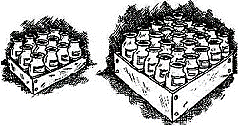
A batch of bottles were packed in $2 5$ boxes with 12 bottles in each box. If the same batch is packed using 20 bottles in each box, how many boxes would be filled?
Image
Answer
Let the number of boxes filled be $x$.
Then, we have the following table
Number of bottles in a box1220
Number of boxes25x
Here, more the number of bottles in a box, lesser the number of boxes. Therefore, it is a case of inverse proportion.
So, $12 \times 25=20 \times x$
$
\Rightarrow \quad x=\frac{12 \times 25}{20}=\frac{12 \times 5}{4}
$
[dividing numerator and denominator by 5 ]
$
\therefore \quad x=15
$
Hence, 15 bores wornid be filled, if the same hatch is packed using 20 bottles in each box
View full question & answer
Question 83 Marks
A farmer has enough food to feed 20 animals in his cattle for 6 days. How long would the food last, if there were 10 more animals in his cattle?
Answer
Let the food will last for $x$ days.
Then, we have the following table
Number of animals2020 + 10 = 30
Number of days6x
Here, the number of animals increases, so the number of days will decreases. Therefore, this is a case of inverse proportion.
So,
$
\begin{aligned}
20 \times 6 & =30 \times x \\
x & =\frac{20 \times 6}{30}=4
\end{aligned}
$
Hence, the food would last for 4 days if there were 10 more animals in his cattle.
View full question & answer
Question 93 Marks
If a box of sweets is divided among 24 children, they will get 5 sweets each. How many would each get, if the number of the children is reduced by 4 ?
Answer
Let each children gets $x$ number of sweets.
Then, we have the following table
Number of children2424 - 4 = 20
Number of sweets5x
Here, less the number of students, more would be the number of sweets each get, i.e. if the number of children decreases, then the number of sweets each get will increases.
This is a case of inverse proportion.
So, $\quad 24 \times 5=20 \times x\qquad$ $\left[\because x_1 y_1=x_2 y_2\right]$
$\Rightarrow \quad x=\frac{24 \times 5}{20}=6$
Hence, each children will get 6 sweets if the number of the children is reduced by 4 .
View full question & answer
Question 103 Marks
A 5 m 60 cm high vertical pole casts a shadow 3 m 20 cm long. Find at the same time
(i) the length of the shadow cast by another pole 10 m 50 cm high.
(ii) the height of a pole which casts a shadow 5 m long.
Answer
(i) Let the height of vertical pole and length of shadow be $x m$ and $y m$, respectively.
Now, we can make a table as shown below
Height of vertical pole (x)5 m 60 cm10 m 50 cm
Length of shadow (y)3 m 20 cmym
As the height of the vertical pole increases, the length of the shadow also increases. So, it is the case of direct proportion.
Here, $x_1=5 m 60 cm=5 m+60 cm$
$
\begin{aligned}
& =5 m+\frac{60}{100} m \quad \quad\left[\because 1 cm=\frac{1}{100} m\right] \\
\Rightarrow \quad x_1 & =5 m+0.6 m=5.6 m \\
\Rightarrow \quad x_2 & =10 m 50 cm=10 m+50 cm \\
& =10 m+\frac{50}{100} m=10 m+0.50 m=10.5 m \\
\text { and } y_1 & =3 m 20 cm=3 m+20 cm \\
& =3 m+\frac{20}{100} m=3 m+0.2 m=3.2 m
\end{aligned}
$
Now, by using the relation $\frac{x_1}{y_1}=\frac{x_2}{y_2}$, we get
$
\begin{array}{l}
\frac{5.6 m}{3.2 m}=\frac{10.5 m}{y m} \\
\Rightarrow \quad y \times 5.6=3.2 \times 10.5
\end{array}
$
$
\Rightarrow \quad y=\frac{3.2 \times 10.5}{5.6}=\frac{33.6}{5.6}=\frac{336 \times 10}{56 \times 10} \Rightarrow y=6
$
Hence, the length of the shadow cast by another pole is 6 m .
(ii) Ans. 8.75 m
View full question & answer
Question 113 Marks
Rashmi has a road map with a scale of 1 cm representing 18 km . She drives on a road for 72 km . What would be her distance covered In the map?
Answer
Let the distance covered in the map $=x cm$.
Now, we can make a table as shown below
Actual distance ( in km )1872
Distance on the map ( in cm )1x
Here, more the distance covered by Rashmi, more would be the length of distance on the map. So, this is a case of direct proportion.
Here, $x_1=18, x_2=72, y_1=1$ and $y_2=x$
Now, using the relation $\frac{x_1}{y_1}=\frac{x_2}{y_2}$, we get
$
\begin{aligned}
& \frac{18}{1}=\frac{72}{x} \Rightarrow 18 \times x=1 \times 72 \\
\Rightarrow \quad & x=\frac{1 \times 72}{18} \Rightarrow x=4 cm
\end{aligned}
$
Hence, the distance covered by her on the map is 4 cm .
View full question & answer
Question 123 Marks
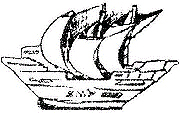
In a model of a ship, the mast is 9 cm high, while the mast of the actual ship is 12 m high. If the length of the ship is 28 m , how long is the model ship?
Image
Answer
Let length of the ship and mast be $x cm$ and $y cm$, respectively.
Now, we can make a table as shown below
Actual shipModel ship
Length of the ship (x)28 mX2 cm
Height of the mast (y)12 m9 cm
Here, as the height of the mast decreases, so the length of the ship also decreases in the same ratio. So, this is a case of direct proportion.
Here, $x_1=28 m, y_1=12 m, y_2=9 cm, x_2=$ ?
Now, by using the relation $\frac{x_1}{y_1}=\frac{x_2}{y_2}$, we get
$\frac{28 m}{12 m}=\frac{x_2 cm}{9 cm} \Rightarrow x_2 \times 12=28 \times 9$
$
\Rightarrow \quad x_2=\frac{28 \times 9}{12}=21 \Rightarrow x_2=21
$
Hence, the length of model ship is 21 cm .
View full question & answer
Question 133 Marks
A machine in a soft drink factory fills 840 bottles in six hours. How many bottles will it fill in flive hours?
Answer
Let the number of bottles filled by machine in 5 h be $x$. So, we form a table as shown below
Number of hours (x)65
Number of bottles filled (y)840x
Here, as the number of hours decreases, the number of bottles filled will also decrease. So, the number of bottles filled and the number of hours are directly proportional to each other.
Here, $x_1=6, x_2=840, y_1=5$ and $y_2=x$
Now, by using the relation $\frac{x_1}{x_2}=\frac{y_1}{y_2}$, we get $\frac{6}{840}=\frac{5}{x}$
$
\begin{array}{lrl}
\Rightarrow & 6 \times x=5 \times 840 \\
\Rightarrow & x=\frac{5 \times 840}{6}=140 \times 5=700
\end{array}
$
Hence, 700 bottles will be filled in 5 h .
View full question & answer
Question 143 Marks
30 persons can reap a field in 17 days. How many more persons should be engaged to reap the same field in 10 days?
Answer
Since, more persons can reap a field in lesser days.
Hence, the number of persons and number of days to reap a field are in inverse proportion.
Let number of persons $=n$ and number of days $=d$.
Here, $n_1=30, d_1=17, d_2=10$ and $n_2=$ ?
In case of inverse proportion,
$
n_1 d_1=n_2 d_2 \Rightarrow 30 \times 17=n_2 \times 10 \Rightarrow n_2=\frac{30 \times 17}{10}=51
$
Hence, the number of more persons which should be engaged $=51-30=21$
View full question & answer
Question 153 Marks
In a camp, there is enough flour for 300 persons for 42 days. How long will the flour last if 20 more persons join the camp?
Answer
As number of persons increases, number of days will decreases for finishing the same amount of flour. This is a case of inverse proportion.
Let number of persons $=n$
Number of days $=d$
Since, $n \propto \frac{1}{d} \Rightarrow n_1 d_1=n_2 d_2$
Here, $n_1=300, d_1=42$ days,
$
\begin{aligned}
\text {then}\qquad n_2 & =300+20=320, d_2=? \\
\therefore \qquad300 \times 42 & =320 \times d_2 \\
d_2 & =\frac{300 \times 42}{320}=\frac{315}{8}=39 \frac{3}{8} \text { days }
\end{aligned}
$
View full question & answer
Question 163 Marks
$I$ varies directly as $m$ and $I=5$, when $m=\frac{2}{3}$. Find $I$, when $m=\frac{16}{3}$
Answer
Given, I varies directly as $m$ i.e. $I \propto m$.
Here, $l_1=5, m_1=\frac{2}{3}, l_2=?, m_2=\frac{16}{3}$
$\therefore \quad \frac{I_1}{m_1}=\frac{I_2}{m_2}$
$\therefore \quad \frac{5}{\frac{2}{3}}=\frac{I_2}{\frac{16}{3}} \Rightarrow \frac{5 \times 3}{2}=\frac{3 \times I_2}{16}$
$l_2=\frac{5 \times 3 \times 16}{2 \times 3}=40$
View full question & answer
Question 173 Marks
The mass of an aluminium rod varies directly with its length. If a 16 cm long rod has a mass of 192 g , then find the length of the rod whose mass is 105 g .
Answer
It is given that
Mass of the rod $\propto$ Length of the rod
Let mass of the rod $=m$
and length of the rod $=1$
$
\because \quad m \propto l \Rightarrow \frac{m_1}{l_1}=\frac{m_2}{l_2}
$
Here, $m_1=192 g, l_1=16 cm, m_2=105 g$ and $l_2=$ ?
It is given that
$
\begin{array}{}
\frac{m_1}{l_1} =\frac{m_2}{l_2} \\
\Rightarrow \quad \frac{192}{16} =\frac{105}{l_2} \\
\Rightarrow \quad l_2 =\frac{16 \times 105}{192}=8.75 cm
\end{array}
$
View full question & answer
Question 183 Marks
A recipe for a particular type of muffins requires 1 cup of milk and 1.5 cups of chocolate. Riya has 7.5 cups of chocolate. If she is using the recipe as a guide, how many cups of milk will she need to prepare muffins?
Image
Answer
Let $x$ cups of milk she need to prepare muffins.
According to the question, it is a case of direct variation.
$\begin{array}{rlrl} \therefore \frac{1}{1.5} =\frac{x}{75} \\ \Rightarrow 1.5 \times x =7.5 \\ \Rightarrow x =\frac{7.5}{1.5}=5\end{array}$
So, 5 cups of milk are required by her to prepare muffins.
View full question & answer
Question 193 Marks
Inverse Variation
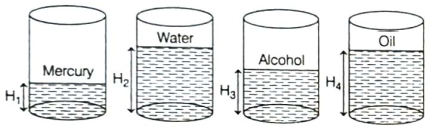
Take four cylindrical containers of the same size each of radius 5 cm . Fill the containers with different types of liquids with same mass (different density) like mercury, water, alcohol, oil.
Image
Note the height in each case at which the level of liquid stands. Tabulate this information in the following table and show that this is case of inverse proportion.
DensityMercutyWaterAlcoholOil
$\left( g / cm ^3\right)$$13.6\left(D_1\right)$$0.99\left(D_2\right)$$0.78\left(D_3\right)$$0.96\left(D_4\right)$
Height (cm)$H _1$$H _2$$H _3$$H _4$
Density $\times$ Height $=$ Constant .
Answer
Self
View full question & answer
Question 203 Marks
$
\text { Speed }=\frac{\text { Distance Travelled }}{\text { Time Taken }}
$
Calculate the speed for atleast 10 students of your class by giving them a certain distance to walk. Measure the distance each student has walked and record the time taken by each to cover the distance. Then, complete the table given below:
Name of the studentDistance walked
(in metres)
Time taken
(in min )
Rate of speed
(in m/min )
1
2
Which student ran the fastest?
Answer
Self
View full question & answer
Question 213 Marks
Find the valaues of $x$ and $y$, if $a$ and $b$ are in inverse proportion.
a12x8
b305y
Answer
It is given that $a$ and $b$ are in inverse proportion.
Hence, the product of $a$ and $b$ will be a constant.
Case I $a b=12 \times 30=360$
Case II $5 \times x=360 \Rightarrow x=\frac{360}{5}=72$
Case III $8 \times y=360 \Rightarrow y=\frac{360}{8}=45$
Hence, the required value of $x=72$ and $y=45$.
View full question & answer
Question 223 Marks
Find the missing quantity if $x$ varies directly as $y$.
x126
y48-
Answer
Here, $x$ varies directly as $y$,
x126
y48-
$\begin{array}{l}\Rightarrow \quad \frac{12}{48}=\frac{6}{a} \Rightarrow 12 a=6 \times 48 \\ \Rightarrow \quad a=\frac{6 \times 48}{12} \Rightarrow a=24\end{array}$
View full question & answer
Question 233 Marks
The area occupied by 15 postal stamps is $60 cm^2$. Find the area occupied by 120 such postal stamps.
Answer
Since, more postal stamps occupy more area.
Hence, the number of stamps and total area occupied by these stamps will be directly proportional.
Let number of stamps $=n$
Area occupied by these stamps $=a$
Then, $n_1=15$ and $a_1=60 cm^2, n_2=120$ and $a_2=$ ?
Now $\frac{n_1}{a_1}=\frac{n_2}{a_2} \Rightarrow \frac{15}{60}=\frac{120}{a_2} \Rightarrow a_2 \times 15=60 \times 120$
$
\Rightarrow \quad a_2=\frac{60 \times 120}{15}=4 \times 120=480 cm^2
$
Hence, $480 cm^2$ area is occupied by 120 postal stamps.
View full question & answer
Question 243 Marks
If two cardboard boxes occupy $1000 cm^3$ space. then how much space is required to keep 200 such boxes?
Answer
If the number of boxes increases, the space required to keep them also increases.
This is a case of direct proportion.
Let number of boxes $=n$
The space required to keep them $=v$
Now,
$
\frac{n_1}{v_1}=\frac{n_2}{v_2}
$
Here, $n_1=2, v_1=1000 cm^3$ and $n_2=200, v_2=$ ?
$
\Rightarrow \quad \frac{2}{1000}=\frac{200}{v_2} \Rightarrow v_2=\frac{1000 \times 200}{2}=100000
$
Thus, the required space is $100000 cm^3$.
View full question & answer
Question 253 Marks
In which of the following case do the quantities vary directly with each other?
(i)
x0.52832
y2832128
(ii)
p$1^2$$2^2$$3^2$$4^2$
q$1^3$$2^3$$3^3$$4^3$
Answer
(i) We will find $\frac{x}{y}$ in each case.
$
\begin{aligned}
& \frac{x}{y}=\frac{05}{2}=\frac{1}{4} \Rightarrow \frac{x}{y}=\frac{2}{8}=\frac{1}{4} \\
\Rightarrow & \frac{x}{y}=\frac{8}{32}=\frac{1}{4} \Rightarrow \frac{x}{y}=\frac{32}{128}=\frac{1}{4}
\end{aligned}
$
Since, the value of $\frac{x}{y}$ is same for all.
$\therefore$ The quantities vary directly in this case.
(ii) We will find $\frac{p}{q}$ in each case.
$
\begin{array}{l}
\frac{p}{q}=\frac{1^2}{1^3}=1, \frac{p}{q}=\frac{2^2}{2^3}=\frac{1}{2}, \frac{p}{q}=\frac{3^2}{3^3}=\frac{1}{3}, \\
\frac{p}{q}=\frac{4^2}{4^3}=\frac{1}{4}
\end{array}
$
Here, $\frac{p}{q}$ is not constant.
So, in this case, the quantities does not vary directly with each other.
View full question & answer
3 Marks Question - MATHS STD 8 Questions - Vidyadip