Questions

4 Mark Question

🎯

Test yourself on this topic

12 questions · timed · auto-graded

Question 14 Marks
Principal $=₹  1000$, Rate $=8 \%$ per annum. Fill in the following table and find which type of interest (simple or compound) changes in direct proportion with time period.
Time period1 yr2 yr3 yr
Simple interest (in ₹)
Compound interest (in ₹)
Answer
Given, $P=$ ₹ $ 1000, R=8 \%$
Simple interest for different time periods
(i) For $T=1 yr$,
$
\text { Simple interest }=\frac{P R T}{100}=\frac{1000 \times 8 \times 1}{100}=$ ₹ $ 80
$
(ii) For $T=2 yr$,
$
\text { Simple interest }=\frac{P R T}{100}=\frac{1000 \times 8 \times 2}{100}=$ ₹ $ 160
$
(iii) For $T=3 yr$,
$
\text { Simple interest }=\frac{P R T}{100}=\frac{1000 \times 8 \times 3}{100}=$ ₹ $ 240
$
Compound interest for different time periods
(i) For $T=1 yr$
Compound interest $=P\left(1+\frac{R}{100}\right)^T-P$
$=1000\left(1+\frac{8}{100}\right)^1-1000$
$=1000 \times \frac{108}{100}-1000$
$=1080-1000=$ ₹ $80$
(ii) Ans. ₹ 166.40
(iii) Ans. ₹ 259.712
Hence, the complete table is as follows
Time period1 yr2 yr3 yr
Simple interest (in ₹)80160240
Compound interest (in ₹ )80166.40259.712
Now, ratio of simple interest with time period are as follows :
For $1 yr , \frac{80}{1}=80$
For $2 yr , \frac{160}{2}=80$
and for $3 yr , \frac{240}{3}=80$
Here, ratio of simple interest with time period is same for every year. Hence, the simple interest changes in direct proportion with time period.
Ratio of compound interest with time period are as follow
For $1 yr , \frac{80}{1}=80$
For $2 yt , \frac{166.40}{2}=8.2 .20$
and for $3 yt , \frac{259.712}{3}=86.5706$
Here, ratio of compound interest with time period is not same for every year. Hence, the compound interest does not change in direct proportion with time period.
View full question & answer
Question 24 Marks
Two persons could fit new windows in a house in 3 days.
(i) One of the persons fell ill before the work started. How long would the job take now ?
(ii) How many persons would be needed to fit the windows in one day?
Answer
(i) Let the job would take $x$ days.
Then, we have the following table
Number of persons22 – 1 = 1
Number of days3x
Here, lesser the number of persons, more would be the number of days required to complete the job. Therefore, it is a case of inverse proportion.
$
\begin{array}{lc}
\text { So, } & 2 \times 3=1 \times x \\
\therefore & x=6
\end{array}
$
Hence, the job would take 6 days when one of the persons fell ill before the work started.
(ii) Let the number of persons needed to fit the windows in one day be $x$.
Then, we have the following table
Number of days31
Number of persons2x
Here, lesser the number of days, more will be the number of persons needed to fit the windows. Therefore, it is a case of inverse proportion.
So, $\quad 3 \times 2=1 \times x \Rightarrow x=6$
Here, 6 persons would be needed to fit the windorns In one day.
View full question & answer
Question 34 Marks
A mixture of paint is prepared by mixing 1 part of red pigment with 8 parts of base. In the following table, find the parts of base that need to be added.
Parts of red pigment1471220
Parts of base8
Answer
Let the number of parts of red pigment be $x$ and the number of parts of the base be $y$.
So, the relation between them is of the type
$
\frac{x_1}{y_1}=\frac{x_2}{y_2}
$
Given, $\quad x_1=1$ and $y_1=8$
(i) For $x_2=4$,
$
\frac{x_1}{y_1}=\frac{x_2}{y_2} \Rightarrow \frac{1}{8}=\frac{4}{y_2} \Rightarrow y_2=\frac{4 \times 8}{1}=32
$
Hence, 32 parts of base should be added to 4 parts of red pigment.
(ii) For $x_3=7$,
$
\frac{x_1}{y_1}=\frac{x_3}{y_3} \Rightarrow \frac{1}{8}=\frac{7}{y_3} \Rightarrow y_3=\frac{7 \times 8}{1}=56
$
Hence, 56 parts of the base should be added to 7 parts of red pigment.
(iii) For $x_4=12$,
$
\frac{x_1}{y_1}=\frac{x_4}{y_4} \Rightarrow \frac{1}{8}=\frac{12}{y_4} \Rightarrow y_4=\frac{12 \times 8}{1} \Rightarrow
$ $y_4=96$
Hence, 96 parts of the base should be added to 12 parts of red pigment.
(iv) For $x_5=20$,
$
\frac{x_1}{y_1}=\frac{x_5}{y_5} \Rightarrow \frac{1}{8}=\frac{20}{y_5} \Rightarrow y_5=\frac{20 \times 8}{1} \Rightarrow y_5=160
$
Hence, 160 parts of the base should be added to 20 parts of red pigment.
Hence, the complete table is
Parts of red pigment (x)1 471220
Parts of base (y)8325696160
View full question & answer
Question 44 Marks
The following table shows the distance travelled by one of the new eco-friendly energy efficient cars travelled on gas.
Litres of gas10.522.535
Distance (km)157.53037.54575

Which type of properties are indicated by the table? How much distance will be covered by the car in 8 L of gas?
View full question & answer
Question 54 Marks
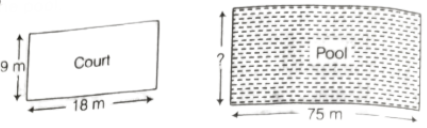
A volleyball court is in a rectangular shape and its dimensions are directly proportional to the dimensions of the swimming pool given below. Find the width of the pool.
Image
Answer
It is given that a volleyball court and a swimming pool both are rectangular in shape and their dimensions are directly proportional.
Let length be $l$ and breadth be $b$.
$
\begin{array}{ll}
\text { If } & l \propto b \\
\Rightarrow & \frac{l_1}{b_1}=\frac{l_2}{b_2}
\end{array}
$
Here, $l_1=18 m, b_1=9 m, l_2=75 m, b_2=$ ?
Then, $\quad \frac{9}{18}=\frac{b_2}{75}$
$
\therefore \quad b_2=\frac{9 \times 75}{18}=\frac{75}{2}=37.5 m
$
So, the width of the pool is 37.5 m .
View full question & answer
Question 64 Marks
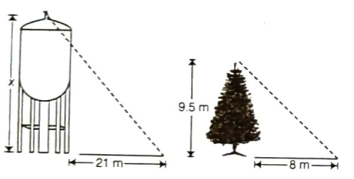
A water tank casts a shadow 21 m long. A tree of height 9.5 m casts a shadow 8 m long at the same time. The lengths of the shadows are directly proportional to their heights. Find the height of the tank.
Image
Answer
It is given that a water tank casts a shadow 21 m long and a tree of height 9.5 m casts a shadow 8 m long at the same time. Here the lengths of the shadows are directly proportional to their heights.
Let height $=h$ and the length of shadow $=l$.
Here, $h_1=9.5 m, l_1=8 m, h_2=x, l_2=21 m$
For direct proportion,
$
\begin{aligned}
\frac{h_1}{l_1} =\frac{h_2}{l_2} \Rightarrow \frac{95}{8}=\frac{x}{21} \\
\therefore =\frac{95 \times 21}{8}=24.9 m
\end{aligned}
$
$\therefore$ The height of the tank is 24.9 m .
View full question & answer
Question 74 Marks
Ashwani has a road map with a scale of $1 cm=24 km$.
(i) Find the distance covered in the map, if he drives on a road for 168 km .
(ii) Find the distance on the road, if corresponding distance covered on map is 11 cm .
(iii) Which mathematical concept is used here?
Answer
(i) Let the distance covered on the map be x cm.
Then, we have the following table :
Actual distance covered on the road (in km )Distance covered (represented) on the map (in cm )
241
168x
It is the case of direct proportion.
$
\therefore \quad \frac{24}{168}=\frac{1}{x} \Rightarrow x=\frac{168}{24}=7
$
So, distance covered on the map is 7 cm .
(ii) Let the distance covered on the road be x km.
Then, we have the following table :
Actual distance covered on the road (in km )Distance covered (represented) on the map (in cm )
241
x11
It is case of direct proportion.
$
\begin{array}{l}
\text { So, } \frac{24}{x}=\frac{1}{11} \\
\Rightarrow \quad x=24 \times 11 \Rightarrow x=264
\end{array}
$
Hence, the distance covered on the road is 264 km .
(iii) Here, concept of direct proportion is used.
View full question & answer
Question 84 Marks
The students of Anju's class sold posters to raise money. Anju wanted to apply the concept of variation for finding the amount of money her class would make for different numbers of posters sold. She know that they could raise ₹ 250 for every 60 posters sold.
(i) How much money would Anju's class make for selling 102 posters?
(ii) If Anju's class raise exactly ₹ 2000, then how many posters would they need to sell?
Answer
(i) Let money raised by Anju's class be ₹ x.
The above information can be exhibited in the following table form
Money250x
Poster60102
Since, more posters sold, more money will be raised. So, it is a case of direct variation.
$\therefore \quad \frac{250}{60}=\frac{x}{102}$
$\begin{array}{l}\Rightarrow 60 \times x=250 \times 102 \\ \Rightarrow \quad x=\frac{250 \times 102}{60} \Rightarrow x=425\end{array}$
Hence, ₹ 425 would make by Anju's class for selling 102 posters.
(ii) Let posters need to sell be $x$.
Then, we have the following table
Money2502000
Poster60x
It is a case of direct variation.
$
\therefore \quad \frac{250}{60}=\frac{2000}{x} \Rightarrow 250 \times x=60 \times 2000
$
$
\Rightarrow \quad x=\frac{60 \times 2000}{250}=480
$
So, 480 posters need to be sell.
View full question & answer
Question 94 Marks
A bicycle dealer has ₹ 60000 to invest, when a bicycle is available for ₹ 1000. If the price of a bicycle increases by $25 \%$, then find the number of bicycle he can purchase with the same sum?
Answer
If the cost of bicycle is more, dealer can buy less number of bicycles in the given amount.
Given, total money $=$ ₹ $ 60000$
Cost of 1 bicycle $=$ ₹ $ 1000$
$\therefore$ Number of bicycles $=\frac{60000}{1000}=60$
If the cost of bicycle increases by $25 \%$, then
new price of a bicycle $=1000+25 \%$ of 1000
$
=1000+\frac{25 \times 1000}{100}=1000+250=$ ₹ $ 1250
$
Here, $x_1=60, y_1=$ ₹ $ 1000, x_2=?, y_2=$ ₹ $ 1250$
For inverse proportion, we know that
$
\begin{array}{l}
x_1 y_1=x_2 y_2 \\
\therefore \quad 60 \times 1000=x_2 \times 1250 \\
\Rightarrow \quad x_2=\frac{60 \times 1000}{1250}=48
\end{array}
$
So, he can purchase 48 bicycles with the same sum.
View full question & answer
Question 104 Marks
It is given that I varies directly as $m$.
(i) Write an equation which relates I and $m$.
(ii) Find the constant of proportion (k) when $l$ is 6 and $m$ is 18 .
(iii) Find $l$ when $m$ is 33 .
(iv) Find $m$ when $l$ is 8 .
Answer
Given, $l \propto m$
$
\Rightarrow \quad l=k m
$
where, $k$ is any constant.
$
\Rightarrow \quad k=\frac{l}{m}
$
(i) $k=\frac{l}{m}$
(ii) Given, $l=6$ and $m=18$
$
\begin{array}{ll}
\because & k=\frac{l}{m} \Rightarrow k=\frac{6}{18} \\
\therefore & k=\frac{1}{3}
\end{array}
$
(iii) Given, $m=33$ and $l=$ ?
$\because k=\frac{1}{m} \Rightarrow \frac{1}{3}=\frac{1}{33}\qquad$ $[$$\because k=\frac{1}{3}$ from part (ii)$]$
$\therefore l=11$
(iv) Given, $I=8$ and $m=$ ?
$\because \quad k=\frac{1}{m} \Rightarrow \frac{1}{3}=\frac{8}{m}\qquad$ $[$$\because k=\frac{1}{3}$ from part (ii)$]$
$\Rightarrow \quad m=24$
View full question & answer
Question 114 Marks
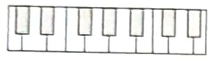
Here is a keyboard of a harmonium.
Image
(i) Find the ratio of white keys to black keys of the keyboard.
(ii) What is the ratio of black keys to all keys of the given keyboard?
(iii) This pattern of keys is repeated on larger keyboard. How many black keys would you expect to find on a keyboard with 14 such patterns?
Answer
In the given figure, number of white keys $=10$
Number of black keys $=7$
Number of total keys $=10+7=17$
(i) Required ratio $=\frac{\text { Number of white keys }}{\text { Number of black keys }}=\frac{10}{7}=10: 7$
(ii) Required ratio $=\frac{\text { Number of black keys }}{\text { Number of total keys }}=\frac{7}{17}=7: 17$
(iii) In 1 pattern, number of black keys = 7
In 14 such patterns, number of black keys
$=7 \times 14=98$
View full question & answer
Question 124 Marks
Fill in the blanks in the following table by a suitable number, if $x$ and $y$ vary directly.
x2--124-
y31512--21
Answer
x2--124-
y31512--21
Since, $x$ and $y$ vary directly.
Hence, $\frac{x}{y}=$ constant
$\Rightarrow \quad \frac{x}{y}=\frac{2}{3}$
We can take $x$ as $x_1=2$ as $y_1=3$ for each case.
Case I
$\begin{array}{l}\text { Here, } x_1=2, y_1=3, x_2=?, y_2=15 \\ \because \quad \frac{x_1}{y_1}=\frac{x_2}{y_2} \Rightarrow \frac{2}{3}=\frac{x_2}{15} \\ \Rightarrow \quad x_2=\frac{2 \times 15}{3}=10\end{array}$
Case II
$
\begin{aligned}
& x_1=2, y_1=3, x_2=?, y_2=12 \\
\because & \frac{x_1}{y_1}=\frac{x_2}{y_2} \Rightarrow \frac{2}{3}=\frac{x_2}{12} \\
\Rightarrow \quad x_2 & =\frac{2 \times 12}{3}=8
\end{aligned}
$
Case III
$
\begin{aligned}
& x_1=2, y_1=3, x_2=12, y_2=? \\
\because \frac{x_1}{y_1} & =\frac{x_2}{y_2} \Rightarrow \frac{2}{3}=\frac{12}{y_2} \\
\Rightarrow & y_2=\frac{3 \times 12}{2}=18
\end{aligned}
$
Case IV
$
\begin{array}{l}
x_1=2, y_1=3, x_2=4, y_2=? \\
\because \frac{x_1}{y_1}=\frac{x_2}{y_2} \Rightarrow \frac{2}{3}=\frac{4}{y_2} \Rightarrow y_2=\frac{4 \times 3}{2}=6
\end{array}
$
Case V
$
\begin{aligned}
& x_1=2, y_1=3, x_2=?, y_2=21 \\
\because & \frac{x_1}{y_1}=\frac{x_2}{y_2} \Rightarrow \frac{2}{3}=\frac{x_2}{21} \\
\Rightarrow & x_2=\frac{2 \times 21}{3}=14
\end{aligned}
$
So, the complete table is shown below :
x210812414
y3151218621
View full question & answer
4 Mark Question - MATHS STD 8 Questions - Vidyadip