Question 15 Marks
Rehman is making a wheel using spokes. He wants to fix equal spokes in such a way that the angles between any pair of consecutive spokes are equal. Help him by completing the following table:
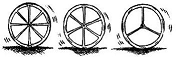
(i) Are the number of spokes and the angles formed between the pairs of consecutive spokes in inverse proportion?
(ii) Calculate the angle between a pair of consecutive spokes on a wheel with 15 spokes.
(iii) How many spokes would be needed, if the angle between a pair of consecutive spokes is $40^{\circ}$ ?
| Number of spokes | 4 | 6 | 8 | 10 | 12 |
| Angle between a pair of consecutive spokes | $90^{\circ}$ | $60^{\circ}$ | … | … | … |
(ii) Calculate the angle between a pair of consecutive spokes on a wheel with 15 spokes.
(iii) How many spokes would be needed, if the angle between a pair of consecutive spokes is $40^{\circ}$ ?
Answer
View full question & answer→It is clear that more the number of spokes, less the measure of angle between a pair of consecutive spokes.
So, it is the case of inverse proportion.
Here, $x_2=6, y_2=60$ and $x_3=8, y_3=$ ?
We know that $x_2 y_2=x_3 y_3$$
\therefore \quad 6 \times 60=8 \times y_3 \Rightarrow y_3=\frac{6 \times 60}{8}=\frac{6 \times 15}{2}$
[dividing numerator and denominator by 4]
$\begin{array}{l}
\Rightarrow \quad y_3=45^{\circ} \\
\text { Now, } \quad x_3=8, y_3=45 \text { and } x_4=10, y_4=? \\
\because \quad x_3 y_3=x_4 y_4 \Rightarrow 8 \times 45=10 \times y_4 \\
\Rightarrow \quad y_4=\frac{8 \times 45}{10}=\frac{8 \times 9}{2}
\end{array}$
[dividing numerator and denominator by 5]
$\begin{array}{l}
\Rightarrow \quad y_4=36^{\circ} \\
\text { Now, } \quad x_4=10, y_4=36 \text { and } x_5=12, y_5=? \\
\because \quad x_4 y_4=x_5 y_5 \Rightarrow 10 \times 36=12 \times y_5 \\
\Rightarrow \quad y_5=\frac{10 \times 36}{12}=\frac{10 \times 6}{2}
\end{array}$
[dividing numerator and denominator by 6]
$\Rightarrow \quad y_5=30^{\circ}$
Now, the complete table is given below
(i) Given, $4 \times 90^{\circ}=6 \times 60^{\circ}=8 \times 45^{\circ}=10 \times 36^{\circ}$$\begin{array}{c}
=12 \times 30^{\circ}=360^{\circ} \\
\text { i.e. } x_1 y_1=x_2 y_2=x_3 y_3=x_4 y_4=x_5 y_5=360^{\circ}
\end{array}$
So, it is clear that it is the case of inverse proportion. Yes, the number of spokes and the angles formed between the pairs of consecutive spokes are in inverse proportion.
(ii) Let the measure of angle be $x$.Lesser the number of spokes, more will be the angle between a pair of consecutive spokes.
So, it is the case of inverse proportion.
Here, $x_1=4, y_1=90^{\circ}$ and $x_2=15, y_2=x$
We know that $x_1 y_1=x_2 y_2$
$\begin{array}{rlrl}\therefore 4 \times 90 =15 \times x \\ \Rightarrow =\frac{4 \times 90}{15}=4 \times 6=24^{\circ}\end{array}$
Hence, the angle between a pair of consecutive spokes on a wheel with 15 spokes is $24^{\circ}$.
(iii) Let number of spokes be $n$. Lesser the number of spokes, more will be the angle between a pair of consecutive spokes.
So, it is the case of inverse proportion.
Here, $x_1=4, y_1=90^{\circ}$ and $x_2=n, y_2=40^{\circ}$ We know that $x_1 y_1=x_2 y_2$
$\therefore \quad 4 \times 90=n \times 40 \Rightarrow n=\frac{4 \times 90}{40}=9$
Hence, 9 spokes would be needed, if the angle between a pair of consecutive spokes is $40^{\circ}$.
So, it is the case of inverse proportion.
Here, $x_2=6, y_2=60$ and $x_3=8, y_3=$ ?
We know that $x_2 y_2=x_3 y_3$$
\therefore \quad 6 \times 60=8 \times y_3 \Rightarrow y_3=\frac{6 \times 60}{8}=\frac{6 \times 15}{2}$
[dividing numerator and denominator by 4]
$\begin{array}{l}
\Rightarrow \quad y_3=45^{\circ} \\
\text { Now, } \quad x_3=8, y_3=45 \text { and } x_4=10, y_4=? \\
\because \quad x_3 y_3=x_4 y_4 \Rightarrow 8 \times 45=10 \times y_4 \\
\Rightarrow \quad y_4=\frac{8 \times 45}{10}=\frac{8 \times 9}{2}
\end{array}$
[dividing numerator and denominator by 5]
$\begin{array}{l}
\Rightarrow \quad y_4=36^{\circ} \\
\text { Now, } \quad x_4=10, y_4=36 \text { and } x_5=12, y_5=? \\
\because \quad x_4 y_4=x_5 y_5 \Rightarrow 10 \times 36=12 \times y_5 \\
\Rightarrow \quad y_5=\frac{10 \times 36}{12}=\frac{10 \times 6}{2}
\end{array}$
[dividing numerator and denominator by 6]
$\Rightarrow \quad y_5=30^{\circ}$
Now, the complete table is given below
| Number of spokes | 4 | 6 | 8 | 10 | 12 |
| Angle between a pair of consecutive spokes | $90^{\circ}$ | $60^{\circ}$ | $45^{\circ}$ | $36^{\circ}$ | $30^{\circ}$ |
(i) Given, $4 \times 90^{\circ}=6 \times 60^{\circ}=8 \times 45^{\circ}=10 \times 36^{\circ}$$\begin{array}{c}
=12 \times 30^{\circ}=360^{\circ} \\
\text { i.e. } x_1 y_1=x_2 y_2=x_3 y_3=x_4 y_4=x_5 y_5=360^{\circ}
\end{array}$
So, it is clear that it is the case of inverse proportion. Yes, the number of spokes and the angles formed between the pairs of consecutive spokes are in inverse proportion.
(ii) Let the measure of angle be $x$.Lesser the number of spokes, more will be the angle between a pair of consecutive spokes.
So, it is the case of inverse proportion.
Here, $x_1=4, y_1=90^{\circ}$ and $x_2=15, y_2=x$
We know that $x_1 y_1=x_2 y_2$
$\begin{array}{rlrl}\therefore 4 \times 90 =15 \times x \\ \Rightarrow =\frac{4 \times 90}{15}=4 \times 6=24^{\circ}\end{array}$
Hence, the angle between a pair of consecutive spokes on a wheel with 15 spokes is $24^{\circ}$.
(iii) Let number of spokes be $n$. Lesser the number of spokes, more will be the angle between a pair of consecutive spokes.
So, it is the case of inverse proportion.
Here, $x_1=4, y_1=90^{\circ}$ and $x_2=n, y_2=40^{\circ}$ We know that $x_1 y_1=x_2 y_2$
$\therefore \quad 4 \times 90=n \times 40 \Rightarrow n=\frac{4 \times 90}{40}=9$
Hence, 9 spokes would be needed, if the angle between a pair of consecutive spokes is $40^{\circ}$.