Question types

Parallelograms question types

57 questions across 6 question groups — pick any mix to generate a MATHS paper with step-by-step answer keys.

57
Questions
6
Question groups
5
Question types
Sample Questions

Parallelograms questions

One sample from each question group in this chapter. Select any group above to see the full set with answer keys.

If an angle of a parallelogram is two-thirds of its adjacent angle, the smallest angle of the parallelogram is:
  • A
    $54^\circ$
  • $72^\circ$
  • C
    $81^\circ$
  • D
    $108^\circ$

Answer: B.

View full solution
The length and breadth of a rectangle are in the ratio $4 : 3.$ If the diagonal measures $25\ cm$ then the perimeter of the rectangle is:
  • A
    $56\ cm$
  • B
    $60\  cm$
  • $70\ cm$
  • D
    $80\ cm$

Answer: C.

View full solution
Assertion (A): A triangle can have at the most one obtuse angle while a quadrilateral can have at the most three obtuse angles.
Reason ( $R$ ): The sum of the angles of a triangle is $180^{\circ}$ while the sum of the angles of a quadrilateral is $360^{\circ}$.
  • A
    Both A and R are true and R is the correct explanation of A
  • B
    Both A and R are true but R is not the correct explanation of A
  • C
    A is true but R is false
  • D
    A is false but R is true
View full solution
Assertion (A): If the diagonals of a quadrilateral bisect each other then it is a parallelogram.
Reason (R): The opposite sides being equal and parallel, a parallelogram is a symmetrical figure and so diagonals bisect each other.
  • A
    Both A and R are true and R is the correct explanation of A
  • B
    Both A and R are true but R is not the correct explanation of A
  • C
    A is true but R is false
  • D
    A is false but R is true
View full solution
Assertion (A): A kite has two pairs of equal adjacent sides but unequal opposite sides.
Reason (R): Every kite is a parallelogram.
  • A
    Both A and R are true and R is the correct explanation of A
  • B
    Both A and R are true but R is not the correct explanation of A
  • C
    A is true but R is false
  • D
    A is false but R is true
View full solution
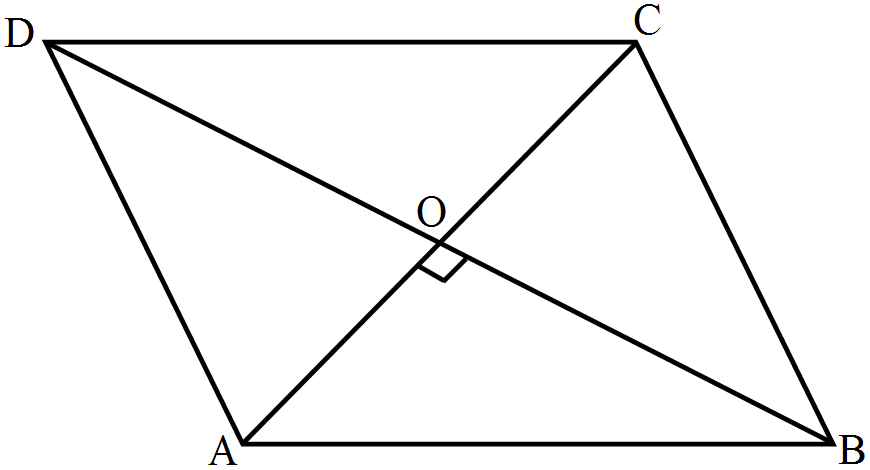
Assertion (A): If the diagonals of a quadrilateral are unequal and intersect each other at right angles then it is a parallelogram.
Resson ( $R$ ): Every parallelogram is a trapezium
  • A
    Both A and R are true and R is the correct explanation of A
  • B
    Both A and R are true but R is not the correct explanation of A
  • C
    A is true but R is false
  • D
    A is false but R is true
View full solution
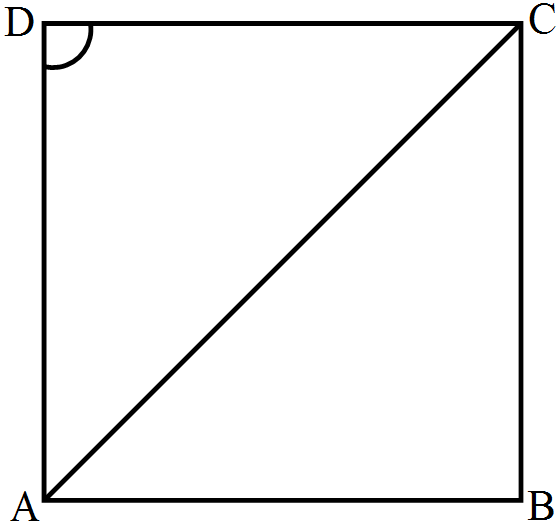
Assertion (A): In a square $A B C D$, the diagonals meet at point $O$. Then, $\triangle A O B$ is an isosceles right-angled triangle.
Reasen ( $R$ ): The diagonals of a square are equal and bisect each other at right angles
  • A
    Both A and R are true and R is the correct explanation of A
  • B
    Both A and R are true but R is not the correct explanation of A
  • C
    A is true but R is false
  • D
    A is false but R is true
View full solution
Q 153 Marks Question3 Marks
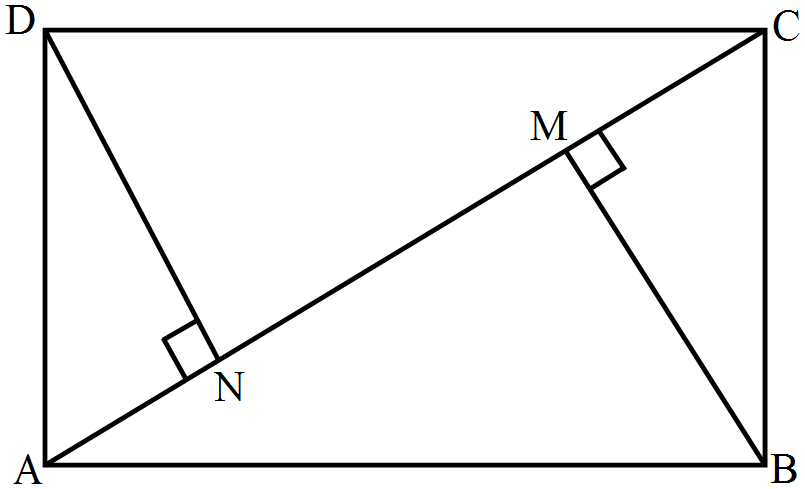
In the adjacent figure, $ABCD$ is a rectangle. If $BM$ and $DN$ are perpendiculars from $B$ and $D$ on $AC$, prove that $\triangle\text{BMC}\cong\triangle\text{DNA}.$ Is it true that $BM = DN$?
View full solution
Q 173 Marks Question3 Marks
$ABCD$ is a parallelogram in which $\angle\text{A}=110^\circ.$ Find the measure of each of the angles $\angle\text{A},\angle\text{B}$ and $\angle\text{D.}$
View full solution
Q 183 Marks Question3 Marks
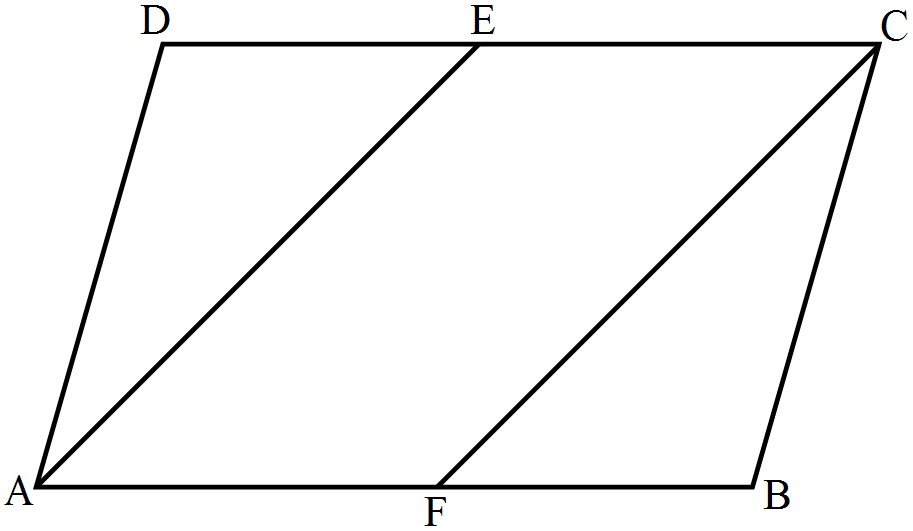
In the adjacent figure, $ABCD$ is a parallelogram and line segments $AE$ and $CF$ bisect the angles $A$ and $C$ respectively. Show that $AE\ ||\ CF$.
View full solution
During a mathematics class, a teacher once gave her students a surprise test to review their knowledge of basic concepts on quadrilaterals. She mentioned the special properties of specific quadrilaterals on different slips and asked each of her students to pick one slip each and identify the quadrilaterals from the given property.
(1) Student A picked the following slip.
A quadrilateral whose all sides, diagonals and angles are equal
A's reply would be
(a) trapezium (b) rhombus (c) rectangle (d) square
(2) Student B picked the following slip.
A quadrilateral whose adjacent sides are equal
B's reply would be
(a) rectangle (b) rhombus (c) trapezium (d) kite
(3) Student C picked the following slip.
A quadrilateral which has the properties of a kite and a parallelogram
C's reply would be
(a) trapezium (b) rhombus (c) rectangle (d) isosceles trapezium
(4) Student D picked the following slip.
A quadrilateral in which only one diagonal bisects the other
D's reply would be
(a) rectangle (b) rhombus (c) trapezium (d) kite
Q.1. Student E picked the following slip.
A quadrilateral in which each diagonals bisects the angles at the vertices through which it passes
E's reply would be
(a) parallelogram (b) rectangle (c) rhombus (d) square
View full solution

Generate a Parallelograms paper free

Pick question groups from the list above, set marks and difficulty, and export a branded PDF with step-by-step answer keys. First 3 chapters free — no signup.

Download App