Questions

3 Marks Question

🎯

Test yourself on this topic

19 questions · timed · auto-graded

Question 13 Marks
By repeated subtraction of odd number starting from 1, find whether the following numbers are perfect squares or not. If the number is a perfect square, then find its square root.
(i) 121$\quad$(ii) 55$\quad$(iii) 36$\quad$(iv) 49$\quad$(v) 90
Answer
(i) Given number is 121.
Now, we subtract successive odd numbers starting from 1 as follows :
$\begin{array}{ll}121-1=120, & 120-3=117, \\ 117-5=112, & 112-7=105, \\ 105-9=96, & 96-11=85, \\ 85-13=72, & 72-15=57, \\ 57-17=40, & 40-19=21,\quad 21-21=0\end{array} $
We observe that the number 121 reduced to zero after subtracting first 11 odd numbers. So, 121 is a perfect square.
$\therefore \quad \sqrt{121}=11$
Hence, the square root of 121 is 11.
(ii) Given number is 55.
Now, we subtract successive odd numbers starting from 1 as follows :
$\begin{aligned} 55-1 & =54, & & 54-3=51, \\ 51-5 & =46, & & 46-7=39, \\ 39-9 & =30, & & 30-11=19, \\ 19-13 & =6, & & 6-15=-9 .\end{aligned}$
We observe that the number 55 do not reduced to 0 after subtracting first 8 odd numbers.
Therefore, 55 is not a perfect square.
(iii) 36 is a perfect square. Its square root is 6
(iv) 49 is a perfect square. Its square root is 7
(v) 90 is not a perfect square
View full question & answer
Question 23 Marks
What will be the ones digit in the square of the following numbers?
(i) 1234 $\quad$ $\quad$(ii) 26387 $\quad$ (iii) 52698
(iv) 99880 $\quad$ (v) 21222 $\quad$ (vi) 9106
Answer
(i) Given number is 1234.
Unit dipit of $1234=4$
So, square of unit digit $=(4)^2=16$
Hence, unit digit of the square of unit digit of the given number is 6.
(ii) Given number is 26387.
Unit digit of $26387=7$
So, square of unit digit $=(7)^2=49$
Hence, unit digit of the square of unit digit of the given number is 9.
(iii) Ans. 4
(iv) Ans. 0
(v) Ans. 4
(vi) Ans. 6
View full question & answer
Question 33 Marks
Which of the following numbers would have digit 6 at unit place?
(i) $19^2$ $\quad$ (ii) $24^2$ $\quad$ (iii) $26^2$
(iv) $36^2$$\quad$(v) $34^2$
Answer
(i) Since, number 19 does not end with 4 or 6 , so the number getting from the square of 19 , will not end with the digit 6.
(ii) Since, number 24 ends with digit 4 , so the number getting from the square of 24 , will end with the digit 6 .
(iii) Since, number 26 ends with digit 6, so the number getting from the square of 26 , will end with the digit 6 .
(iv) Since, number 36 ends with digit 6, so the number getting from the square of 36 , will end with the digit 6 .
(v) Since, number 34 ends with digit 4 , so the number getting from the square of 34 , will end with the digit 6 .
View full question & answer
Question 43 Marks
(i) $(-1)^2=1$. Is -1, a square root of 1?
(ii) $(-2)^2=4$. Is -2, a square root of 4?
(iii) $(-9)^2=81$. Is -9, a square root of 81?
Answer
(i) Yes, we have $(-1)^2=1$ i.e. $(-1) \times(-1)=1$
Therefore, square root of 1 can also be -1.
(ii) Yes, we have $(-2)^2=4$ i.e. $(-2) \times(-2)=4$
Therefore, square root of 4 can also be -2.
(iii) Yes, we have $(-9)^2=81$ i.e. $(-9) \times(-9)=81$
Therefore, square root of 81 can also be -9.
View full question & answer
Question 53 Marks
In a right angled $\triangle \text{ABC}, \angle \text{B}=90^{\circ}$.
(i) If $\text{AB}=6 \text{ cm}$ and $\text{BC}=8 \text{ cm}$, find $\text{AC}$.
(ii) If $\text{AC}=13 \text{ cm}$ and $\text{BC}=5 \text{ cm}$, find $\text{AB}$.
Answer
(i) Here, $A B=6 cm, B C=8 cm$
In right angled $\triangle A B C, \angle B=90^{\circ}$
Using Pythagoras theorem,
$AC^2=AB^2+BC^2$
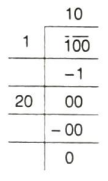
$\begin{array}{l}\Rightarrow A C^2=(6)^2+(8)^2 \\ \Rightarrow A C^2=36+64 \\ \Rightarrow A C^2=100\end{array}$
Image
$\therefore \text{AC}=\sqrt{100}=10\text{ cm}$
(ii) Here, $A C=13 cm, B C=5 cm$
In right angled $\triangle A B C, \angle B=90^{\circ}$
Using Pythagoras theorem,
$A C^2=A B^2+B C^2$
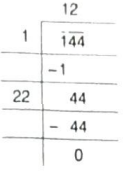
$\begin{array}{l}\Rightarrow A B^2=A C^2-B C^2 \\ \Rightarrow A B^2=(13)^2-(5)^2 \\ \Rightarrow A B^2=169-25 \\ \Rightarrow \quad A B^2=144\end{array}$
Image
$\begin{aligned} \therefore \quad A B & =\sqrt{144} \\ & =12 cm\end{aligned}$
View full question & answer
Question 63 Marks
2025 plants are to be planted in a garden in such a way that each row contains as many plants as the number of rows. Find the number of rows and the number of plants in each row.
Answer
Let the number of rows be x.
Then, the number of plants in a row = x
So, number of plants to be planted in a garden $=x \times x=x^2$
According to the question,
Total number of plants to be
Planted = 2025
$x^2 =2025 $
$\begin{aligned}\Rightarrow \quad x & =\sqrt{2025} \\ & =\sqrt{3 \times 3 \times 3 \times 3 \times 5 \times 5} \\ & =3 \times 3 \times 5 \\ & =45\end{aligned}$
32025
3675
3225
375
525
55
1
Hence, the number of rows is 45 and the number of plants in each row is 45.
View full question & answer
Question 73 Marks
The students of Class VIII of a school donated ₹ 2401 in all, for Prime Minister's National Relief Fund. Each student donated as many rupees as the number of students in the class. Find the number of students in the class.
Answer
Let the number of students be x.
Since, each student donated as many rupees as the number of students in the class.
So, amount donated by the each student
= ₹ x
$\therefore$ Total amount donated by the class
$=$ ₹ $x \times x=$ ₹ $x^2$
According to the question,
Total number of students of Class VIII donated
$=$ ₹ $2401 \Rightarrow x^2=2401$
$\therefore \quad x=\sqrt{2401}=\sqrt{7 \times 7 \times 7 \times 7}=7 \times 7=49$
72401
7343
749
77
1
Hence, the number of students in the class is 49.
View full question & answer
Question 83 Marks
For each of the following numbers, find the smallest, whole number by which it should be divided, so as to get a perfect square. Also, find the square root of the square number so obtained.
2925
Answer
Given number is 2925.
Using prime factorisation, we get
$2925=3 \times 3 \times 5 \times 5 \times 13$
32925
3975
5325
565
1313
1
Here, prime factor 13 is unpaired.
It is clear that in order to get a perfect square, the given number is divided by 13. So, the given number should be divided by 13 to make the quotient a perfect square. Thus, $2925\div 13=225$ is a perfect square.
Now, the prime factor of $225=3 \times 3 \times 5 \times 5=(3 \times 5)^2$
$\therefore \quad \sqrt{36}=6$
Hence, the square root of 225 is 15.
View full question & answer
Question 93 Marks
For each of the following numbers, find the smallest, whole number by which it should be divided, so as to get a perfect square. Also, find the square root of the square number so obtained.
252
Answer
Given number is 252.
Using prime factorisation, we get
$252=2 \times 2 \times 3 \times 3 \times 7$
2252
2126
363
321
77
1
Here, prime factor 7 is unpaired. It is clear that in order to get a perfect square, the given number is divided by 7.
So, the given number should be divided by 7 to make the quotient a perfect square.
So, $252 \div 7=36$ is a perfect square.
Now, the prime factor of $36=2 \times 2 \times 3 \times 3=(2 \times 3)^2$
$\therefore \quad \sqrt{36}=6$
Hence, the square root of 36 is 6 .
View full question & answer
Question 103 Marks
The squares of which of the following would be odd numbers?
(i) 431 $\quad$ (ii) 2826 $\quad$ (iii) 7779 $\quad$ (iv) 82004
Answer
(i) The square of 431 is an odd number because 431 is an odd number.
(ii) The square of 2826 is an even number because 2826 is an even number.
(iii) The square of 7779 is an odd number because 7779 is an odd number.
(iv) The square of 82004 is an even number because 82004 is an even number.
View full question & answer
Question 113 Marks
Show that 500 is not a perfect square.
Answer
We have, $500=\underline{2 \times 2} \times \underline{5 \times 5} \times 5$
2500
2250
5125
525
55
1
Here, by grouping into a pair of equal factors, we are left with one factor 5, which cannot be paired.
Hence, 500 is not a perfect square.
View full question & answer
Question 123 Marks
Find the least square number which is divisible by $3,4,5,6$ and $8.$
Answer
Firstly, we find out the LCM of $3, 4, 5, 6, 8$
33, 4, 5, 6, 8
21, 4, 5, 2, 8
21, 2, 5, 1, 4
21, 1, 5, 1, 2
51, 1, 5, 1, 1
1, 1, 1, 1, 1
To make $3 \times 2 \times 2 \times 2 \times 5$ a perfect square, we need to multiply it with $3 \times 2 \times 5$.
Thus, we have
$3 \times 2 \times 2 \times 2 \times 5 \times 3 \times 2 \times 5=120 \times 30=3600$
View full question & answer
Question 133 Marks
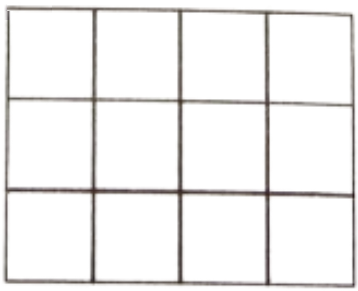
The rectangle below is made of unit squares.
Image
What are the possible ways of converting it into a square?
Answer
(i) The possible ways of converting it into a square are as follows:
(a) Remove one column of unit squares in the rectangle.
(b) Remove two columns and one row of the unit squares in the rectangle.
(c) Add one more row in the rectangle.
View full question & answer
Question 143 Marks
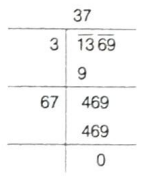
Find the square root of 1369 by long division method.
Answer
We have, 1369
By division method
Image
$\therefore \sqrt{1369}=37$
View full question & answer
Question 153 Marks
Find the length of the side of a square, whose area is $729 \text{m}^2.$
Answer
Let the side of the square be $\text{x m.}$
$\begin{array}{l}\text {Area }=(\text {Side})^2=x^2 \\\therefore \quad x^2=729 \Rightarrow x=\sqrt{729} \Rightarrow x=27 \text{ m}\end{array}$
View full question & answer
Question 163 Marks
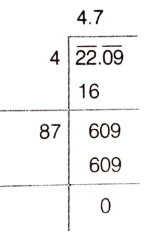
Evaluate the square root of 22.09 by long division method.
Answer
We have, $22.09$
Image
Therefore, $\sqrt{22.09}=4.7$
View full question & answer
Question 173 Marks
Using prime factorisation, find the square root of 1025.
Answer
We have, 11025
By prime factorisation,
511025
52205
3441
3147
749
77
1
$\therefore\quad 11025=\underline{5 \times 5} \times \underline{3 \times 3} \times \underline{7 \times 7}$
$\begin{aligned} \text{or }\sqrt{11025} & =5 \times 3 \times 7 \\ & =105\end{aligned}$
View full question & answer
Question 183 Marks
Write the Pythagorean triplet whose smallest number is 18.
Answer
Given, smallest number is 18 .
$\therefore \quad 2 \text{m}=18~$ or $~\text{m}=9$
$\text{m}^2+1=9^2+1=81+1=82$
$\text{m}^2-1=9^2-1=81-1=80$
So, the Pythagorean triplet is $(18,80,82).$
View full question & answer
Question 193 Marks
Check, whether 180 is a perfect square or not using prime factorisation.
Answer
By prime factorisation
2180
290
345
315
55
1
$\therefore 180= \underline{2\times2}\times\underline{3\times3}\times5$
Here, the prime factor 5 is not in a pair, so 180 is not a perfect square.
View full question & answer