Question 13 Marks
After showing $\text{m} \angle \text{R = m} \angle \text{N}=70^{\circ},$ can you find $\text{m} \angle \text{I}$ and $\text{m} \angle \text{G}$ by any other method?
Answer
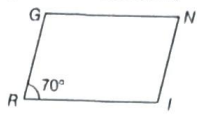
View full question & answer→Yes, we can find $\text{m} \angle \text{I}$ and $\text{m} \angle \text{G}$ by any other method. Given that in a parallelogram RING,
$m \angle R=70^{\circ}$
Here, $R G \| I N$ and $R I$ is a transversal.
We know that if two parallel lines are cut by a transversal, then each pair of interior angles on the same side of the transversal are supplementary.
So, $m \angle R+m \angle I=180^{\circ} \Rightarrow 70^{\circ}+m \angle I=180^{\circ}$
$\Rightarrow \quad m \angle I=180^{\circ}-70^{\circ}=110^{\circ}$
Similarly, $R I \| G N$ and $R G$ is a transversal.
$\therefore \quad m \angle R+m \angle G=180^{\circ} \quad$ [interior angles]
$\Rightarrow \quad 70^{\circ}+m \angle G=180^{\circ}$
$\Rightarrow \quad m \angle G=180^{\circ}-70^{\circ}$
$\Rightarrow \quad m \angle G=110^{\circ}$
Hence, $\quad m \angle I=m \angle G=110^{\circ}$
$m \angle R=70^{\circ}$
Here, $R G \| I N$ and $R I$ is a transversal.
We know that if two parallel lines are cut by a transversal, then each pair of interior angles on the same side of the transversal are supplementary.
So, $m \angle R+m \angle I=180^{\circ} \Rightarrow 70^{\circ}+m \angle I=180^{\circ}$
$\Rightarrow \quad m \angle I=180^{\circ}-70^{\circ}=110^{\circ}$
Similarly, $R I \| G N$ and $R G$ is a transversal.
$\therefore \quad m \angle R+m \angle G=180^{\circ} \quad$ [interior angles]
$\Rightarrow \quad 70^{\circ}+m \angle G=180^{\circ}$
$\Rightarrow \quad m \angle G=180^{\circ}-70^{\circ}$
$\Rightarrow \quad m \angle G=110^{\circ}$
Hence, $\quad m \angle I=m \angle G=110^{\circ}$