- ✓Cell wall.
- BCell membrane.
- CMitochondria.
- DNucleus.
50 questions · timed · auto-graded
|
$(i)$
|
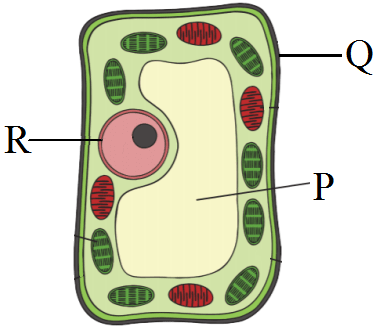
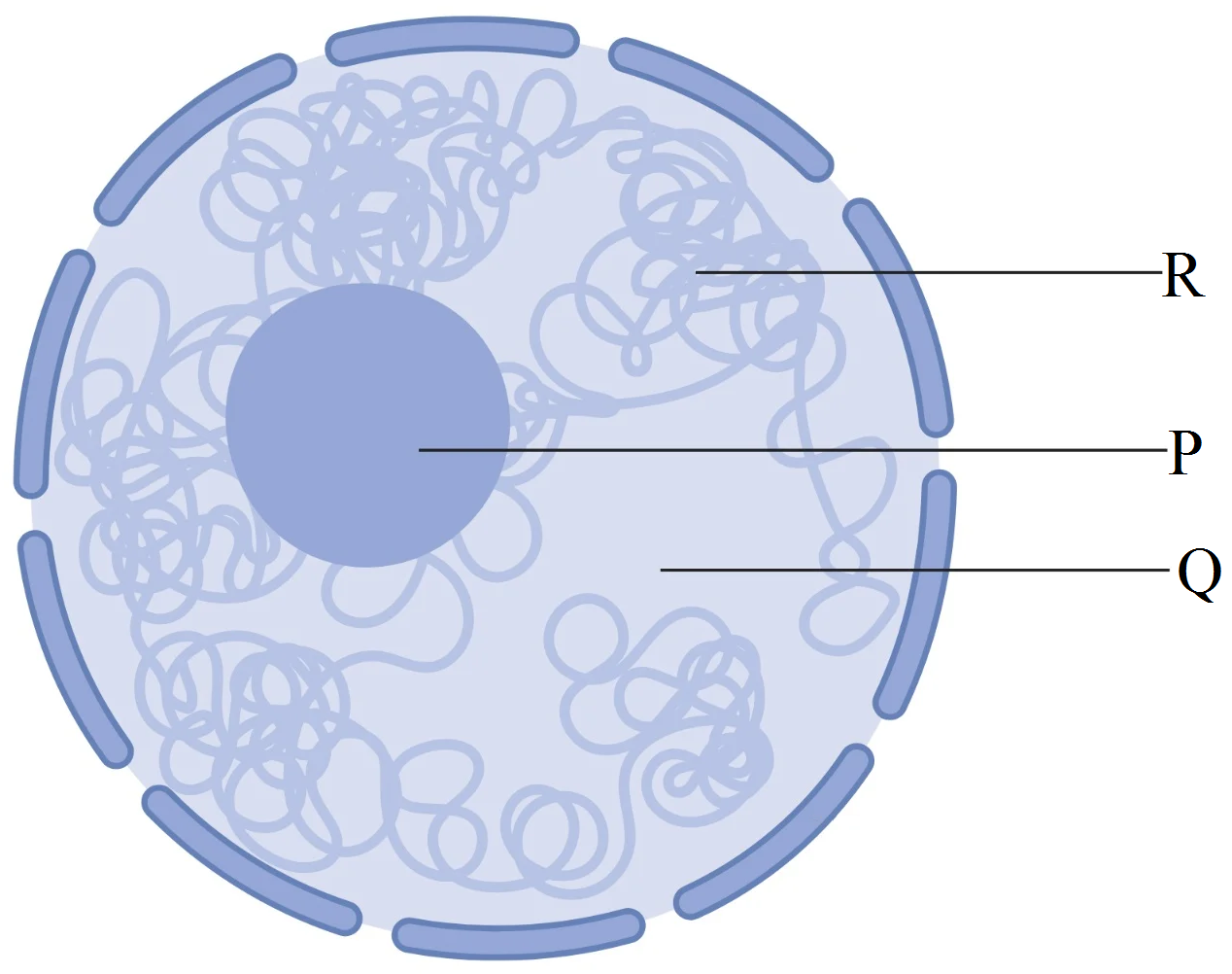
The part labelled $P$ is found in plant cell only.
|
|
$(ii)$
|
The part labelled $Q$ is cell wall, which provides rigidity to a plant cell.
|
|
$(iii)$
|
The part labelled $R$ is the controlling centre.
|
|
$(iv)$
|
The part labelled $R$ gets its shape from part labelled $P$.
|
Cell membrane is the common part of every cell. It encloses the protoplasm, protects the cell, gives the cell its shape and control the entry and exit of substances.
Rbosome is not a part of nucleus. They are found floating in the cytosol or attached to the endoplasmic reticulum. Nucleus is the largest organelle in cell that contains thread-like structure is called chromosomes on which genes are present. Nucleolus is the round irregular structures present inside nucleus.
|
$(i)$
|
Oxidation of food during cell respiration
|
|
$(ii)$
|
Storage and secretion of substances from the cell
|
|
$(iii)$
|
Allow minerals to pass through
|
|
$(iv)$
|
Transport of substances within cell.
|
The blood is a liquid connective tissue.
|
$(i)$
|
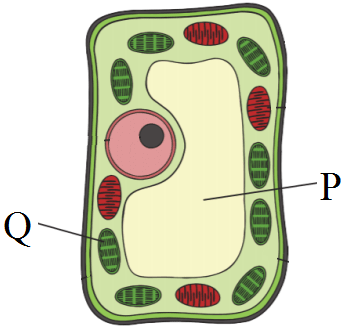
Part $P$ helps in osmoregulation.
|
|
$(ii)$
|
Cellular respiration occurs in part $Q$.
|
|
$(iii)$
|
Synthesis of sugars occurs in part $Q$.
|
|
$(iv)$
|
Part $P$ provides colour to flowers and fruits.
|

| $(i)$ | $P$ is an important site for protein synthesis. |
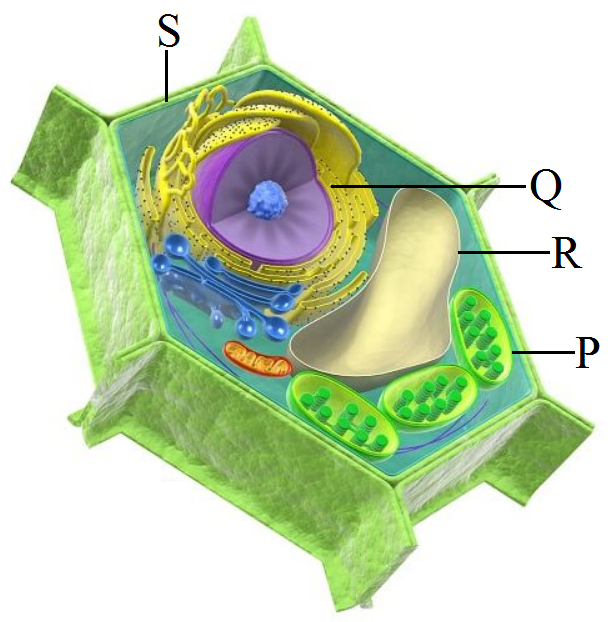
| $(ii)$ | $R$ transfers the characteristics of a cell that are formed during cell division. |
| $(iii)$ | $Q$ is a dense fluid like agranular substance. |
| $(iv)$ | $P$ contains $DNA$ while $R$ contains $RNA$. |
|
|
Column $A$
|
|
Column $B$
|
|
$(I)$
|
Laminaria
|
$[A]$
|
Protozoa
|
|
$(II)$
|
Paramecium
|
$[B]$
|
Bacteria
|
|
$(III)$
|
Penicillium
|
$[C]$
|
Algae
|
|
$(IV)$
|
Streptococcus
|
$[D]$
|
Fungi
|
|
$(i)$
|
$\text{RBC}$
|
$(ii)$
|
$\text{WBC}$
|
|
$(iii)$
|
Blood
|
$(iv)$
|
Muscle
|
|
$(v)$
|
Blood vessels
|
$(vi)$
|
Brain
|
|
$(vii)$
|
Heart
|
$(viii)$
|
Lung
|
|
$(ix)$
|
Sperm
|
$(x)$
|
Kidney
|
|
Cell
|
Tissue
|
Organ
|
|
$(i), (ii), (ix)$
|
$(iii), (iv)$
|
$(v), (vi), (vii), (viii), (x)$
|
|
Cell
|
Tissue
|
Organ
|
|
$(i), (ii), (iii), (x)$
|
$(iv), (v)$
|
$(vi), (vii), (viii), (ix)$
|
|
Cell
|
Tissue
|
Organ
|
|
$(i), (ii), (iv), (ix)$
|
$(iii), (v), (vi)$
|
$(vii), (viii), (x)$
|
|
Cell
|
Tissue
|
Organ
|
|
$(i), (ii), (ix)$
|
$(iii), (iv), (v)$
|
$(vi), (vii), (viii), (x)$
|
|
Cell
|
Tissue
|
Organ
|
|
$(i), (ii), (ix)$
|
$(iii), (iv)$
|
$(v), (vi), (vii), (viii), (x)$
|

The cell membrane controls the entry (movement into the cell) and exit (movement out of the cell) of materials. It also protects and gives shape to the cell.
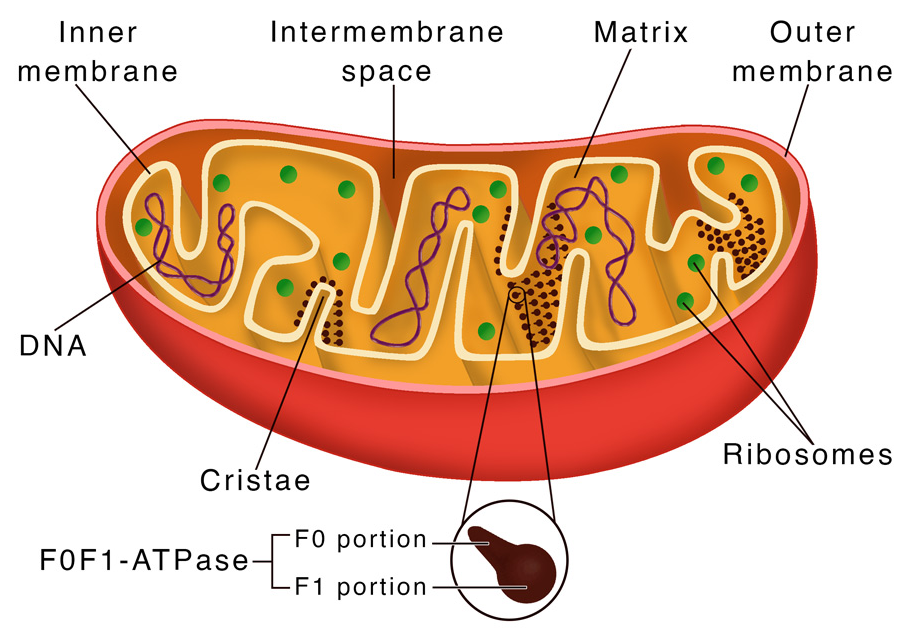
The mitochondrion is called the "powerhouse of the cell" because it is responsible for producing energy-rich $ATP$ molecules. Cells use $ATP$ for all their energy needs.