Question types

Electricity: Magnetic and Heating Effects question types

101 questions across 9 question groups — pick any mix to generate a Science paper with step-by-step answer keys.

101
Questions
9
Question groups
5
Question types
Sample Questions

Electricity: Magnetic and Heating Effects questions

One sample from each question group in this chapter. Select any group above to see the full set with answer keys.

Nichrome wire is commonly used in electrical heating devices because it
  • A
    is a good conductor of electricity.
  • generates more heat for a given current.
  • C
    is cheaper than copper.
  • D
    is an insulator of electricity.

Answer: B.

View full solution
An electric current flows through a nichrome wire for a short time.
(i) The wire becomes warm.
(ii) A magnetic compass placed below the wire is deflected.
  • A
    Only (i) is correct
  • B
    Only (ii) is correct
  • Both (i) and (ii) are correct
  • D
    Both (i) and (ii) are not correct

Answer: C.

View full solution
Assertion (A): While making elements of heating appliances from wires of materials like nichrome, the length of the wires is increased by making coils of the wire.
Reason (R): The increase in the length of the conducting wire does not change the heating effect of the electric current.
  • A
    Both (A) and (R) are true, and (R) is the correct explanation of (A).
  • B
    Both (A) and (R) are true, but (R) is not the correct explanation of (A).
  • C
    (A) is true, but (R) is false.
  • D
    (A) is false, but (R) is true.
View full solution
Assertion (A): When an electric current passes through a conductor, it gets heated. This warming is called the heating effect of electric current.
Reason (R): When electric current flows through any conductor, it faces some opposition or resistance to its flow. This resistance converts some electric energy to heat energy.
  • A
    Both (A) and (R) are true, and (R) is the correct explanation of (A).
  • B
    Both (A) and (R) are true, but (R) is not the correct explanation of (A).
  • C
    (A) is true, but (R) is false.
  • D
    (A) is false, but (R) is true.
View full solution
The strength of the electromagnet does NOT change with a change in
  • A
    The nature and thickness of the conductor
  • B
    Time duration for which the current is passed
  • C
    Strength of the electric current
  • D
    The number of turns in the coil
View full solution
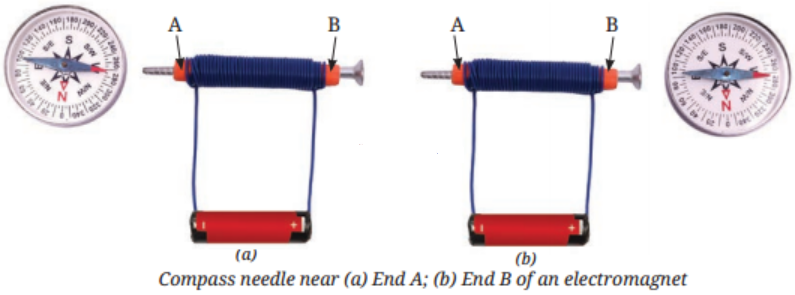
Look at the Figure. If the compass is placed near the coil deflects:
Image
1. Draw an arrow on the diagram to show the path of the electric current.
2. Explain why the compass needle moves when current flows.
3. Predict what would happen to the deflection if you reverse the battery terminals.
View full solution
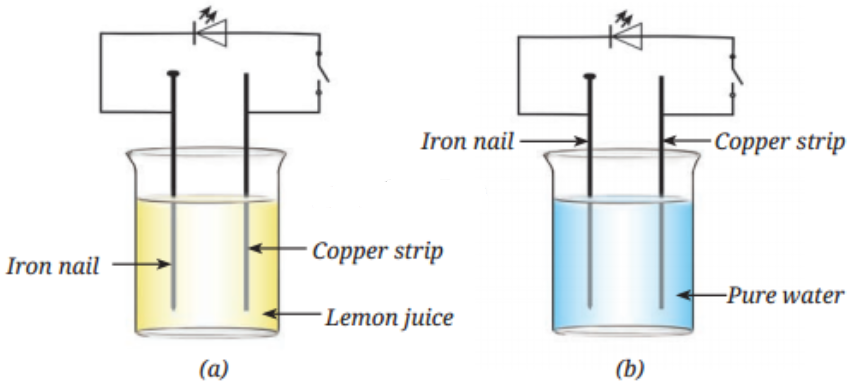
A Voltaic cell, also known as a Galvanic cell, contains two metal plates made of different materials and a liquid called an electrolyte, placed in a glass or plastic container. The plates, called electrodes, are partly dipped in the electrolyte, which is usually a weak acid or a salt solution. A chemical reaction between the plates and the electrolyte produces electricity.
(a) In what way is the Voltaic cell different from the dry cell?
(b) Who discovered the Voltaic or the Galvanic cell? What was the difference of opinion between the two scientists about the electricity generation by the cell, and how was it resolved?
View full solution
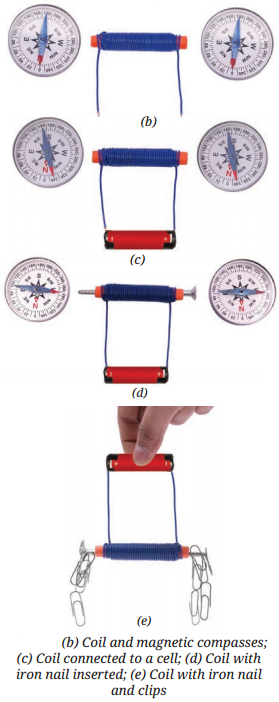
Neha keeps the coil the same way as in Activity but slides the iron nail out, leaving only the coiled wire. Will the coil still deflect the compass? If yes, will the deflection be more or less than before?
Image
View full solution
Electric heating devices (like an electric heater or a stove) are often considered more convenient than traditional heating methods (like burning firewood or charcoal). Give reasons to support this statement, considering societal impact.
View full solution
Suppose Sumana forgets to move the switch of her lifting electromagnet model to the OFF position (in the introduction story). After some time, the iron nail no longer picks up the iron paper clips, but the wire wrapped around the iron nail is still warm. Why did the lifting electromagnet stop lifting the clips? Give possible reasons.
View full solution
Column AColumn B
Q.1. Voltaic Cell(a) Best suited for an electric heater
Q.2. Electric iron(b) Works on magnetic effect of electric current
Q.3. Nichrome wire(c) Works on the heating effect of electric current
Q.4. Electromagnet(d) Generates electricity by chemical reactions
View full solution
Clounm AColumn B
Q.1. Example of the heating effect of electric current(a) Dry cell electrolyte
Q.2. Example of the magnetic effect of electric current(b) Metallic trip over the carbon rod
Q.3. A weak acid or salt solution in liquid form(c) Room heater,electric stove,hair dryer,electric icon
Q.4. An electrolyte in the form of a thick,moist paste(d) Magnets in door bells,loudspeaker,electric motors,and fans
(e) Electrolyte in a Voltaic cell
View full solution
Column AColumn B
Q.1. Examples of the heating effect of electric current(a) North Pole and South Pole
Q.2. Increases the magnetic strength of an electromagnet(b) Iron/copper, zinc/copper, zinc/silver, lead/copper
Q.3. Pairs of electrode materials used in Voltaic cells(c) Number of turns in the coil
Q.4. Electromagnets also have(d) Electric iron, electric kettle
View full solution

Generate a Electricity: Magnetic and Heating Effects paper free

Pick question groups from the list above, set marks and difficulty, and export a branded PDF with step-by-step answer keys. First 3 chapters free — no signup.

Download App