Question types

Light: Mirrors and Lenses question types

120 questions across 9 question groups — pick any mix to generate a Science paper with step-by-step answer keys.

120
Questions
9
Question groups
5
Question types
Sample Questions

Light: Mirrors and Lenses questions

One sample from each question group in this chapter. Select any group above to see the full set with answer keys.

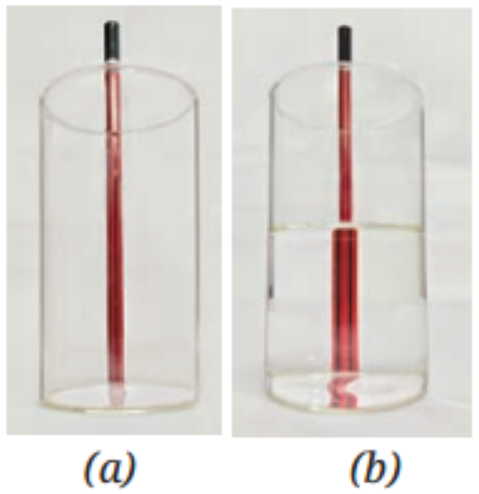
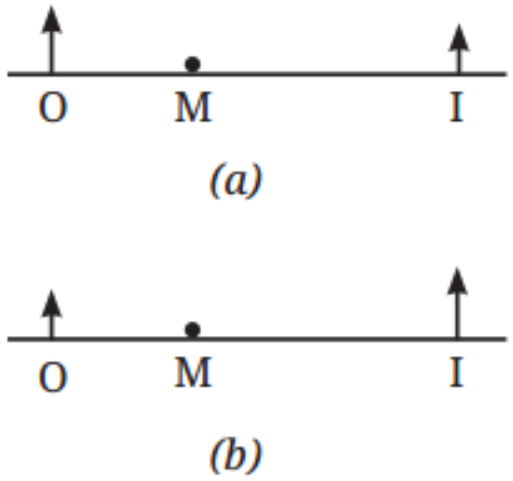
In the Figure, note that O stands for object, M for mirror, and I for image.
Image
Which of the following statements is true?
  • A
    Figure (a) indicates a plane mirror, and Figure (b) indicates a concave mirror.
  • Figure (a) indicates a convex mirror and Figure (b) indicates a concave mirror.
  • C
    Figure (a) indicates a concave mirror and Figure (b) indicates a convex mirror.
  • D
    Figure (a) indicates a plane mirror, and Figure (b) indicates a convex mirror.

Answer: B.

View full solution
Assertion: Convex mirrors are preferred for observing the traffic behind us.
Reason: Convex mirrors provide a significantly larger view area than plane mirrors.
  • Both Assertion and Reason are correct, and Reason is the correct explanation for Assertion.
  • B
    Both Assertion and Reason are correct, but Reason is not the correct explanation for Assertion.
  • C
    Assertion is correct, but Reason is incorrect.
  • D
    Both Assertion and Reason are incorrect.

Answer: A.

View full solution
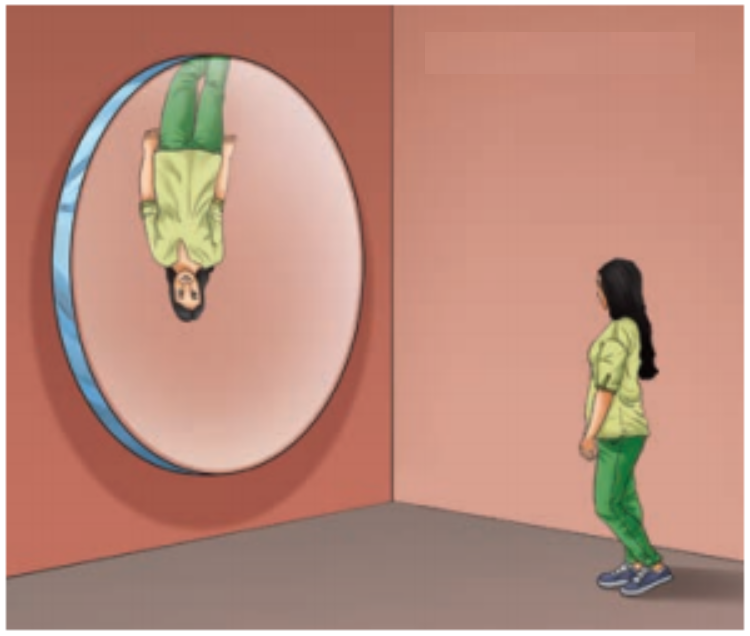
In a museum, a woman walks towards a large convex mirror (Figure). She will see that:
Image
  • Her erect image keeps decreasing in size.
  • B
    her inverted image keeps decreasing in size.
  • C
    her inverted image keeps increasing in size, and eventually it becomes erect and magnified.
  • D
    Her erect image keeps increasing in size.

Answer: A.

View full solution
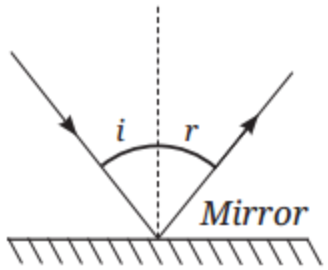
A light ray is incident on a mirror and gets reflected by it (Figure). The angle made by the incident ray with the normal to the mirror is 40°. What is the angle made by the reflected ray with the mirror?
Image
  • A
    40°
  • 50°
  • C
    45°
  • D
    60°

Answer: B.

View full solution
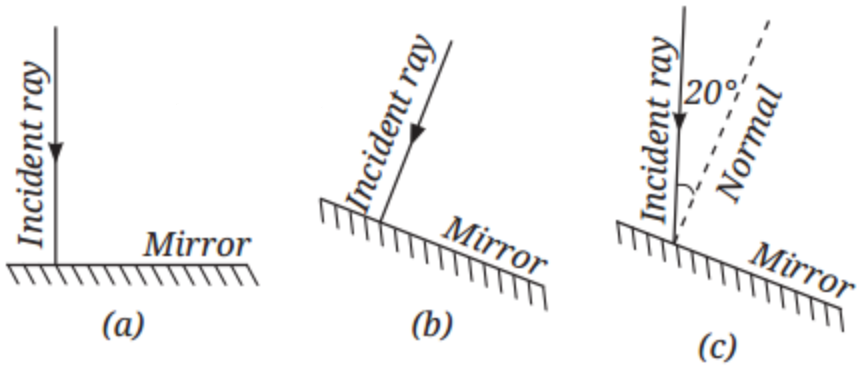
The figure shows three different situations where a light ray falls on a mirror:
Image
1. The light ray falls along the normal.
2. The mirror is tilted, but the light ray still falls along the normal to the tilted surface.
3. The mirror is tilted, and the light ray falls at an angle of 20° from the normal.
Draw the reflected ray in each case (Use a ruler and protractor for accurate drawing). What is the angle of reflection in each case?
View full solution
Column IColumn II
(i) Concave mirror(a) Spherical mirror with a reflecting surface that curves inwards.
(ii) Convex mirror(b) It forms an image which is always erect and diminished in size.
(iii) Convex lens(c) Object placed behind it may appear inverted at some distance.
(iv) Concave lens(d) Object placed behind it always appears diminished in size.
View full solution
C olumn IColumn II
Q.1. Convex lens(a) Diverges light ray
Q.2. Concave lens(b) Used in a magnifying glass
Q.3. Convex mirror(c) Forms a real and inverted image
Q.4. Concave mirror(d) Used in the rear view mirror
(e) Can be projected on screen
View full solution

Generate a Light: Mirrors and Lenses paper free

Pick question groups from the list above, set marks and difficulty, and export a branded PDF with step-by-step answer keys. First 3 chapters free — no signup.

Download App