Questions

M.C.Q. [I MARKS]

Take a timed test

27 questions · 25 auto-graded MCQ + 2 self-marked written.
MCQ 11 Mark
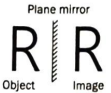
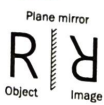
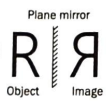
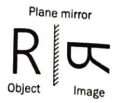
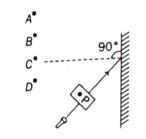
A student studies that a plane mirror results in a laterally inverted image after reflecting. Which of these represents the image likely to be formed by a plane mirror?
  • A

    Image
  • B

    Image
  • C

    Image
  • D

    Image
Answer
self
View full question & answer
MCQ 31 Mark
Part of the eye which controls the entering of light is called
  • iris
  • B
    cornea
  • C
    lens
  • D
    retina
Answer
Correct option: A.
iris
A
View full question & answer
MCQ 61 Mark
We can see a non-luminous object when light
  • A
    emitted by the object falls on the eye
  • is reflected from the object towards our eye
  • C
    completely passes through the object
  • D
    gets completely absorbed by the object
Answer
Correct option: B.
is reflected from the object towards our eye
B
View full question & answer
MCQ 81 Mark
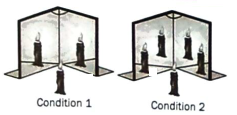
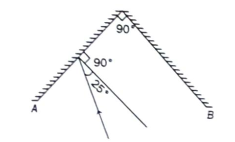
The picture shows a candle in front of two plane mirrors joined at their sides.
Image
What will increase the number of images formed In the mirrors?
  • A
    Decrease in the size of the object
  • B
    Increase in the size of the mirrors
  • Decrease in the angle between the two mirrors
  • D
    Increase in the distance between the object and the mirrors
Answer
Correct option: C.
Decrease in the angle between the two mirrors
C
View full question & answer
MCQ 91 Mark
Which of these objects reflects light?
  • A
    The sun
  • The moon
  • C
    A glowing bulb
  • D
    Burning wood
Answer
Correct option: B.
The moon
B
View full question & answer
MCQ 111 Mark
The change in converging power of an eye lens is caused by the action of
  • A
    retina
  • B
    optic nerve
  • ciliary muscles
  • D
    iris
Answer
Correct option: C.
ciliary muscles
C
View full question & answer
MCQ 121 Mark
Assertion (A) Rainbow is the natural phenomenon of multiple reflection.
Reason (R) Rainbow forms when sunlight falls on the rainwater droplets.
  • A
    Both A and R are true and R is the correct explanation of A
  • B
    Both A and R are true but R is not the correct explanation of A
  • C
    A is true but R is false.
  • A is false but R is true.
Answer
Correct option: D.
A is false but R is true.
D
View full question & answer
MCQ 131 Mark
Assertion (A) Owl can see very well in the night.
Reason (R) Owl has a large cornea and a large pupil to allow more light in its eye.
  • Both A and R are true and R is the correct explanation of A
  • B
    Both A and R are true but R is not the correct explanation of A
  • C
    A is true but R is false.
  • D
    A is false but R is true.
Answer
Correct option: A.
Both A and R are true and R is the correct explanation of A
A
View full question & answer
MCQ 141 Mark
If a single ray is incident on a plane mirror, then how many reflected ray will you observe?
  • A
    Two
  • B
    Zero
  • One
  • D
    Infinite
Answer
Correct option: C.
One
C
View full question & answer
MCQ 151 Mark
The light ray after reflection from a surface is known as
  • A
    normal ray
  • B
    refracted ray
  • reflected rays
  • D
    incident ray
Answer
Correct option: C.
reflected rays
C
View full question & answer
MCQ 161 Mark
The nature of image formed by a plane mirror is
  • always virtual
  • B
    always inverted
  • C
    always real
  • D
    real and virtual
Answer
Correct option: A.
always virtual
A
View full question & answer
MCQ 171 Mark
Assertion (A) Eye sight becomes foggy in old ages.
Reason (R) Crystalline lens becomes milky and cloudy in old ages.
  • Both A and R are true and R is the correct explanation of A.
  • B
    Both A and R are true but R is not the correct explanation of A.
  • C
    A is true but R is false.
  • D
    A is false but R is true.
Answer
Correct option: A.
Both A and R are true and R is the correct explanation of A.
A
View full question & answer
MCQ 181 Mark
Assertion (A) Iris controls the size of lens.
Reason (R) Iris controls the amount of light entering in the eye.
  • A
    Both A and R are true and R is the correct explanation of A.
  • B
    Both A and R are true but R is not the correct explanation of A.
  • C
    A is true but R is false.
  • A is false but R is true.
Answer
Correct option: D.
A is false but R is true.
(D) A is false but R is true.
Iris controls the size of pupil. Hence, A is false but R is true.
View full question & answer
MCQ 191 Mark
Assertion (A) Night birds have more rods than cones.
Reason (R) Rods are more sensitive for dim light than cones.
  • Both A and R are true and R is the correct explanation of A.
  • B
    Both A and R are true but R is not the correct explanation of A.
  • C
    A is true but R is false.
  • D
    A is false but R is true.
Answer
Correct option: A.
Both A and R are true and R is the correct explanation of A.
(A) Both A and R are true and R is the correct explanation of A.
Night birds have more rods than cones because they are designed by nature to see in night. Hence, both A and R are true and R is the correct explanation of A
View full question & answer
MCQ 201 Mark
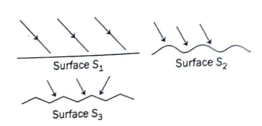
Assertion (A) Irregular surfaces produce diffused reflection.
Reason (R) Due to failure of law of reflection, diffused reflection is produced.
  • A
    Both A and R are true and R is the correct explanation of A.
  • B
    Both A and R are true but R is not the correct explanation of A.
  • A is true but R is false.
  • D
    A is false but R is true.
Answer
Correct option: C.
A is true but R is false.
(C) A is true but R is false.
The law of reflection is followed by every surface but due to irregularities, some surfaces produce diffused reflection. Hence, A is true but R is false.
View full question & answer
MCQ 211 Mark
A person cannot see the distant objects clearly, (though) he can see the nearby object clearly. He Is suffering from the defect of vision called
  • myopia
  • B
    hypermetropia
  • C
    cataract
  • D
    night blindness
Answer
Correct option: A.
myopia
A
View full question & answer
MCQ 221 Mark
Which of the following statements is correct regarding rods and cones in the human eye?
  • A
    Cones are sensitive to dim light.
  • Cones are sensitive to bright light.
  • C
    Rods are sensitive to bright light.
  • D
    Rods can sense colour.
Answer
Correct option: B.
Cones are sensitive to bright light.
B
View full question & answer
MCQ 231 Mark
How does the eye change in order to focus on near or distant objects?
  • A
    The eye lens moves in or out
  • B
    The retina moves in or out
  • The eye lens becomes thicker or thinner
  • D
    The pupil becomes larger or smaller
Answer
Correct option: C.
The eye lens becomes thicker or thinner
C
View full question & answer
MCQ 241 Mark
As the angle between two plane mirrors is decreasing gradually, the number of images of an object placed between them
  • A
    first increases then decreases
  • B
    first decreases then increases
  • increases
  • D
    decreases
Answer
Correct option: C.
increases
C
View full question & answer
MCQ 261 Mark
Image formed by a plane mirror is
  • A
    virtual, behind the mirror and enlarged
  • virtual, behind the mirror and of the same size as the object
  • C
    real at the surface of the mirror and enlarged
  • D
    real, behind the mirror and of the same size as the object
Answer
Correct option: B.
virtual, behind the mirror and of the same size as the object
B
View full question & answer
MCQ 271 Mark
Angle of incidence is equal to the angle of reflection.
  • Always
  • B
    Sometimes
  • C
    Under special conditions
  • D
    Never
Answer
Correct option: A.
Always
A
View full question & answer