Questions

questions in short. [3 marks ]

Take a timed test

8 questions · self-marked practice — reveal the answer and mark yourself.

Question 13 Marks
How is the phenomenon of reflection used in making a kaleidoscope. What are the applications of a kaleidoscope?
Answer
Kaleidoscope is a cylinder with three mirrors containing loose, coloured objects such as beads or pebbles and bits of glass. As the viewer looks into one end, light entering the other creates a colourful pattern due to reflection. Its applications are given below
(i) It works on the principle of multiple reflection, where several mirrors are placed at an angle (usually $60^{\circ}$) to one another. Typically, these are three rectangular mirrors set at $60^{\circ}$ to each other, so that they form an equilateral triangle.
(ii) The $60^{\circ}$ angle creates seven duplicate images of the objects, 5 at $60^{\circ}$ and 2 at $90^{\circ}.$ As the tube is rotated, the tumbling of the coloured objects present varying colours and patterns.
(iii) It is used in decoration purposes, attractive toys, etc
View full question & answer
Question 23 Marks
Sunita is a science student. She performs an activity to obtain multiple images of an object by two plane mirrors. She starts placing these mirrors at different-different angles. She was surprised to see the number of images started increasing as she decreases the angle between two plane mirrors.
(i) Draw a ray diagram for the formation of images when two plane mirrors are parallel to each other. 
(ii) Name two devices which is based on the multiple reflection between two plane mirrors.
(ii) How do we determine the number of images formed by two plane mirrors at a certain angle?
(iii) How do we determine the number of images formed by two plane mirrors at a certain angle?
Answer
self
View full question & answer
Question 33 Marks
Draw a labelled diagram showing how a plane mirror forms an image of a point placed in front of it.
Answer
self
View full question & answer
Question 53 Marks
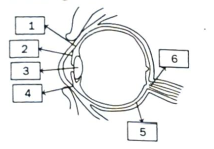
Write down the names of parts of the eye in the blank spaces shown in figure.
Image
Answer
1. Ciliary muscles
2. Iris
3. Lens
4. Cornea
5. Retina
6. Optic nerves
View full question & answer
Question 63 Marks
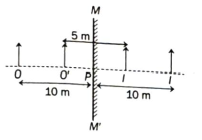
A man stands 10 m in front of a large plane mirror, so how far must he walk before he is 5 m away from his image?
View full question & answer
Question 73 Marks
Explain how you can take care of your eyes?
Answer
We can take care of our eyes in the following manner 
(i) If advised, use suitable spectacles.
(ii) Too little or too much light is bad for eyes. Insufficient light can cause eye strain and headache.
(iii) Too much light like that of the sun, a powerful lamp or a laser torch can injure the retina.
(iv) Wash the eyes frequently with clean water.
(v) Always read at normal distance for vision.
(vi) Never rub your eyes.
View full question & answer
Question 83 Marks
Mention against each of the following whether regular or diffused reflection will take place when a beam of light strikes. Justify your answer in each case.
(a) Polished wooden table
(b) Chalk powder
(c) Cardboard surface
(d) Marble floor with water spread over it
(e) Mirror
(f) Piece of paper
Answer
(a) Polished wooden table As the surface is smooth, so there is a regular reflection through it.
(b) Chalk powder Since, the surface is not smooth or it is uneven, thus there is a diffused reflection through it.
(c) Cardboard surface As its surface is uneven, so it will produce a diffused reflection.
(d) Marble floor with water spread over it As marble floor itself is very smooth, besides this there is a layer of water on it which makes the surface regular for reflection.
(e) Mirror Since, the surface of mirror is smooth, thus it will produce a regular reflection.
(f) Piece of paper Since, the surface is uneven, thus it will produce a diffused reflection.
View full question & answer
questions in short. [3 marks ] - Science STD 8 Questions - Vidyadip