Questions · Page 1 of 2

questions in short. [2 marks ]

Take a timed test

50 questions · self-marked practice — reveal the answer and mark yourself.

Question 12 Marks
State the laws of reflection.
Answer
Laws of reflection:
$a.$ The angle of reflection is always equal to the angle of incidence.
$b.$ The incident ray, the reflected ray and the normal to the reflective surface at the point of incidence all lie in the same plane.
View full question & answer
Question 22 Marks
Suppose you are in a dark room. Can you see objects in the room? Can you see objects outside the room? Explain.
Answer
The objects in a dark room cannot be seen because there is no light. We can only see something when a certain amount of light falls on it. The objects outside the room can only be seen if there is light outside the room.
View full question & answer
Question 32 Marks
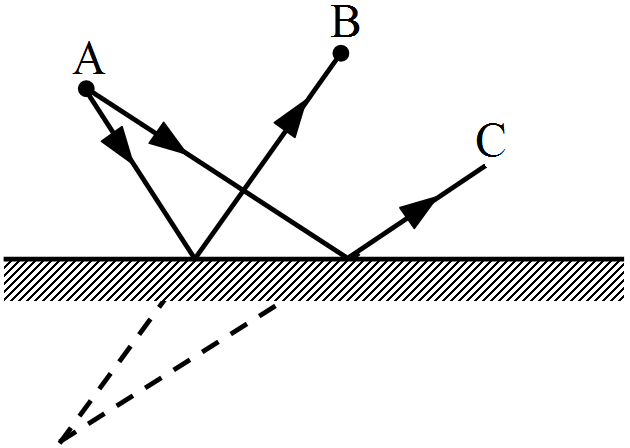
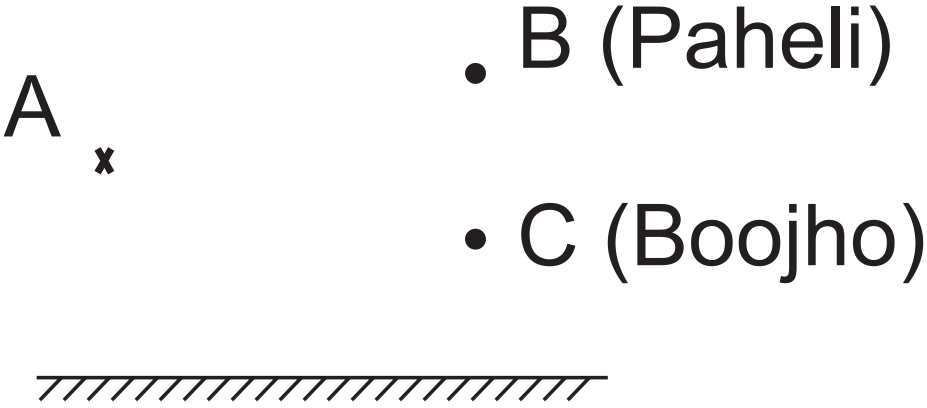
$a.$ Find out the position of the image of an object situated at $A$ in the plane mirror.
$b.$ Can Paheli at $B$ see this image$?$
$c.$ Can Boojho at $C$ see this image?
$d.$ When Paheli moves from $B$ to $C,$ where does the image of $A$ move$?$
Answer
$a.$ Image of the object at position $A$ will be formed behind the mirror. The distance of the image from the mirror is equal to the distance of $A$ from the mirror.

$b.$ Yes. Paheli at $B$ can see the object.
$c.$ Yes. Boojho at $C$ can see the object.
$d.$ If we trace the reflected rays from $B$ and $C$ backwards, they converge at point behind the mirror. Position of image $A$ remains fixed even if Paheli moves.
View full question & answer
Question 42 Marks
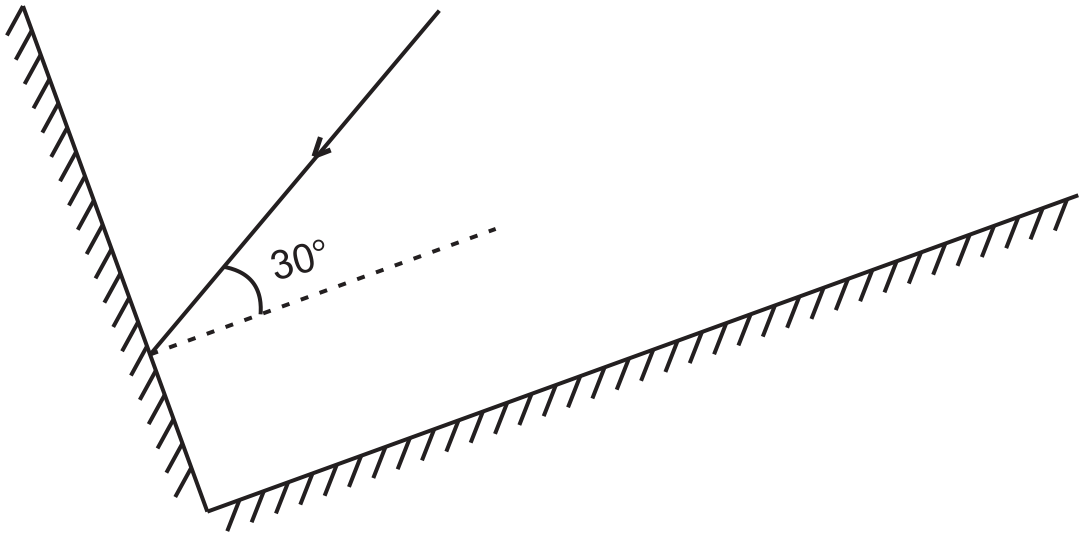
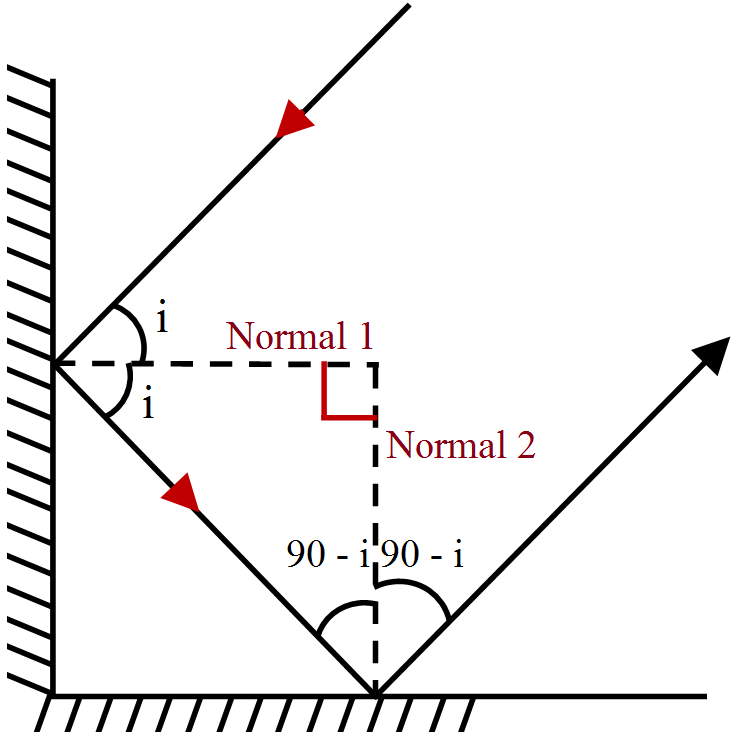
Two mirrors meet at right angles. A ray of light is incident on one at an angle of $30^\circ $ as shown in Fig. $16.19$. Draw the reflected ray from the second mirror.
Answer
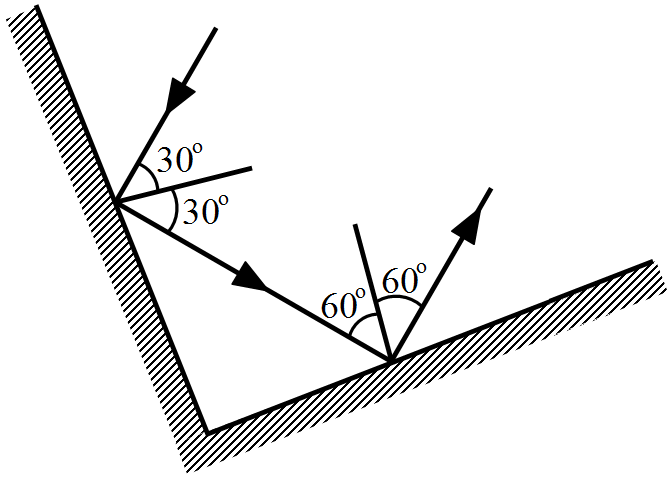
The laws of reflection are used to obtain the path of reflected light.

It can be observed that the given ray of light will reflect from the second mirror at an angle $60^\circ$.
View full question & answer
Question 52 Marks
What is the angle of incidence of a ray of light if the reflected ray is at an angle of $90^\circ $ to the incident ray$?$
Answer
The angle of incidence $=$ angle of reflection.
According to the question, given $I + r = 90$ degree $I = r$
hence, $I + I = 90$ degree $2i = 90$ degree.
$I = 45$ degree.
Therefore, the angle of incidence is $45$ degree.
View full question & answer
Question 62 Marks
Gurmit wanted to perform Activity $16.8$ using a laser torch. Her teacher advised her not to do $so.$ Can you explain the basis of the teacher’s advice?
Answer
Laser light is harmful for the human eyes, because its intensity is very high. It can cause damage to the retina and lead to blindness. Hence, it is advisable not to look at a laser beam directly.
View full question & answer
Question 72 Marks
State the information that you get about sunlight from the formation of a rainbow.
Answer
A rainbow is a spectrum of sunlight. By seeing a rainbow we come to know that sunlight is consist of any colours. We can say that sunlight $= ($Red $+$ orange $+$ yellow $+$ green $+$ blue $+$ indigo $+$ violet$)$ here we only consider the basic colour.
View full question & answer
Question 82 Marks
Name a device which works on the reflection of reflected light.
Answer
Periscope is one such device which works on the reflection of reflected light. The light from the object falls on one mirror that is placed at $45^\circ$ to the object and the light gets reflected. This reflected light in turn falls on another mirror and is again reflected until it reaches the eyepiece.
View full question & answer
Question 92 Marks
What is meant by 'incident ray'?
Answer
A ray of light that strikes a surface or falls on a surface before being reflected, transmitted or absorbed is known as incident ray.
View full question & answer
Question 102 Marks
Explain, why the virtual image cannot be taken on screen.
Answer
Virtual image is formed by an extension of reflected ray where the ray never meets in real. That is a reason virtual image cannot be taken on screen.
View full question & answer
Question 112 Marks
Which type of reflection of light, regular reflection or diffuse reflection, leads to the formation of images?
Answer
Regular reflection, wherein the reflected rays are parallel to each other, lead to the formation of images because all the rays get reflected in a particular direction. Regular reflection always occurs from a smooth surface. Diffused reflection does not lead to the formation of images because the rays do not reflect in one particular direction.
View full question & answer
Question 122 Marks
How are the two plane mirrors in a periscope arranged:
$i.$ With respect to one another$?$
$ii.$ With respect to sides of the tube$?$
Answer
$i.$ The $2$ plane mirrors are parallel to one another.
$ii.$ The plane mirrors make an angle of $45$ degrees with respect to the sides of the tube.
View full question & answer
Question 132 Marks
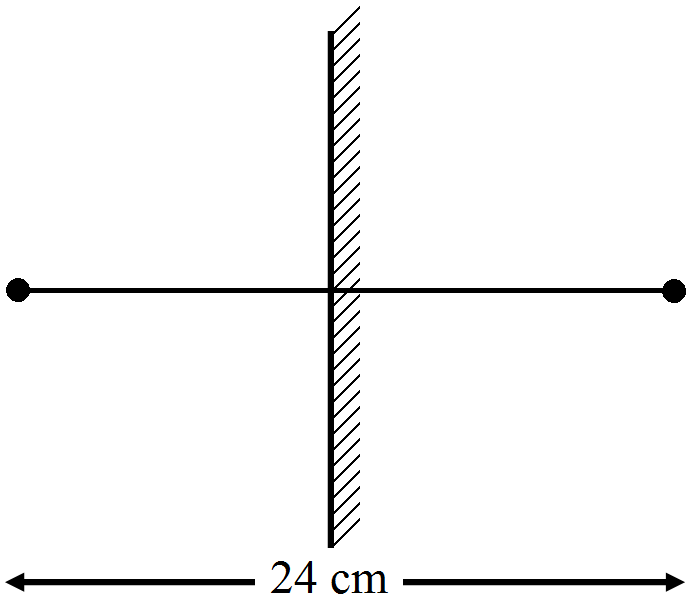
The distance between the object and its image formed by a plane mirror appears to be $24\ cm.$ What is the distance between the mirror and the object?
Answer
In case of plane mirror, the image formed is at the same distance behind the mirror as the object infront of it.i.e. object distance from the mirror $=$ image distance from the mirror.

So, distance between the mirror and the object $= 12\ cm$
View full question & answer
Question 142 Marks
If an object is placed at a distance of $7.5\ cm$ from a plane mirror, how far would it be from its image$?$
Answer
The object would be $15\ cm$ far away from its image if it is placed at a distance of $7.5\ cm$ from the plane mirror. The object is at $7.5\ cm$ from the mirror, then the image of the object is $7.5\ cm$ on the other side of the mirror. Hence, the image is a total of $15\ cm$ from object $(7.5\ cm$ to the mirror $+\ 7.5\ cm$ to the image$).$
View full question & answer
Question 152 Marks
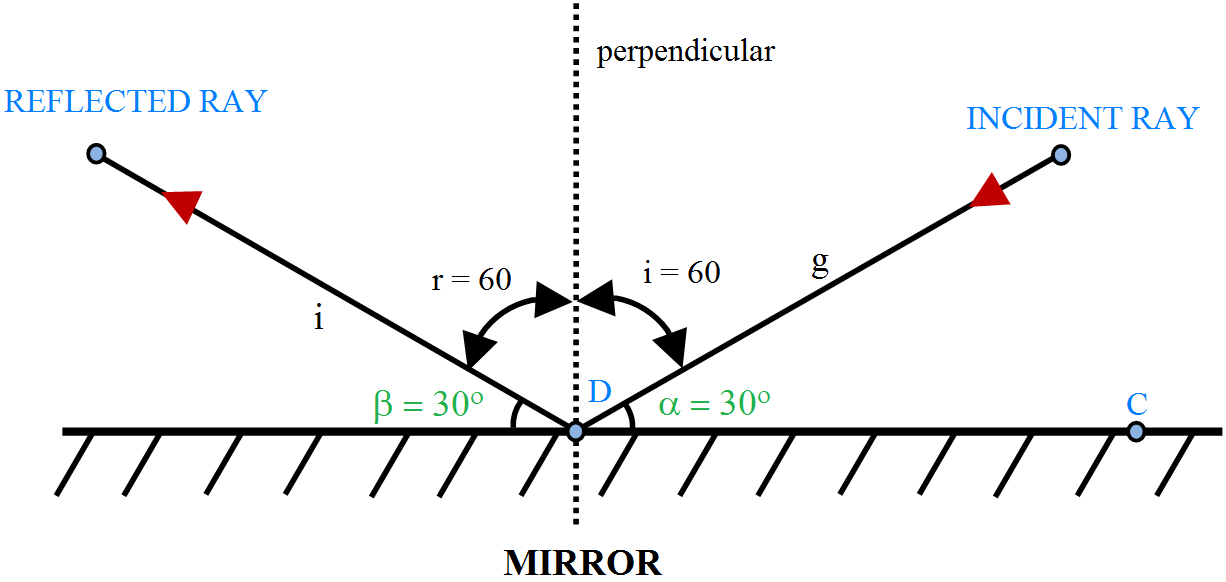
A ray of light is incident on a plane mirror at an angle of $30^\circ .$ What is the angle of reflection$?$
Answer

According to the law of reflection
The angle of incidence $=$ Angle of reflection
Let’s draw a figure for this question-

According to the given question, incident ray is making an angle of $30^\circ$ with the plane mirror $(\alpha=30^\circ)$
So angle of incidence $\angle\text{i}+30^\circ=90^\circ$
Angle of incidence $\angle\text{i}=60^\circ$
From law of reflection, Angle of reflection $\angle\text{i}=60^\circ $
View full question & answer
Question 162 Marks
Is laws of reflections are valid for irregular reflection?
Answer
Law of the reflection means the angle of incidence is equal to the angle of reflection. For irregular reflection law of reflection does not hold true.
View full question & answer
Question 172 Marks
What is lateral inversion? Explain with the help of an example.
Answer
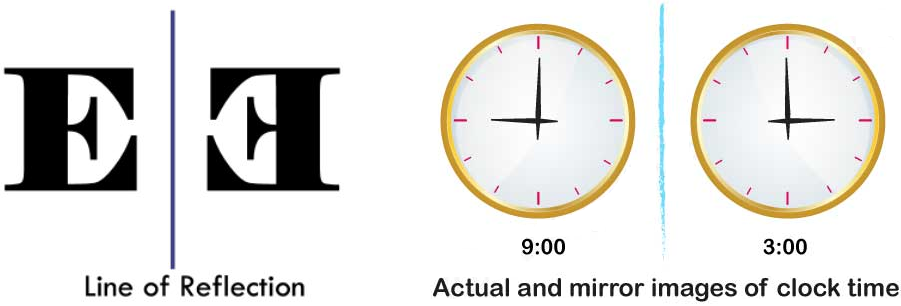
The effect produced by a plane mirror in reversing the images from left to right and right to left while forming images is lateral inversion. Example- The images are reversed by the plane mirror.
View full question & answer
Question 182 Marks
Mention the name of a phenomenon which takes places when patterns are formed in a kaleidoscope.
Answer
Kaleidoscope is based on the phenomenon of multiple reflections when plane mirror is place together making some angle.
View full question & answer
Question 192 Marks
What information do you get about sunlight from the formation of a rainbow?
Answer
The information that we get about sunlight from the formation is about dispersion of light. The separation of white light into seven different colors is known as dispersion.
View full question & answer
Question 202 Marks
We can see the sun because it is glowing. How are we able to see the moon?
Answer
We are able to see the moon because the light of sun falls on moon and is reflected onto the earth. Hence, we are able to see the moon.
View full question & answer
Question 212 Marks
Look at the figure. Can the image of the child in it be obtained on a screen?
Answer
The image of the child cannot be obtained on the screen because the image is not real. The images formed by plane mirror are virtual, so these virtual images cannot be seen (or obtain) on the screen.
View full question & answer
Question 222 Marks
Define the angle of incidence.
Answer
The angle which incident ray makes with the perpendicular to the surface at the point of incidence.
View full question & answer
Question 232 Marks
Mention the type of reflection of light takes place from.
$i.$ A rough surface.
$ii.$ A smooth surface.
Answer
$i.$ For rough surface irregular reflection or diffused reflection takes place.
$ii.$ For smooth surface regular reflection takes place.
View full question & answer
Question 242 Marks
What happens when a beam of sunlight is passed through a glass prism$?$
Answer
When a beam of sunlight is passed through a glass prism, it splits up into a band of $7$ colors, also known as a spectrum.
View full question & answer
Question 252 Marks
Draw figure showing the position of the plane mirror. Also label the angle of incidence and angle of reflection on it.

View full question & answer
Question 262 Marks
Briefly mention, which of the following will cause regular reflection of light and which diffuse reflection of light. Chalk powder
Answer
Diffuse reflection of light takes place. When a ray of light fall (strike) on the surface of Chalk powder, reflected ray get scatted in a different direction with a different angle. So, the law of reflection doesn't hold true. Thus, diffuse reflection.
View full question & answer
Question 272 Marks
What is the name of a small opening in the iris of an eye?
Answer
A small opening in the iris of an eye is known as pupil. Pupil controls the amount of light that enters the eye.
View full question & answer
Question 282 Marks
What type of reflection of light takes place from?
$i.$ A cinema screen?
$ii.$ A plane mirror?
Answer
$i.$ Regular reflection occurs from a cinema screen because the surface of the screen is smooth.
$ii.$ Regular reflection occurs from a plane mirror because the surface of a plane mirror is smoot/ even.
View full question & answer
Question 292 Marks
What is the angle of reflection when a ray of light is incident normally on a plane mirror?
Answer
The angle of reflection when a ray of light is incident normally on a plane mirror will be zero degree because the angle of incidence will be zero degree as the ray is incident normally. By law of reflection, angle of incidence = angle of reflection.
View full question & answer
Question 302 Marks
Name the part of our eye that gives it as distinctive colour.
Answer
Cone cell Our eye contains two types of cells – cone cell and rod cell. Cone cell is responsible for the colour and it is sensitive to bright light. Rod cell is sensitive to dim light.
View full question & answer
Question 312 Marks
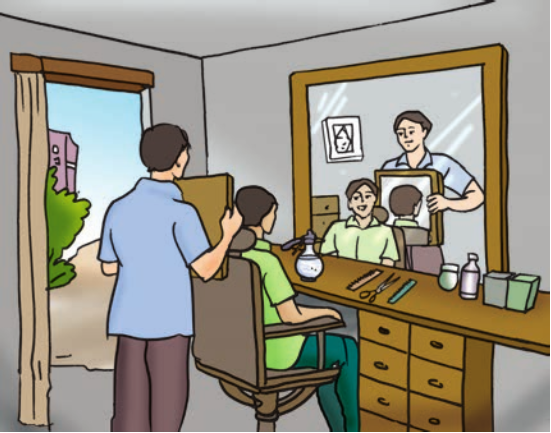
Explain how, a hair dresser makes you see hair at the back of your head after the hair cut is complete.
Answer
The phenomenon that applies here is multiple reflection that provides the image of back of the head to be viewed. A person is made to stand in front of a mirror and another mirror is held at the back of the head. The reflection from the mirror at the back is visible in the mirror in front of the person and hence the hair at the back of the head is visible to the person in the front mirror.
View full question & answer
Question 322 Marks
Mention how many reflected rays can be obtained for a given single incident ray falling on a plane mirror?
Answer
We are having only one plane mirror as per given in the question. For every incident ray, there is only one reflected ray. There will be only one reflected ray for a single ray falling on a plane mirror.
View full question & answer
Question 332 Marks
What do you understand by the term 'point of incidence'?
Answer
The point of incidence is the point where the incident ray strikes the mirror.
View full question & answer
Question 342 Marks
Explain why, when an object is placed between two plane mirrors inclined at an angle, then multiple images are formed.
Answer
Multiple images are formed due to multiple reflection when an object is placed between two plane mirrors at any angle.$\text{N}=\Big(\frac{360}{\theta}\Big)-1$
Say, the angle is $120$
$\text{N}=\Big(\frac{360}{120}\Big)-1$
$\text{N}=3-1$
$\text{N}=2$
View full question & answer
Question 352 Marks
Define the angle of reflection.
Answer
The angle between the reflected ray and the line perpendicular to the reflecting surface at the point of incidence is known as the angle of reflection.
View full question & answer
Question 362 Marks
Name the part of the eye.
$i.$ Which controls the amount of light entering the eye.
$ii.$ Which converges light rays to form the image.
Answer
$i.$ Iris control the amount of light entering the eye.
$ii.$ Lens converges $($focus$)$ light ray on a layer called retina.
View full question & answer
Question 372 Marks
What is the angle of incidence when a ray of light is incident normally on a plane mirror?
Answer
The angle of incidence when a ray of light is incident normally on a plane mirror is zero degree because the ray is incident normally.
View full question & answer
Question 382 Marks
Determine the number of images formed when an object is placed between two parallel plane mirrors facing each other.
Answer
Infinite number of the image is formed when an object is placed between two parallel plane mirrors facing each other.
View full question & answer
Question 392 Marks
Draw a ray diagram of the formation of images when two mirrors as placed at an angle of $90^\circ$ to each other.
Answer
When two plane mirror placed at an angle of $90^\circ$ to each other.

Here in the above diagram we suppose incidence angle is.
View full question & answer
Question 402 Marks
Which part of the eye gives it its distinctive color?
Answer
Iris, the part of our eye, contains pigment and gives the eye its distinctive color. Iris also helps in controlling the size of the pupil by constricting and dilating it, thus reducing and increasing the amount of light entering the eye.
View full question & answer
Question 412 Marks
State the laws of reflection of light.
Answer
The laws of reflection of light are:
$-$The incident ray, the normal ray and the reflected ray all lie in the same plane, and.
$-$The angle of incidence is always equal to angle of reflection.
View full question & answer
Question 422 Marks
How can you show that white light (say, sunlight) consists of seven colors$?$
Answer
White light (say, sunlight) consists of seven colors can be shown by passing this light through a prism. The sunlight passes through the prism and splits into a band of $7$ colors, also known as the spectrum.
View full question & answer
Question 432 Marks
What is cataract? How can the vision of a person having cataract be restored?
Answer
Cataract is the clouding of the lens of human eye, that lies behind the iris and pupil. It leaves to a blurred vision or decrease in vision. The lens that has becomes cloudy is replaced by an artificial lens to restore the normal and clear vision.
View full question & answer
Question 442 Marks
What type of lens (convex or concave) is present in the human eye?
Answer
The human eye has convex type of lens. Light that hits the lens of the eye is focused by the lens so that it hits the retina. Retina has photoreceptor cells (rods and cones) which get stimulated and sends signals to the brain for viewing.
View full question & answer
Question 452 Marks
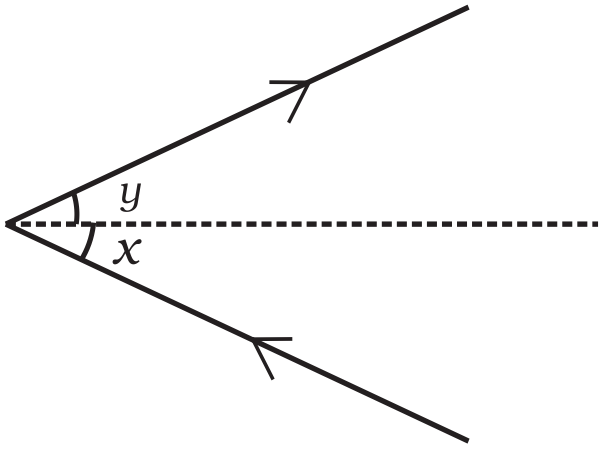
What is the full form of $i$ and $r?$ What is the relation between them$?$
Answer
$i =$ angle of incidence and $r =$ angle of reflection By law of reflection, the angle of incidence is equal to the angle of reflection.
View full question & answer
Question 462 Marks
Explain why, too little or too much light, both are bad for eyes.
Answer
In the presence of little light the iris has to dilate pupil to facilitate entry of more and more light to view things, which leads to strain on the eyes and causes headaches. In case of too much light, the retina may get injured and damaged thus impairing vision.
View full question & answer
Question 472 Marks
Explain what happens to the size of the pupil of our eye in bright.
Answer
The pupil is the part of your eye that controls how much light gets in. When we enter in an area of bright light, size of pupil gets smaller (contract) because to control the amount of light.Additional information:
While entering the dark room pupil becomes large (expands) so that more and more light can enter the eye. Size of the pupil is controlled by iris. Thus we can say that iris controls the amount of light entering into the eye.
View full question & answer
Question 482 Marks
State one use of kaleidoscope.
Answer
A Kaleidoscope is a toy mostly used by children for enjoyment. It is made of a tube with plain mirrors and colored glass pieces inside it at one of the ends. Kaleidoscope having object chambers are used for hiding valuables.
View full question & answer
Question 492 Marks
Eyes of the nocturnal birds have large cornea and a large pupil. How does this structure help them?
Answer
The size of the eyes of nocturnal bird is large. Eyes of the nocturnal birds having large cornea with a wider pupil, can collect more ambient light which help them to see the objects even at night.
View full question & answer
Question 502 Marks
What is a periscope$?$ How many mirrors are there in a periscope$?$
Answer
A periscope is a device that reflects the reflected ray again. It consists of a tube attached to a set of mirrors. There are $2$ mirrors in a periscope. The light from the object falls on one mirror that is placed at $45^\circ$ to the object and the light gets reflected. This reflected light in turn falls on another mirror and is again reflected until it reaches the eyepiece.
View full question & answer