MCQ 11 Mark
Voice of which of the following is likely to have minimum frequency:
MCQ 21 Mark
Sound can travel through:
- A
- B
- C
- ✓
Solids, liquids and gases
AnswerCorrect option: D. Solids, liquids and gases
View full question & answer→MCQ 31 Mark
The number of vibrations made by a vibrating body in one second is.
MCQ 41 Mark
Read the following sentences carefully, and choose the incorrect one:
- A
The speed of sound in air is $340$ meters per second.
- B
The speed of sound in water is $1500$ meters per second.
- C
Sound travels at a speed of $5000$ metres per second through iron or steel.
- ✓
View full question & answer→MCQ 51 Mark
$1$ hertz is equal to:
- A
$1$ Vibration per minute
- B
$10$ Vibrations per minute
- ✓
$60$ Vibrations per minute
- D
$600$ Vibrations per minute
AnswerCorrect option: C. $60$ Vibrations per minute
$1 Hz = 1$ Vibration per sound $= 60$ vibration per minute
View full question & answer→MCQ 61 Mark
Pitch is the sensation of the $...........$ of an emitted sound.
View full question & answer→MCQ 71 Mark
Consider the following statements and select the correct option which correctly identifies true $(T)$ and false $(F).$
$i.$ Short string produces notes of low pitch.
$ii.$ Thin string produces notes of high pitch.
$iii.$ Tightly stretched string produces notes of low pitch.
- A
$(i) - T, (ii) - F, (iii) - T$
- B
$(i) - T, (ii) - T, (iii) - F$
- C
$(i) - F, (ii) - F, (iii) - T$
- ✓
$(i) - F, (ii) - T, (iii) - F$
AnswerCorrect option: D. $(i) - F, (ii) - T, (iii) - F$
View full question & answer→MCQ 81 Mark
In which medium does sound travel fastest:
MCQ 91 Mark
In which of the following media can sound travel through?
$i.$ Glass of water
$ii.$ Balloon full of air
$iii.$ Iron bar
$iv.$ Vacuum
- A
$(i)$ and $(ii)$
- B
$(i)$ and $(iii)$
- ✓
$(i), (ii)$ and $(iii)$
- D
AnswerCorrect option: C. $(i), (ii)$ and $(iii)$
View full question & answer→MCQ 101 Mark
Speed is$...........?$
View full question & answer→MCQ 111 Mark
The loudness of a sound depends on$...........?$
View full question & answer→MCQ 121 Mark
- A
- ✓
A very quick movement back and forth.
- C
The loudness or softness of a sound.
- D
$A$ and $C$
AnswerCorrect option: B. A very quick movement back and forth.
A very quick movement back and forth.
View full question & answer→MCQ 131 Mark
Noise pollution is harmful for:
MCQ 141 Mark
There are some sounds which cannot be heard by human ear. These sounds have frequency, either more than $20\ kHz$ or less than $20Hz$ The sound whose frequency is less than the $20Hz$ is called $...........$
View full question & answer→MCQ 151 Mark
$1Hz$ is equal to:
- ✓
$1$ vibration per minute.
- B
$10$ vibrations per minute.
- C
$60$ vibrations per minute.
- D
$600$ vibrations per minute.
AnswerCorrect option: A. $1$ vibration per minute.
View full question & answer→MCQ 161 Mark
Consider the following statements and choose the correct one:
- A
The pitch of a sound depends on the frequency of vibration.
- B
If the frequency of vibration is low, the sound produced has a low pitch.
- C
If the frequency of vibration is high, the sound produced has a high pitch.
- ✓
View full question & answer→MCQ 171 Mark
Puja is writing some statements but she confused to know whether the statements are correct or not? If you know the answer to this question, then tell her:
AnswerCorrect option: D. Sound can be heard on the moon but only the $\frac{1}{6}^{th}$ part of the total sound.
Sound requires a medium for propagation. Sound cannot be heard on the surface of moon because there is no air to carry the sound waves. Mass of the moon is $\frac{1}{100}$ times and radius of moon is $\frac{1}{4}$ times that of the earth. Therefore, the gravitational attraction on the moon is about one sixth of that on the earth. Hence, the weight of an object on the moon is $\frac{1}{6}^{th}$ of the weight on the earth not the sound.
View full question & answer→MCQ 181 Mark
Vikash is doing his homework which is given by his teacher. Would you help him to choose the incorrect sentences?
- A
When the muscles of vocal cords contract and stretch, the vocal cords become tight and thin and a sound of high frequency is produced.
- B
When the muscles relax, the vocal cords become loose and thick and a sound of low frequency is produced.
- C
Due to the shorter vocal cords, the frequency or pitch of a woman’s voice is higher than that of a man.
- ✓
View full question & answer→MCQ 191 Mark
In a quiz competition, you are asked a question where you have to choose the statement which is/ are incorrect?
- A
The outer part of ear is called “pinna”.
- B
The inner part of ear has a coiled tube called “cochlea”.
- ✓
The three tiny bones in the ear act as a system of levers and sound vibration passing them on the brain.
- D
AnswerCorrect option: C. The three tiny bones in the ear act as a system of levers and sound vibration passing them on the brain.
The three tiny bones in the middle part of ear act as a system of levers and sound vibration passing them on the “cochlea” not in brain. Cochlea sets up the vibrations or electrical impulses by auditory nerve to the brain.
View full question & answer→MCQ 201 Mark
In order to reduce the loudness of a sound we have to:
- A
Decrease its frequency of vibration of the sound.
- B
Increase its frequency of vibration of the sound.
- ✓
Decrease its amplitude of vibration of the sound.
- D
Increase its amplitude of vibration of the sound.
AnswerCorrect option: C. Decrease its amplitude of vibration of the sound.
Since, loudness depends upon amlitude, so it can be increased by increasing amplitude and it can be decreased by decreasing amplitude.
View full question & answer→MCQ 211 Mark
Sound is caused by$...........?$
View full question & answer→MCQ 221 Mark
Above $...........dB$ the sound becomes physically painful:
View full question & answer→MCQ 231 Mark
The sound from a mosquito is produced when it vibrates its wings at the average rate of $500$ vibration per second. What is the time period of the vibration?
- ✓
$0.002$ seconds.
- B
$0.02$ seconds.
- C
$0.2$ seconds.
- D
$2.0$ seconds.
AnswerCorrect option: A. $0.002$ seconds.
Mosquito vibrates $500$ vibration in $1$ second.
As, time period is the time taken to complete one vibration.
So, time period = time taken/ number of oscillations time period $= 1/ 500 = 0.002$ seconds.
View full question & answer→MCQ 241 Mark
Which of the following frequencies can be heard by a normal human being:
- ✓
$10^4\ Hz$
- B
$10^5\ Hz$
- C
$10^6\ Hz$
- D
$10^7\ Hz$
AnswerCorrect option: A. $10^4\ Hz$
The audible range of frequency for human ear is $20\ Hz$ to $20\ kHz$. Among the given options, only $104\ Hz$ frequency lies in the audible range.
View full question & answer→MCQ 251 Mark
Which of the following frequency of sound can be generated by a vibrating simple pendulum as well as by the vibrating vocal cords of a rhinoceros?
- A
$5 kHz.$
- B
$25 Hz.$
- ✓
$10 Hz.$
- D
$15,000 Hz.$
AnswerCorrect option: C. $10 Hz.$
$10Hz$ can be generated by a vibrating simple pendulum as well as by the vibrating vocal cords of a rhinoceros.
View full question & answer→MCQ 261 Mark
View full question & answer→MCQ 271 Mark
View full question & answer→MCQ 281 Mark
Pitch of sound is determined by it's:
MCQ 291 Mark
In an experiment to measure the speed of sound in air, a boy stands $40m$ away from a wall and bangs two pieces of wood together. At the instant he hears the echo, he bangs them together again. He does this activity $50$ times. The time taken for $50$ bangs is $12s$. Which calculation gives the speed of sound in air?
- A
$\frac{12} { 40 \times5 0} $
- B
$\frac{40 \times5 0} { 12} $
- ✓
$\frac{40 \times2\times50}{12}$
- D
$\frac{40 \times2\times12}{50}$
AnswerCorrect option: C. $\frac{40 \times2\times50}{12}$
$\text{Speed} = \frac{\text{Total distance}}{\text{Total time taken}}$
Number of times he bangs two pieces of wood $= 50$
Total distance $= (40 \times 2 \times 50)m$
Total time taken $= 12s.$
$\therefore$ Speed of soundin air $= \frac{40\times2\times50}{12}$
View full question & answer→MCQ 301 Mark
A bomb explodes on the moon. How long will it take for the sound to reach the earth?
- A
$10$ seconds
- B
$1000$ seconds
- C
$1$ day
- ✓
View full question & answer→MCQ 311 Mark
Loudness of a sound is determined by its:
- ✓
- B
- C
Ratio of amplitude and frequency of the vibration.
- D
Product of amplitude and frequency of vibration.
View full question & answer→MCQ 321 Mark
Which of the following statements are correct?
$i.$ Sound is produced by vibrations.
$ii.$ Sound requires a medium for propagation.
$iii.$ Light and sound both require a medium for propagation.
$iv.$ Sound travels slower than light.
$v.$ Sound travels slower than light.
- A
$i\ \& \ ii$ only
- B
$i, ii \ \&\ iii$ only
- C
$ii, iii \ \&\ iv$ only
- ✓
$i, ii \ \&\ iv$ only
AnswerCorrect option: D. $i, ii \ \&\ iv$ only
Because light can travel in vaccum also but it is only sound which requires medium to tavel.
View full question & answer→MCQ 331 Mark
When we change a feeble sound to a loud sound, we increase its:
MCQ 341 Mark
he velocities of sound waves in four media $P, Q, R$ and $S$ are $18,000km/h, 900km/h, 0 km/h,$ and 1200km/h respectively. Which medium could be a liquid substance?
AnswerBecause the speed of sound in liquids is more than gas but less than solids.
View full question & answer→MCQ 351 Mark
Direction: Read the given paragraph and answer the following questions. Two metal rulers of lengths $30\ cm$ and $60\ cm$ are kept in such a manner that a $30\ cm$ ruler extends about $15\ cm$ over the edge and a $60\ cm$ ruler extends about $30\ cm$ over the edge. Both the ends are flicked. Which of the following statements is correct regarding this?
$i.$ The metal ruler of length $30\ cm$ is able to vibrate slower.
$ii.$ The metal ruler of length $30\ cm$ produces a high pitch sound.
$iii.$ The metal ruler of length $60\ cm$ is able to vibrate faster.
$iv.$ The metal ruler of length $60\ cm$ produces a low pitch sound.
- A
Only $(i)$ and $(iii)$ are correct.
- ✓
Only $(ii)$ and $(iv)$ are correct.
- C
Only $(i)$ and $(iv)$ are correct.
- D
Only $(ii)$ and $(iii)$ are correct.
AnswerCorrect option: B. Only $(ii)$ and $(iv)$ are correct.
A smaller length of the ruler vibrating i.e., $30\ cm$ is able to vibrate faster. This increases the frequency of vibration. Hence the pitch of the sound produced is high. A larger length of the ruler vibrating produces a low pitch sound.
View full question & answer→MCQ 361 Mark
The hearing range of human ear is:
- ✓
$20 \ Hz$ to $20,000 \ Hz$
- B
Less than $20 \ Hz$
- C
More than $20,000 \ Hz$
- D
$20 \ Hz$ to $25,000 \ Hz$
AnswerCorrect option: A. $20 \ Hz$ to $20,000 \ Hz$
View full question & answer→MCQ 371 Mark
Pitch of sound is determined by its:
Answerpitch or shrillness is determined by the frequency of sound.
View full question & answer→MCQ 381 Mark
A student performed an experiment as shown in the figure.
What would be happened as air was pumped out of the jar and the electric bell rang?
- A
- B
The sound became fainter first and then louder once all the air was pumped out.
- ✓
The sound could not be heard anymore.
- D
The sound was the same as before.
AnswerCorrect option: C. The sound could not be heard anymore.
The sound could not be heard because he has created a vacuum inside the jar and the sound cannot travel through vacuum.
View full question & answer→MCQ 391 Mark
There are two bottles of glass, one bottle is two third filled with water and another bottle is filled one third with water. When we blow across the mouth of each bottle, then:
$i.$ The bottle with the less air in it gives the note of higher pitch.
$ii.$ The shorter the air column, the higher the pitch of the note produced.
AnswerCorrect option: A. Both $(i)$ and $(ii)$ are correct and $(ii)$ is the correct explanation of $(i).$
Most wind instruments work on the principle that shorter the air column, the higher the pitch of the note produced.
View full question & answer→MCQ 401 Mark
Noise pollution can cause:
AnswerNoise pollution is hazardous to health in many ways as it can cause insomnia, hypertension and hearing impairment.
View full question & answer→MCQ 411 Mark
The frequencies of four sound waves are given below. Which of these sound waves can be used to measure the depth of sea?
- A
$15,000\ Hz.$
- B
$10k\ Hz.$
- ✓
$50\ kHz.$
- D
$10,000\ Hz.$
AnswerCorrect option: C. $50\ kHz.$
The ultrasound waves can be used to measure the depth of sea.
View full question & answer→MCQ 421 Mark
We hear sounds when they enter to our$...........?$
View full question & answer→MCQ 431 Mark
A list of mediums is given below.
$i.$ wood
$ii.$ air
$iii.$ water
$iv.$ vacuum
In which of these mediums can sound travel?
- A
$i\ \& \ ii$ only
- ✓
$i, ii\ \& \ iii$ only
- C
$iii\ \& \ iv$ only
- D
$ii, iii\ \& \ iv$ only
AnswerCorrect option: B. $i, ii\ \& \ iii$ only
Sound requires any medium to travel but in vacuum there is no medium, so sound cannot travel through them.
View full question & answer→MCQ 441 Mark
Consider the following statements and choose the incorrect one:
- A
Partial hearing loss can also be caused by noise pollution.
- B
Partial hearing loss is generally due to an illness, infection, injury or old age.
- ✓
Hearing aid is a small sound amplifying device worn on the ear by any deaf person.
- D
AnswerCorrect option: C. Hearing aid is a small sound amplifying device worn on the ear by any deaf person.
Hearing aid is a small sound amplifying device worn on the ear by a partially deaf person not deaf person.
View full question & answer→MCQ 451 Mark
Loudness of sound is determined by:
MCQ 461 Mark
An object that does not vibrate cannot produce$...........?$
View full question & answer→MCQ 471 Mark
Drum produces sound from:
- A
- ✓
Vibrating stretched membrane
- C
- D
AnswerCorrect option: B. Vibrating stretched membrane
View full question & answer→MCQ 481 Mark
Read the following sentences carefully, and choose the incorrect one:
MCQ 491 Mark
A loud sound is called $...........?$
View full question & answer→MCQ 501 Mark
When a body moves with a speed which is greater than the speed of sound in air, it is said to be travelling at:
MCQ 511 Mark
Length of vocal cords of women is $...........$ men.
View full question & answer→MCQ 521 Mark
The sound energy has wide application in medical science, as well as in many other fields. The sound of high frequency used in medical science is called ultrasound. The ultrasound used for the checking of the functioning of human heart is called $...........$
View full question & answer→MCQ 531 Mark
Ultrasound has frequency of vibration
- A
Between $20$ and $20,000 \ Hz$
- B
Below $20 \ Hz$
- ✓
Above $20,000 \ Hz$
- D
Between $500$ and $10,000 \ Hz$
AnswerCorrect option: C. Above $20,000 \ Hz$
Ultrasound has frequency of vibration above $20000 \ Hz.$
View full question & answer→MCQ 541 Mark
The loudness of sound is determined by the
- ✓
- B
Ratio of amplitude and frequency of vibration
- C
- D
Product of amplitude and frequency of vibration
AnswerLoudness of sound is determined by the amplitude of its vibrators.
View full question & answer→MCQ 551 Mark
Which of the following statement is or are incorrect?
MCQ 561 Mark
The amplitude of the vibration of an ordinary conversation between two persons is approximately:
- A
$10 - 7$ metres
- ✓
$10 - 9$ metres
- C
$10 - 11$ metres
- D
$10 - 13$ metres
AnswerCorrect option: B. $10 - 9$ metres
The magnitude of maximum disturbance in the medium on either side of the mean position is called the amplitude of the wave.
In the case of ordinary talk, the amplitude of vibration is approximately $10^{−9}m.$
View full question & answer→MCQ 571 Mark
A person can hear an approaching train when he presses his ear to the railway track faster than one who simply stands on the tracks. What makes this possible?
- A
The vibration of railway tracks.
- B
- ✓
The speed of sound in solids is more.
- D
The hearing ability of the man.
AnswerCorrect option: C. The speed of sound in solids is more.
View full question & answer→MCQ 581 Mark
A tuning fork sends sound waves in air. If the temperature of air increases, which of the following parameters will change?
MCQ 591 Mark
Which material is the sound worst through?
MCQ 601 Mark
Which of the following characteristics of sound depends on the amplitude of vibrations:
MCQ 611 Mark
The sound in the audible range is called:
MCQ 621 Mark
The unit of frequency is:
AnswerFrequency is the number of complete vibrational cycles of a medium per a given amount of time.
The frequency would have units of cycles/ second, waves/ second or vibrations/ second.
The unit for frequency is the Hertz (abbreviated Hz) where $1 Hz$ is equivalent to $1$ cycle/second.
View full question & answer→MCQ 631 Mark
One of the following can hear infrasound. This one is:
AnswerDog can hear both the infrasound as well as ultrasound.
View full question & answer→MCQ 641 Mark
Large amplitude of sound vibrations will produce:
MCQ 651 Mark
The loudness of sound is measured in units of $............?$
- ✓
Decibel $(dB)$
- B
Hertz $(Hz)$
- C
Metre $(m)$
- D
Metre/ Second $(m/ s)$
AnswerCorrect option: A. Decibel $(dB)$
View full question & answer→MCQ 661 Mark
What is the cause for the difference in the voices of men, women and children?
- A
- B
- ✓
Difference in vocal cords.
- D
AnswerCorrect option: C. Difference in vocal cords.
View full question & answer→MCQ 671 Mark
Which of the following frequencies produces sound that is audible:
- A
$5 \ Hz$
- B
$15 \ Hz$
- ✓
$500 \ Hz$
- D
$50,000 \ Hz$
AnswerCorrect option: C. $500 \ Hz$
View full question & answer→MCQ 681 Mark
If the time period of a wave increases, then its frequency will:
- A
- ✓
- C
- D
First increases then decreases
Answer$\text{f}=\frac{1}{\text{T}}$
$f \rightarrow$ frequency
$T \rightarrow$ timeperiod
Frequency is inversely proportional to the time period of the wave.
So when time period increases then the frequency will decrease.
View full question & answer→MCQ 691 Mark
The pitch of sound depends on:
MCQ 701 Mark
Sounds can be $...........$ or $...........?$
- A
high$-$low
- B
up$-$down
- ✓
loud$-$soft
- D
loud$-$high
AnswerCorrect option: C. loud$-$soft
View full question & answer→MCQ 711 Mark
In dholak sound is produced due to:
MCQ 721 Mark
Choose the statements which are incorrect about noise pollution:
- A
Loud noise can cause irritation and headache.
- B
Loud noise can even damage the ears permanently and cause deafness.
- C
Loud noise can cause an ailment called hypertension or high blood pressure.
- ✓
Loud noise gives energy to all young persons including teenag.
AnswerCorrect option: D. Loud noise gives energy to all young persons including teenag.
According to a report from the world health organization a continuous excessive loud noise exhausted your body and nerves of the brain. Excessive loud noise is harmful to us. The presence of excessive noise in the surroundings may cause main health related problems. Loud noise can damage the ear permanently and cause deafness for all young persons or teenagers if they want to hear the loud noise constantly as music.
View full question & answer→MCQ 731 Mark
A dog barks in a park and hears its echo after $0.5$ seconds. The sound of its bark got reflected by a nearby building. The sound of speed in air is $346\ m/ s$. The distance between the dog and the building is:
- ✓
$86.5\ m.$
- B
$80.6\ m.$
- C
$75\ m.$
- D
$8.65\ m.$
AnswerCorrect option: A. $86.5\ m.$
The echo is heard when the sound wave travels a distance $2x.$
$\text{distance}= \text{speed} \times \text{ time}$
As
$\therefore \text{2x}=346 \times 0.5$
$\text{or} \text{ x}= \frac{346 \times 0.5 }{2}= \text{86.5m.}$
View full question & answer→MCQ 741 Mark
View full question & answer→MCQ 751 Mark
The frequency of subsonic sound is:
- A
More than $20 \ Hz$
- B
$100 \ Hz$
- ✓
Less than $20 \ Hz$
- D
More than $20,000 \ Hz$
AnswerCorrect option: C. Less than $20 \ Hz$
View full question & answer→MCQ 761 Mark
The ultrasound equipment works at frequencies:
AnswerCorrect option: A. Higher than $20,000 \ Hz$
View full question & answer→MCQ 771 Mark
Speed of sound increase with:
MCQ 781 Mark
Voice of which of the following is likely to have the minimum frequency?
AnswerThe voice of man has the least frequency.
View full question & answer→MCQ 791 Mark
Sound can travel through:
- A
- ✓
- C
- D
Solids, liquids and gases.
AnswerSound does not need any material medium to travel.
View full question & answer→MCQ 801 Mark
View full question & answer→MCQ 811 Mark
Vocal cords in men are about $............$ long.
- ✓
$20\ mm$
- B
$20\ cm$
- C
$2\ mm$
- D
$2\ cm$
AnswerCorrect option: A. $20\ mm$
View full question & answer→MCQ 821 Mark
View full question & answer→MCQ 831 Mark
We know that, the sound is not transmitted by the actual movement of the particle. It is transmitted by the disturbance in the medium. The maximum distance moved by a vibrating layer on the either side of the mean position is called $...........$
View full question & answer→MCQ 841 Mark
An ultrasound equipment works at frequency:
- ✓
Higher than $20,000 \ Hz$
- B
Higher than $10,000 \ Hz$
- C
Lower than $20,000 \ Hz$
- D
Lower than $10,000 \ Hz$
AnswerCorrect option: A. Higher than $20,000 \ Hz$
View full question & answer→MCQ 851 Mark
A simple pendulum makes $10$ oscillation in $20$ seconds. What is the time period and frequency of its oscillations?
- ✓
$0.5hz$ and $2s$ respectively.
- B
$0.1hz$ and $0.5s$ respectively.
- C
$0.2hz$ and $3s$ respectively.
- D
$0.3hz$ and $4s$ respectively.
AnswerCorrect option: A. $0.5hz$ and $2s$ respectively.
Oscillation $= 10$, time taken $= 20$s as we know that the number of oscillations per second is frequency.
Frequency = no. Of oscillations/ time taken $= 10/ 20 = 0.5hz.$
Time period = 1/ frequency $= 1/ 0.5 = 2s.$
View full question & answer→MCQ 861 Mark
If the temperature increases, then what happens to the frequency of the sound produced by the organ pipe?
AnswerFrequency of sound produced by the organ pipe increases with increase in temperature. The reason is that with an increase in temperature, there is a decrease in the density of air and consequently the speed of sound increases.
View full question & answer→MCQ 871 Mark
When we say that sound travels in a medium, what do we mean?
- A
The particles of the medium travel.
- B
- ✓
- D
View full question & answer→MCQ 881 Mark
Which of the following vibrates when a musical note is produced by the cymbals in an orchestra?
AnswerMetal plates vibrates when a musical note is produced by the cymbals in an orchestra. Cymbals is a musical instrument which produces sound when being struck. The person who plays cymbals is called cymbalist. It has two discs which is made up of various alloys. It is used in metal and heavy bands, orchestra, percussion ensembles and marching groups.
View full question & answer→MCQ 891 Mark
The ultrasound waves can penetrate into matter to a large extent because they have:
AnswerThe ultrasound waves can penetrate into matter to a large extent because they have very high frequency.
View full question & answer→MCQ 901 Mark
Which of these is expected to be the best absorber of sound:
MCQ 911 Mark
Sound travels best through in $..........?$
View full question & answer→MCQ 921 Mark
A student sets up a slinky $PQ$ on a smooth table top in the manner as shown in figure. How can he produce transverse waves in the slinky by moving its free end $Q?$
AnswerIn transverse wave, vibration of a wave is perpendicular to its direction of propagation of wave.
View full question & answer→MCQ 931 Mark
In humans, the sound is produced by:
MCQ 941 Mark
A musical instrument is producing a continuous note. This note cannot be heard by a person having a normal hearing range. This note must then be passing through:
AnswerThis note must then be passing through vacuum.
View full question & answer→MCQ 951 Mark
The frequency determines the of a sound:
MCQ 961 Mark
Vibration in a body produce:
MCQ 971 Mark
An object is vibrating at $50$ hertz. What is its time period?
- ✓
$0.02 s$
- B
$0.2 s$
- C
$2 s$
- D
$20.0 s$
AnswerCorrect option: A. $0.02 s$
We know that
Frequency $=\frac{1}{\text{Time period}}$
$\Rightarrow $ Time period$=\frac{1}{\text{Frequency}}$
$\Rightarrow $ Time period$=\frac{1}{\text{50}}=0.02 \ \text{s}$
View full question & answer→MCQ 981 Mark
When a tightly stretched band is plucked it:
- A
Vibrate but do not produce sound.
- B
Produce sound but do not vibrate.
- ✓
Vibrate and produce sound.
- D
Only oscillate to and fro.
AnswerCorrect option: C. Vibrate and produce sound.
View full question & answer→MCQ 991 Mark
In which of these medium can sound travel?
- A
- ✓
- C
- D
Water and air and vacuum.
AnswerSound requires any medium to travel but in vacuum there is no medium, so sound cannot travel through them.
View full question & answer→MCQ 1001 Mark
The maximum displacement of a body from its mean position is called.
MCQ 1011 Mark
Which of the following modes is utilized in the production of sound by humans?
AnswerThe vocal cords are two bands of smooth muscle tissue found in the larynx. The larynx or the voice box is set in the neck at the top of the trachea $($windpipe$)$. The vocal cords vibrate and air passes through the cords from the lungs to produce the sound of your voice. The vocal folds, also known popularly as vocal cords, are composed of twin infoldings of mucous membrane stretched horizontally across the larynx. They vibrate, modulating the flow of air being expelled from the lungs during phonation. The vocal cords in men are about $20mm$ long. In women these are about $5mm$ shorter. Children have very short vocal cords. This is the reason why the voices of men, women and children are different.
View full question & answer→MCQ 1021 Mark
Which one of the following material will reflect sound better?
MCQ 1031 Mark
Read the given statements and select the correct option.
Statement $1:$ When Ravi saw a film on space wars, he didn't hear any explosions.
Statement $2:$ Sound travels slowest through gases
- A
Both statements $1$ and $2$ are true and statement $2$ is the correct explanation of statement $1.$
- ✓
Both statements $1$ and $2$ are true but statement $2$ is not the correct explanation of statement $1.$
- C
Statement $1$ is true but statement $2$ is false.
- D
Statement $1$ is false but statement $2$ is true.
AnswerCorrect option: B. Both statements $1$ and $2$ are true but statement $2$ is not the correct explanation of statement $1.$
In a film on space wars, the sound of explosion would not be heard because sound does not travel in vacuum. It needs a medium to travel, which can be solid, liquid or gas. The speed of sound is maximum in solids and minimum in gases.
View full question & answer→MCQ 1041 Mark
Before playing the orchestra is in a musical concert a sitarist tries to adjust the tension and pluck the string suitably. By doing so he is adjusting:
- A
Intensity of the sound only.
- B
Amplitude of the sound only.
- ✓
Frequency of the sitar string with the frequency of other musical instruments.
- D
AnswerCorrect option: C. Frequency of the sitar string with the frequency of other musical instruments.
A violin and a flute may both be played at the same time in an orchestra. Both sounds travel through the same medium, that is, air and arrive at our ear at the same time. Both sounds travel at the same speed irrespective of the source. But the sounds we receive are different. This is due to the different characteristics associated with the sound. Generally, tone and note should be matched in pleasant way. So, the sitarist adjusts the frequency of sitar according to other musical instruments. Only if all the musical instruments are in the same frequency, will the output will be in unison. Otherwise, the music will not be pleasing to the hear’s ears.
View full question & answer→MCQ 1051 Mark
The pitch of sound depends on the $...........$ of the vibrating body.
View full question & answer→MCQ 1061 Mark
The number of oscillations per second is called$...........?$
View full question & answer→MCQ 1071 Mark
Before playing the orchestra in a musical concert, a sitarist tries to adjust the tension and pluck the strings suitably. By doing so he is adjusting:
- A
- B
- ✓
Frequency of the sitar string, with the frequency of other musical instruments.
- D
AnswerCorrect option: C. Frequency of the sitar string, with the frequency of other musical instruments.
He is adjusting the frequency of the sitar string, with the frequency of other musical instruments.
View full question & answer→MCQ 1081 Mark
- A
- ✓
second$^{−1}$
- C
- D
meter$^1$
AnswerCorrect option: B. second$^{−1}$
Hertz is the unit of frequency and frequency is defined as number of vibrations per second,
$f =$ number of vibrations/ time $($in second$),$
View full question & answer→MCQ 1091 Mark
Voice of man is heavy compared to a woman because:
- A
Female vocal cord is longer
- B
Male vocal cord is shorter
- ✓
Male vocal cord is longer
- D
The concept is not related
AnswerCorrect option: C. Male vocal cord is longer
View full question & answer→MCQ 1101 Mark
The time taken to complete $...........$ oscillation $(s)$ is called time period.
View full question & answer→MCQ 1111 Mark
To an fro motion of an object is called:
MCQ 1121 Mark
In order to reduce the loudness of a sound, we have to$...........?$
- A
decrease its frequency of vibration of the sound.
- B
increase its frequency of vibration of the sound.
- ✓
decrease its amplitude of vibration of the sound.
- D
increase its amplitude of vibration of the sound.
AnswerCorrect option: C. decrease its amplitude of vibration of the sound.
View full question & answer→MCQ 1131 Mark
Recently, in a science class test, you are asked a question where you have to say whether the statements are correct or not?
- A
Sound is a form of energy which makes us hear.
- B
Sound is produced by vibrating objects.
- ✓
Sound is produced by different objects but human cannot produce sound.
- D
The vibration of the sound producing object are so small that we cannot see them easily.
AnswerCorrect option: C. Sound is produced by different objects but human cannot produce sound.
Human can also produce sound by vocal cords. The vibration of our vocal cords are small so, we can only feel them with our hands. When we talk, we make sound. When we sing we make sound very easily by our throat or voice box.
View full question & answer→MCQ 1141 Mark
The quality of sound produced by a tuning fork is different from that produced by a musical instrument because of difference in:
MCQ 1151 Mark
Consider the following statements and choose the correct one:
- A
Sound is produced by the vibration of vocal cords.
- B
The human voice box or larynx contain two ligaments known as “vocal cords”.
- C
The human beings produce sound by using the voice box which is called larynx.
- ✓
View full question & answer→MCQ 1161 Mark
Read the given statements and select the correct option.
Statement 1: Sound would travel faster on a hot summer day than on a cold winter day.
Statement 2: Velocity of sound depends on temperature.
- ✓
Both statements $1$ and $2$ are true and statement $2$ is the correct explanation of statement $1.$
- B
Both statements $1$ and $2$ are true but statement $2$ is not the correct explanation of statement $1.$
- C
Statement $1$ is true and statement $2$ is false.
- D
Both statements $1$ and $2$ are false.
AnswerCorrect option: A. Both statements $1$ and $2$ are true and statement $2$ is the correct explanation of statement $1.$
Velocity of sound increases with increase in temperature. So sound wave travels faster on a hot summer day than on a cold winter day.
View full question & answer→MCQ 1171 Mark
$1$ hertz is equal to:
- A
$1$ vibration per minute.
- B
$10$ vibrations per minute.
- ✓
$60$ vibrations per minute.
- D
$600$ vibrations per minute.
AnswerCorrect option: C. $60$ vibrations per minute.
View full question & answer→MCQ 1181 Mark
Sound waves were sent down from a ship and they returned after $2$ seconds. What is the depth of the sea, if the speed of sound in water is $1.5\ km s^{-1}\ ?$
- A
$150\ m$
- B
$3\ km$
- ✓
$1.5\ km$
- D
$750\ m$
AnswerCorrect option: C. $1.5\ km$
Let the depth of the sea $= x$ The time taken by sound wave to go down and then return to the ship $= 2s$
$\therefore$ The distance travelled by the sound wave $= x \div x = 2x$ Speed of sound $(v) = 1.5\ kms$ As distance $=$ speed $\times$ time, $2x = 1.5 \times 2, x = 1.5\ km.$
View full question & answer→MCQ 1191 Mark
Which of the following is true for an oscillating pendulum of fixed length?
- A
Frequency depends on amplitude of oscillation.
- B
Frequency and time$-$period are not related.
- C
Time$-$period depends on amplitude of oscillation.
- ✓
Frequency and time$-$period do not depend on amplitude of oscillation.
AnswerCorrect option: D. Frequency and time$-$period do not depend on amplitude of oscillation.
View full question & answer→MCQ 1201 Mark
If frequency of a wave is $5 Hz$, then it is:
AnswerInfrasound, sometimes referred to as low-frequency sound, is sound that is lower in frequency than $20 \ Hz$ or cycles per second, the "normal" limit of human hearing.
So $5Hz$ is infrasonic.
View full question & answer→MCQ 1211 Mark
View full question & answer→MCQ 1221 Mark
Frequency is expressed in:
MCQ 1231 Mark
- A
- B
- ✓
Communicate with one another
- D
AnswerCorrect option: C. Communicate with one another
View full question & answer→MCQ 1241 Mark
The unit of frequency is:
MCQ 1251 Mark
The maximum speed of vibrations which produce audible sound will be in:
AnswerThe sound travels faster in solids than liquids than gases.
View full question & answer→MCQ 1261 Mark
The hearing range of human ear is:
- ✓
$20Hz$ to $20,000Hz$
- B
Less than $20Hz$
- C
More than $20,000Hz$
- D
$20Hz$ to $25,000Hz$
AnswerCorrect option: A. $20Hz$ to $20,000Hz$
View full question & answer→MCQ 1271 Mark
Loudness of sound is measured in units of:
- ✓
Decibel $(dB)$
- B
Hertz $(Hz)$
- C
Metre $(m)$
- D
Metre/second $(m/s)$
AnswerCorrect option: A. Decibel $(dB)$
Unit of loudness of sound is decibel$(dB).,,$
View full question & answer→MCQ 1281 Mark
We can distinguish between the musical sounds produced by different singers on the basis of the characteristic of sound called:
AnswerTimbre or rhythm or modulation can distinguish between the musical sounds produced by different singers on the basis of the characteristic of sound. Sounds may be generally characterized by pitch, loudness, and quality. Sound quality or timbre describes those characteristics of sound which allow the ear to distinguish sounds which have the same pitch and loudness. Timbre is general term for the distinguishable characteristics of a tone. Hence, the quality or timbre of sound is that characteristic which enables us to distinguish one sound from one person to another having the same pitch and loudness.
View full question & answer→MCQ 1291 Mark
In a quiz competition, you are asked a question where you have to choose the statement which is/ are incorrect?
- A
Ultrasound is used to study the growth of foetus inside the mother’s womb.
- B
Ultrasound is used to measure the depth of sea or ocean and also used to locate underwater objects.
- C
Ultrasound is used in the treatment of muscular pain and a disease called arthritis which is inflammation of joints.
- ✓
View full question & answer→MCQ 1301 Mark
The sound waves travel fastest:
AnswerThe sound travels faster in solids than liquids than gases.
View full question & answer→MCQ 1311 Mark
The loudness of sound depends on:
AnswerSound will be loud when its amplitude is large and sound will be soft when its amplitude is small hence, loudness of sound depends upon its amplitude.
View full question & answer→MCQ 1321 Mark
Which of the following require material medium for propagation?
MCQ 1331 Mark
The frequency of subsonic sound is:
- A
More than $20\ Hz$
- B
$100\ Hz$
- ✓
Less than $20\ Hz$
- D
More than $20,000\ Hz$
AnswerCorrect option: C. Less than $20\ Hz$
View full question & answer→MCQ 1341 Mark
Sound cannot travel through:
MCQ 1351 Mark
Direction: Read the given paragraph and answer the following questions.
Two metal rulers of lengths $30\ cm$ and $60\ cm$ are kept in such a manner that a $30\ cm$ ruler extends about $15\ cm$ over the edge and a $60\ cm$ ruler extends about $30\ cm$ over the edge. Both the ends are flicked.
Read the given statements and select the correct option.
Statement $1:$ The note heard in the vibration of $30\ cm$ ruler is louder when flicked with larger amplitude.
Statement $2:$ Loudness of a sound depends on the amplitude of vibrations.
- ✓
Both statements $1$ and $2$ are true and statement $2$ is the correct explanation of statement $1.$
- B
Both statements $1$ and $2$ are true but statement $2$ is not the correct explanation of statement $1.$
- C
Statement $1$ is true but statement $2$ is false.
- D
Statement $1$ is false but statement $2$ is true.
AnswerCorrect option: A. Both statements $1$ and $2$ are true and statement $2$ is the correct explanation of statement $1.$
View full question & answer→MCQ 1361 Mark
Name the sounds of the frequencies given below $10\ Hz.$
AnswerInfra-sound is a low-frequency sound. It is sound that is lower in frequency than $20 \ Hz$ or cycles per second, the normal limit of human hearing.
Hearing becomes gradually less sensitive as frequency decreases, so for humans to perceive infrasound, the sound pressure must be sufficiently high.
The ear is the primary organ for sensing infra-sound, but at higher intensities it is possible to feel infra-sound vibrations in various parts of the body.
View full question & answer→MCQ 1371 Mark
The number of oscillations per second is called:
MCQ 1381 Mark
Which of the following sound frequencies can be heard by a woman having a normal hearing range?
$A. 25000Hz.$
$B. 15\ kHz.$
$C. 40000Hz.$
$D. 25Hz.$
- A
$A$ and $B$
- B
$B$ and $C$
- C
$B$ and $D$
- ✓
Only $D$
AnswerCorrect option: D. Only $D$
$25\ Hz$ because the human audible range is $20Hz$ to $20,000Hz.$
View full question & answer→MCQ 1391 Mark
When an object is moved a little, it will make a $...........$ sound.
View full question & answer→MCQ 1401 Mark
$1$ hertz is equal to $.........?$
- A
$1$ vibration per minute
- B
$10$ vibrations per minute
- ✓
$60$ vibrations per minute
- D
$600$ vibrations per minute
AnswerCorrect option: C. $60$ vibrations per minute
View full question & answer→MCQ 1411 Mark
The pitch of a given sound can be measured by its $...........?$
AnswerThe pitch of a given sound can be measured by its frequency.
A high pitch sound corresponds to a high frequency sound wave and a low pitch sound corresponds to a low frequency sound wave.
View full question & answer→MCQ 1421 Mark
Sound of frequency $320 \ Hz$ is of lower pitch than sound of frequency:
- A
$10 \ Hz$
- B
$180 \ Hz$
- C
$256 \ Hz$
- ✓
$512 \ Hz$
AnswerCorrect option: D. $512 \ Hz$
View full question & answer→MCQ 1431 Mark
Human can hear sound in the range of:
- A
$200 - 2000Hz$
- ✓
$20 - 20000Hz$
- C
$2 - 20000Hz$
- D
$2000 - 200000Hz$
AnswerCorrect option: B. $20 - 20000Hz$
View full question & answer→MCQ 1441 Mark
In most of the cases vibration of objects are not visible because:
MCQ 1451 Mark
View full question & answer→MCQ 1461 Mark
Sound cannot travel in $...........$
View full question & answer→MCQ 1471 Mark
How does a whistle produce sound?
- A
The body of whistle stores air.
- ✓
- C
The person produces vibrations.
- D
View full question & answer→MCQ 1481 Mark
Which of the following sentences incorrect $..........?$
View full question & answer→MCQ 1491 Mark
The velocity of sound at $20^\circ C$ is approximately.
- A
$3400m/ sec.$
- ✓
$340m/ sec.$
- C
$430m/ sec$
- D
$304m/ sec.$
AnswerCorrect option: B. $340m/ sec.$
View full question & answer→MCQ 1501 Mark
The speeds of sound in four different media are given below. Which of the following is the most likely speed in m/s with which the two under water whales in a sea talk to each other when separated by a large distance?
- A
$340$
- B
$5170$
- C
$1280$
- ✓
$1530$
AnswerCorrect option: D. $1530$
View full question & answer→MCQ 1511 Mark
The speed of highly penetrating ultrasonic waves is:
- A
Lower than those of audible sound waves.
- B
Higher than those of audible sound waves.
- C
Much higher than those of audible sound waves.
- ✓
Same as those of audible sound waves.
AnswerCorrect option: D. Same as those of audible sound waves.
The speed of sound waves is same in a particular medium.
View full question & answer→MCQ 1521 Mark
A key of mechanical piano is first struck gently and then struck again but much harder this time. In the second case:
- ✓
Sound will be louder but pitch will not be different.
- B
Sound will be louder and the pitch will also be higher.
- C
Sound will be louder but pitch will be lower.
- D
Both loudness and pitch will remain unaffected.
AnswerCorrect option: A. Sound will be louder but pitch will not be different.
When the mechanical piano is struck harder the second time, we find sound will be louder but pitch remains the same because the frequency has not changed. The pitch depends on frequency of the particular key which is being hit and hence there would be no change in pitch of sound. In another words, when the key of a mechanical piano struck harder, the vibrations caused are more resulting in larger amplitude of the wave that propagates from the key. Loudness depends on the square of the amplitude of the wave. Amplitude is the size of the vibration, and this determines how loud the sound is. Larger vibrations make a louder sound. Pitch of the sound depends on the frequency of the wave which is not change when the key is struck harder.
View full question & answer→MCQ 1531 Mark
Choose the examples of soft sounds.
MCQ 1541 Mark
- ✓
$\frac{\text{Distance Travelled}}{\text{Time}}$
- B
$\frac{\text{Time}}{\text{Distance Travelled}}$
- C
Distance Travelled $\times $ Time
- D
Time $\times $ Distance Travelled
AnswerCorrect option: A. $\frac{\text{Distance Travelled}}{\text{Time}}$
View full question & answer→MCQ 1551 Mark
Which of the following factor influence speed of sound most?
MCQ 1561 Mark
Meradona was standing on the cliff, $825\ m$ from the point, from where the gun was fired. After how long he will hear the echo? Speed of sound is taken as $330m/ s.$
- A
$1$ sec
- B
$2$ sec
- C
$4$ sec
- ✓
$5$ sec
AnswerCorrect option: D. $5$ sec
View full question & answer→MCQ 1571 Mark
Which of the following statement is or are incorrect?
- A
Sound can travel through solids, liquids and gases.
- B
The sound of ringing telephone bell travels to us through the air in the room.
- C
Sound cannot travel through vacuum because vacuum has no molecules which can vibrate and carry sound waves.
- ✓
View full question & answer→MCQ 1581 Mark
Cochlea is a part of $...........?$
View full question & answer→MCQ 1591 Mark
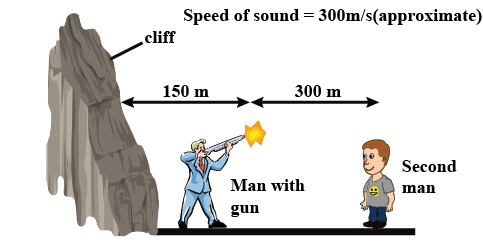
A man fires a gun $150\ m$ from a cliff. A second man who is standing $300\ m$ further away from the cliff hears the gun $1$ second after he sees the flash. The second man will hear the echo from the cliff:
- A
$1$ second after seeing the flash.
- B
$2$ seconds after hearing the gun.
- ✓
$2$ seconds after seeing the flash.
- D
$4$ seconds after hearing the gun.
AnswerCorrect option: C. $2$ seconds after seeing the flash.
Echo will be heard when the sound of the gun gets reflected from the cliff, Thus the total distance travelled by the sound of gun, $S = x_1 + x_2 + x_3 = 150 + 150 + 300 = 600m v = 300m s^{−1}$
$\therefore\text{t}= \frac{\text{S}}{\text{U}}= \frac{600}{300}=\text{2s}$
View full question & answer→MCQ 1601 Mark
A pendulum oscillates $20$ times in $4$ seconds. Find its time period.
- A
$0.05$ sec.
- B
$0.001$ sec.
- ✓
$0.2$ sec.
- D
$0.1$ sec
AnswerCorrect option: C. $0.2$ sec.
View full question & answer→MCQ 1611 Mark
Sound is a kind of$...........?$
View full question & answer→MCQ 1621 Mark
Frequency $(ν)$ and time period $(T)$ are related as
- ✓
$V \times T = 1$
- B
$V/ T = 1$
- C
$V = T/ 2$
- D
$V = T2$
AnswerCorrect option: A. $V \times T = 1$
Frequency is the reciprocal of the time period.
So, frequency and time period are related as $\text{v}=\frac{1}{\text{T}}$
$\therefore V \times T = 1.$
View full question & answer→MCQ 1631 Mark
An object vibrates with a frequency of $15$ hertz. Which of the following is true:
- A
It produces sound that we can hear.
- B
It does not produce sound.
- ✓
It produces sound that we cannot hear.
- D
It produces sound that we can hear if we strain our ears.
AnswerCorrect option: C. It produces sound that we cannot hear.
View full question & answer→MCQ 1641 Mark
The sound above $...........$ is physically painful.
- A
$20dB$
- B
$40dB$
- C
$60dB$
- ✓
$80dB$
AnswerCorrect option: D. $80dB$
View full question & answer→MCQ 1651 Mark
Which of the following sound is $\text{NOT}$ a cause of noise pollution:
AnswerTelevision has the lowest volume, out of the given, and it also doesn't disturb other people therefore generally it is not a cause of noise pollution.
Where other causes are generally very loud so they are the causes of noise pollution.
View full question & answer→MCQ 1661 Mark
A shehnai produces sound from:
MCQ 1671 Mark
Sound propagates maximum in:
MCQ 1681 Mark
If the amplitude of a sound is doubled, then its ?
AnswerThe amplitude of a sound is independent of velocity, frequency, and wavelength.
So it can't be changed by changing any of them.
View full question & answer→MCQ 1691 Mark
Vibrating part of flute is:
AnswerCorrect option: A. Air$-$column
View full question & answer→MCQ 1701 Mark
View full question & answer→MCQ 1711 Mark
Sound cannot travel through:
MCQ 1721 Mark
Fill in the blanks with the most appropriate option.
If a guitar string is pulled strongly, its amplitude of vibration $..............$ and the note heard is $..............$ If it is pulled lightly, its amplitude of vibration $..............$ and the note heard is $..............$
- A
$(i)$ Increases, $(ii)$ Louder, $(iii)$ Increases, $(iv)$ Louder.
- B
$(i)$ Decreases, $(ii)$ Softer, $(iii)$ Decreases, $(iv)$ Softer.
- ✓
$(i)$ Increases, $(ii)$ Louder, $(iii)$ Decreases, $(iv)$ Softer.
- D
$(i)$ Decreases, $(ii)$ Softer, $(iii)$ Increases, $(iv)$ Louder.
AnswerCorrect option: C. $(i)$ Increases, $(ii)$ Louder, $(iii)$ Decreases, $(iv)$ Softer.
View full question & answer→MCQ 1731 Mark
When the amplitude is small, the sound produced is:
MCQ 1741 Mark
The human ear can hear sounds having frequency in range:
- A
Between $200 - 20,000Hz$
- B
Between $20 - 2000Hz$
- C
Between $200 - 2000Hz$
- ✓
Between $20 - 20,000Hz$
AnswerCorrect option: D. Between $20 - 20,000Hz$
View full question & answer→MCQ 1751 Mark
Find the difference between a musical sound and noise.
MCQ 1761 Mark
When the amplitude of vibration is large, sound produced is:
- A
- B
- ✓
- D
No relation between amplitude and sound
View full question & answer→MCQ 1771 Mark
Speed of sound in solids is $...........$ the speed of sound in liquids.
- A
- ✓
- C
- D
Sometimes greater and sometimes less than
View full question & answer→MCQ 1781 Mark
We can distinguish between the musical sounds produced by different singers on the basis of the characteristic of sound called:
AnswerTimbre can distinguish between the musical sounds produced by different singers on the basis of the characteristic of sound.
View full question & answer→MCQ 1791 Mark
Vibration is also known as:
MCQ 1801 Mark
To and fro or back and forth motion of an object is termed as $...........$
View full question & answer→MCQ 1811 Mark
Frequency of oscillations is:
- A
The number of oscillations per minute
- B
The number of oscillations per hour
- ✓
The number of oscillations per second
- D
AnswerCorrect option: C. The number of oscillations per second
View full question & answer→MCQ 1821 Mark
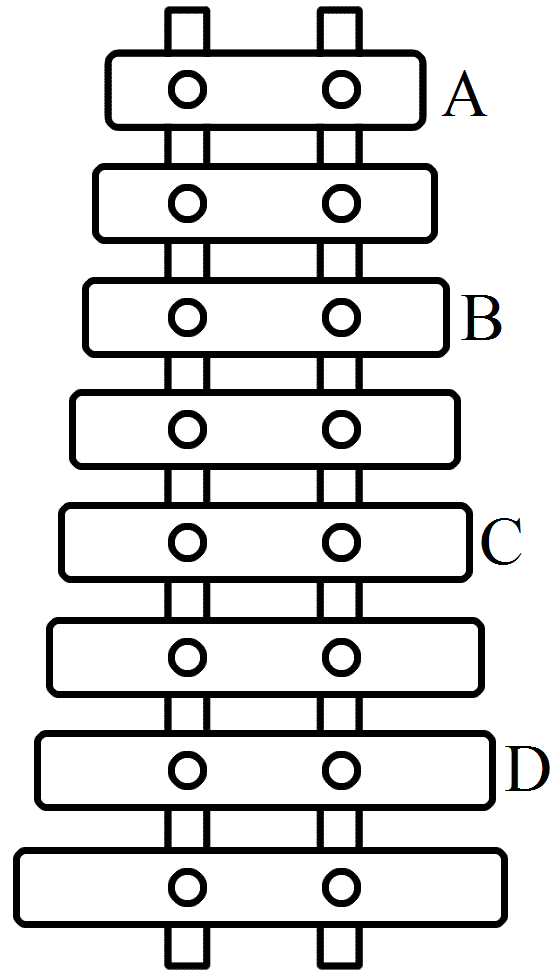
The picture shows a xylophone. $A, B, C$ and $D$ are the rods in it. Which of the following rods has high pitch of the sound and which has low frequency of vibrations?
- A
High pitch - $D$, Low frequency - $A$
- B
High pitch - $C$, Low frequency - $B$ and $C$
- C
High pitch - $A$ and $D$, Low frequency - $A$ and $D$
- ✓
High pitch - $A$, Low frequency - $D$
AnswerCorrect option: D. High pitch - $A$, Low frequency - $D$
Pitch of sound depends on the frequency of vibrations. Smaller length vibrates faster, so the frequency increases and sound produced is of high pitch.
View full question & answer→MCQ 1831 Mark
Which of the following are used to study the growth of fetus inside the mother’s womb?
AnswerInfra$-$red Waves are used to study the growth of fetus inside the mother’s womb.
View full question & answer→MCQ 1841 Mark
Voice box or larynx of human process:
MCQ 1851 Mark
The loudness of sound is determined by its:
- ✓
- B
Ratio of amplitude and frequency of vibration.
- C
- D
Product of amplitude and frequency of vibration.
AnswerLoudness of sound is determined by the amplitude of its vibration.
View full question & answer→MCQ 1861 Mark
Voice of man is heavy compared to a woman because
- A
Female vocal cord is longer
- B
Male vocal cord is shorter
- ✓
Male vocal cord is longer
- D
The concept is not related
AnswerCorrect option: C. Male vocal cord is longer
View full question & answer→MCQ 1871 Mark
An ultrasound equipment works at frequency
- A
Higher than $20,000 \ Hz$
- B
Higher than $10,000 \ Hz$
- ✓
Lower than $20,000 \ Hz$
- D
Lower than $10,000 \ Hz$
AnswerCorrect option: C. Lower than $20,000 \ Hz$
View full question & answer→MCQ 1881 Mark
Human can hear sound in the range of
- A
$ 200-2000 \ Hz$
- ✓
$ 20-20,000 \ Hz$
- C
$ 2-20000 \ Hz$
- D
$ 2000-200000 \ Hz$
AnswerCorrect option: B. $ 20-20,000 \ Hz$
View full question & answer→MCQ 1891 Mark
When the amplitude of vibration is large, sound produced is
- A
- B
- ✓
- D
No relation between amplitude and sound
View full question & answer→MCQ 1901 Mark
Above$ ........... dB$ the sound becomes physically painful
- A
$ 60$
- B
$ 40$
- C
$ 120$
- ✓
$ 80$
View full question & answer→MCQ 1911 Mark
The number of oscillations per second is called
MCQ 1921 Mark
Frequency is expressed in
MCQ 1931 Mark
Vibration is also known as
MCQ 1941 Mark
Sound cannot travel through
MCQ 1951 Mark
View full question & answer→MCQ 1961 Mark
The velocity of sound at $20^\circ C$ is approximately
- A
$3400\ m/sec.$
- ✓
$340\ m/sec.$
- C
$430\ m/sec$
- D
$304\ m/sec.$
AnswerCorrect option: B. $340\ m/sec.$
View full question & answer→MCQ 1971 Mark
The maximum displacement of a body from its mean position is called
MCQ 1981 Mark
The number of vibrations made by a vibrating body in one second is
MCQ 1991 Mark
Loudness of sound is determined by
MCQ 2001 Mark
A pendulum oscillates $20$ times in $4$ seconds. Find its time period.
- A
$0.05 \sec.$
- B
$0.001 \sec.$
- ✓
$0.2 \sec.$
- D
$0.1 \sec$
AnswerCorrect option: C. $0.2 \sec.$
View full question & answer→MCQ 2011 Mark
View full question & answer→MCQ 2021 Mark
The sound in the audible range is called
MCQ 2031 Mark
Sound cannot travel through
MCQ 2041 Mark
$1$ hertz is equal to
- A
$1$ vibration per minute
- B
$10$ vibrations per minute
- ✓
$60$ vibrations per minute
- D
$600$ vibrations per minute
AnswerCorrect option: C. $60$ vibrations per minute
View full question & answer→MCQ 2051 Mark
View full question & answer→MCQ 2061 Mark
The frequency of subsonic sound is
- A
more than $20\ Hz$
- B
$100\ Hz$
- ✓
less than $20\ Hz$
- D
more than $20,000\ Hz$
AnswerCorrect option: C. less than $20\ Hz$
View full question & answer→MCQ 2071 Mark
Pitch of sound is determined by its
MCQ 2081 Mark
The hearing range of human ear is
- ✓
$20\ Hz$ to $20,000\ Hz$
- B
less than $20\ Hz$
- C
more than $20,000\ Hz$
- D
$20\ Hz$ to $25,000\ Hz$
AnswerCorrect option: A. $20\ Hz$ to $20,000\ Hz$
View full question & answer→MCQ 2091 Mark
View full question & answer→MCQ 2101 Mark
The voice box is also called as