Questions

3 Marks Question

🎯

Test yourself on this topic

17 questions · timed · auto-graded

Question 13 Marks
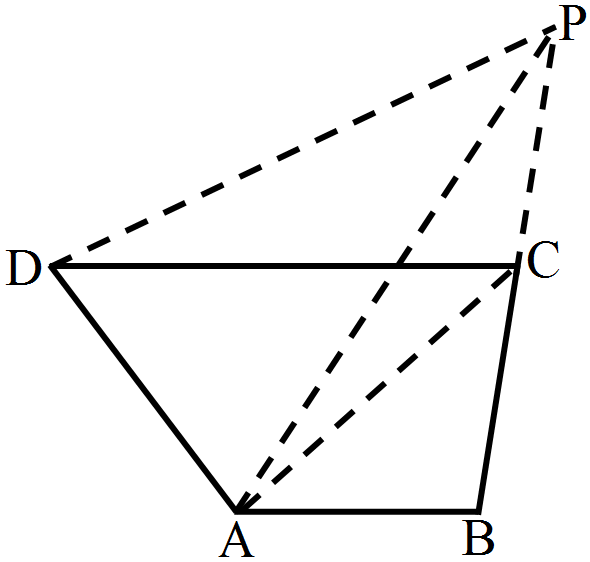
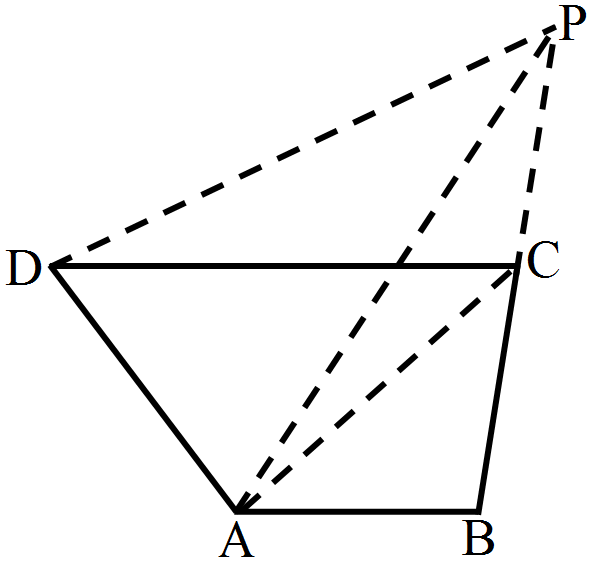
In the adjoining figure, ABCD is a quadrilateral. A line through D, parallel to AC, meets BC produced in P.
Prove that $\text{ar}(\triangle\text{ABP})=\text{ar}(\text{quadrilateral ABCD}).$
Answer
Given:
ABCD is a quadrilateral in which through D. A line drawn parallel to AC which meets BC produced in P.
To prove:
$\text{ar}(\triangle\text{ABP})=\text{ar}(\text{quadrilateral ABCD})$
Proof:
$\triangle\text{ACP}$ and $\triangle\text{ACD}$ have same base AC and lie between parallel lines AC and DP.
$\therefore\ \text{ar}(\triangle\text{ACP})=\text{ar}(\triangle\text{ACD})$
Adding $\text{ar}(\triangle\text{ABC})$ on both sides, we get:
$\text{ar}(\triangle\text{ACP})+\text{ar}(\triangle\text{ABC})=\text{ar}(\triangle\text{ACD})+\text{ar}(\triangle\text{ABC})$
$\Rightarrow\ \text{ar}(\triangle\text{ABP})=\text{ar}(\text{quadrilateral ABCD})$
View full question & answer
Question 23 Marks
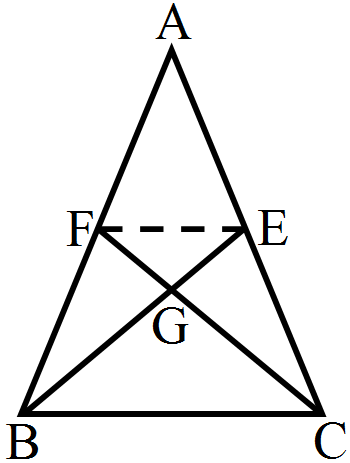
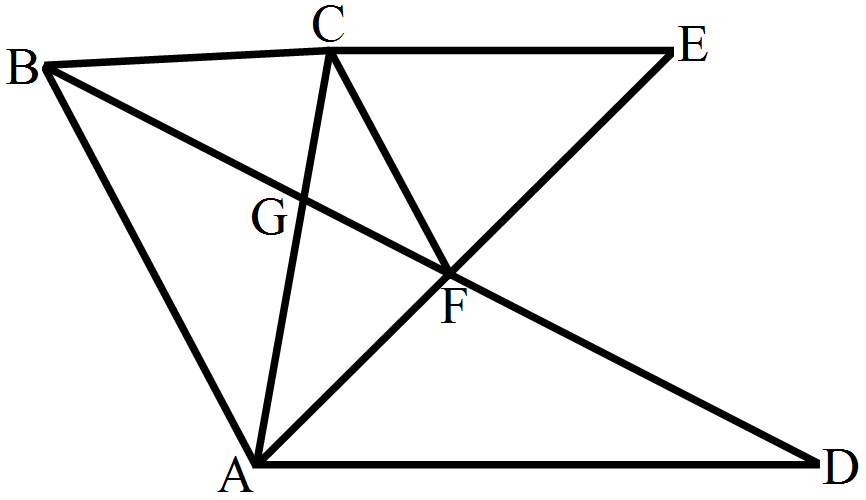
In the adjoining figure, CE || AD and CF || BA. Prove that $\text{ar}(\triangle\text{CBG})=\text{ar}(\triangle\text{AFG}).$

Answer
$\triangle\text{BCF}$ and $\triangle\text{ACF}$ are on the same base CF and between the same parallel lines CF and BA.
$\therefore\ \text{ar}(\triangle\text{BCF})=\text{ar}(\triangle\text{ACF})$
$\Rightarrow\ \text{ar}(\triangle\text{BCF})-\text{ar}(\triangle\text{CGF})=\text{ar}(\triangle\text{ACF})-\text{ar}(\triangle\text{CGF})$
$\Rightarrow\ \text{ar}(\triangle\text{CBG})=\text{ar}(\triangle\text{AFG})$
View full question & answer
Question 33 Marks
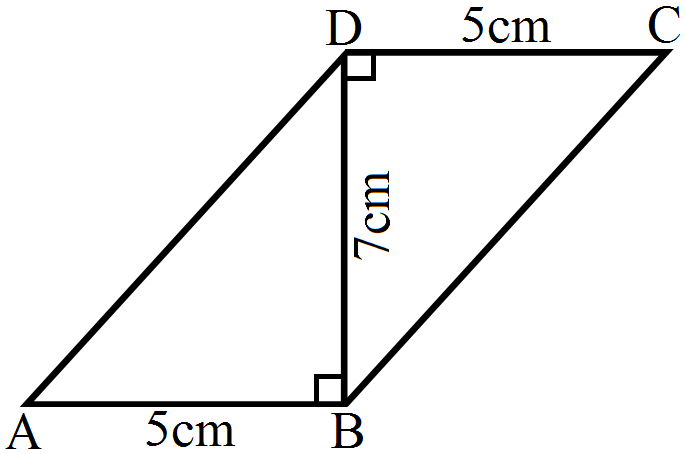
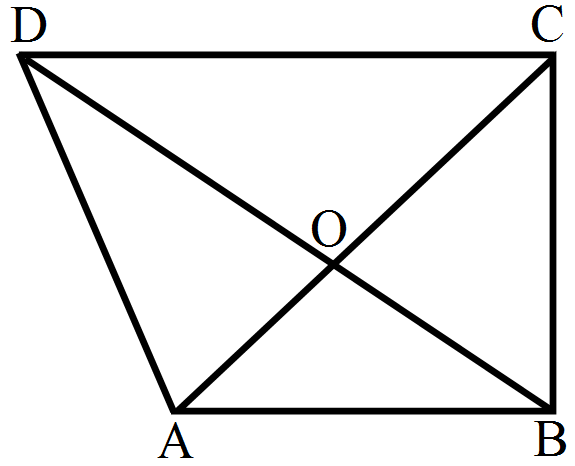
In the adjoining figure, show that ABCD is a parallelogram. Calculate the area of || gm ABCD.

Answer

$\text{Area of }\triangle\text{ABD}=\frac{1}{2}\times\text{base}\times\text{height}$
$=\Big(\frac{1}{2}\times5\times7\Big)\text{cm}^2=\frac{35}{2}\text{cm}^2$
$\text{Area of }\triangle\text{CBD}=\Big(\frac{1}{2}\times5\times7\Big)\text{cm}^2=\frac{35}{2}\text{cm}^2$
Since the diagonal BD divides ABCD into two triangles of equal area.
$\therefore$ ABCD is a parallellogram.
$\therefore$ Area of parallellogram $=\text{Area of }\triangle\text{ABD}+\text{Area of }\triangle\text{CBD}$
$=\Big(\frac{35}{2}+\frac{35}{2}\Big)\text{cm}^2=\frac{70}{2}\text{cm}^2$
$=35\text{cm}^2$
$\therefore$ Area of parallellogram = 35cm2.
View full question & answer
Question 43 Marks
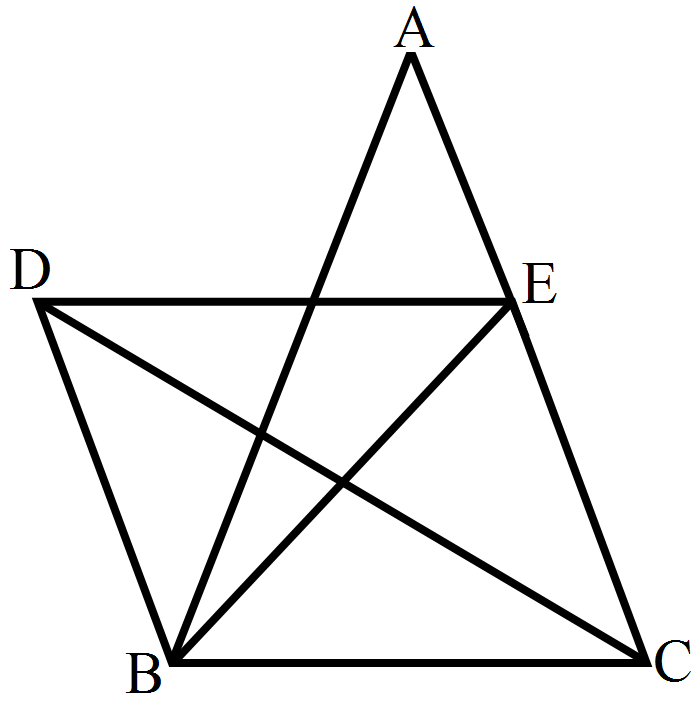
In the adjoining figure, BD || CA, E is the midpoint of CA and $\text{BD}=\frac{1}{2}\text{CA}.$ Prove that $\text{ar}(\triangle\text{ABC})=2\text{ar}(\triangle\text{DBC}).$

Answer
E is the midpoint of CA.
So, AE = EC ...(1)
Also,
$\text{BD}=\frac{1}{2}\text{CA}$ [Given]
So, BD = AE ...(2)
From (1) and (2) we have
BD = EC
BD || CA and BD = EC
So, BDEC is a parallelogram BE acts as the median of $\triangle\text{ABC}.$
So, 
$\text{ar}(\triangle\text{BCE})=\text{ar}(\triangle\text{ABE})=\frac{1}{2}\text{ar}(\triangle\text{ABC})\dots(1)$
$\text{ar}(\triangle\text{DBC})=\text{ar}(\triangle\text{BCE})\dots(2)$ [Triangles on the same base and between the same parallels are equal in area]
From (1) and (2)
$\text{ar}(\triangle\text{ABC})=2\text{ar}(\triangle\text{DBC})$
View full question & answer
Question 53 Marks
In the adjoining figure, D and E are respectively the midpoints of sides AB and AC of $\triangle\text{ABC}.$ If PQ || BC and CDP and BEQ are straight lines then prove that$\text{ar}(\triangle\text{ABQ})=\text{ar}(\triangle\text{ACP}).$

Answer
Since D and E are the mid-points of AB and AC respectively,
DE || BC || PQ
In $\triangle\text{ACP},$ AP || DE and E is the mid-point of AC.
⇒ D is the mid-point of PC [Converse of mid-point theorem]
$\Rightarrow\ \text{DE}=\frac{1}{2}\text{AP}$
$\Rightarrow\ \text{AP}=2(\text{DE})\dots(\text{i})$
In $\triangle\text{ABQ},$ AQ || DE and D is the mid-point of AB.
⇒ E is the mid-point of BQ [Converse of mid-point theorem]
$\Rightarrow\ \text{DE}=\frac{1}{2}\text{AQ}$
$\Rightarrow\ \text{AQ}=2(\text{DE})\dots(\text{ii})$
From (i) and (ii),
AP = AQ
Now, $\triangle\text{ACP}$ and $\triangle\text{ABQ}$ are on the equal bases AP and AQ and between the same parallels BC and PQ.
$\Rightarrow\ \text{ar}(\triangle\text{ACP})=\text{ar}(\triangle\text{ABQ})$
View full question & answer
Question 63 Marks
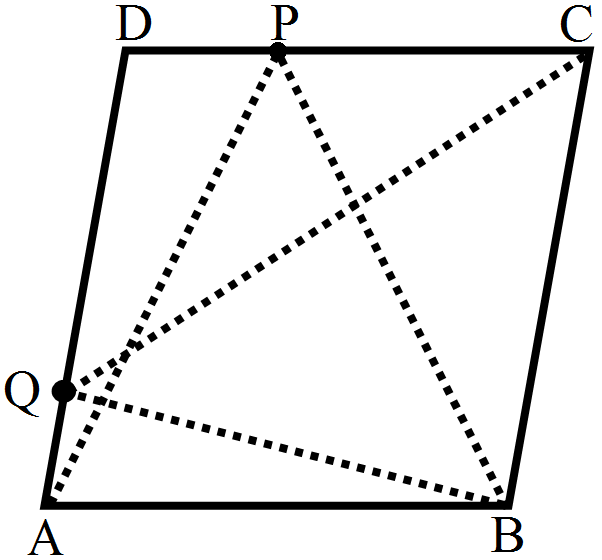
If P and Q are any two points lying respectively on the sides DC and AD of a parallelogram ABCD then show that $\text{ar}(\triangle\text{APB})=\text{ar}(\triangle\text{BQC}).$
Answer

We know
$\text{ar}(\triangle\text{APB})=\frac{1}{2}\text{ar}(\text{ABCD})\dots(1)$ [If a triangle and a parallelogram are on the same base and between the same parallels then the area of the triangle is equal to half the area of the parallelogram]
Similarly,
$\text{ar}(\triangle\text{BQC})=\frac{1}{2}\text{ar}(\text{ABCD})\dots(2)$
From (1) and (2)
$\text{ar}(\triangle\text{APB})=\text{ar}(\triangle\text{BQC})$
Hence proved.
View full question & answer
Question 73 Marks
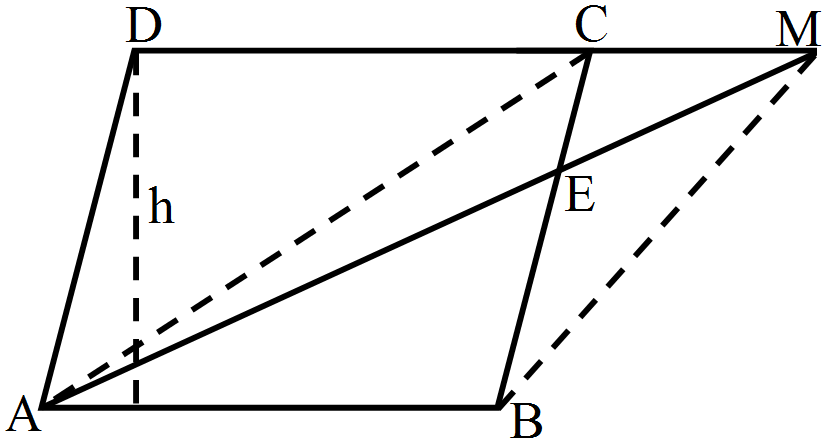
In a parallelogram ABCD, any point E is taken on the side BC. AE and DC when produced meet at a point M. Prove that $\text{ar}(\triangle\text{ADM})=\text{ar}(\text{ABMC}).$
Answer
Construction: Join AC and BM
Let h be the distance between AB and CD.

$\text{A}(\triangle\text{ACD})=\frac{1}{2}\times\text{CD}\times\text{h}$
$\text{A}(\triangle\text{ABM})=\frac{1}{2}\times\text{AB}\times\text{h}$
$=\frac{1}{2}\times\text{CD}\times\text{h}$ [AB = CD, opposite sides of ||m ABCD]
$\Rightarrow\ \text{A}(\triangle\text{ABM})=\text{A}(\triangle\text{ACD})$
$\Rightarrow\ \text{A}(\triangle\text{ABM})+\text{A}(\triangle\text{ACM})=\text{A}(\triangle\text{ACD})+\text{A}(\triangle\text{ACM})$
$\Rightarrow\ \text{A}(\text{ABMC})=\text{A}(\triangle\text{ADM})$
View full question & answer
Question 83 Marks
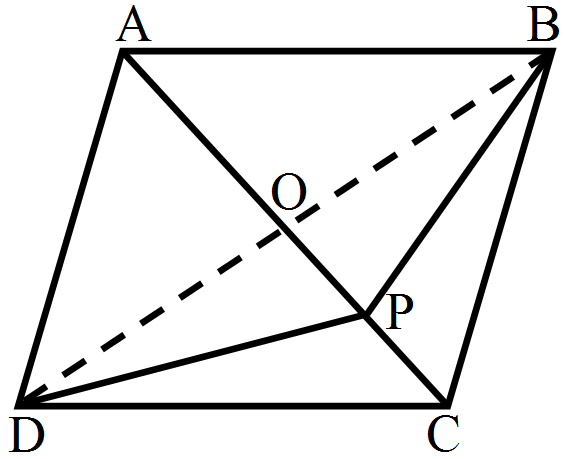
P is any point on the diagonal AC of a parallelogram ABCD. Prove that $\text{ar}(\triangle\text{ADP})=\text{ar}(\triangle\text{ABP}).$
Answer
Construction: Join BD.
Let the diagonals AC and BD intersect at point O.

Diagonals of a parallelogram bisect each other.
Hence, O is the mid-point of both AC and BD.
We know that the median of a triangle divides it into two triangles of equal area.
In $\triangle\text{ABD},$ OA is the median.
$\Rightarrow\ \text{A}(\triangle\text{AOD})=\text{A}(\triangle\text{AOB})\dots(\text{i})$
In $\triangle\text{BPD},$ OP is the median.
$\Rightarrow\ \text{A}(\triangle\text{OPD})=\text{A}(\triangle\text{OPB})\dots(\text{ii})$
Adding (i) and (ii), we get:
$\text{A}(\triangle\text{AOD})+\text{A}(\triangle\text{OPD})=\text{A}(\triangle\text{AOB})+\text{A}(\triangle\text{OPB})$
$\Rightarrow\ \text{A}(\triangle\text{ADP})=\text{A}(\triangle\text{ABP})$
View full question & answer
Question 93 Marks
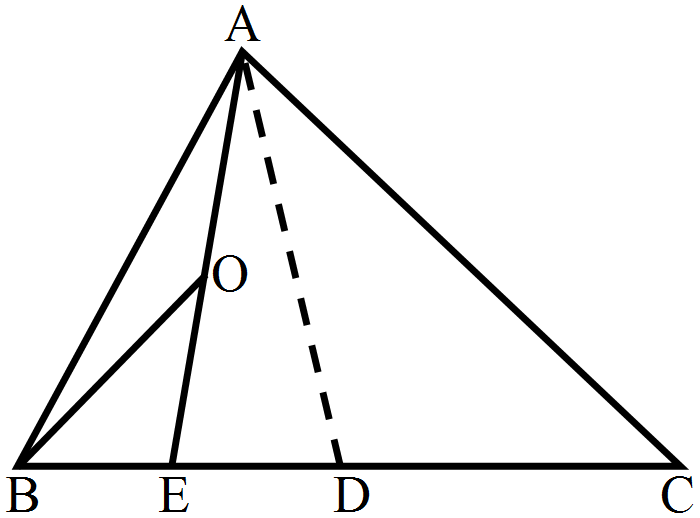
D is the midpoint of side BC of $\triangle\text{ABC}$ and E is the midpoint of BD. If O is the
midpoint of AE, prove that $\text{ar}(\triangle\text{BOE})=\frac{1}{8}\text{ar}(\triangle\text{ABC})$

Answer
D is the midpoint of side BC of $\triangle\text{ABC}.$
⇒ AD is the median of $\triangle\text{ABC}.$
$\Rightarrow\ \text{ar}(\triangle\text{ABD})=\text{ar}(\triangle\text{ACD})=\frac{1}{2}\text{ar}(\triangle\text{ABC})$
 E is the midpoint of side BD of $\triangle\text{ABD},$
⇒ AE is the median of $\triangle\text{ABD}.$
$\Rightarrow\ \text{ar}(\triangle\text{ABE})=\text{ar}(\triangle\text{AED})\\=\frac{1}{2}\text{ar}(\triangle\text{ABD})=\frac{1}{4}\text{ar}(\triangle\text{ABC})$
Also, O is the midpoint of side AE,
⇒ BO is the median of $\triangle\text{ABE},$
$\Rightarrow\ \text{ar}(\triangle\text{ABO})=\text{ar}(\triangle\text{BOE})=\frac{1}{2}\text{ar}(\triangle\text{ABE})\\=\frac{1}{4}\text{ar}(\triangle\text{ABD})=\frac{1}{8}\text{ar}(\triangle\text{ABC})$
Thus, $\text{ar}(\triangle\text{BOE})=\frac{1}{8}\text{ar}(\triangle\text{ABC})$
View full question & answer
Question 103 Marks
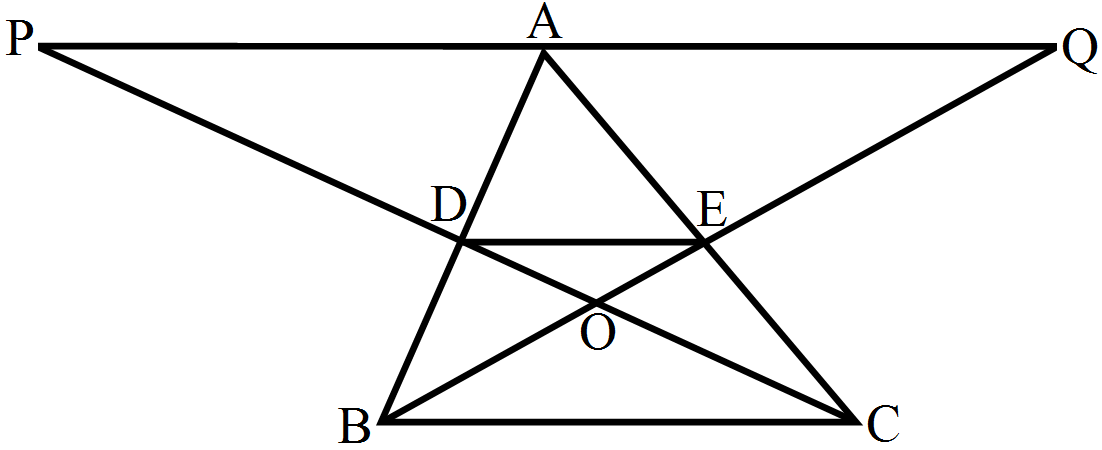
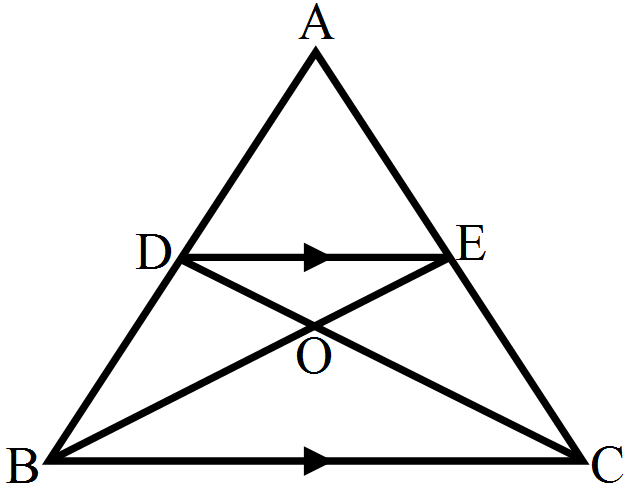
In the adjoining figure, DE || BC. Prove that:

  1. $\text{ar}(\triangle\text{ACD})=\text{ar}(\triangle\text{ABE})$

  2. $\text{ar}(\triangle\text{OCE})=\text{ar}(\triangle\text{OBD}).$

Answer
$\triangle\text{DEC}$ and $\triangle\text{DEB}$ lies on the same base and between the same parallel lines.

So, $\text{ar}(\triangle\text{DEC})=\text{ar}(\triangle\text{DEB})\dots(1)$

  1. On adding $\text{ar}(\triangle\text{ADE})$ in both sides of equation (1), we get:

$\text{ar}(\triangle\text{DEC})+\text{ar}(\triangle\text{ADE})=\text{ar}(\triangle\text{DEB})+\text{ar}(\triangle\text{ADE})$

$\Rightarrow\ \text{ar}(\triangle\text{ACD})=\text{ar}(\triangle\text{ABE})$

  1. On adding $\text{ar}(\triangle\text{ODE})$ in both sides of equation (1), we get:

$\text{ar}(\triangle\text{DEC})-\text{ar}(\triangle\text{ODE})=\text{ar}(\triangle\text{DEB})-\text{ar}(\triangle\text{ODE})$

$\Rightarrow\ \text{ar}(\triangle\text{OCE})=\text{ar}(\triangle\text{OBD}).$

View full question & answer
Question 113 Marks
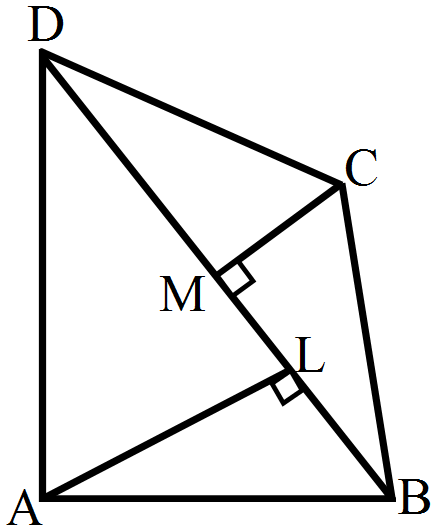
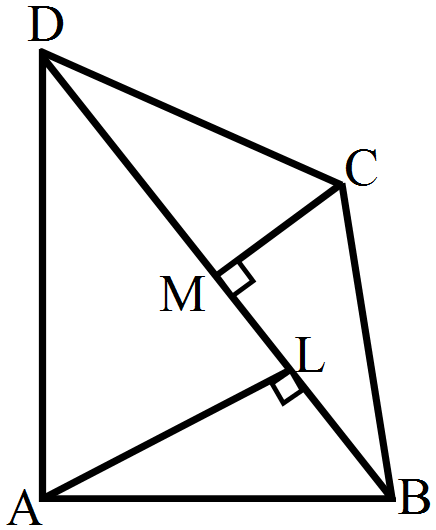
In the adjoining figure, ABCD is a quadrilateral in which diagonal BD = 14 cm. If $\text{AL}\perp\text{BD}$ and $\text{CM}\perp\text{BD}$such that AL = 8cm and CM = 6cm, find the area of quadrilateral ABCD.

Answer
Area of $\triangle\text{BAD}=\frac{1}{2}\times\text{BD}\times\text{AL}$
$=\Big(\frac{1}{2}\times14\times8\Big)\text{cm}^2$
$=56\text{cm}^2$
Area of $\triangle\text{CBD}=\frac{1}{2}\times\text{BD}\times\text{CM}$
$=\Big(\frac{1}{2}\times14\times6\Big)\text{cm}^2$
$=42\text{cm}^2$

$\therefore$ Area of quadrilateral ABCD $=\text{Area of }\triangle\text{ABD}+\text{Area of }\triangle\text{CBD}$ 
= (56 + 42)cm2 = 98cm2
View full question & answer
Question 123 Marks
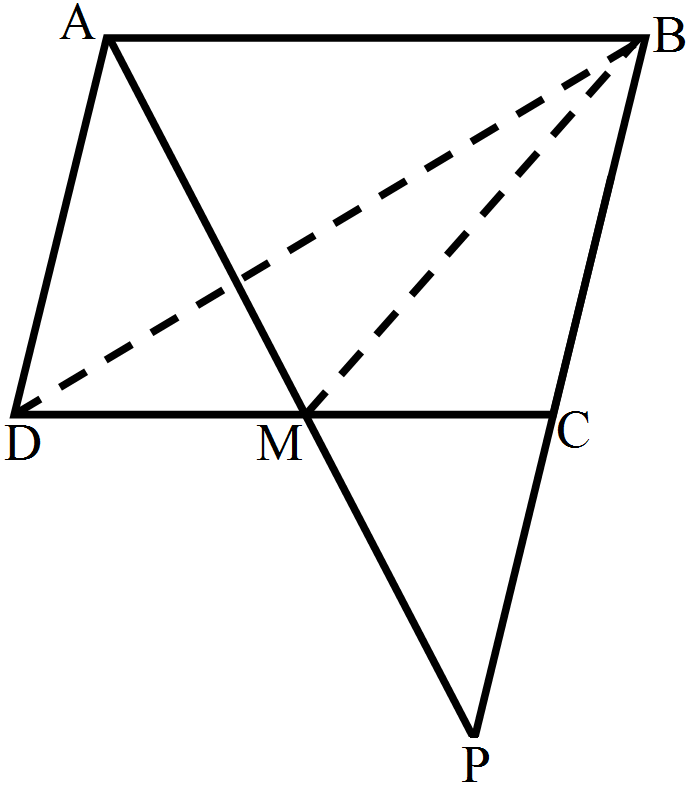
ABCD is a parallelogram in which BC is produced to P such that CP = BC, as shown in the adjoining figure. AP intersects CD at M. If ar(DMB) = 7cm2, find the area of parallelogram ABCD.

Answer
In $\triangle\text{ADM}$ and $\triangle\text{PCM},$
$\angle\text{ADM}=\angle\text{PCM}$ [alternate angles]
AD = CP [AD = BC = CP]
$\angle\text{AMD}=\angle\text{PMC}$ [vertically opposite angles]
$\therefore\ \triangle\text{ADM}\cong\triangle\text{PCM}$
$\Rightarrow\ \text{A}(\triangle\text{ADM})=\text{A}(\triangle\text{PCM})$
And,
DM = CM [C.P.C.T.]
⇒ BM is the median of $\triangle\text{BDC}.$.
$\Rightarrow\ \text{A}(\triangle\text{DMB})=\text{A}(\triangle\text{CMB})$
$\Rightarrow\ \text{A}(\triangle\text{BDC})=2\times\text{A}(\triangle\text{DMB})$
$\Rightarrow\ 2\times7=14\text{cm}^2$
Now,
A(parallelogram ABCD) $=2\times\text{A}(\triangle\text{BDC})$
$=2\times14=28\text{cm}^2$
View full question & answer
Question 133 Marks
In a triangle ABC, the medians BE and CF intersect at G. Prove that
$\text{ar}(\triangle\text{BCG})=\text{ar}(\text{AFGE}.)$
Answer
Construction: Join EF

Since the line segment joining the mid-points of two sides of a triangle is parallel to the third side, FE || BC.
Clearly, $\triangle\text{BEF}$ and $\triangle\text{CEF}$ are on the same base EF and between the same parallel lines.
$\therefore\ \text{ar}(\triangle\text{BEF})=\text{ar}(\triangle\text{CEF})$
$\Rightarrow\ \text{ar}(\triangle\text{BEF})-\text{ar}(\triangle\text{GEF})=\text{ar}(\triangle\text{CEF})-\text{ar}(\triangle\text{GEF})$
$\Rightarrow\ \text{ar}(\triangle\text{BFG})=\text{ar}(\triangle\text{CEG})\dots(\text{i})$
We know that a median of a triangle divides it into two triangles of equal area.
$\therefore\ \text{ar}(\triangle\text{BEC})=\text{ar}(\triangle\text{ABE})$
$\Rightarrow\ \text{ar}(\triangle\text{BGC})+\text{ar}(\triangle\text{CEG})\\=\text{ar}(\text{quadrilateral AFGE})+\text{ar}(\triangle\text{BFG})$
$\Rightarrow\ \text{ar}(\triangle\text{BGC})+\text{ar}(\triangle\text{BFG})\\=\text{ar}(\text{quadrilateral AFGE})+\text{ar}(\triangle\text{BFG})$ [Using (i)]
$\Rightarrow\ \text{ar}(\triangle\text{BGC})=\text{ar(quadrilateral AFGE)}$
View full question & answer
Question 143 Marks
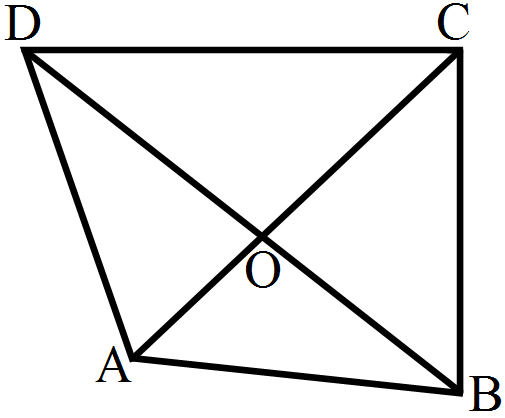
In the adjoining figure, the diagonals AC and BD of a quadrilateral ABCD intersect at O.
If BO = OD, prove that $\text{ar}(\triangle\text{ABC})=\text{ar}(\triangle\text{ADC}).$

Answer
Given:
A quadrilateral ABCD in which diagonal AC and BD intersect at O and BO = OD.

To prove:
$\text{ar}(\triangle\text{ABC})=\text{ar}(\triangle\text{ADC})$
Proof:
Since OB = OD [Given]
So,
AO is the median of $\triangle\text{ABD}$
$\therefore\ \text{ar}(\triangle\text{AOD})=\text{ar}(\triangle\text{AOB})\dots(\text{i})$
As OC is the median of $\triangle\text{CBD}$
$\therefore\ \text{ar}(\triangle\text{DOC})=\text{ar}(\triangle\text{BOC})\dots(\text{ii})$
Adding both sides of (i) and (ii), we get
$\text{ar}(\triangle\text{AOD})+\text{ar}(\triangle\text{DOC})=\text{ar}(\triangle\text{AOB})+\text{ar}(\triangle\text{BOC})$
$\therefore\ \text{ar}(\triangle\text{ADC})=\text{ar}(\triangle\text{ABC})$
View full question & answer
Question 153 Marks
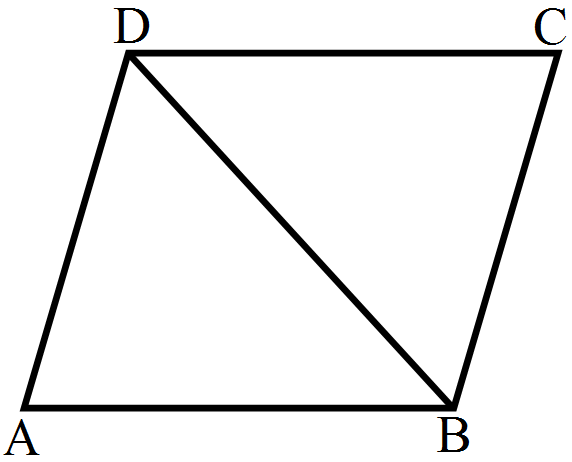
Show that a diagonal divides a parallelogram into two triangles of equal area.
Answer

Let ABCD be a parallelogram and BD be its diagonal.
To prove:
$\text{ar}(\triangle\text{ABD})=\text{ar}(\triangle\text{CDB})$
Proof:
In $\triangle\text{ABD}$ and $\triangle\text{CDB},$ we have :
AB = CD [Opposite sides of a parallelogram]
AD = CB [Opposite sides of a parallelogram]
BD = DB [Common]
i. e., $\triangle\text{ABD}\cong\triangle\text{CDB}$ [SSS criteria]
$\therefore\ \text{ar}(\triangle\text{ABD})=\text{ar}(\triangle\text{CDB})$
View full question & answer
Question 163 Marks
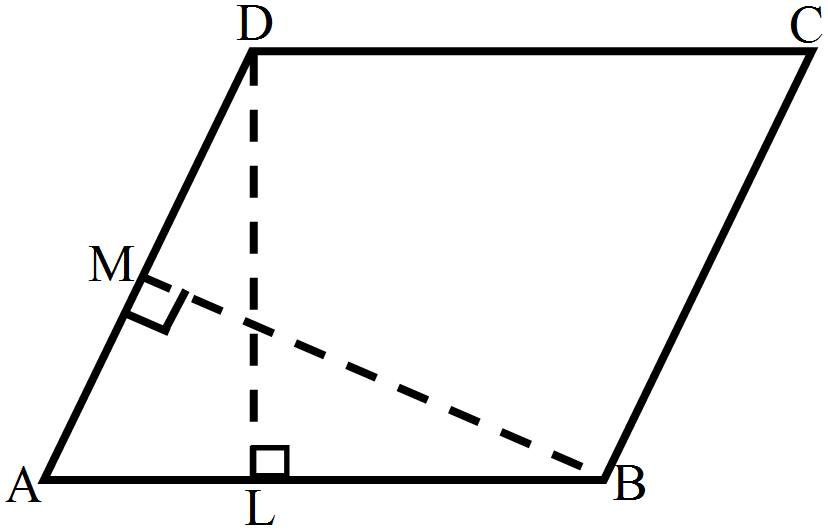
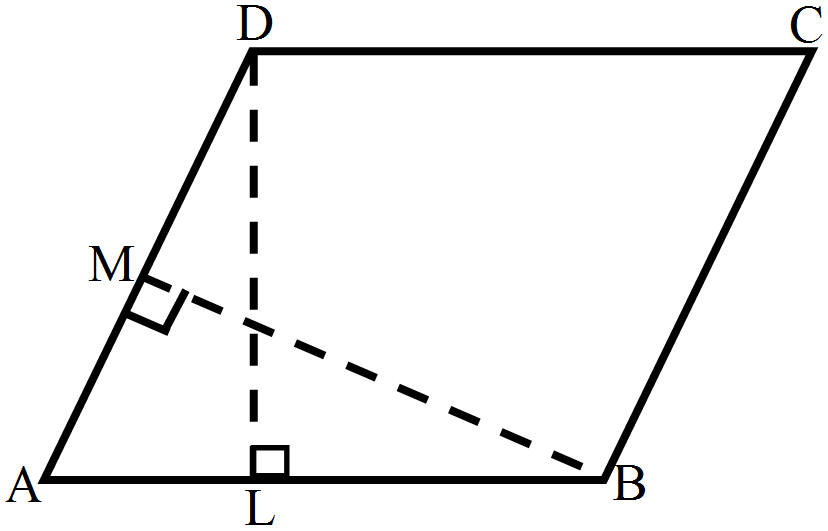
In a parallelogram ABCD, it is being given that AB = 10cm and the altitudes corresponding to the sides AB and AD are DL = 6cm and BM = 8cm, respectively. Find AD.

Answer
Since ABCD is a parallelogram and DL is perpendicular to AB.

So, its area = AB × DL
= (10 × 6)cm2
= 60cm2
Also, in parallelogram ABCD,
$\text{BM}\perp\text{AD}$
$\therefore$ Area of parallelogram ABCD = AD × BM 
60 = AD × 8cm
$\therefore$ AD × 8 = 60
$\Rightarrow\ \text{AD}=\frac{60}{8}=7.5\text{cm}$
$\therefore$ AD = 7.5cm
View full question & answer
Question 173 Marks
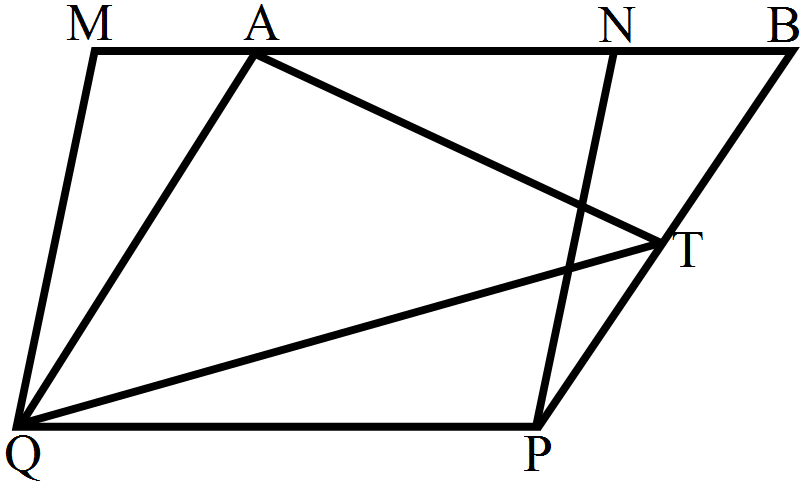
In the adjoining figure, MNPQ and ABPQ are parallelograms and T is any point on the side BP. Prove that

  1. $\text{ar}(\text{MNPQ})=\text{ar}(\text{ABPQ})$

  2. $\text{ar}(\triangle\text{ATQ})=\frac{1}{2}\text{ar}\text{(MNPQ}).$

Answer
  1. We know that parallelograms on the same base and between the same parallels are equal in area.

So,

$\text{ar}(\text{MNPQ})=\text{ar}(\text{ABPQ})$ [Same base PQ and MB || PQ] ...(1)

  1. If parallelogram and a triangle are on the same base and between the same paralles then the area of the triangle is equal to half the area of the parallelogram.

So, $\text{ar}(\triangle\text{ATQ})=\frac{1}{2}\text{ar}(\text{ABPQ})$ [Same base AQ and AQ || BP] ...(2)

From (1) and (2)

$\text{ar}(\triangle\text{ATQ})=\frac{1}{2}\text{ar}(\text{MNPQ})$

View full question & answer
3 Marks Question - Maths STD 9 Questions - Vidyadip