Questions

M.C.Q

🎯

Test yourself on this topic

42 questions · timed · auto-graded

Question 11 Mark
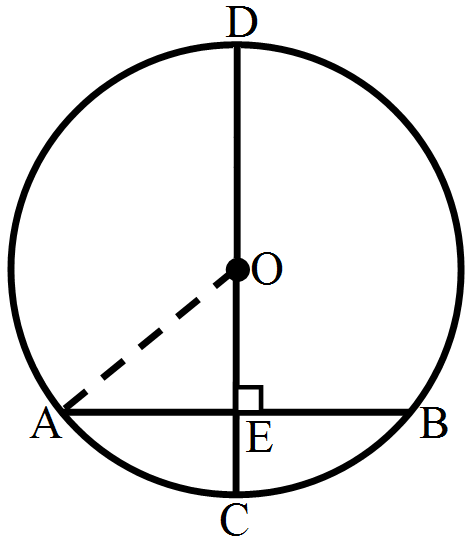
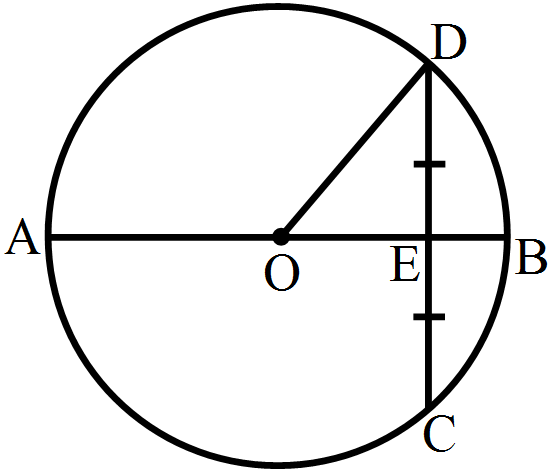
In the given figure, CD is the diameter of a circle with centre O and CD is perpendicular to chord AB. If AB = 12cm and CE = 3cm, then radius of the circles is:

  1. 6cm
  2. 9cm
  3. 7.5cm
  4. 8cm

Answer
  1. 7.5cm

Solution:

OA = OC

⇒ OA = OE + CE

⇒ OA = OE + 3

⇒ OE = OA - 3 ...(i)

$\text{AE}=\frac{1}{2}\text{AB}$ [Perpendicular drawn from the centre of a circle to the chord bisect the chord]

$=\frac{1}{2}(12)=6\text{cm}$

In right $\triangle\text{OEA},$

OA2 = OE2 + AE2

⇒ OA2 = (OA - 3)2 + AE2 [From (i)]

⇒ OA2 = OA2 - 6OA + 9 + AE2

⇒ 6OA = 9 + 62

⇒ 6OA = 9 + 36

$\Rightarrow\ \text{OA}=\frac{45}{6}=7.5\text{cm}$

So, the radius of the circle is 7.5cm.
View full question & answer
Question 21 Mark
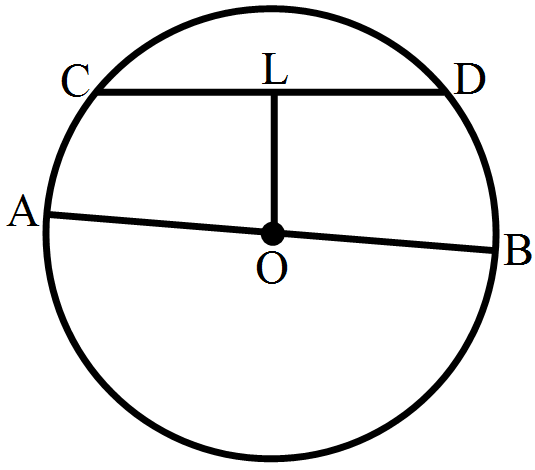
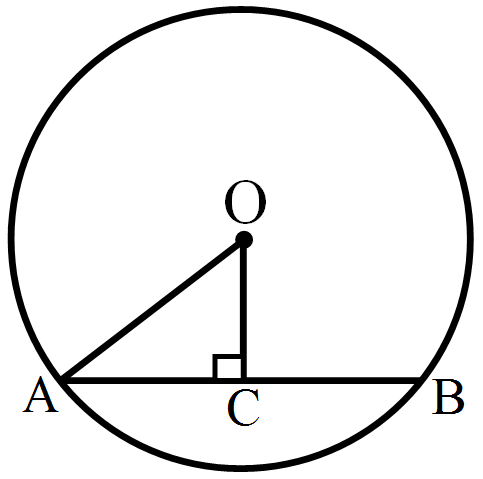
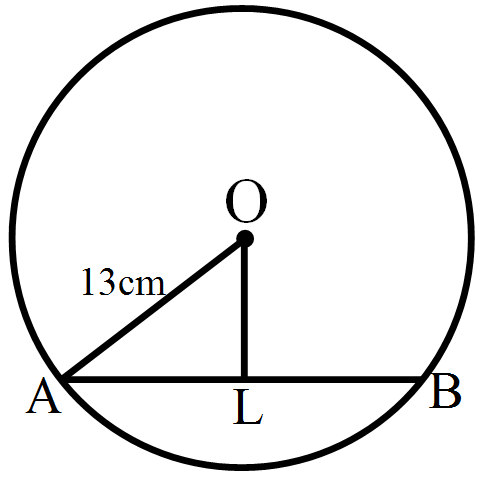
The radius of a circle is 13cm and the length of one of its chords is 10cm. The distance of the chord from the centre is:
  1. $11.5\text{cm}$
  2. $12\text{cm}$
  3. $\sqrt{69}\text{cm}$
  4. $23\text{cm}$
Answer
  1. $12\text{cm}$

Solution:

Let O be the centre of the circle with radius OA = 13cm.
AB is given to be 10cm.
Distance of a point to a line is always perpendicular to the line.

So, $\text{OL}\perp\text{AB}.$

We know that, the perpendicular drawn from the centre to the chord bisects the chord.

⇒ AL = LB = 5cm

In right $\triangle\text{OLA},$

OL2 = AO2 - AL2 [By pythagoras theorem]

⇒ OL2 = 132 - 52

⇒ OL2 = 169 - 25

⇒ OL2 = 144

⇒ OL = 12cm

View full question & answer
Question 31 Mark
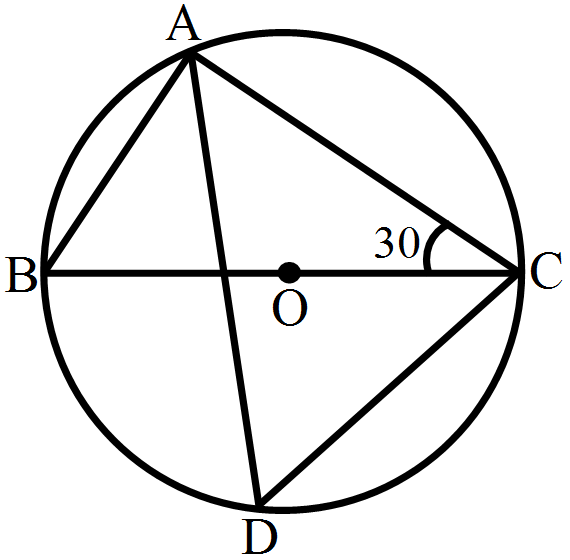
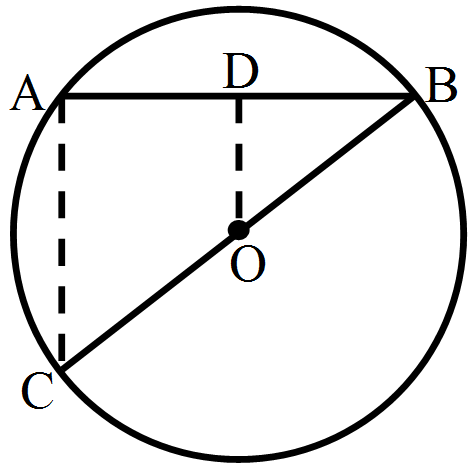
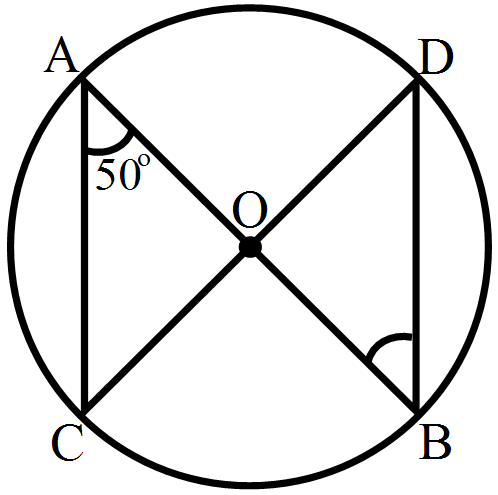
 In the given figure, BOC is a diameter of a circle with centre O. If $\angle\text{BCA}=30^\circ$ then $\angle\text{CDA}=?$

  1. 30°
  2. 45°
  3. 60°
  4. 50°

Answer
  1. 60°

Solution:

Since BOC is a diameter, $\angle\text{BAC}=90^\circ.$

In $\triangle\text{BAC},$

$\angle\text{BAC}+\angle\text{ABC}+\angle\text{BCA}=180^\circ$ [Angle sum property]

$\Rightarrow\ 90^\circ+\angle\text{ABC}+30^\circ=180^\circ$

$\Rightarrow\ \angle\text{ABC}=60^\circ$

Since angles in the same segment of a circle are equal.

$\angle\text{CDA}=\angle\text{ABC}=60^\circ.$

View full question & answer
Question 41 Mark
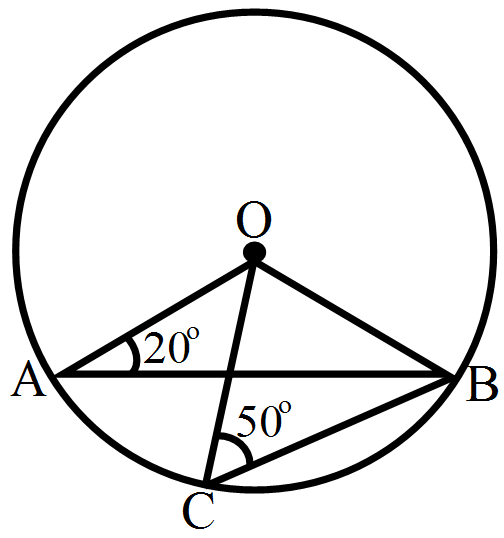
In the given figure, O is the centre of a circle in which $\angle\text{OAB}=20^\circ$ and $\angle\text{OCB}=50^\circ.$ Then, $\angle\text{AOC}=?$

  1. 50°
  2. 70°
  3. 20°
  4. 60°

Answer
  1. 60°

Solution:

OA = OC [Radii of the same circle]

$\Rightarrow\ \angle\text{OBA}=\angle\text{OAB}=20^\circ$

In $\triangle\text{OAB,}$

$\angle\text{OBA}+\angle\text{OAB}+\angle\text{AOB}=180^\circ$ [Angle sum property]

$\Rightarrow\ 20^\circ+20^\circ+\angle\text{AOB}=180^\circ$

$\Rightarrow\ \angle\text{AOB}=140^\circ$

Now,

OB = OC [Radii of the same circle]

$\Rightarrow\ \angle\text{OBC}=\angle\text{OCB}=50^\circ$

In $\triangle\text{OCB},$

$\angle\text{OBC}+\angle\text{OCB}+\angle\text{COB}=180^\circ$ [Angle sum property]

$\Rightarrow\ 50^\circ+50^\circ+\angle\text{COB}=180^\circ$

$\Rightarrow\ \angle\text{COB}=80^\circ$

So,

$\angle\text{AOB}=\angle\text{AOC}+\angle\text{COB}$

$\Rightarrow\ \angle\text{AOC}=\angle\text{AOB}-\angle\text{COB}$

$\Rightarrow\ \angle\text{AOC}=140^\circ-80^\circ$

$\Rightarrow\ \angle\text{AOC}=60^\circ$

View full question & answer
Question 51 Mark
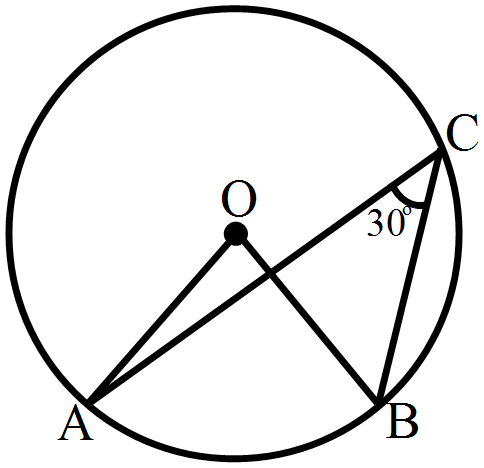
In the given figure, O is the centre of a circle and $\angle\text{ACB}=30^\circ.$ Then, $\angle\text{AOB}=?$

  1. 30°
  2. 15°
  3. 60°
  4. 90°

Answer
  1. 60°

Solution:

We know that, the angle subtended by an arc of a circle at the centre is double the angle subtended by it at any point on the remaining part of the circle.

So,

$\angle\text{AOB}=2\angle\text{ACB}$

$=2(30^\circ)$

$=60^\circ$

View full question & answer
Question 61 Mark
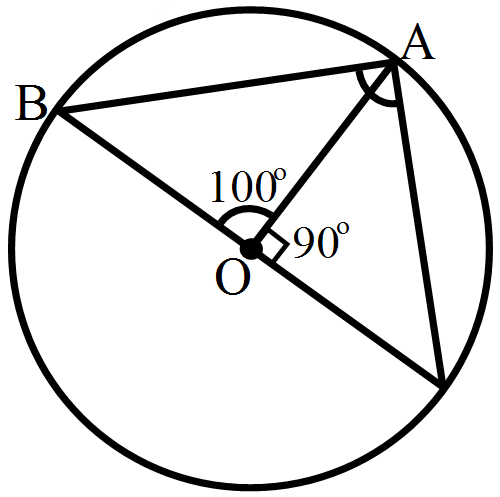
In the given figure, O is the centre of a circle. If $\angle\text{AOB}=100^\circ$ and $\angle\text{AOC}=90^\circ$ then $\angle\text{BAC}=?$

  1. 85°
  2. 80°
  3. 95°
  4. 75°

Answer
  1. 85°

Solution:

$\angle\text{BOA}+\angle\text{AOC}+\angle\text{BOC}=360^\circ$ [Angles around a point are 360°]

$\Rightarrow\ 100^\circ+90^\circ+\angle\text{BOC}=360^\circ$

$\Rightarrow\ \angle\text{BOC}=170^\circ$

Now,

$\angle\text{BAC}=\frac{1}{2}(\angle\text{BOC})=\frac{1}{2}(170^\circ)=85^\circ$

View full question & answer
Question 71 Mark
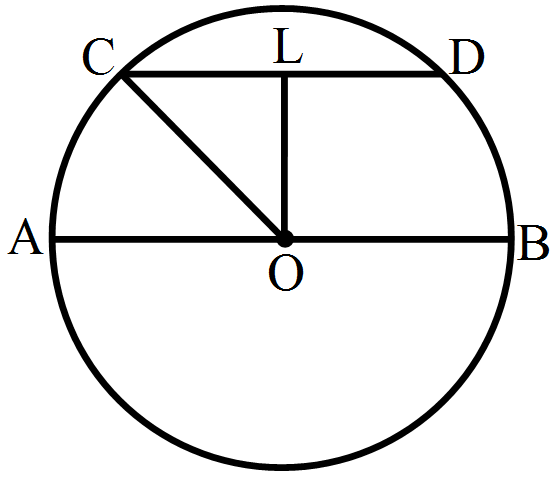
In the given figure, AOB is a diameter of a circle with centre O such that AB = 34cm and CD is a chord of length 30cm. Then the distance of CD from AB is:

  1. 8cm
  2. 15cm
  3. 18cm
  4. 6cm

Answer
  1. 8cm

Solution:

Construction: Join OC.

We know that, the perpendicular drawn from the centre to the chord bisects the chord.

So, $\text{CL}=\frac{1}{2}\text{CD}=\frac{1}{2}(30)=15\text{cm}$

AB is the diameter.

So, $\text{AO}=\frac{1}{2}\text{AB}=\frac{1}{2}(34)=17\text{cm}.$

In $\triangle\text{OLC},$

OL2 = OC2 - CL2

⇒ OL2 = 172 - 152

⇒ OL2 = 289 - 225

⇒ OL2 = 64

⇒ OL = 8cm

View full question & answer
Question 81 Mark
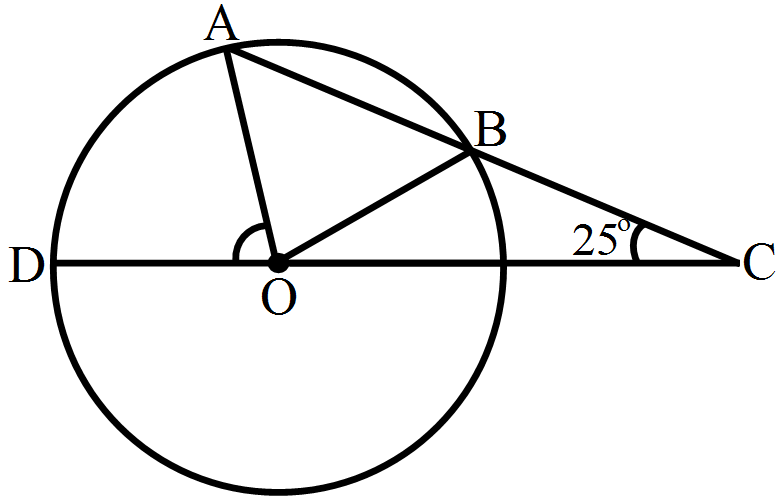
In the given figure, AB is a chord of a circle with centre O and AB is produced to C such that BC = OB. Also, CO is joined and produced to meet the circle in D. If $\angle\text{ACD}=25^\circ,$ then $\angle\text{AOD}=?$

  1. 50°
  2. 75°
  3. 90°
  4. 100°

Answer
  1. 75°

Solution:

OB = BC [Given]

$\Rightarrow\ \angle\text{OBC}=\angle\text{BCO}=25^\circ$ [Angles opposite equal sides are equal]

Now,

$\angle\text{OBC}=\angle\text{BOC}+\angle\text{BCO}=25^\circ+25^\circ=50^\circ$

OA = OB [Radii of the same circle]

$\Rightarrow\ \angle\text{OAB}=\angle\text{OBA}=50^\circ$

In $\triangle\text{AOC},$

$\angle\text{AOD}=\angle\text{OAC}+\angle\text{ACO}$

$=\angle\text{OAB}+\angle\text{BCO}$

$=50^\circ+25^\circ$

$=75^\circ$

View full question & answer
Question 91 Mark
A chord is at a distance of 8cm from the centre of a circle of radius 17cm. The length of the chord is:
  1. 25cm
  2. 12.5cm
  3. 30cm
  4. 9cm
Answer
  1. 30cm

Solution:

Let O be the centre of the circle with radius OA = 17cm.

Since $\text{OC}\perp\text{AB}.$

In right $\triangle\text{OCA},$

OA2= OC2 + AC2 [By pythagoras theorem]

AC2 = OA2 - OC2

⇒ AC2 = 172 - 82

⇒ AC2 = 289 - 64

⇒ AC2 = 225

⇒ AC = 15cm

We know that, the perpendicular drawn from the centre to the chord bisects the chord.

⇒ AB = 2AC = 2(15) = 30cm.

View full question & answer
Question 101 Mark
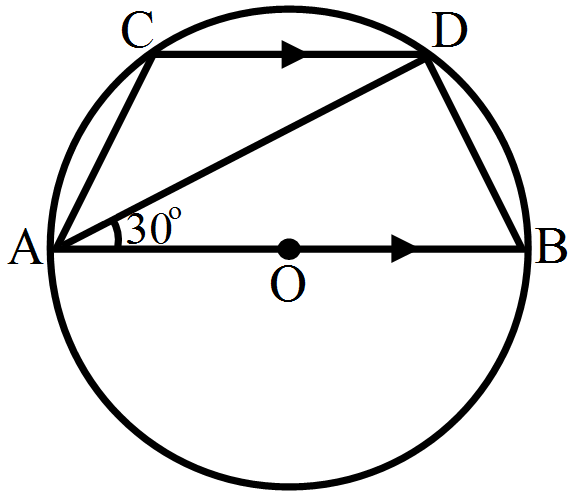
In the given figure, AOB is a diameter of a circle and CD || AB. If $\angle\text{BAD}=30^\circ$ then $\angle\text{CAD}=?$

  1. 30°
  2. 60°
  3. 45°
  4. 50°

Answer
  1. 30°

Solution:

Since AB || CD, $\angle\text{BAD}=\angle\text{CDA}=30^\circ$ [Alternate angles]

Since AOB is a diameter, $\angle\text{ADB}=90^\circ$

$\angle\text{CDB}=\angle\text{CDA}+\angle\text{ADB}=30^\circ$

$\Rightarrow\ \angle\text{CDB}=30^\circ+90^\circ$

$\Rightarrow\ \angle\text{CDB}=120^\circ$

We know that the opposite angles of a quadrilateral are supplementary.

$\angle\text{CAB}+\angle\text{CDB}=180^\circ$

$\Rightarrow\ \angle\text{CAD}+\angle\text{DAB}+\angle\text{CDB}=180^\circ$

$\Rightarrow\ \angle\text{CAD}+30^\circ+120^\circ=180^\circ$

$\Rightarrow\ \angle\text{CAD}=30^\circ$

View full question & answer
Question 111 Mark
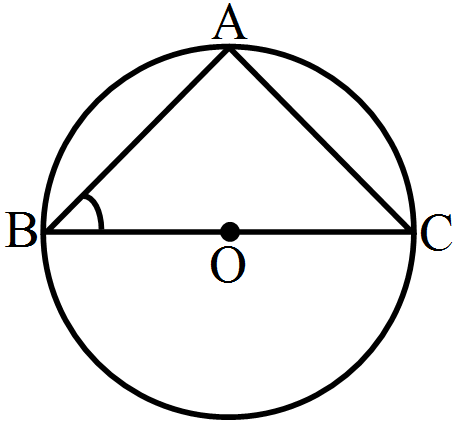
In the given figure, BOC is a diameter of a circle and AB = AC. Then, $\angle\text{ABC}=?$

  1. 30°
  2. 45°
  3. 60°
  4. 90°

Answer
  1. 45°

Solution:

Since BOC is a diameter of a circle, $\angle\text{BAC}$ is 90°.

Given that AB = AC.

$\Rightarrow\ \angle\text{ABC}=\angle\text{ACB}$

In $\triangle\text{BAC},$

$\angle\text{ABC}+\angle\text{ACB}+\angle\text{BAC}=180^\circ$ [Angle sum property]

$\Rightarrow\ \angle\text{ABC}+\angle\text{ABC}+90^\circ=180^\circ$

$\Rightarrow\ 2\angle\text{ABC}=90^\circ$

$\Rightarrow\ \angle\text{ABC}=45^\circ$

View full question & answer
Question 121 Mark
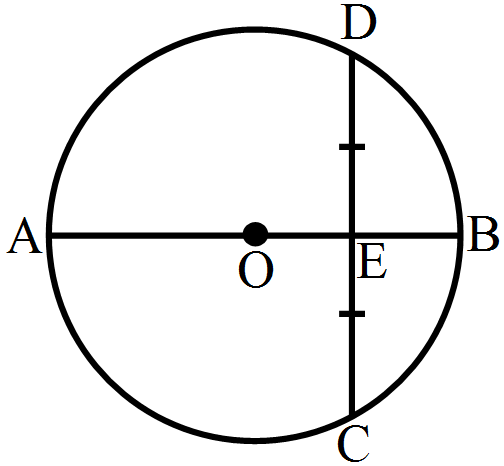
In the given figure, O is the centre of a circle and diameter AB bisects the chord CD at a point E such that CE = ED = 8cm and EB = 4cm. The radius of the circle is:

  1. 10cm
  2. 12cm
  3. 6cm
  4. 8cm

Answer
  1. 10cm

Solution:

Construction: Join OD.

OB = OD

⇒ OB = OE + EB

⇒ OB = OE + 4

⇒ OE = OB - 4 ...(i)

In right $\triangle\text{OED},$

OD2 = OE2 + DE2

⇒ OD2 = (OB - 4)2 + DE2 [From (i)]

⇒ OD2 = OB2 - 80A + 16 + 82

⇒ 8OD = 16 + 64

⇒ 8OD = 80

$\Rightarrow\ \text{OD}=\frac{80}{8}=10\text{cm}$

So, the radius of the circle is 10cm.

View full question & answer
Question 131 Mark
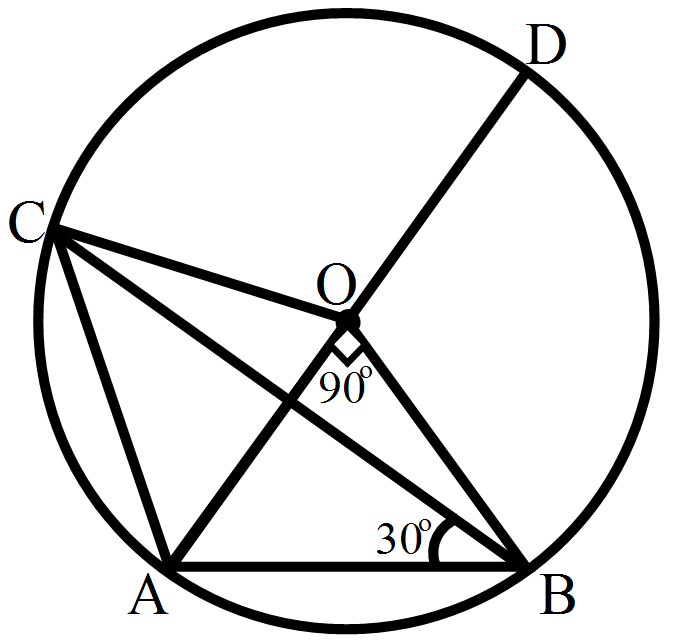
In the given figure, $\angle\text{AOB}=90^\circ$ and $\angle\text{ABC}=30^\circ.$ Then, $\angle\text{CAO}=?$

  1. 30°
  2. 45°
  3. 60°
  4. 90°

Answer
  1. 60°

Solution:

$\angle\text{AOB}=2\angle\text{ACB}$

$\Rightarrow\ \angle\text{ACB}=\frac{1}{2}\angle\text{AOB}$

$\Rightarrow\ \angle\text{ACB}=\frac{1}{2}(90^\circ)$

$\Rightarrow\ \angle\text{ACB}=45^\circ$

$\angle\text{COA}=2\angle\text{CBA}=2(30^\circ)=60^\circ$

Since AOD is a straight line,

$\therefore\ \angle\text{COD}+\angle\text{AOC}=180^\circ$

$\therefore\ \angle\text{COD}+60^\circ=180^\circ$

$\therefore\ \angle\text{COD}=120^\circ$

$\Rightarrow\ \angle\text{CAO}=\frac{1}{2}\angle\text{COD}=\frac{1}{2}\times120^\circ=60^\circ$

View full question & answer
Question 141 Mark
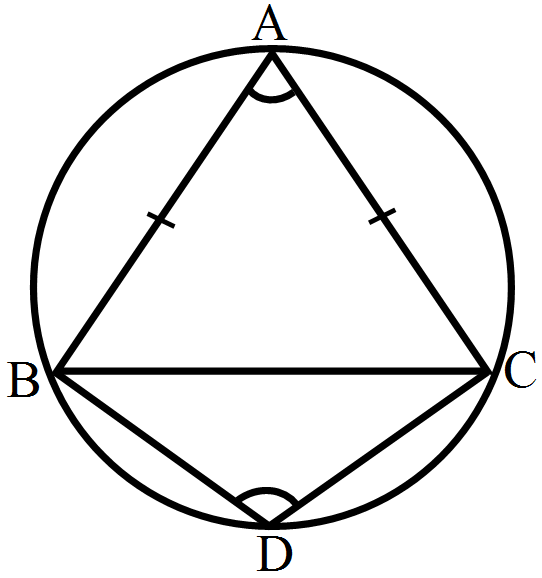
In the given figure, equilateral $\triangle\text{ABC}$ is inscribed in a circle and ABCD is a quadrilateral, as shown. Then, $\angle\text{BDC}=?$

  1. 90°
  2. 60°
  3. 120°
  4. 150°

Answer
  1. 120°

Solution:

Since $\triangle\text{BDC}$ is an equilateral traingle, $\angle\text{BAC}=60^\circ.$

Since ABCD is a cyclic equilateral,

$\angle\text{BAC}+\angle\text{BDC}=180^\circ$

$\Rightarrow\ 60^\circ+\angle\text{BDC}=180^\circ$

$\Rightarrow\ \angle\text{BDC}=120^\circ$

View full question & answer
Question 151 Mark
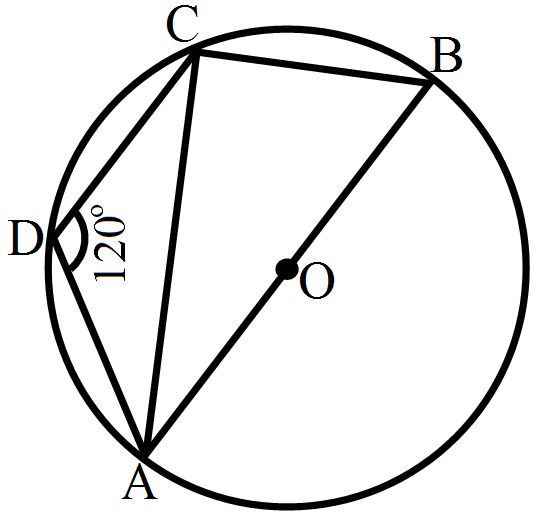
In the given figure, AOB is a diameter and ABCD is a cyclic quadrilateral. If $\angle\text{ADC}=120^\circ$ then $\angle\text{BAC}=?$

  1. 60°
  2. 30°
  3. 20°
  4. 45°

Answer
  1. 30°

Solution:

We know that the opposite angles of a quadrilateral are supplementary.

$\angle\text{ADC}+\angle\text{ABC}=180^\circ$

$\Rightarrow\ 120^\circ+\angle\text{ABC}=180^\circ$

$\Rightarrow\ \angle\text{ABC}=60^\circ$

 Since BOC is a diameter $\angle\text{ACB}=90^\circ.$

In $\triangle\text{CAB},$

$\angle\text{ABC}+\angle\text{BAC}+\angle\text{ACB}=180^\circ$ [Angle sum property]

$\Rightarrow\ 60^\circ+\angle\text{BAC}+90^\circ=180^\circ$

$\Rightarrow\ \angle\text{BAC}=30^\circ$

View full question & answer
Question 161 Mark
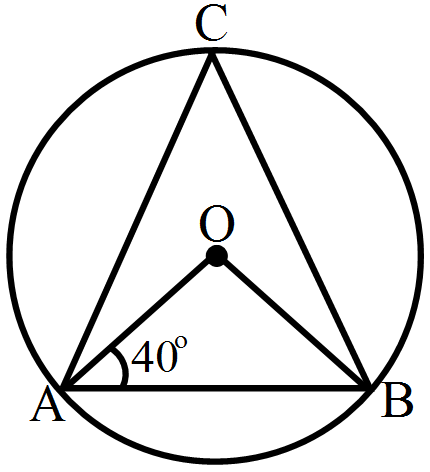
In the given figure, O is the centre of a circle. If $\angle\text{OAB}=40^\circ$ and C is a point on the circle, then $\angle\text{ACB}=?$

  1. 40°
  2. 50°
  3. 80°
  4. 100°

Answer
  1. 50°

Solution:

In $\triangle\text{OAB},$

$\text{OA}=\text{OB}$ [Radii of the same circle]

$\Rightarrow\ \angle\text{OAB}=\angle\text{OBA}$ [Angle opposite equal sides are equal]

$\angle\text{OAB}+\angle\text{OBA}+\angle\text{AOB}=180^\circ$ [Angle sum property]

$\Rightarrow\ 40^\circ+40^\circ+\angle\text{AOB}=180^\circ$

$\Rightarrow\ \angle\text{AOB}=100^\circ$

We know that, the angle subtended by an arc of a circle at the centre is double the angle subtended by it at any point on the remaining part of the circle.

So, $\angle\text{ACB}=\frac{1}{2}\angle\text{AOB}$

$=\frac{1}{2}(100^\circ)$

$=50^\circ$

View full question & answer
Question 171 Mark
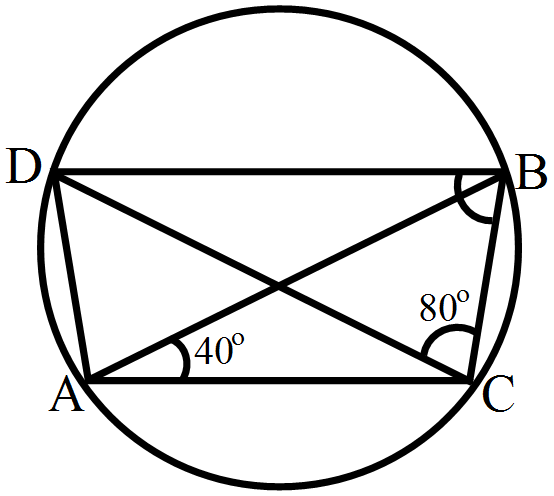
In the give figure, AB and CD are two intersecting chords of a circle. If $\angle\text{CAB}=40^\circ$ and $\angle\text{BCD}=80^\circ$then $\angle\text{CBD}=?$

  1. 80°
  2. 60°
  3. 50°
  4. 70°

Answer
  1. 60°

Solution:

Since angles in the same segment are equal,

$\angle\text{BDC}=\angle\text{BAC}=40^\circ$

In $\triangle\text{BDC},$

$\angle\text{BDC}+\angle\text{BCD}+\angle\text{CBD}=180^\circ$ [Angle sum property]

$\Rightarrow\ 40^\circ+80^\circ+\angle\text{CBD}=180^\circ$

$\Rightarrow\ \angle\text{CBD}=60^\circ$

View full question & answer
Question 181 Mark
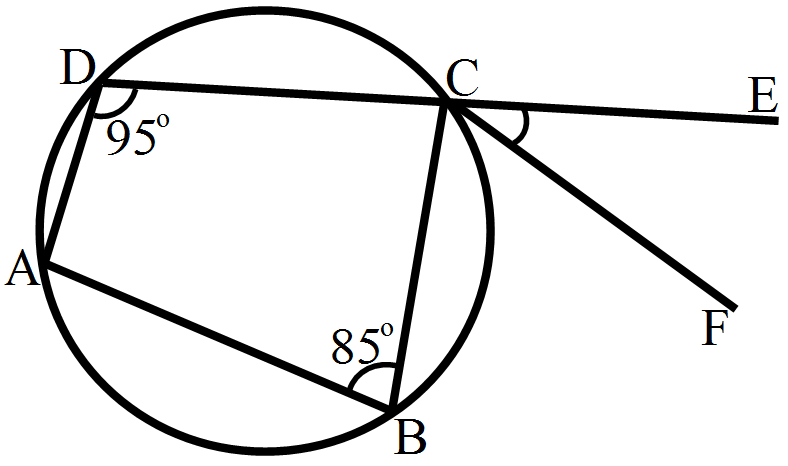
In the given figure, ABCD is a cyclic quadrilateral in which DC is produced to E and CF is drawn parallel to AB such that $\angle\text{ADC}=95^\circ$ and $\angle\text{ECF}=20^\circ.$ Then, $\angle\text{EAD}=?$

  1. 95°
  2. 85°
  3. 105°
  4. 75°

Answer
  1. 105°

Solution:

Since CF || AB, $\angle\text{ABC}=\angle\text{BCF}=85^\circ$

$\angle\text{BAD}=\angle\text{BCE}$

$\Rightarrow\ \angle\text{BAD}=\angle\text{BCF}+\angle\text{ECF}$

$\Rightarrow\ \angle\text{BAD}=105^\circ$

View full question & answer
Question 191 Mark
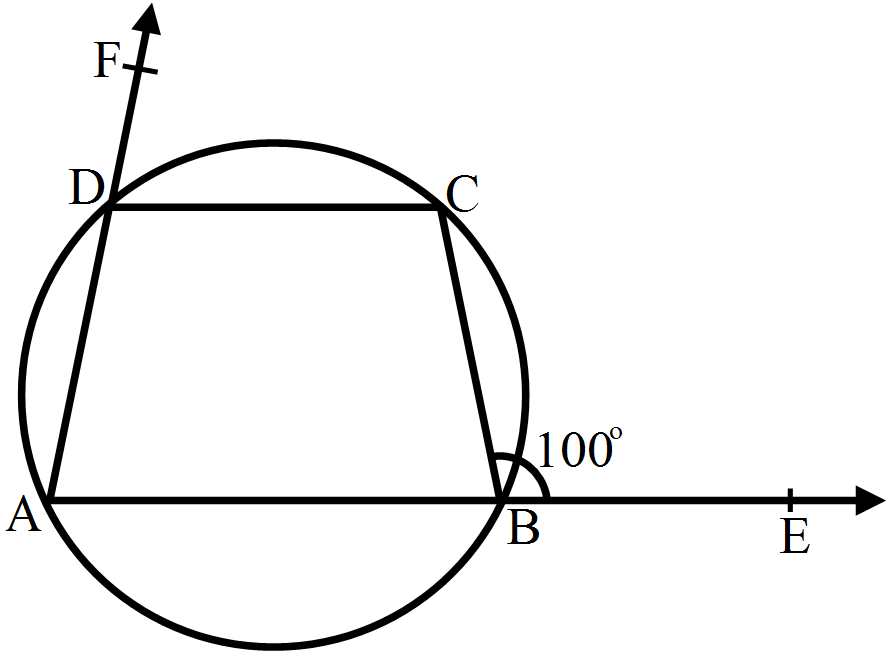
In the given figure, sides AB and AD of quad. ABCD are produced to E and F respectively. If $\angle\text{CBE}=100^\circ$ then $\angle\text{CDF}=?$

  1. 100°
  2. 80°
  3. 130°
  4. 90°

Answer
  1. 80°

Solution:

Since ABCD is a cyclic equilateral,

$\angle\text{CBE}=\angle\text{ADC}=100^\circ$

Since ADF is a straight line,

$\angle\text{CDF}+\angle\text{ADC}=180^\circ$

$\Rightarrow\ \angle\text{CDF}+100^\circ=180^\circ$

$\Rightarrow\ \angle\text{CDF}=80^\circ$

View full question & answer
Question 201 Mark
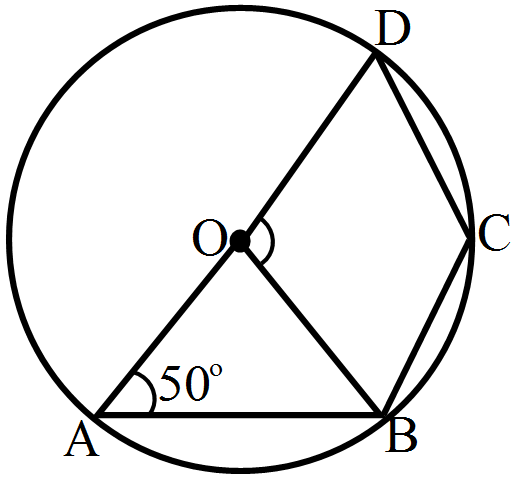
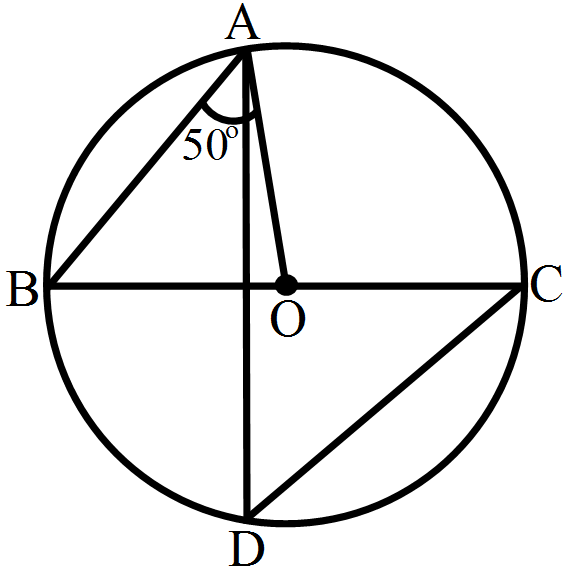
In the given figure, O is the centre of a circle and $\angle\text{OAB}=50^\circ.$ Then, $\angle\text{BOD}=?$

  1. 130°
  2. 50°
  3. 100°
  4. 80°

Answer
  1. 100°

Solution:

OA = OB [Radii of the same circle]

$\Rightarrow\ \angle\text{OAB}=\angle\text{OBA}=50^\circ$ [Angle opposite equal sides are equal]

$\angle\text{BOD}=\angle\text{OAB}+\angle\text{OBA}$

$\Rightarrow\ \angle\text{BOD}=50^\circ+50^\circ$

$\Rightarrow\ \angle\text{BOD}=100^\circ$

View full question & answer
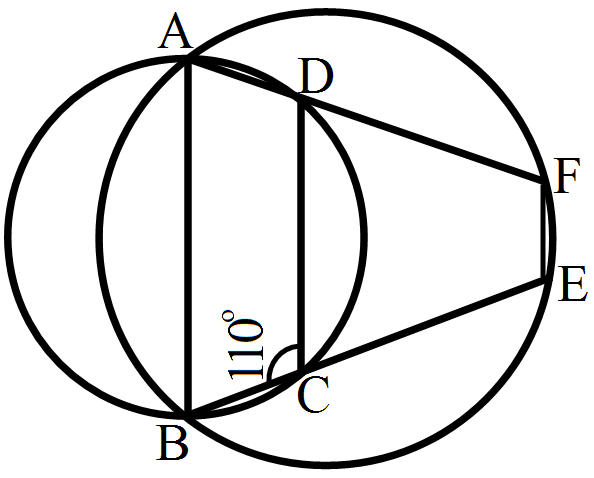
Question 211 Mark
In the given figure, ABCD and ABEF are two cyclic quadrilaterals. If $\angle\text{BCD}=110^\circ$ then $\angle\text{BEF}=?$

  1. 55°
  2. 70°
  3. 90°
  4. 110°

Answer
  1. 110°

Solution:

Since ABCD is a cyclic qyadrilateral, we have:

$\angle\text{BAD}+\angle\text{BCD}=180^\circ$

$\Rightarrow\ \angle\text{BAD}+110^\circ=180^\circ$

$\Rightarrow\ \angle\text{BAD}=70^\circ$

Since ABEF is a cyclic qyadrilateral, we have:

$\angle\text{BAD}+\angle\text{BEF}=180^\circ$

$\Rightarrow\ 70^\circ+\angle\text{BEF}=180^\circ$

$\Rightarrow\ \angle\text{BEF}=110^\circ$

View full question & answer
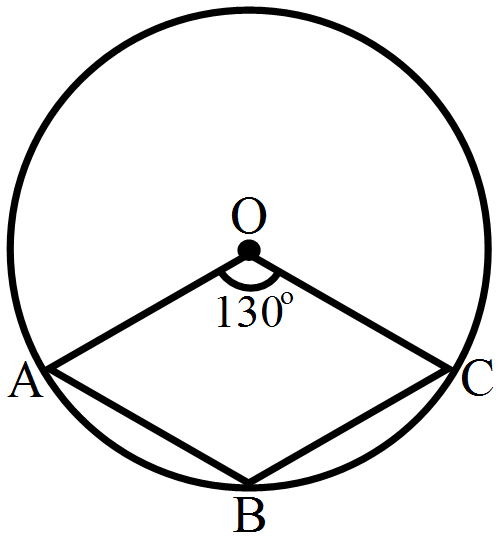
Question 221 Mark
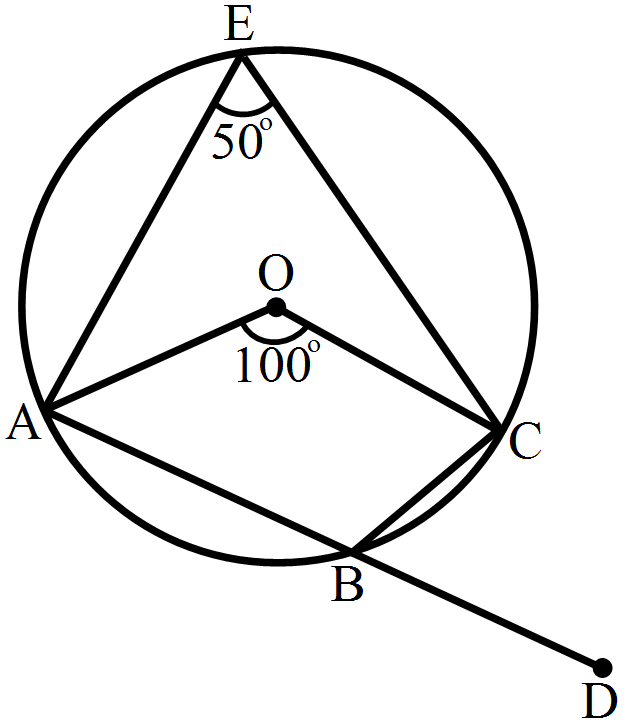
In the given figure, O is the centre of a circle and $\angle\text{AOC}=130^\circ.$ Then, $\angle\text{ABC}=?$

  1. 50°
  2. 65°
  3. 115°
  4. 130°

Answer
  1. 115°

Solution:

Minor $\angle\text{AOC}=130^\circ$

Major $\angle\text{AOC}=360^\circ-130^\circ$

⇒ Major $\angle\text{AOC}=230^\circ$

Since $\angle\text{ABC}=\frac{1}{2}\text{major}\angle\text{AOC}$

$\Rightarrow\ \angle\text{ABC}=\frac{1}{2}(230^\circ)$

$\Rightarrow\ \angle\text{ABC}=115^\circ$

View full question & answer
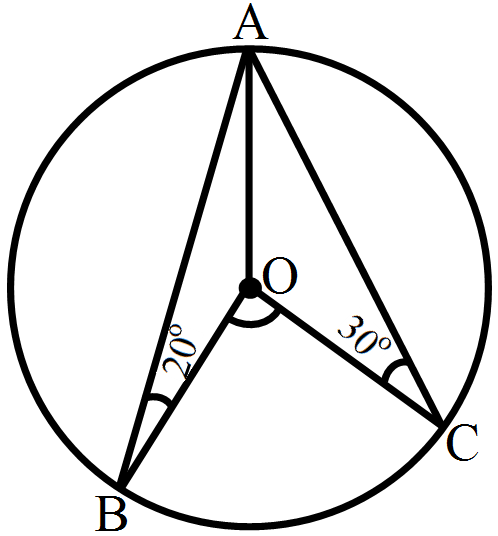
Question 231 Mark
In the given figure, O is the centre of a circle in which $\angle\text{OBA}=20^\circ$ and $\angle\text{OCA}=30^\circ.$ Then, $\angle\text{BOC}=?$

  1. 50°
  2. 90°
  3. 100°
  4. 130°

Answer
  1. 100°

Solution:

In $\triangle\text{OAB},$

OA = OB [Radii of the same circle]

$\Rightarrow\ \angle\text{OBA}=\angle\text{OAB}=20^\circ$ [Angle opposite equal sides are equal]

In $\triangle\text{OAC},$

OA = OC [Radii of the same circle]

$\Rightarrow\ \angle\text{OCA}=\angle\text{OAC}=30^\circ$ [Angle opposite equal sides are equal]

Now, $\angle\text{BAC}=\angle\text{BAO}+\angle\text{CAO}$

$=20^\circ+30^\circ$

$=50^\circ$

$\angle\text{BOC}=2\angle\text{BAC}=2(50^\circ)=100^\circ.$

View full question & answer
Question 241 Mark
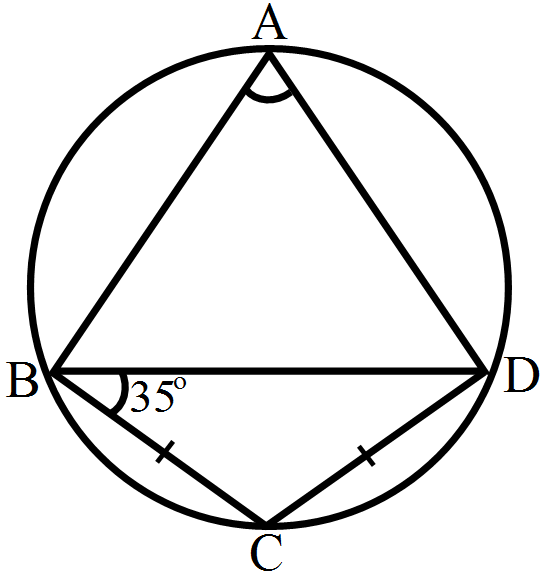
In the give figure, ABCD is a cyclic quadrilateral in which BC = CD and $\angle\text{CBD}=35^\circ.$ Then, $\angle\text{BAD}=?$

  1. 65°
  2. 70°
  3. 110°
  4. 90°

Answer
  1. 70°

Solution:

BC = BD [Given]

$\angle\text{BDC}=\angle\text{CBD}=35^\circ$ [Angle opposite equal sides are equal]

In $\triangle\text{BCD},$

$\angle\text{BCD}+\angle\text{BDC}+\angle\text{CBD}=180^\circ$ [Angle sum property]

$\Rightarrow\ \angle\text{BCD}+35^\circ+35^\circ=180^\circ$

$\Rightarrow\ \angle\text{BCD}=110^\circ$

Since ABCD is a cyclic quadrilateral,

$\angle\text{BAD}+\angle\text{BCD}=180^\circ$

$\Rightarrow\ \angle\text{BAD}+110^\circ=180^\circ$

$\Rightarrow\ \angle\text{BAD}=70^\circ$

View full question & answer
Question 251 Mark
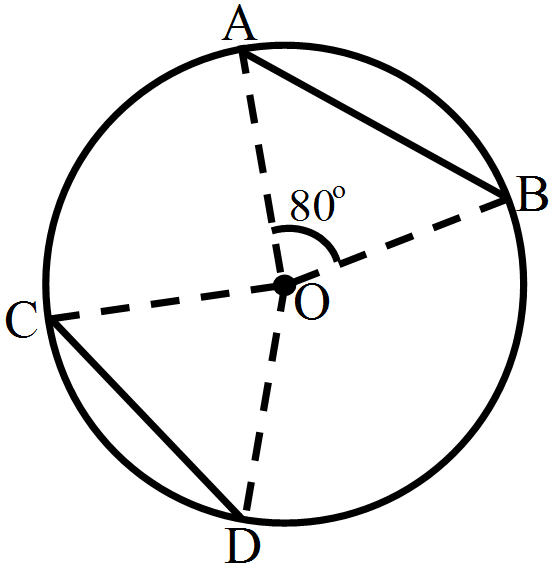
AB and CD are two equal chords of a circle with centre O such that $\angle\text{AOB}=80^\circ$ then $\angle\text{COD}=?$

  1. 100°
  2. 80°
  3. 120°
  4. 40°

Answer
  1. 80°

Solution:

Given that AB = CD.

Since equal chord, subtend equal angles at the centre,

$\angle\text{COD}=\angle\text{AOB}=80^\circ.$

View full question & answer
Question 261 Mark
In the given figure, O is the centre of a circle and $\angle\text{OAB}=50^\circ.$ Then, $\angle\text{CDA}=?$

  1. 40°
  2. 50°
  3. 75°
  4. 25°

Answer
  1. 50°

Solution:

OA = OB [Radii of the same circle]

$\Rightarrow\ \angle\text{OBA}=\angle\text{OAB}=50^\circ$

Since angles in the same segment are equal, $\angle\text{ABC}=\angle\text{CDA}.$

That is, $\angle\text{ABO}=\angle\text{CDA}=50^\circ$

View full question & answer
Question 271 Mark
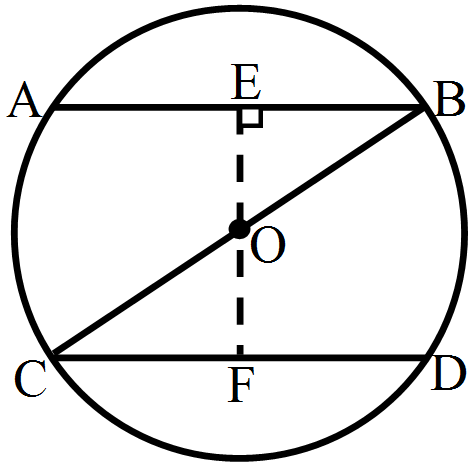
In the given figure, BOC is a diameter of a circle with centre O. If AB and CD are two chords such that AB || CD. If AB = 10cm, then CD = ?

  1. 5cm
  2. 12.5cm
  3. 15cm
  4. 10cm

Answer
  1. 10cm

Solution:

In $\triangle\text{BEO}$ and $\triangle\text{CFO},$

OB = OC [Radii of the same circle]

$\angle\text{OBE}=\angle\text{OCF}$ [Alternate angles since AB || CD]

$\angle\text{BOE}=\angle\text{COF}$ [Vertically angles]

$\Rightarrow\ \triangle\text{BEO}\cong\triangle\text{CFO}$ [ASA congruence criterion]

⇒ OE = OF [C.P.C.T.]

Since chord are equidistant from the centre are equal, AB = CD = 10 cm.

View full question & answer
Question 281 Mark
In the given figure, AB is a chord of a circle with centre O and BOC is a diameter. If $\text{OD}\perp\text{AB}$ such that OD = 6cm, then AC = ?

  1. 9cm
  2. 12cm
  3. 15cm
  4. 7.5cm

Answer
  1. 12cm

Solution:

In $\triangle\text{BOD}$ and $\triangle\text{CAB},$

Since BOC is the diameter, $\angle\text{CAB}=90^\circ.$

Also, $\angle\text{ODB}=90^\circ.$

So, $\angle\text{DBO}=\angle\text{ABC}$ [Common angles]

$\Rightarrow\ \triangle\text{BOD}\sim\triangle\text{BCA}$ [AA congruence criterion]

$\Rightarrow\ \frac{\text{OD}}{\text{CA}}=\frac{\text{BO}}{\text{BA}}$

$\Rightarrow\ \frac{\text{OD}}{\text{CA}}=\frac{1}{2}$ [Since radius = 2 diameter]

$\Rightarrow\ \frac{6}{\text{CA}}=\frac{1}{2}$

⇒ CA = 12cm that is, AC = 12cm.

View full question & answer
Question 291 Mark
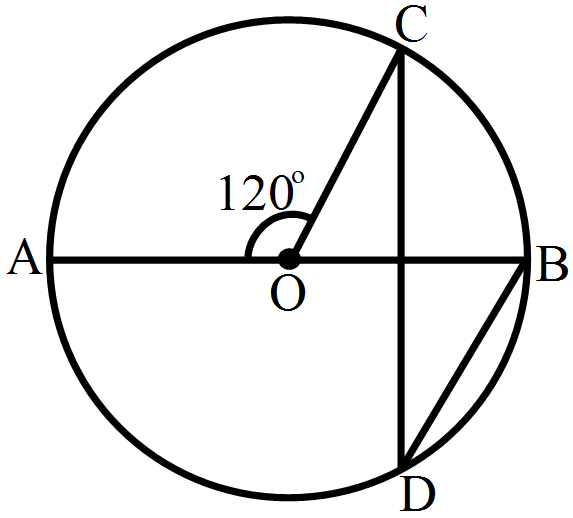
In the given figure, O is the centre of a circle and $\angle\text{AOC}=120^\circ.$ Then, $\angle\text{BDC}=?$

  1. 60°
  2. 45°
  3. 30°
  4. 15°

Answer
  1. 30°

Solution:

Since BOA is a diameter.

$\angle\text{AOC}+\angle\text{BOC}=180^\circ$

$\Rightarrow\ 120^\circ+\angle\text{BOC}=180^\circ$

$\Rightarrow\ \angle\text{BOC}=60^\circ$

So, $\angle\text{BDC}=\frac{1}{2}\angle\text{BOC}=\frac{1}{2}(60^\circ)=30^\circ$

View full question & answer
Question 301 Mark
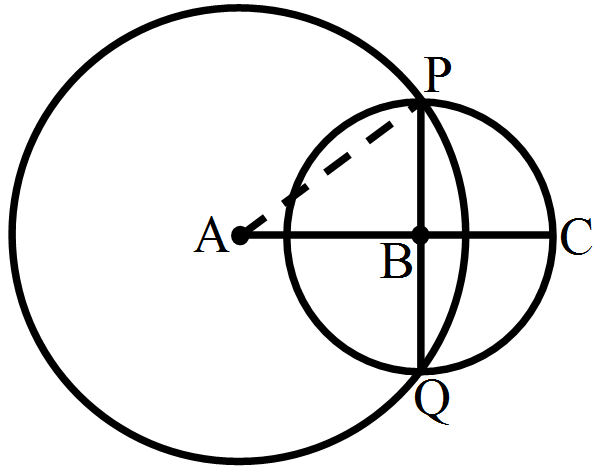
In the given figure, A and B are the centres of two circles having radii 5cm and 3cm respectively and intersecting at points P and Q respectively. If AB = 4cm, then the length of common chord PQ is:

  1. 3cm
  2. 6cm
  3. 7.5cm
  4. 9cm

Answer
  1. 6cm

Solution:

We know that, the line joining centres is the perpendicular bisector of the common chord.

Then,

AP = 5cm, BP = 3cm and AB = 4cm

AP2 = 52 = 25

BP2 + AB2 = 32 + 42 = 25

In $\triangle\text{ABP},$

Since AP2 = BP2 + AB2

$\triangle\text{ABP},$ is a right-angled triangle and PQ = 2BP = 2(3) = 6cm.

View full question & answer
Question 311 Mark
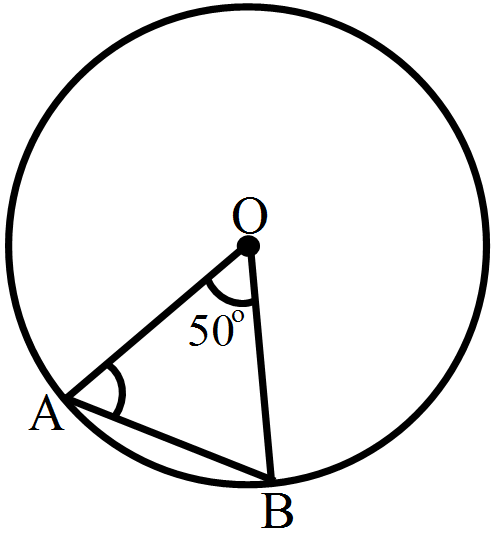
In the given figure, O is the centre of a circle. Then, $\angle\text{OAB}=?$

  1. 50°
  2. 60°
  3. 55°
  4. 65°

Answer
  1. 65°

Solution:

OA = OB [Radii of the same circle]

$\Rightarrow\ \angle\text{OAB}=\angle\text{OBA}$

In $\triangle\text{OAB},$

$\angle\text{BOA}+\angle\text{OAB}+\angle\text{OBA}=180^\circ$ [Angle sum property]

$\Rightarrow\ 50^\circ+\angle\text{OAB}+\angle\text{OAB}=180^\circ$

$\Rightarrow\ 2\angle\text{OAB}=130^\circ$

$\Rightarrow\ \angle\text{OAB}=65^\circ$

View full question & answer
Question 321 Mark
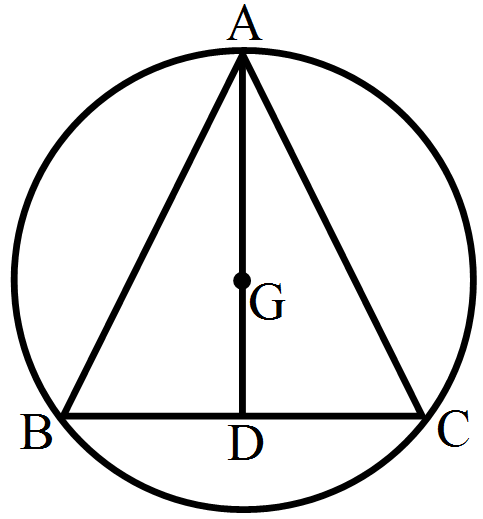
An equilateral triangle of side 9cm is inscribed in a circle. The radius of the circle is:
  1. $3\text{cm}$
  2. $3\sqrt{2}\text{cm}$
  3. $3\sqrt{3}\text{cm}$
  4. $6\text{cm}$
Answer
  1. $3\sqrt{3}\text{cm}$

Solution:

Let $\triangle\text{ABC}$ be an equilateral triangle.

Let AD be one of its medians.

Then, $\text{AD}\perp\text{BC}$ and BD = 4.5cm

In right $\triangle\text{ADB},$

$\therefore\ \text{AD}=\sqrt{\text{AB}^2-\text{BD}^2}$ [By pythagoras theorem]

$=\sqrt{9^2-\frac{9^2}{2}}$

$=\sqrt{81-\frac{81}{2}}$

$=\sqrt{\frac{243}{2}}$

$=\frac{9\sqrt{3}}{2}\text{cm}$

Let G be the centroid of $\triangle\text{ABC}.$

Then, AG : GD = 2 : 1

$\therefore$ radius $=\text{AG}=\frac{2}{3}\text{AD}=\Big(\frac{2}{3}\times\frac{9\sqrt{3}}{2}\Big)=3\sqrt{3}\text{cm}$

View full question & answer
Question 331 Mark
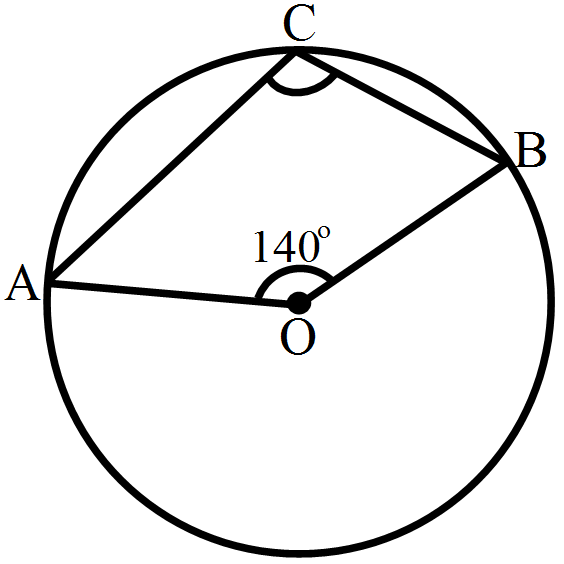
In the given figure, O is the centre of a circle and $\angle\text{AOB}=140^\circ.$ Then, $\angle\text{ACB}=?$

  1. 70°
  2. 80°
  3. 110°
  4. 40°

Answer
  1. 110°

Solution:

Minor $\angle\text{AOB}=140^\circ$

Major $\angle\text{AOB}=360^\circ-140^\circ$

⇒ Major $\angle\text{AOB}=220^\circ$

Since $\angle\text{ACB}=\frac{1}{2}\text{major}\angle\text{AOB}$

$\Rightarrow\ \angle\text{ACB}=\frac{1}{2}(220^\circ)$

$\Rightarrow\ \angle\text{ACB}=110^\circ$

View full question & answer
Question 341 Mark
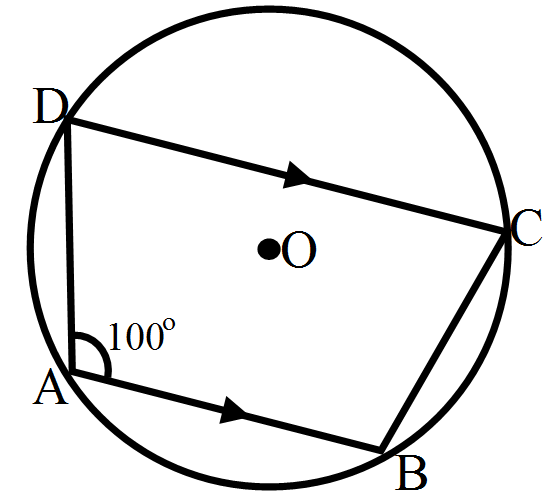
In the given figure ABCD is a cyclic quadrilateral in which AB || DC and $\angle\text{BAD}=100^\circ.$ Then, $\angle\text{ABC}=?$

  1. 80°
  2. 100°
  3. 50°
  4. 40°

Answer
  1. 100°

Solution:

Since AB || DC,

$\angle\text{ADC}+\angle\text{BAD}=180^\circ$

$\Rightarrow\ 100^\circ+\angle\text{BAD}=180^\circ$

$\Rightarrow\ \angle\text{BAD}=80^\circ$

We know that the opposite angles of a quadrilateral are supplementary.

$\angle\text{BAD}+\angle\text{ABC}=180^\circ$

$\Rightarrow\ 80^\circ+\angle\text{ABC}=180^\circ$

$\Rightarrow\ \angle\text{ABC}=100^\circ$

View full question & answer
Question 351 Mark
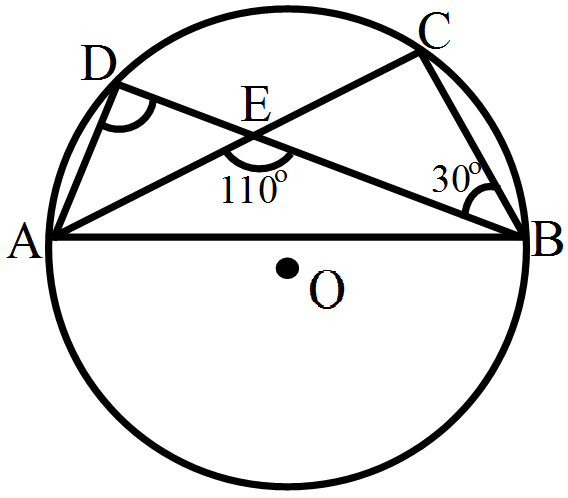
In the given figure, O is the centre of a circle and chords AC and BD intersect at E. If $\angle\text{AEB}=110^\circ$ and $\angle\text{CBE}=30^\circ,$ then $\angle\text{ADB}=?$

  1. 70°
  2. 60°
  3. 80°
  4. 90°

Answer
  1. 80°

Solution:

$\angle\text{AED}=\angle\text{ECB}+\angle\text{EBC}$

$\Rightarrow\ 110^\circ=\angle\text{ECB}+30^\circ$

$\Rightarrow\ \angle\text{ECB}=80^\circ$

Since angles in the same segment are equal,

$\angle\text{ADB}=\angle\text{ECB}=80^\circ$

View full question & answer
Question 361 Mark
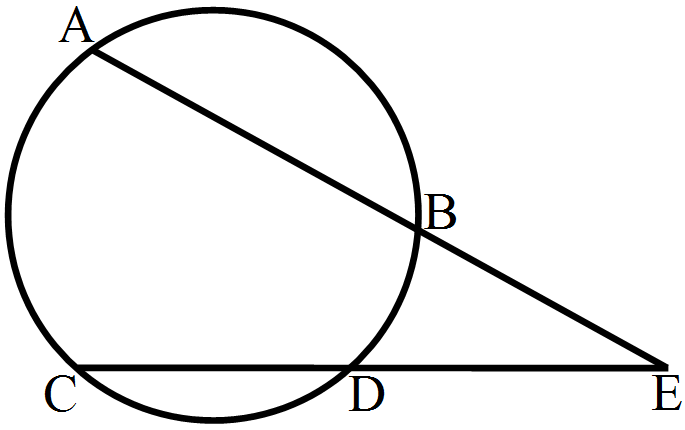
Two chords AB and CD of a circle intersect each other at a point E outside the circle. If AB = 11cm, BE = 3cm and DE = 3.5cm, then CD = ?

  1. 10.5cm
  2. 9.5cm
  3. 8.5cm
  4. 7.5cm

Answer
  1. 8.5cm

Solution:

Construction: Join AC.

$\frac{\text{AE}}{\text{CE}}=\frac{\text{DE}}{\text{BE}}$

⇒ AE × BE = DE × CE ...(i)

Then,

AE = AB + BE = 11 + 3 = 14cm, BE = 3cm, CE = (x + 3.5)cm and DE = 3.5cm

So, from (i), we get

14 × 3 = 3.5 × (CD + 3.5)

$\Rightarrow\ \frac{14\times3}{3.5}=\text{CD}+3.5$

⇒ 12 = CD + 3.5

⇒ CD = 8.5cm

View full question & answer
Question 371 Mark
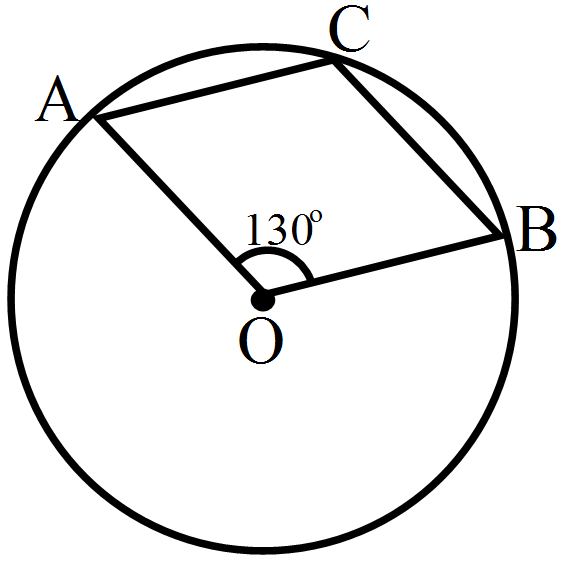
In the given figure, O is the centre of a circle and $\angle\text{AOB}=130^\circ.$ Then, $\angle\text{ACB}=?$

  1. 50°
  2. 65°
  3. 115°
  4. 155°

Answer
  1. 115°

Solution:

Minor $\angle\text{AOB}=130^\circ$

Major $\angle\text{AOB}=360^\circ-130^\circ$

⇒ Major $\angle\text{AOB}=230^\circ$

Since $\angle\text{ACB}=\frac{1}{2}\text{major}\angle\text{AOB}$

$\Rightarrow\ \angle\text{ACB}=\frac{1}{2}(230^\circ)$

$\Rightarrow\ \angle\text{ACB}=115^\circ$

View full question & answer
Question 381 Mark
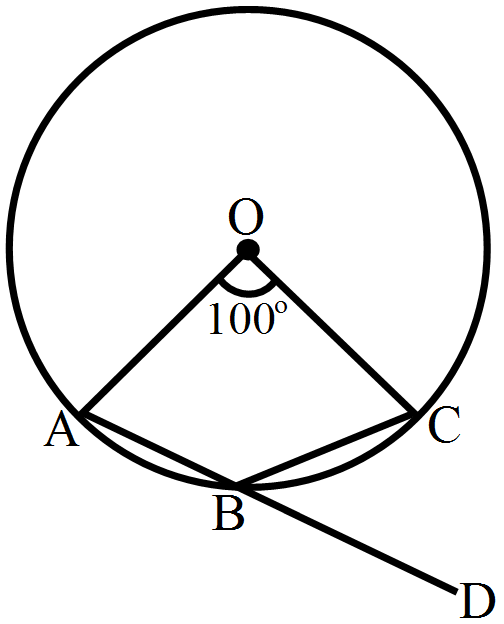
In the given figure, O is the centre of a circle in which $\angle\text{AOC}=100^\circ.$ Side AB of quadrilateral OABC has been produced to D. Then, $\angle\text{CBD}=?$

  1. 50°
  2. 40°
  3. 25°
  4. 80°

Answer
  1. 50°

Solution:

Construction: Let E be a point on the reamaining part of the circumference of the circle.

Join AE and CE.

$\angle\text{AEC}=\frac{1}{2}\angle\text{AOC}$

$\Rightarrow\ \angle\text{AEC}=\frac{1}{2}(100^\circ)=50^\circ$

Since AECB forms a cyclic quadrilateral.

$\Rightarrow\ \angle\text{CBD}=\angle\text{AEC}=50^\circ$

View full question & answer
Question 391 Mark
In the given figure, O is the centre of a circle. If $\angle\text{OAC}=50^\circ$ then $\angle\text{ODB}=?$

  1. 40°
  2. 50°
  3. 60°
  4. 75°

Answer
  1. 50°

Solution:

Since angles in the same segment of a circle are equal.

$\angle\text{CDB}=\angle\text{BAC}$

That is , $\angle\text{ODB}=\angle\text{OAC}=50^\circ.$

View full question & answer
Question 401 Mark
The angle in a semicircle measures:
  1. 45°
  2. 60°
  3. 90°
  4. 36°
Answer
  1. 90°

Solution:

The angle in a semicircle measures 90°.

View full question & answer
Question 411 Mark
Angles in the same segment of a circle area are:
  1. Equal
  2. Complementary
  3. Supplementary
  4. None of these
Answer
  1. Equal

Solution:

Angles in a the same segment of a circle area are equal.

View full question & answer
Question 421 Mark
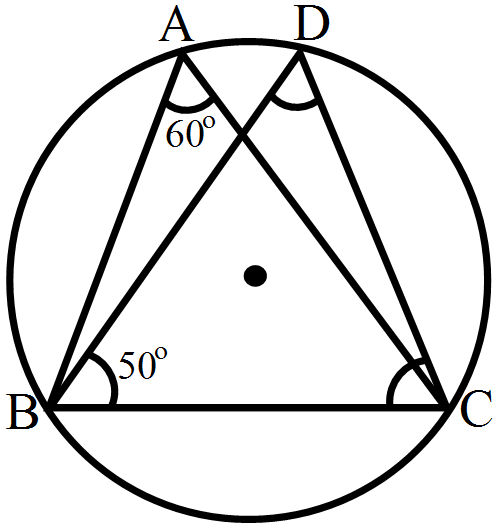
In the given figure, $\triangle\text{ABC}$ and $\triangle\text{DBC}$ are inscribed in a circle such that $\angle\text{BAC}=60^\circ$ and $\angle\text{DBC}=50^\circ.$ Then $\angle\text{BCD}=?$

  1. 50°
  2. 60°
  3. 70°
  4. 80°

Answer
  1. 70°

Solution:

Since angles in the same segment of a circle are equal.

$\angle\text{BAC}=\angle\text{BDC}=60^\circ.$

In $\triangle\text{BDC},$

$\angle\text{BDC}+\angle\text{DBC}+\angle\text{BCD}=180^\circ.$

$\Rightarrow\ 60^\circ+50^\circ+\angle\text{BCD}=180^\circ$

$\Rightarrow\ \angle\text{BCD}=70^\circ$

View full question & answer
M.C.Q - Maths STD 9 Questions - Vidyadip