Questions · Page 1 of 2

M.C.Q

🎯

Test yourself on this topic

50 questions · timed · auto-graded

MCQ 11 Mark
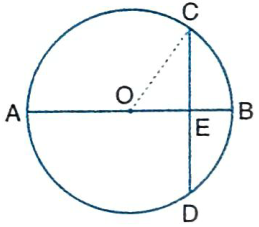
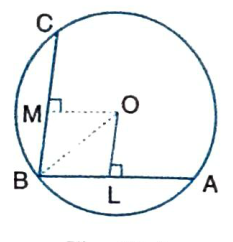
If $A B=12 cm, B C=16 cm$ and $A B$ is perpendicular to $B C$, then the radius of the circle passing through the points A, B and C is
Image
  • A
    6 cm
  • B
    8 cm
  • 10 cm
  • D
    12 cm
Answer
Correct option: C.
10 cm
(c) 10 cm
Perpendicular from the centre to a chord bisects the chord. Therefore, $L$ and $M$ are mid-points of $A B$ and $B C$ respectively. Thus, in right triangle $O L B$, we have
$O L=B M=\frac{1}{2} B C=8 cm \text { and } B L=\frac{1}{2} A B=6 cm$
Applying Pythagoras theorem in $\triangle O L B$, we obtain
$O B^2=O L^2+L B^2 \Rightarrow O B=\sqrt{8^2+6^2}=\sqrt{100}=10 cm$
View full question & answer
MCQ 21 Mark
  • A
    $2: 1$
  • B
    $1: 2$
  • $3: 1$
  • D
    $1: 3$
Answer
Correct option: C.
$3: 1$
(c) $3: 1$
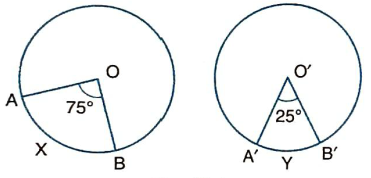
$\frac{\operatorname{arc} A X B}{\operatorname{arc} A^{\prime} Y^{\prime} B}=\frac{m(\widehat{A X B})}{m\left(A^{\prime} X B^{\prime}\right)}=\frac{75^{\circ}}{25^{\circ}}=\frac{3}{1}$
View full question & answer
MCQ 31 Mark
  • $50^{\circ}$
  • B
    $40^{\circ}$
  • C
    $60^{\circ}$
  • D
    $70^{\circ}$
Answer
Correct option: A.
$50^{\circ}$
(a) $50^{\circ}$
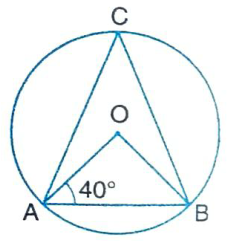
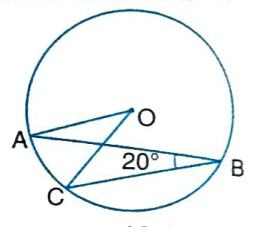
In $\triangle O A B$, we have
$O A=O B \Rightarrow \angle O B A=\angle O A B \Rightarrow \angle O B A=40^{\circ}$
Using angle sum property in $\triangle A O B$, we obtain
$\begin{array}{ll}& \angle O A B+\angle O B A+\angle A O B=180^{\circ} \\
\Rightarrow & 40^{\circ}+40^{\circ}+\angle A O B=180^{\circ} \Rightarrow \angle A O B=100^{\circ}\end{array}$
Thus, $\operatorname{arc} A B$ subtends $\angle A O B=100^{\circ}$ at the centre and $\angle A C B$ at a point on the circumference.
$\therefore \quad \angle A C B=\frac{1}{2} \angle A O B=50^{\circ}$
View full question & answer
MCQ 41 Mark
  • A
    $60^{\circ}$
  • B
    $50^{\circ}$
  • $70^{\circ}$
  • D
    $80^{\circ}$
Answer
Correct option: C.
$70^{\circ}$
(c) $70^{\circ}$
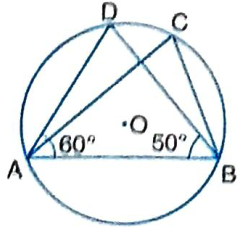
In $\triangle A B D$, we have
$\begin{array}{l}\angle D A B=60^{\circ} \text { and } \angle A B D=50^{\circ} \\
\angle A D B=180^{\circ}-60^{\circ}-50^{\circ}=70^{\circ}\end{array}$
We find that $\angle A D B$ and $\angle A C B$ are angles made by the are $A B$ in the same segment.
$
∴\quad$ \angle A C B=\angle A D B \Rightarrow \angle A C B=70^{\circ}$
View full question & answer
MCQ 51 Mark
  • A
    $30^{\circ}$
  • B
    $60^{\circ}$
  • C
    $90^{\circ}$
  • $45^{\circ}$
Answer
Correct option: D.
$45^{\circ}$
(d) $45^{\circ}$
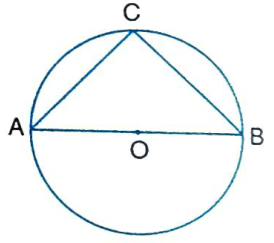
We find that angle in a semi-circle is a right angle. Therefore, $\angle A C B=90^{\circ}$.
It is given that
$A C=B C \Rightarrow \angle C A B=\angle C B A$
Using angle sum property in $\triangle A B C$, we obtain
$\angle A C B+\angle C A B+\angle C B A=180^{\circ} \Rightarrow 90^{\circ}+2 \angle C A B=180^{\circ} \Rightarrow\angle C A B=45^{\circ}$
View full question & answer
MCQ 61 Mark
  • A
    $30^{\circ}$
  • B
    $45^{\circ}$
  • C
    $90^{\circ}$
  • $60^{\circ}$
Answer
Correct option: D.
$60^{\circ}$
(d) $60^{\circ}$
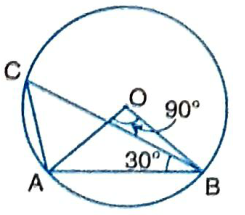
In $\triangle A O B$, we find that
$\begin{array}{ll}& O A=O B \\
\Rightarrow \quad & \angle O A B=\angle O B A\end{array}$
Using angle sum property in $\triangle O A B$, we obtain
$\begin{array}{ll}& \angle O A B+\angle O B A+\angle A O B=180^{\circ} \\
\Rightarrow \quad & 2 \angle O A B+90^{\circ}=180^{\circ} \Rightarrow \angle O A B=45^{\circ} \Rightarrow \angle O BA=45^{\circ}\end{array}$
Arc $A B$ subtends $\angle A O B=90^{\circ}$ at the centre $O$ and $\angle A C B$ at a point on the remaining part of the circle.
$\therefore \quad \angle A C B=\frac{1}{2} \angle A O B=\frac{1}{2} \times 90^{\circ}=45^{\circ}$
Thus, in $\triangle A B C$, we have $\angle A B C=30^{\circ}$ and $\angle A C B=45^{\circ}$.
$\begin{array}{ll}\therefore & \angle B A C=180^{\circ}-30^{\circ}-45^{\circ}=105^{\circ} \quad \text { [Using angle sum property in } \triangle A B C \text { ] } \\
\Rightarrow & \angle C A O+\angle O A B=105^{\circ} \Rightarrow \angle C A O+45^{\circ}=105^{\circ} \Rightarrow
\angle C A O=60^{\circ}\end{array}$
View full question & answer
MCQ 81 Mark
  • A
    $30^{\circ}$
  • B
    $45^{\circ}$
  • $60^{\circ}$
  • D
    $120^{\circ}$
Answer
Correct option: C.
$60^{\circ}$
(c) $60^{\circ}$
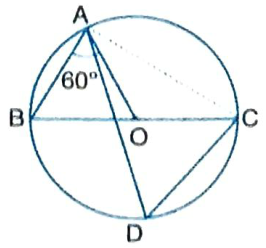
We observe that $\angle B A C$ is the angle in a semi-circle. Therefore, $\angle B A C=90^{\circ}$.
$\therefore \quad \angle O A C=\angle B A C-\angle O A B=90^{\circ}-60^{\circ}-30^{\circ}$
In $\triangle O A C$, we have
$O A=O C \Rightarrow \angle O A C=\angle O C A \Rightarrow \angle O C A=30^{\circ}$
Thus, in $\triangle O A C$, we have
$\begin{array}{ll}& \angle O A C=\angle O C A=30^{\circ} \\
\therefore \quad & \angle A O C=180^{\circ}-(\angle O A C+\angle O C A)=180^{\circ}
\left(30^{\circ}+30^{\circ}\right)=120^{\circ}\end{array}$
Clearly, arc $A C$ makes angle $\angle A O C=120^{\circ}$ at the centre $O$ and $\angle A D C$ at point on the remaining part of the circle.
$\therefore \quad \angle A D C=\frac{1}{2} \angle A O C=\frac{1}{2} \times 120^{\circ}=60^{\circ}$
View full question & answer
MCQ 91 Mark
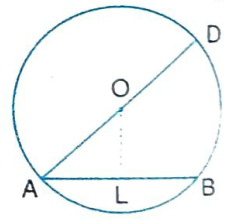
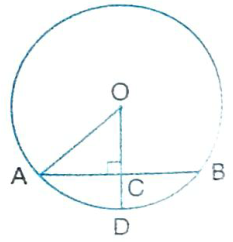
AD is a diameter of a circle and AB is a chord. If AD = 34 cm, AB = 30 cm, the distance of AB from the centre of the circle is
Image
  • A
    17 cm
  • B
    15 cm
  • C
    4 cm
  • 8 cm
Answer
Correct option: D.
8 cm
(d) 8 cm
Let O be the centre of the circle and $O L \perp A B$. Then, $L$ is the midpoint of $A B$. We have, $O A=17 cm$ and $A L=15 cm$.
Applying Pythagoras theorem in $\triangle O L A$, we obtain
$\begin{array}{ll}& O A^2=O L^2+A L^2 \\
\Rightarrow \quad & O L=\sqrt{O A^2-O L^2}=\sqrt{17^2-15^2}=\sqrt{289-225}=\sqrt{64}=8 cm\end{array}$
View full question & answer
MCQ 101 Mark
Two equal circles of radius r intersect such that each passes through the of the other. The length of the common chord of the circles, is
  • A
    $\sqrt{r}$
  • B
    $\sqrt{2} r A B$
  • $\sqrt{3} r$
  • D
    $\frac{\sqrt{3}}{2} r$
Answer
Correct option: C.
$\sqrt{3} r$
c
View full question & answer
MCQ 111 Mark
The radius of a circle is 6 cm. The perpendicular distance from the centre of the circle to the chord which is 8 cm in length, is
  • A
    $\sqrt{5} cm$
  • $2 \sqrt{5} cm$
  • C
    $2 \sqrt{7} cm$
  • D
    $\sqrt{7} cm$
Answer
Correct option: B.
$2 \sqrt{5} cm$
b
View full question & answer
MCQ 121 Mark
The greatest chord of a circle is called its
  • A
    radius
  • B
    secant
  • diameter
  • D
    none of these
Answer
Correct option: C.
diameter
c
View full question & answer
MCQ 131 Mark
The chord of a circle is equal to its radius. The angle subtended by this chord at the minor arc of the circle, is
  • A
    $60^{\circ}$
  • B
    $75^{\circ}$
  • C
    $120^{\circ}$
  • $150^{\circ}$
Answer
Correct option: D.
$150^{\circ}$
d
View full question & answer
MCQ 141 Mark
PQRS is a cyclic quadrilateral such that PR is a diameter of the circle. If $\angle Q P R=67^{\circ}$ and $\angle S P R=72^{\circ}$, then $\angle Q R S=$
  • $41^{\circ}$
  • B
    $23^{\circ}$
  • C
    $67^{\circ}$
  • D
    $18^{\circ}$
Answer
Correct option: A.
$41^{\circ}$
a
View full question & answer
MCQ 151 Mark
One chord of a circle is known to be 10 cm. The radius of this circle must be
  • A
    5 cm
  • greater than 5 cm
  • C
    greater than or equal to 5 cm
  • D
    less than 5 cm
Answer
Correct option: B.
greater than 5 cm
b
View full question & answer
MCQ 161 Mark
Number of circles that can be drawn through three non-collinear points, is
  • 1
  • B
    $0$
  • C
    2
  • D
    3
Answer
Correct option: A.
1
a
View full question & answer
MCQ 171 Mark
Let C be the mid-point of an arc AB of a circle such that m$\overparen{A B}=183^{\circ}$. If the region bounded by the arc ACB and line segment AB is denoted by S, then the centre O of the circle lies
  • in the interior of S
  • B
    in the exterior of S
  • C
    on the segment AB
  • D
    on AB and bisects AB
Answer
Correct option: A.
in the interior of S
a
View full question & answer
MCQ 181 Mark
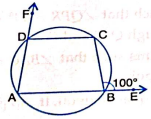
In Fig. sides AB and AD of quadrilateral ABCD are produced to E and F respectively. If $\angle C B E=100^{\circ}$, then $\angle C D F=$
Image
  • A
    $100^{\circ}$
  • $80^{\circ}$
  • C
    $130^{\circ}$
  • D
    $90^{\circ}$
Answer
Correct option: B.
$80^{\circ}$
b
View full question & answer
MCQ 191 Mark
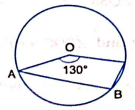
In Fig. O is the centre of the circle such that $\angle A O C=130^{\circ}$, then $\angle A B C=$
Image
  • A
    $130^{\circ}$
  • $115^{\circ}$
  • C
    $65^{\circ}$
  • D
    $165^{\circ}$
Answer
Correct option: B.
$115^{\circ}$
b
View full question & answer
MCQ 201 Mark
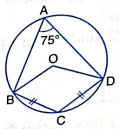
In Fig. O is the centre of the circle. If $\angle B A D=75^{\circ}$ and chord BC = chord CD then $\angle B O C=$
Image
  • A
    $80^{\circ}$
  • B
    $65^{\circ}$
  • $75^{\circ}$
  • D
    $105^{\circ}$
Answer
Correct option: C.
$75^{\circ}$
c
View full question & answer
MCQ 211 Mark
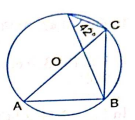
In Fig. O is the centre of the circle and $\angle B D C=42^{\circ}$. The measure of $\angle A C B$ is
Image
  • A
    $42^{\circ}$
  • $48^{\circ}$
  • C
    $58^{\circ}$
  • D
    $52^{\circ}$
Answer
Correct option: B.
$48^{\circ}$
b
View full question & answer
MCQ 221 Mark
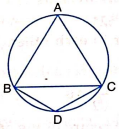
In Fig. if equilateral triangle ABC is inscribed in a circle and ABCD is a quadrilateral, then $\angle B D C=$
Image
  • A
    $90^{\circ}$
  • B
    $60^{\circ}$
  • $120^{\circ}$
  • D
    $150^{\circ}$
Answer
Correct option: C.
$120^{\circ}$
c
View full question & answer
MCQ 231 Mark
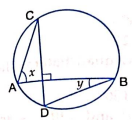
In Fig. if chords AB and CD of the circle intersect each other at right angles, then x + y =
Image
  • A
    $45^{\circ}$
  • B
    $60^{\circ}$
  • C
    $75^{\circ}$
  • $90^{\circ}$
Answer
Correct option: D.
$90^{\circ}$
d
View full question & answer
MCQ 241 Mark
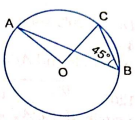
In Fig. if $\angle A B C=45^{\circ}$, then $\angle A O C=$
Image
  • A
    $45^{\circ}$
  • B
    $60^{\circ}$
  • C
    $75^{\circ}$
  • $90^{\circ}$
Answer
Correct option: D.
$90^{\circ}$
d
View full question & answer
MCQ 251 Mark
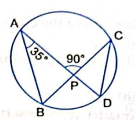
In Fig. chords AD and BC intersect each other at right angles at a point P. If $\angle D A B=35^{\circ}$, then $\angle A D C=$
Image
  • A
    $35^{\circ}$
  • B
    $45^{\circ}$
  • $55^{\circ}$
  • D
    $65^{\circ}$
Answer
Correct option: C.
$55^{\circ}$
c
View full question & answer
MCQ 261 Mark
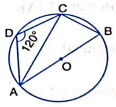
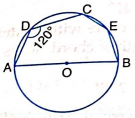
In Fig. AOB is a diameter of the circle. If $\angle A D C=120^{\circ}$, then $\angle B A C=$
Image
  • A
    $60^{\circ}$
  • $30^{\circ}$
  • C
    $45^{\circ}$
  • D
    $20^{\circ}$
Answer
Correct option: B.
$30^{\circ}$
b
View full question & answer
MCQ 271 Mark
In Fig. $\angle O B D=$
Image
  • A
    $30^{\circ}$
  • $15^{\circ}$
  • C
    $20^{\circ}$
  • D
    $35^{\circ}$
Answer
Correct option: B.
$15^{\circ}$
b
View full question & answer
MCQ 281 Mark
In Fig. $\angle B O D=$
Image
  • $150^{\circ}$
  • B
    $140^{\circ}$
  • C
    $105^{\circ}$
  • D
    $145^{\circ}$
Answer
Correct option: A.
$150^{\circ}$
a
View full question & answer
MCQ 291 Mark
In Fig. $\angle B C D=$
Image
  • A
    $95^{\circ}$
  • B
    $85^{\circ}$
  • C
    $100^{\circ}$
  • $105^{\circ}$
Answer
Correct option: D.
$105^{\circ}$
d
View full question & answer
MCQ 301 Mark
In Fig. AB is a diameter of the circle. If $\angle A D C=120^{\circ}$, then $\angle C A B=$
Image
  • A
    $60^{\circ}$
  • B
    $45^{\circ}$
  • $30^{\circ}$
  • D
    $40^{\circ}$
Answer
Correct option: C.
$30^{\circ}$
c
View full question & answer
MCQ 311 Mark
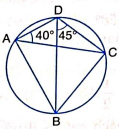
In Fig. ABCD is a quadrilateral inscribed in a circle. If $\angle D A C=40^{\circ}$ and $\angle B D C=45^{\circ}$, then $\angle B C D=$
Image
  • A
    $85^{\circ}$
  • $95^{\circ}$
  • C
    $75^{\circ}$
  • D
    $105^{\circ}$
Answer
Correct option: B.
$95^{\circ}$
b
View full question & answer
MCQ 321 Mark
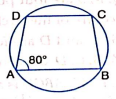
In Fig. ABCD is a cyclic quadrilateral in which AB || DC. If $\angle A=80^{\circ}$, then $\angle B=$
Image
  • A
    $100^{\circ}$
  • $80^{\circ}$
  • C
    $120^{\circ}$
  • D
    $60^{\circ}$
Answer
Correct option: B.
$80^{\circ}$
b
View full question & answer
MCQ 331 Mark
In a circle with centre O, AB and CD are two diameters perpendicular each other. The length of chord AC, is
  • A
    2AB
  • B
    $\sqrt{2}$
  • C
    $\frac{1}{2} A B$
  • $\frac{1}{\sqrt{2}} A B$
Answer
Correct option: D.
$\frac{1}{\sqrt{2}} A B$
d
View full question & answer
MCQ 341 Mark
In a circle, the major arc is 3 times the minor arc. The corresponding central angles and the degree measures of two arcs are
  • A
    $90^{\circ}$ and $270^{\circ}$
  • B
    $90^{\circ}$ and $90^{\circ}$
  • $270^{\circ}$ and $90^{\circ}$
  • D
    $60^{\circ}$ and $210^{\circ}$
Answer
Correct option: C.
$270^{\circ}$ and $90^{\circ}$
c
View full question & answer
MCQ 351 Mark
In a circle of radius 17 cm, two parallel chords are drawn on opposite side of a diameter. The distance between the chords is 23 cm. If the length of one chord is 16 cm, then the length of the other is
  • A
    34 cm
  • B
    15 cm
  • C
    23 cm
  • 30 cm
Answer
Correct option: D.
30 cm
d
View full question & answer
MCQ 361 Mark
If two diameters of a circle intersect each other at right angles, then quadrilateral formed by joining their end points is a
  • A
    rhombus
  • B
    rectangle
  • C
    parallelogram
  • square
Answer
Correct option: D.
square
d
View full question & answer
MCQ 371 Mark
If the length of a chord of a circle is 16 cm and is at a distance of 15 cm from the centre of the circle, then the radius of the circle is
  • A
    15 cm
  • B
    16 cm
  • 17 cm
  • D
    34 cm
Answer
Correct option: C.
17 cm
c
View full question & answer
MCQ 381 Mark
If O is the centre of a circle of radius rand AB is a chord of the circle at a distance r/2 from O, then $\angle B A O=$
  • A
    $60^{\circ}$
  • B
    $45^{\circ}$
  • $30^{\circ}$
  • D
    $15^{\circ}$
Answer
Correct option: C.
$30^{\circ}$
c
View full question & answer
MCQ 391 Mark
If AB is a chord of a circle, P and Q are the two points on the circle different A and B, then
  • A
    $\angle A P B=\angle A Q B$
  • $\angle A P B+\angle A Q B=180^{\circ}$ or $\angle A P B=\angle A Q B$
  • C
    $\angle A P B+\angle A Q B=90^{\circ}$
  • D
    $\angle A P B+\angle A Q B=180^{\circ}$
Answer
Correct option: B.
$\angle A P B+\angle A Q B=180^{\circ}$ or $\angle A P B=\angle A Q B$
b
View full question & answer
MCQ 401 Mark
If ABC is an arc of a circle and $\angle A B C=135^{\circ}$, then the ratio of arc $\widehat{A B C}$ to the circumference, is
  • 1:4
  • B
    3:4
  • C
    3:8
  • D
    1:2
Answer
Correct option: A.
1:4
a
View full question & answer
MCQ 411 Mark
If A, B, C are three points on a circle with centre O such that $\angle A O B=90^{\circ}$ and $\angle B O C=120^{\circ}$, then $\angle A B C=$
  • A
    $60^{\circ}$
  • $75^{\circ}$
  • C
    $90^{\circ}$
  • D
    $135^{\circ}$
Answer
Correct option: B.
$75^{\circ}$
b
View full question & answer
MCQ 421 Mark
If AB, BC and CD are equal chords of a circle with O as centre and AD diameter, than $\angle A O B=$
  • $60^{\circ}$
  • B
    $90^{\circ}$
  • C
    $120^{\circ}$
  • D
    none of these
Answer
Correct option: A.
$60^{\circ}$
a
View full question & answer
MCQ 431 Mark
If A and B are two points on a circle such that $m(\overparen{A B})=260^{\circ}$. A possible value for the angle subtended by arc BA at a point on the circle is
  • A
    $100^{\circ}$
  • B
    $75^{\circ}$
  • $50^{\circ}$
  • D
    $25^{\circ}$
Answer
Correct option: C.
$50^{\circ}$
c
View full question & answer
MCQ 441 Mark
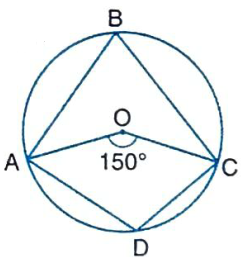
  • A
    $70^{\circ}$
  • B
    $75^{\circ}$
  • C
    $60^{\circ}$
  • $105^{\circ}$
Answer
Correct option: D.
$105^{\circ}$
(d) $105^{\circ}$
Clearly, arc AC subtends $\angle A O C=105^{\circ}$ at the centre O and $\angle A B C$ at point B on the circumference. Therefore,
$\angle A B C=\frac{1}{2} \angle A O C=\frac{1}{2} \times 150^{\circ}=75^{\circ}$
Since $A B C D$ is a cyclic quadrilateral. Therefore,
$\angle A D C+\angle A B C=180^{\circ} \Rightarrow \angle A D C+75^{\circ}=180^{\circ} \Rightarrow \angle A DC=105^{\circ}$
View full question & answer
MCQ 461 Mark
  • A
    $110^{\circ}$
  • B
    $100^{\circ}$
  • C
    $140^{\circ}$
  • $130^{\circ}$
Answer
Correct option: D.
$130^{\circ}$
(d) $130^{\circ}$
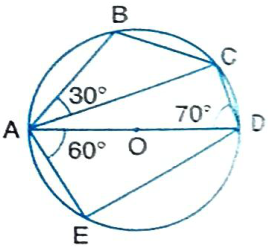
In $\triangle A E D$, we find that
$\angle A E D=90^{\circ} \text { (angle in a semi-circle) and } \angle E A D=60^{\circ} \text {. Therefore, } \angle A DE=30^{\circ} \text {. }$
$A E D C$ is a cyclic quadrilateral such that
$\begin{array}{ll}& \angle E D C=\angle E D A+\angle A D C=30^{\circ}+70^{\circ}=100^{\circ} \\
\therefore \quad & \angle C A E=80^{\circ} \Rightarrow \angle D A C=20^{\circ}\end{array}$
Thus, $A B C D$ is a cyclic quadrilateral, such that $\angle D A B=20^{\circ}+30^{\circ}=50^{\circ}$
$\therefore \quad \angle B C D=180^{\circ}-50^{\circ}=130^{\circ}$
View full question & answer
MCQ 481 Mark
  • A
    $25^{\circ}$
  • B
    $80^{\circ}$
  • $50^{\circ}$
  • D
    $40^{\circ}$
Answer
Correct option: C.
$50^{\circ}$
(c) $50^{\circ}$
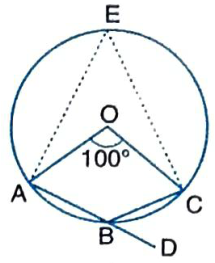
Let $E$ be a point on the circle. We observe that arc ABC makes $\angle A O C=100^{\circ}$ at O and $\angle A E C$ at E.
$\therefore \quad \angle A E C=\frac{1}{2} \angle A O C=\frac{1}{2} \times 100^{\circ}=50^{\circ}$
Using exterior angle property in cyclic quadrilateral $A B C E$, we obtain
$\text { ext } \angle C B D=\angle A E C=50^{\circ}$
View full question & answer
M.C.Q - Maths STD 9 Questions - Vidyadip