Questions

2 Marks Questions

🎯

Test yourself on this topic

8 questions · timed · auto-graded

Question 12 Marks
Answer
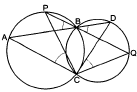
As angles in the same segment of circle are equal
$\angle$ABP = $\angle$ACP ..........................(i)
$\angle$ABP = $\angle$QBD (Vertically opposite angles)
Also, $\angle$QCD = $\angle$QBD (Angles in the same segment)
$\therefore$ $\angle$ABP = $\angle$QCD ...................(ii)
From (i) and (ii), we have
$\angle$ACP = $\angle$QCD.
View full question & answer
Question 22 Marks
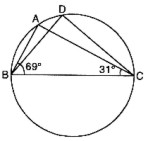
In given figure, $\angle$ABC = 69°, $\angle$ACB = 31°, find $\angle$BDC.

Answer
From the given figure, in $\triangle$ABC, we can write
$\angle$ABC + $\angle$ACB + $\angle$BAC = 180 ( by angle sum property)
69o + 31o + $\angle$BAC = 180o
$\Rightarrow$ $\angle$BAC = 180° -100° = 80°
$\angle$BDC = $\angle$BAC (Angles in the same segment)
$\therefore$ $\angle$BDC = 80°
View full question & answer
Question 32 Marks
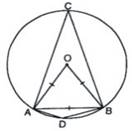
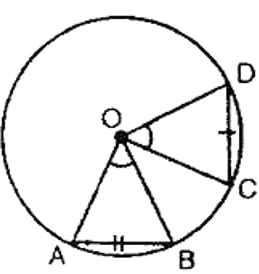
A chord of a circle is equal to the radius of the circle. Find the angle subtended by the chord at a point on the minor arc and also at a point on the major arc.
Answer
OA = OB = AB |Given
 $\therefore$ $\triangle$OAB  is equilateral
 $\therefore$ $\angle$AOB = 60o 

 $\angle$ACB = $\frac{1}{2}$$\angle$AOB
[The angle subtended by an arc at the centre is double the angle subtended by it at any point on the remaining part of the circle]
 =$\frac{1}{2}$ $\times$ 60o = 30o 
Now, $\because$ ADBC is a cyclic quadrilateral.
 $\therefore$ $\angle$ADB + $\angle$ACB  [The sum of either pair of opposite angles of a cyclic quadrilateral is 180o]
 $\Rightarrow$ $\angle$ADB + 30o = 180o 
 $\Rightarrow$ $\angle$ADB = 180o - 30o 
 $\Rightarrow$ $\angle$ADB = 150o 
View full question & answer
Question 42 Marks
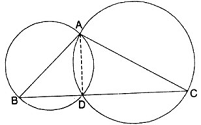
If circles are drawn taking two sides of a triangle as diameters, prove the point of intersection of these circles lie on the third side.
Answer
Given: Circles are described with sides AB and AC of a triangle ABC as diameters. They intersect in a point D.
To prove: D lies on the third side BC of $\triangle$ABC.

Construction: Join AD.
Proof: Circle described on AB as diameter intersects BC in D.
$\angle $ADB = 90° [Angle in a semi-circle]
But $\angle $ADB + $\angle $ADC = 180° [Linear Pair Axiom]
$\therefore$ $\angle $ADC = 90°
Hence, the circle described on AC as diameter must pass through D.
Thus, the two circles intersect in D.
Now $\angle $ADB + $\angle $ADC = 180°
$\therefore$ Points B, D, C are collinear
$\therefore$ D lies on BC.
View full question & answer
Question 52 Marks
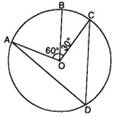
In figure, A, B, C are three points on a circle with centre O such that $\angle$BOC = 30°, $\angle$AOB = 60°. If D is a point on the circle other than the arc ABC, find $\angle$ADC.

Answer
$\angle$AOC = $\angle$AOB + $\angle$BOC
$\Rightarrow$$\angle$AOC = 60° + 30° = 90°
Now $\angle$AOC = 2$\angle$ADC
[$\because$ Angled subtended by an arc, at the centre of the circle is double the angle subtended by the same arc at any point in the remaining part of the circle]
$\Rightarrow$ $\angle$ADC = $\frac{1}{2}$$\angle$AOC
$\Rightarrow$$\angle$ADC = $\frac{1}{2}$ x 90° = 45°
View full question & answer
Question 62 Marks
If two equal chords of a circle intersect within the circle, prove that the line joining the point of intersection to the centre makes equal angles with the chords.
Answer
Given: Two equal chords AB and CD of a circle with centre O intersect within the circle. Their point of intersection is E.
To prove $\angle$OEA = $\angle$OED 
Construction: Join OA and OD
Proof: In  $\triangle$OEA and  $\triangle$OED 
OE = OE |Common
OA = OD |Radii of a circle
AE = DE
 $\therefore$ $\triangle$OEA $\cong$ $\triangle$OED [SSS Rule]
 $\therefore$ $\angle$OEA = $\angle$OED [c.p.c.t]
View full question & answer
Question 72 Marks
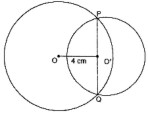
Two circles of radii 5 cm and 3 cm intersect at two points and the distance between their centres is 4 cm. Find the length of the common chord.
Answer


We know that if two circles intersect each other at two points, then the line joining their centres is the perpendicular bisector of their common chord.
$\therefore$Length of the common chord
= PQ =2O'P
= 2 $\times$ 3cm = 6cm
View full question & answer
Question 82 Marks
Prove that if chords of congruent circles subtend equal angles at their centres, then the chords are equal.
View full question & answer
2 Marks Questions - Maths STD 9 Questions - Vidyadip