Questions

3 Marks Question

Take a timed test

25 questions · self-marked practice — reveal the answer and mark yourself.

Question 13 Marks
Prove that two different circles cannot intersect each other at more than two points.
Answer
Suppose two circles intersect in three points $A, B, C$.
Then $A, B, C$ are non-collinear so a unique circle passes through these three points.
This is contradiction to the face that two given circles are passing through $A, B, C$.
Hence, two circles cannot intersect each other at more than two points.
View full question & answer
Question 23 Marks
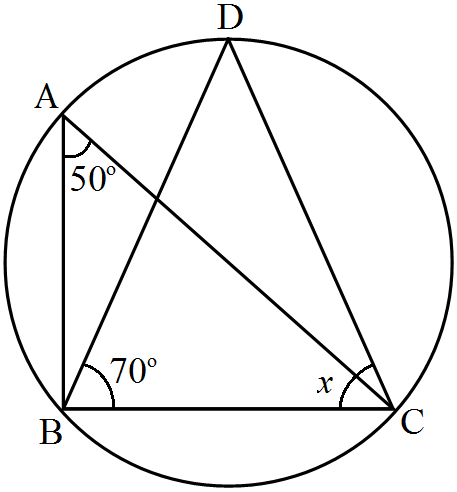
If $O$ is the centre of the circle, find the value of $x$ in the following figure:
Answer
We have$\angle\text{BAC}=50^\circ$ and $\angle\text{DBC}=70^\circ$
$\therefore\angle\text{BDC}=\angle\text{BAC}$ [Angle in same segment]
In $\triangle\text{BDC},$ by angle sum property
$\angle\text{BDC}+\angle\text{BCD}+\angle\text{DBC}=180^\circ$
$\Rightarrow50^\circ+\text{x}+70^\circ=180^\circ$
$\Rightarrow\text{x}=180^\circ-50^\circ-70^\circ=60^\circ$
View full question & answer
Question 33 Marks
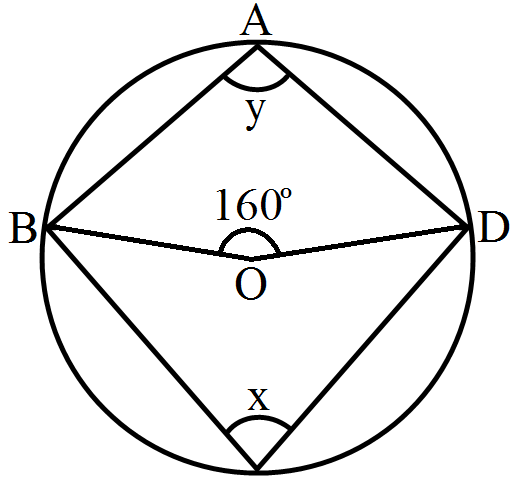
In the given figure, $O$ is the center of the circle. If $\angle\text{BOD}=160^\circ,$ find the value of $x$ and $y$.
Answer
We have, $\angle\text{BOD}=160^\circ$
By degree measure theorem $\angle\text{BOD}=2\angle\text{BCD}$
$\Rightarrow160^\circ=\text{2x}$ $\Rightarrow\text{x}=\frac{160^\circ}{2}=80^\circ$
$\therefore\angle\text{BAD}+\angle\text{BCD}=180^\circ$ [Opposite angles of cyclic quad.]
$\Rightarrow\text{y}+\text{x}=180^\circ$
$\Rightarrow\text{y}+80^\circ=180^\circ$
$\Rightarrow\text{y}=180^\circ-80^\circ=100^\circ$
View full question & answer
Question 43 Marks
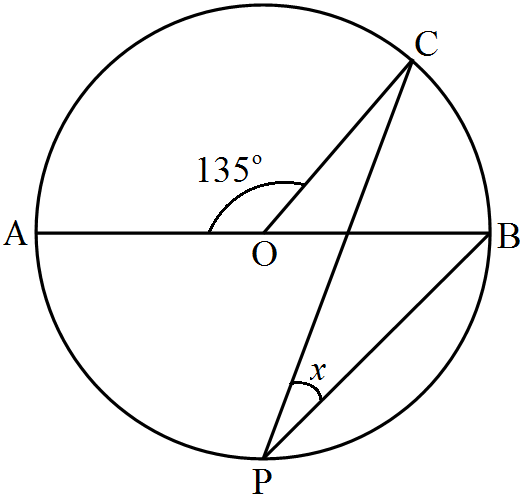
If $O$ is the centre of the circle, find the value of $x$ in the following figures:
Answer
$\angle\text{AOC}=135^\circ$
$\therefore\angle\text{AOC}+\angle\text{BOC}=180^\circ$ [Linear pair of angles]
$\Rightarrow135^\circ+\angle\text{BOC}=180^\circ$
$\Rightarrow\angle\text{BOC}=180^\circ-135^\circ$
$\Rightarrow\angle\text{BOC}=45^\circ$
By degree measure theorem$\angle\text{BOC}=2\angle\text{CPB}$
$\Rightarrow45^\circ=\text{2x}$
$\Rightarrow\text{x}=\frac{45^\circ}{2}=22\frac{1}{2}^\circ$
View full question & answer
Question 53 Marks
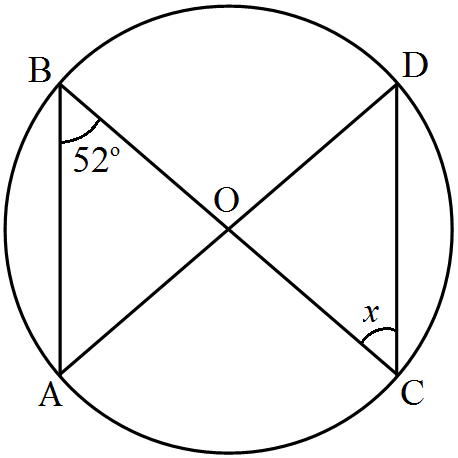
If $O$ is the centre of the circle, find the value of $x$ in the following figure:
Answer
Given that, $\angle\text{ABD} = 40^\circ$
Then $\angle\text{BDC}=\angle\text{BAC}=52^\circ$ [Angle in same segment]
Since $OD = OC$
Then $\angle\text{ODC}=\angle\text{OCD}$ [Opposite angle to equal radii]
$\Rightarrow\text{x}=52^\circ$
View full question & answer
Question 63 Marks
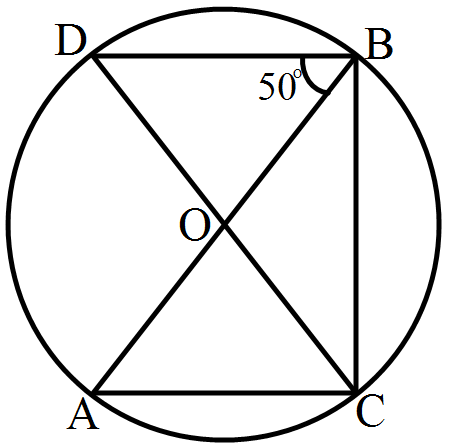
In the given figure, $AB$ and $CD$ are diameters of a circle with center $O$. if $\angle\text{OBD}=50^\circ,$ find $\angle\text{AOC}.$
Answer
We have, $\angle\text{OBD}=50^\circ$ Since, $AB$ and $CD$ are diameters of circle then $O$ is the center of the circle.
$\therefore​​\angle\text{DBC}=90^\circ$ [Angle in semicircle]
$\Rightarrow\angle\text{DOB}+\angle\text{OBC}=90^\circ$
$\Rightarrow50^\circ+\angle\text{OBC}=90^\circ$
$\Rightarrow\angle\text{OBC}=90^\circ-50^\circ=40^\circ$
By degree measure theorem $\angle\text{AOC}=2\angle\text{ABC}$
$\Rightarrow\angle\text{AOC}=2\times40^\circ=80^\circ$
View full question & answer
Question 73 Marks
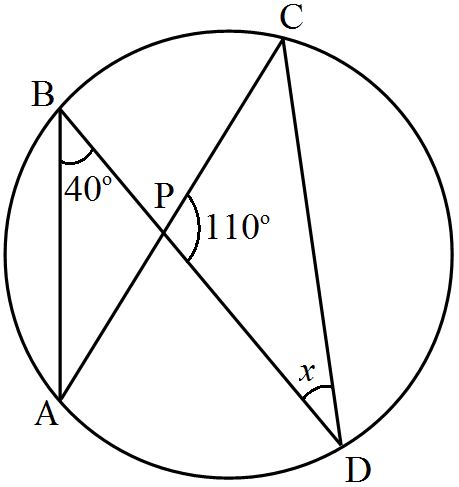
If $O$ is the centre of the circle, find the value of $x$ in the following figure:
Answer
We have,
$\angle\text{ABD} = 40^\circ$
$\angle\text{ACD}=\angle\text{ABD}=40^\circ$ [Angle in same segment]
In $\triangle\text{PCD},$ by angle sum property
$\angle\text{PDC}+\angle\text{CPO}+\angle\text{PDC}=180^\circ$
$\Rightarrow40^\circ+110^\circ+\text{x}=180^\circ$
$\Rightarrow\text{x}=180^\circ-150^\circ$
$\Rightarrow\text{x}=30^\circ$
View full question & answer
Question 83 Marks
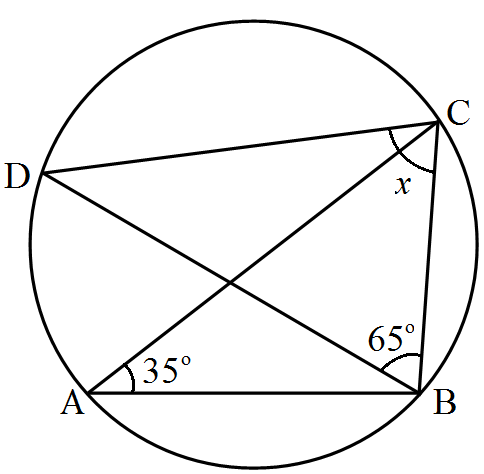
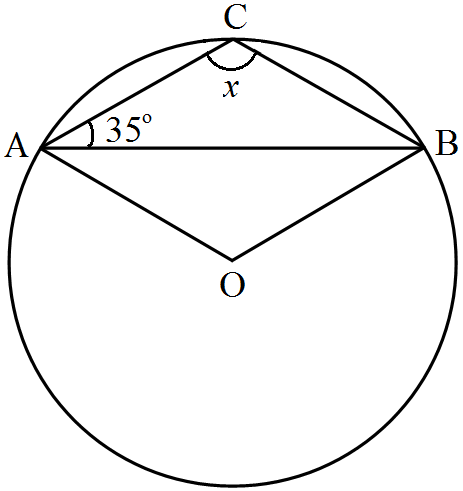
If $O$ is the centre of the circle, find the value of $x$ in the following figure:
Answer
We have, $\angle\text{BAC} = 35^\circ $
$\angle\text{BDC}=\angle\text{BAC}=35^\circ$ [Angle in same segment] In $\triangle\text{BCD},$
by angle sum property $\angle\text{BDC}+\angle\text{BCD}+\angle\text{DBC}=180^\circ$
$\Rightarrow35^\circ+\text{x}+65^\circ=180^\circ$
$\Rightarrow\text{x}=180^\circ-35^\circ-65^\circ=80^\circ$
View full question & answer
Question 93 Marks
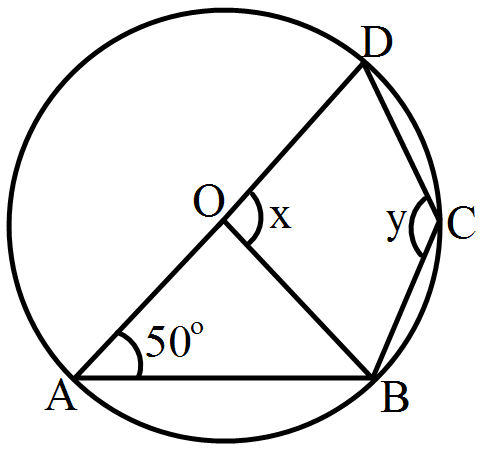
In the given figure, $O$ is the center of the circle and $\angle\text{DAB}=50^\circ.$ Calculate the values of $x$ and $y$.
Answer
We have, $\angle\text{DAB}=50^\circ$
By degree measure theorem $\angle\text{BOD}=2\angle\text{BAD}$
$\Rightarrow\text{x}=2\times50^\circ=100^\circ$
Since, $ABCD$ is a cyclic quadrilateral Then, $\angle\text{A}+\angle\text{C}=180^\circ$
$\Rightarrow50^\circ+\text{y}=180^\circ$
$\Rightarrow\text{y}=180^\circ-50^\circ=130^\circ$
View full question & answer
Question 103 Marks
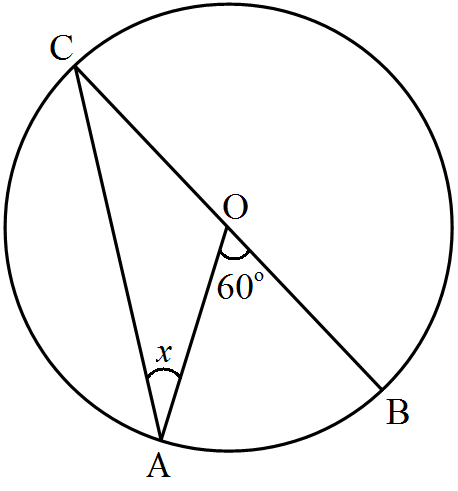
If $O$ is the centre of the circle, find the value of $x$ in the following figure:
Answer
We have $\angle\text{AOB}=60^\circ$
By degree measure theorem reflex $\angle\text{AOB}=2\angle\text{ACB}$
$\Rightarrow60^\circ=2\angle\text{ACB}$
$\Rightarrow\angle\text{ACB}=\frac{60^\circ}{2}=30^\circ$ [Angles opposite to equal radii]
$\Rightarrow\text{x}=30^\circ$
View full question & answer
Question 113 Marks
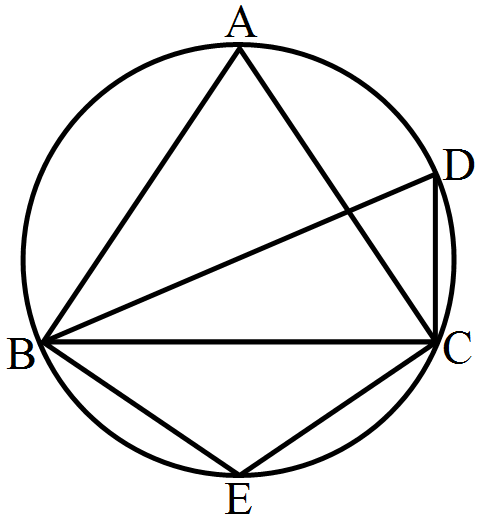
In the given figure, If $ABC$ is an equilateral triangle. Find $\angle\text{BDC}$ and $\angle\text{BEC.}$
Answer
Since, $\triangle\text{ABC}$ is an equilateral triangle
Then, $\angle\text{BAC}=60^\circ$
$\therefore\angle\text{BDC}=\angle\text{BAC}=60^\circ$ [Angles in same segment]
Since, quad. $ABEC$ is a cyclic quadrilateral.
Then, $\angle\text{BAC}+\angle\text{BEC}=180^\circ$
$\Rightarrow60^\circ+\angle\text{BEC}=180^\circ$
$\Rightarrow\angle\text{BEC}=180^\circ-60^\circ=120^\circ$
View full question & answer
Question 123 Marks
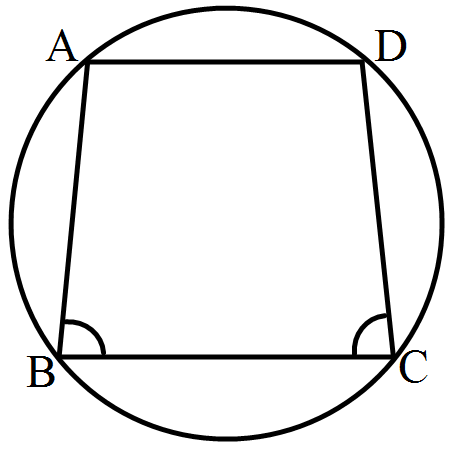
If $ABCD$ is a cyclic quadrilateral in which $AD\ ||\ BC$. Prove that $\angle\text{B}=\angle\text{C}.$
Answer
Since, $ABCD$ is a cyclic quadrilateral with $AD\ ||\ BC$ Then,
$\angle\text{A}+\angle\text{C}=180^\circ\dots(1)$ [Opposite angles of cyclic quad.] And,
$\angle\text{A}+\angle\text{B}=180^\circ\dots(2)$ [Co-interior angles] Compare equations $(1)$ and $(2)$
$\angle\text{B}=\angle\text{C}$
View full question & answer
Question 133 Marks
Prove that the perpendicular bisectors of the sides of a cyclic quadrilateral are concurrent.
Answer
Let $ABCD$ be a cyclic quadrilateral, and let $O$ be the centre of the corresponding circle.
Then, each side of quadrilateral $ABCD$ is a chord of the circle and the perpendicular bisector of a chord always passes through the centre of the circle.
So, right bisectors of the sides of quadrilateral $ABCD$ will pass through the center $O$ of the corresponding circle.
View full question & answer
Question 143 Marks
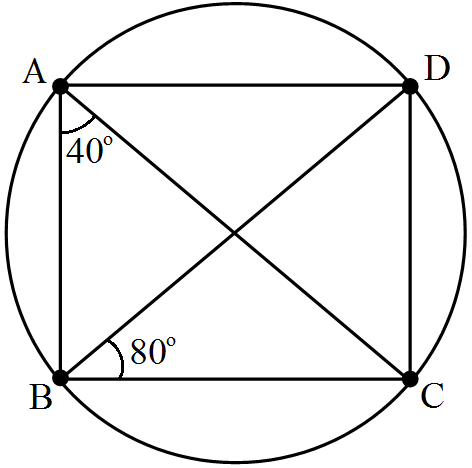
$ABCD$ is a cyclic qudrilateral in which: $ \angle\text{DBC}=80^\circ$ and $\angle\text{BAC}=40^\circ.$ Find $\angle\text{BCD}.$
Answer

$\angle\text{BAC}=\angle\text{BDC}=40^\circ$ [Angle in same segment]
In by angle sum property $\angle\text{DBC}+\angle\text{BCD}+\angle\text{BDC}=180^\circ$
$\Rightarrow80^\circ+\angle\text{BCD}+40^\circ=180^\circ$
$\Rightarrow\angle\text{BCD}=180^\circ-80^\circ-40^\circ=60^\circ$
View full question & answer
Question 153 Marks
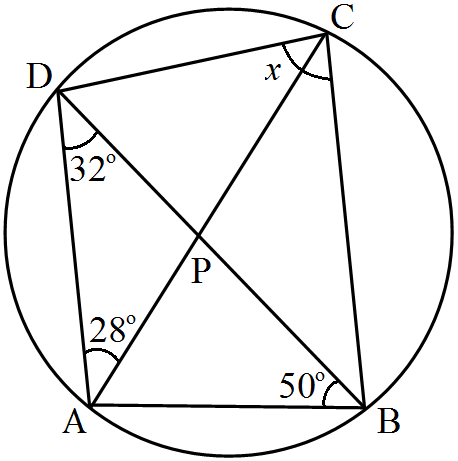
If $O$ is the centre of the circle, find the value of $x$ in the following figure:
Answer
In $\triangle\text{DAB},$ by angle sum property $\angle\text{ADB}+\angle\text{DAB}+\angle\text{ABD}=180^\circ$
$\Rightarrow32^\circ+\angle\text{DAB}+50^\circ=180^\circ$
$\Rightarrow\angle\text{DAB}=180^\circ-32^\circ-50^\circ$
$\Rightarrow\angle\text{DAB}=98^\circ+50^\circ$
Now, $\angle\text{OAB}+\angle\text{DCB}=180^\circ$ [Opposite angles of cyclic quadrilateral]
$\Rightarrow98^\circ+\text{x}=180^\circ$
$\Rightarrow\text{x}=180^\circ-98^\circ=82^\circ$
View full question & answer
Question 163 Marks
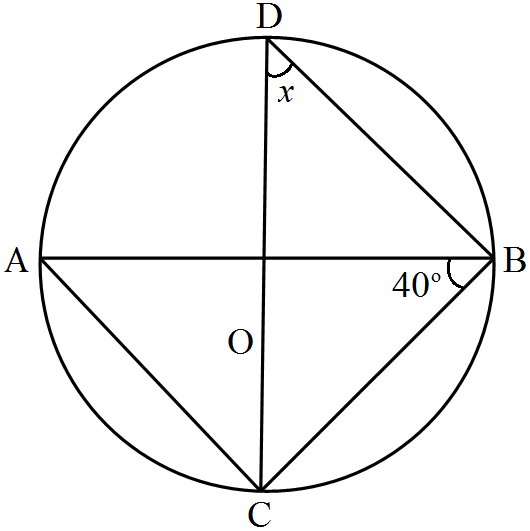
If $O$ is the centre of the circle, find the value of $x$ in the following figures:
Answer
We have $\angle\text{ABC}=40^\circ$ $\angle\text{ACB}=90^\circ$ [Angle in semi circle] In
$\triangle\text{ABC,}$ by angle sum property$\angle\text{CAB}+\angle\text{ACB}+\angle\text{ABC}=180^\circ$
$\Rightarrow\angle\text{CAB}+90^\circ+40^\circ=180^\circ$
$\Rightarrow\angle\text{CAB}=180^\circ-90^\circ-40^\circ$
$\Rightarrow\angle\text{CAB}=50^\circ$
Now, $\angle\text{CDB}=\angle\text{CAB}$ [Angle is same in segment]
$\Rightarrow\text{x}=50^\circ$
View full question & answer
Question 173 Marks
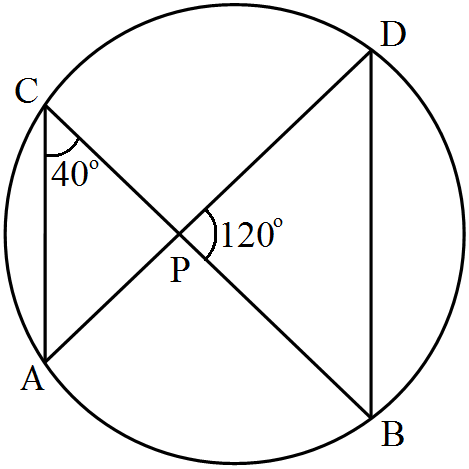
In figure, if $\angle\text{ACB} = 40^\circ, \angle\text{DPB} = 120^\circ,$ find $\angle\text{CBD}.$
Answer
We have, $\angle\text{ACB} = 40^\circ, \angle\text{DPB} = 120^\circ$
$\therefore\angle\text{APB}=\angle\text{DCB}=40^\circ$ [Angle in same segment] In
$\triangle\text{POB},$ by angle sum property $\angle\text{PDB}+\angle\text{PBD}+\angle\text{BPD}=180^\circ$
$\Rightarrow40^\circ +\angle\text{PBD}+120^\circ=180^\circ$
$\Rightarrow\angle\text{PBD}=180^\circ-40^\circ-120^\circ$
$\Rightarrow\angle\text{PBD}=20^\circ$ $\therefore\angle\text{CBD}=20^\circ$
View full question & answer
Question 183 Marks
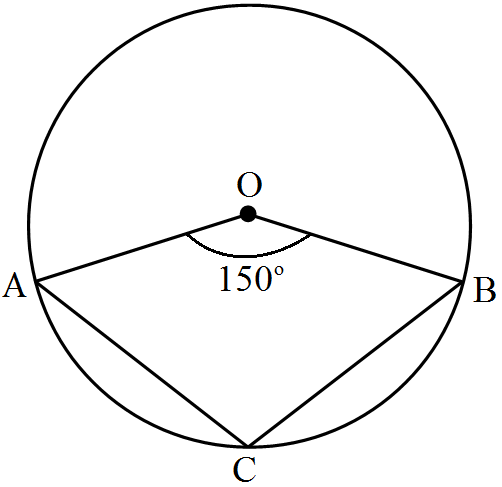
In figure, it is given that $O$ is the centre of the circle and $\angle\text{AOC} = 150^\circ.$ Find $\angle\text{ABC}.$
Answer
$\angle\text{AOC}=150^\circ$
$\therefore\angle\text{AOC}+\text{reflex }\angle\text{AOC}=360^\circ$ [complex angle]
$\Rightarrow150^\circ+\text{reflex }\angle\text{AOC}=360^\circ$
$\Rightarrow\text{reflex }\angle\text{AOC}=360^\circ-150^\circ$
$\Rightarrow\text{reflex }\angle\text{AOC}=210^\circ$
$\Rightarrow2\angle\text{ABC}=210^\circ$ [By degree measure theorem]
$\Rightarrow\angle\text{ABC}=\frac{210^\circ}{2}=105^\circ$
View full question & answer
Question 193 Marks
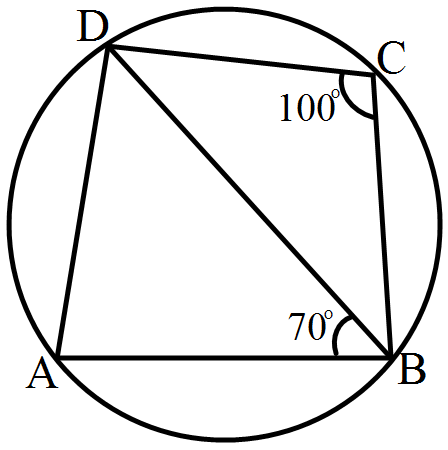
In the given figure $ABCD$ is a cyclic quadrilateral. If $\angle\text{BCD}=100^\circ$ and $\angle\text{ABD}=70^\circ,$ find $\angle\text{ADB}.$
Answer
We have, $\angle\text{BCD}=100^\circ$ and $\angle\text{ABD}=70^\circ$
$\therefore\angle\text{DAB}+\angle\text{BCD}=180^\circ$ [Opposite angles of cyclic quad.]
$\Rightarrow\angle\text{DAB}+100^\circ=180^\circ$
$\Rightarrow\angle\text{DAB}+180^\circ-100^\circ=80^\circ$ In
$\triangle\text{DAB},$ by angle sum property $
\angle\text{ADB}+\angle\text{DAB}+\angle\text{ABD}=180^\circ$
$\Rightarrow\angle\text{ADB}+80^\circ+70^\circ=180^\circ$
$\Rightarrow\angle\text{ADB}=180^\circ-80^\circ-70^\circ=30^\circ$
View full question & answer
Question 203 Marks
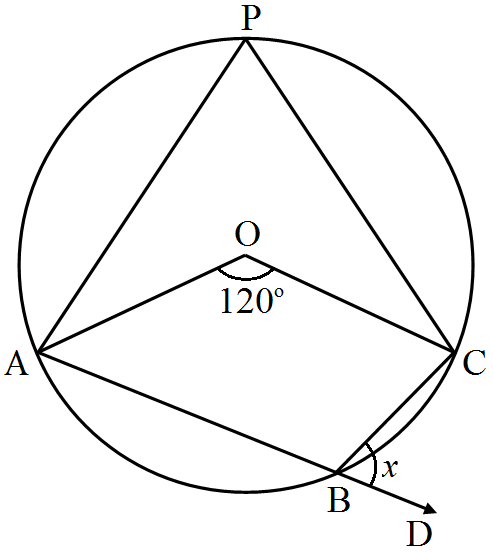
If $O$ is the centre of the circle, find the value of $x$ in the following figure:
 
Answer
We have$\angle\text{AOC}=120^\circ$ By degree measure theorem.
$\angle\text{AOC}=2\angle\text{APC}$
$\Rightarrow120^\circ=2\angle\text{APC}$
$\Rightarrow\angle\text{APC}=\frac{120^\circ}{2}=60^\circ$
$\angle\text{APC}+\angle\text{ABC}=180^\circ$ [Opposite angles of cyclic quadrilaterals]
$\Rightarrow60^\circ+\angle\text{ABC}=180^\circ$
$\Rightarrow\angle\text{ABC}=180^\circ-60^\circ$
$\Rightarrow\angle\text{ABC}=120^\circ$
$\therefore\angle\text{ABC}+\angle\text{DBC}=180^\circ$ [Linear pair of angles]
$\Rightarrow120^\circ+\text{x}=180^\circ$
$\Rightarrow\text{x}=180^\circ-120^\circ=60^\circ$
View full question & answer
Question 213 Marks
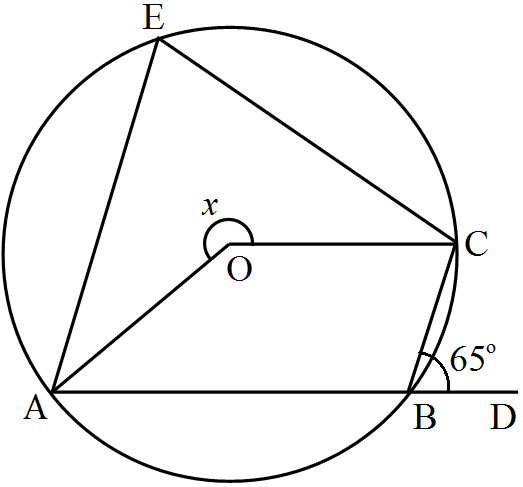
If $O$ is the centre of the circle, find the value of $x$ in the following figure:
Answer
We have$\angle\text{CBD}=65^\circ$
$\therefore\angle\text{ACB}+\angle\text{CBD}=180^\circ$ [Linear pair of angles]
$\Rightarrow\angle\text{ABC}=65^\circ=180^\circ$
$\Rightarrow\angle\text{ABC}=180^\circ-65^\circ=115^\circ$
$\therefore\text{reflex}\angle\text{AOC}=2\angle\text{ABC}$ [By degree measure theorem]
$\Rightarrow\text{x}=2\times115^\circ$
$\Rightarrow\text{x}=230^\circ$
View full question & answer
Question 223 Marks
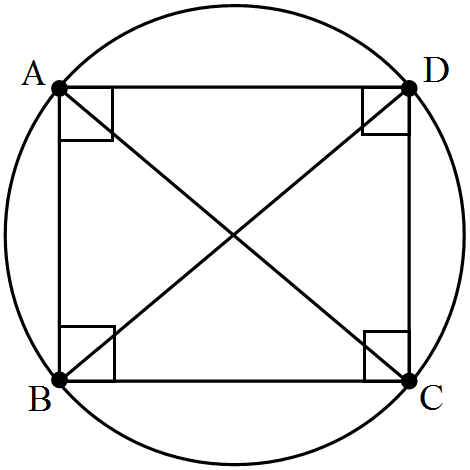
Prove that the centre of the circle circumscribing the cyclic rectangle $ABCD$ is the point of intersection of its diagonals.
Answer

 Let $O$ be the centre of the circle circumscribing the cyclic rectangle $ABCD$.
since $\angle\text{ABC}=90^\circ$ and $AC$ is a chord of the circle, so, $AC$ is a diameter of the circle.
Similarly, $BD$ is a diameter.
Hence, point of intersection of $AC$ and $BD$ is the center of the circle.
View full question & answer
Question 233 Marks
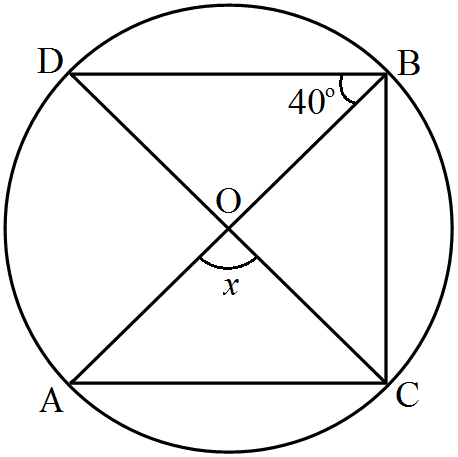
If $O$ is the centre of the circle, find the value of $x$ in the following figure:
Answer
We have$\angle\text{DOB}=40^\circ$ and $\angle\text{DBC}=90^\circ$ [Angle in a semicircle]
$\Rightarrow\angle\text{DOB}+\angle\text{OBC}=90^\circ$
$\Rightarrow40^\circ+\angle\text{OBC}=90^\circ$
$\Rightarrow\angle\text{OBC}=90^\circ-40^\circ=50^\circ$ By degree measure theorem
$\angle\text{AOC}=2\angle\text{OBC}$
$\Rightarrow\text{x}=2\times50^\circ=100^\circ$
View full question & answer
Question 243 Marks
If $O$ is the centre of the circle, find the value of $x$ in the following figure:
Answer
We have $\angle\text{OAB}=35^\circ$ then,
$\angle\text{OBA}=\angle\text{OAB}=35^\circ$ [Angles opposite to equal radii] In
$\triangle\text{AOB},$ by angle sum property
$\Rightarrow\angle\text{AOB}+\angle\text{OAB}+\angle\text{OBA}=180^\circ$
$\Rightarrow\angle\text{AOB}+35^\circ+35^\circ=180^\circ$
$\Rightarrow\angle\text{AOB}=180^\circ-35^\circ-35^\circ=110^\circ$
$\therefore\angle\text{AOB}+\text{reflex }\angle\text{AOB}=360^\circ$ [Complex angle]
$\Rightarrow110^\circ+\text{reflex }\angle\text{AOB}=360^\circ$
$\Rightarrow\text{reflex }\angle\text{AOB}=360^\circ-110^\circ=250^\circ$
By degree measure theorem reflex $\angle\text{AOB}=2\angle\text{ACB}$
$\Rightarrow250^\circ=\text{2x}$
$\text{x}=\frac{250^\circ}{2}=125^\circ$
View full question & answer
Question 253 Marks
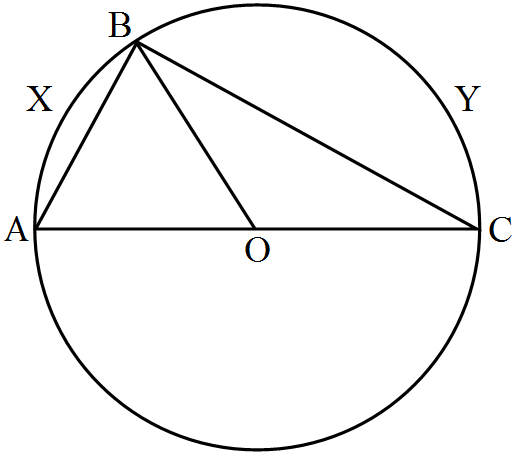
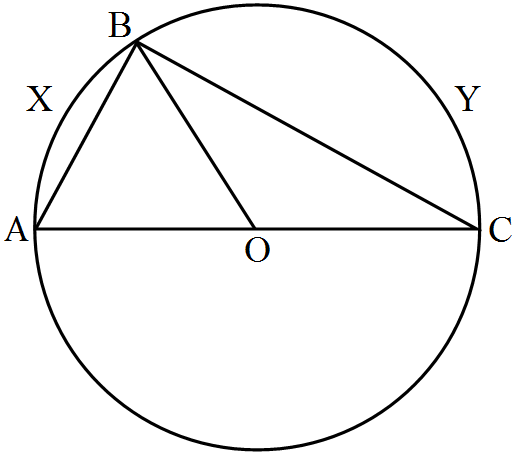
If the given figure, $AOC$ is a diameter of the circle and arc $\text{AXB}=\frac{1}{2}$ arc $BYC$. Find $\angle\text{BOC.}$
Answer
We need to find $\angle\text{BOC}$
$\text{arc}\ \text{AXB}=\frac{1}{2} \text{arc}\ \text{BYC},$
$\angle\text{AOB}=\frac{1}{2}\angle\text{BOC}$
Also $\angle\text{AOB}+\angle\text{BOC}=180^\circ$
Therefore, $\frac{1}{2}\angle\text{BOC}+\angle\text{BOC}=180^\circ$
$\Rightarrow\angle\text{BOC}=\frac{2}{3}\times180^\circ=120^\circ$
View full question & answer
3 Marks Question - Maths STD 9 Questions - Vidyadip