Questions · Page 1 of 4

M.C.Q

🎯

Test yourself on this topic

50 questions · timed · auto-graded

MCQ 11 Mark
If A(2, 3) and B(-3, 4), then (abscissa of A) - (abscissa of B) is:
  • A
    5
  • B
    -1
  • C
    -5
  • D
    1
Answer
  1. 5
    Solution:
    Here we have, the abscissa of A = 2 and abscissa of B = -3.
    So, according to question,
    (abscissa of A) - (abscissa of B)
    = 2 - (-3)
    = 5
View full question & answer
MCQ 21 Mark
If a > 0 and b > 0 then the point (a, b) lies in quadrant.
  • A
    IV
  • B
    II
  • C
    III
  • D
    None of these.
Answer
  1. II
    Solution:
    Since, x co-ordinate is negative and y co-ordinate is positive, the given point lies in Quadrant II.
View full question & answer
MCQ 31 Mark
The zero of the polynomial (x - 2)2 - (x + 2)2 is:
  • A
    0
  • B
    2
  • C
    1
  • D
    -2
Answer
  1. 0
    Solution:
    (x - 2)2 - (x + 2)2
    = (x - 2 + x + 2) (x - 2 - x - 2) [Using identity]
    a2 - b2 = (a + b) (a - b)
    = (2x) (-4)
    = -8x
    Then the zero is,
    -8x = 0
    ⇒ x = 0
View full question & answer
MCQ 41 Mark
Signs of the abscissa and ordinate of a point in the second quadrant are respectively.
  • A
    (+, +)
  • B
    (+, -)
  • C
    (-, -)
  • D
    (-, +)
Answer
  1. (-, +)
    Solution:
    Abscissa means just the horizontal axis i.e. x axis. Ordinate means just the vertical axis i.e. y axis.
    x-corrdinate and y-corrdinate make a point.
    The signs of abscissa and ordinate of a point in quadrant II are (-, +).
View full question & answer
MCQ 51 Mark
Two point having same abscissae but different ordinates lie on:
  • A
    x-axis
  • B
    a-axis
  • C
    A line parallel to y-axis
  • D
    A line parallel to x-axis
Answer
  1. A line parallel to y-axis
    Solution:
    Let two points be (a, b) and (a, c).
    If abscissa is same = a
    and ordinate is different then all such points will lie on a line parallel to Y
    axis because value of X-intercept
    i.e. abscissa is fixed.
View full question & answer
MCQ 61 Mark
The equation of y-axis is:
  • A
    (1, 7)
  • B
    (2, 10)
  • C
    (4, 12)
  • D
    (-1, 1)
Answer
  1. (4, 12)
    Solution:
    y = 3x + 4
    for x = 4, we have
    = 3 × 4 + 4
    = 12 + 4
    = 16 ≠ 12
    Hence, (4, 12) doesn't lie on the given line.
View full question & answer
MCQ 71 Mark
The distance of the point (3, 5) from x- axis is:
  • A
    3 units
  • B
    4 units
  • C
    5 units
  • D
    6 units
Answer
  1. 5 units
    Solution:
    Distance of any point from x-axis is y-coordinate of that given point:
View full question & answer
MCQ 81 Mark
The distance of the point (2, 3) from the y-axis:
  • A
    5 units
  • B
    13 units
  • C
    3 units
  • D
    2 units
Answer
  1. 2 units
    Solution:
    The distance from y-axis is equal to the x-coordinate, so distance = 2 units
View full question & answer
MCQ 91 Mark
If P(3, 9) and Q(-3, -4), then (abscissa of P) - (ordinate of Q) is:
  • A
    -1
  • B
    1
  • C
    7
  • D
    -7
Answer
  1. 7
    Solution:
    From the given data we have,
    The abscissa of P = 3 and ordinate of Q = -4,
    So, according to question,
    (abscissa of P) - (ordinate of Q)
    = 3 - (-4)
    = 7
View full question & answer
MCQ 111 Mark
The ordinate of every point on the x-axis is:
  • A
    1
  • B
    -1
  • C
    0
  • D
    Any real numbers.
Answer
  1. 0
    Solution:
    The ordinate (y co-ordinate) of every point on the x-axis is 0.
View full question & answer
MCQ 121 Mark
Abscissa of all points on the x-axis is:
  • A
    Any number.
  • B
    0
  • C
    -1
  • D
    1
Answer
  1. Any number.
    Solution:
    Abscissa of point in x axis is can be any number but ordinate will always be zero, because for any point to lie on x-axis its y-ordinate must be equal to zero.
View full question & answer
MCQ 131 Mark
The point O(0, 0) lies on:
  • A
    x-axis
  • B
    y-axis
  • C
    both x-axis and y-axis
  • D
    Any quadrant.
Answer
  1. both x-axis and y-axis
    Solution:
    Point (0, 0) is the co-ordinate of origin and origin is the point of intersection of x and y-axis.
    So, point O(0, 0) lies on both axis.
View full question & answer
MCQ 141 Mark
If x > 0 and y < 0, then the point (x, y) lies in:
  • A
    IV Quadrant.
  • B
    III Quadrant.
  • C
    I Quadrant.
  • D
    II Quadrant.
Answer
  1. IV Quadrant.
    Solution:
    Since, x > 0 i.e, x is +ve,
    y < 0 i.e, y is -ve,
    Recall that (+, +) lies in I quadrant, (-, +) lies in II quadrant, (-, -) lies in III quadrant, (+, -) lies in IV quadrant.
    So, (x, y) lies in IV quadrant.
View full question & answer
MCQ 151 Mark
The point (7, 0) lies:
  • A
    On the positive direction of y-axis
  • B
    On the positive direction of x-axis
  • C
    In quadrant II
  • D
    In quadrant IV
Answer
  1. On the positive direction of x-axis
    Solution:
    Since value of y-ordinate is zero so, point lies on x-axis.
    But value of x is +ve so it lies on +ve direction of x-axis.
View full question & answer
MCQ 161 Mark
Write the correct answer in the following:
The points whose abscissa and ordinate have different signs will lie in:
  • A
    I and II quadrants.
  • B
    II and III quadrants.
  • C
    I and III quadrants.
  • D
    II and IV quadrants.
Answer
  1. II and IV quadrants.
    Solution:
    The points whose abscissa and ordinate have different sings will be of the from (-x, y) or (x, -y) and these points will lie in II and IV quadrants.
View full question & answer
MCQ 171 Mark
A point whose abscissa is -3 and ordinate 2 lies in:
  • A
    First quadrant.
  • B
    Second quadrant.
  • C
    Third quadrant.
  • D
    Fourth quadrant.
Answer
  1. Second quadrant
    Solution:
    If absciss = -3
    Intercept on Y axis is = 2
    Y > 0
    So, Point is in Second Quadrant.
View full question & answer
MCQ 181 Mark
The area of $\triangle\text{AOB}$ having vertices A(0, 6), 0(0, 0) and B(6, 0) is:
  • A
    36 sq units
  • B
    18 sq units
  • C
    24 sq units
  • D
    12 sq units
Answer
  1. 18 sq units
    Solution:
    When we plot the given points in the graph paper then,
    is the right angle triangle, where
    OB = Base = 6 units
    Height of triangle = OA = 6 units
    $\therefore$ Area of $\triangle\text{AOB}=\frac{1}{2}\times\text{OA}\times\text{OB}$
    $\Rightarrow$ Area of $\triangle\text{AOB}=\frac{1}{2}\times\text{6}\times\text{6}$
    $\Rightarrow$ Area of $\triangle\text{AOB}=\frac{1}{2}\times\text{36}$
    $\Rightarrow$ Area of $\triangle\text{AOB}=18\text{ square units}$
View full question & answer
MCQ 191 Mark
Abcissa of a point is positive in:
  • A
    I and II quadrant.
  • B
    I and IV quadrant.
  • C
    I quadrant only.
  • D
    II quadrant only.
Answer
  1. I and IV quadrant.
    Solution:
    Absissa of a point is positive when the points are of the form (+, +) and (+, -).
    So, the absissa of the point is positive in quadrant I and IV.
View full question & answer
MCQ 201 Mark
If x2 + kx - 3 = ( x - 3) ( x + 1), then the value of 'k' is:
  • A
    -3
  • B
    2
  • C
    -2
  • D
    3
Answer
  1. -2
    Solution:
    x2 + kx - 3 = (x - 3) (x + 1)
    ⇒ x2 + kx - 3 = x2 + (-3 + 1) x + (-3) x 1
    ⇒ x2 + kx - 3 = x2 - 2x - 3
    On comparing the term, we get k = -2
View full question & answer
MCQ 211 Mark
Write the correct answer in the following:
If the perpendicular distance of a point P from the x-axis is 5 units and the foot of the perpendicular lies on the negative direction of x-axis, then the point P has:
  • A
    x coordinate = -5
  • B
    y coordinate = 5 only
  • C
    y coordinate = –5 only
  • D
    y coordinate = 5 or -5
Answer
  1. y coordinate = 5 or -5
    Solution:
    We do know that perpendicular distance of a point from the X-axis Y-coordinate of that point. Here foot of perpendicular lies on the negative direction of X-axis, so perpendicular distance can be measure in II quadrant or III quadrant. Hence, the point P has y coordinate = 5 or -5
View full question & answer
MCQ 221 Mark
If x < 0 and y > 0, then the point (x, y) lies in.
  • A
    I Quadrant.
  • B
    III Quadrant.
  • C
    II Quadrant.
  • D
    IV Quadrant.
Answer
  1. II Quadrant.
    Solution:
    Here, x < 0 (i.e -ve) and y > 0, (i.e, +ve)
    So in 2nd quadrant value of (x , y) is (-, +).
    So the given point will lie in 2nd quadrant.
View full question & answer
MCQ 231 Mark
Ordinate of a point is negative in:
  • A
    Quadrant III only
  • B
    Quadrant III and IV
  • C
    Quadrant I and II
  • D
    Quadrant IV only
Answer
  1. Quadrant III and IV
    Solution:
    Since, sign of point in 3rd quadrant is (-, -).
    And in 4th quadrant, it is (+, -).
    So, Ordinate of a point is -ve only in 3rd and 4th quadrant.
View full question & answer
MCQ 241 Mark
The perpendicular distance of the point P(-3, -6) from the x-axis is:
  • A
    3 units
  • B
    -3
  • C
    6 units
  • D
    -2
Answer
  1. 6 units
    Solution:
    Perpendicular distance of a point from x-axis is y-ordinate of the given point is (-3, - 6).
    Distance = 6 unit
View full question & answer
MCQ 251 Mark
The point (-3, 0) lies:
  • A
    In quadrant III
  • B
    In quadrant IV
  • C
    On the negative direction of x-axis
  • D
    On the negative direction of y-axis
Answer
  1. On the negative direction of x-axis
    Solution:
    Since value of y-ordinate is zero, so point lies on x-axis.
    But value of x is -ve so, it lies on negative direction of x-axis.
View full question & answer
MCQ 261 Mark
The area of a triangle whose vertices are (0, 0), (4, 0) and (0, 6) is:
  • A
    36 sq. units
  • B
    6 sq. units
  • C
    12 sq. units
  • D
    24 sq. units
Answer
  1. 12 sq. units
    Solution:
    We have a point (0, 0) i.e; origin.
    A point (4, 0) whose y-coordinate is zero.
    So, this point is having 4 units in x-axis = base (let) A point (0, 6) i.e. 6 units in y-axis = height of a triangle so, these point forms a right angle triangle.
    So, Area of a triangle $=\frac{1}{2}\times\text{Base}\times\text{Height}$
    Area of a triangle $=\frac{1}{2}\times6\times4=12\text{ sq.}\text{units.}$
View full question & answer
MCQ 271 Mark
Write the correct answer in the following:
Abscissa of all the points on the x-axis is:
  • A
    0
  • B
    1
  • C
    2
  • D
    Any number.
Answer
  1. Any number.
    Solution:
    Abscissa of all the points on the X-axis is any number because X-axis is a number line which contains many real numbers on it.
View full question & answer
MCQ 281 Mark
The equation of x-axis is:
  • A
    x = 0
  • B
    None of these.
  • C
    y = x
  • D
    y = 0
Answer
  1. y = 0
    Solution:
    In co-ordinate, any point P is written as p(x, y).
    When Y = 0 then the point P lies on x-axis.
    So, Y = 0 is the equation of the x-axis.
View full question & answer
MCQ 291 Mark
The point whose abscissa is 4 and this point lies on the x-axis is:
  • A
    (0, 4)
  • B
    (4, 4)
  • C
    (4, 0)
  • D
    None of these.
Answer
  1. (4, 0)
    Solution:
    Since the abscissa or x-coordinate of a point is 4 and this point lies on the x-axis. And the ordinate or y-coordinate of a point lying on the x-axis is 0.
    Therefore the coordinate of the point is (4, 0).
View full question & answer
MCQ 301 Mark
Point (-10, 0) lies.
  • A
    On the negative direction of the y-axis.
  • B
    In the fourth quadrant.
  • C
    In the third quadrant.
  • D
    On the negative direction of the X-axis.
Answer
  1. On the negative direction of the X-axis.
    Solution:
    In point (-10, 0) y-coordinate is zero, so it lies on X-axis and its x-coordinate is negative, so the point (-10, 0) lies on the X-axis in the negative direction.
View full question & answer
MCQ 311 Mark
A(-6, 3) be a point on the graph. Draw AL $\perp$ x-axis. The co-ordinates of L are:
  • A
    (0, -6)
  • B
    (-6, 0)
  • C
    (0, 0)
  • D
    (-6, 3)
Answer
  1. (-6, 0)
    Solution:
    Since AL perpendicular to x-axis,
    So, point L lies on x-axis, and we know that for any point on x-axis y-ordinate is zero.
    So, we have L = (-6, 0)
View full question & answer
MCQ 321 Mark
Write the correct answer in the following:
The point whose ordinate is 4 and which lies on y-axis is:
  • A
    (4, 0)
  • B
    (0, 4)
  • C
    (1, 4)
  • D
    (4, 2)
Answer
  1. (0, 4)
    Solution:
    Given ordinate of the point is 4 arid the point lies on Y-axis, so its abscissa is zero. Hence, the required point is (0, 4).
View full question & answer
MCQ 331 Mark
The point (-3, 0) lies.
  • A
    In quadrant III
  • B
    In quadrant IV
  • C
    On the negative direction of y-axis.
  • D
    On the negative direction of x-axis.
Answer
  1. On the negative direction of x-axis.
    Solution:
    Since value of y-ordinate is zero, so point lies on x-axis,
    But value of x is -ve so, it lies on negative direction of x-axis.
View full question & answer
MCQ 341 Mark
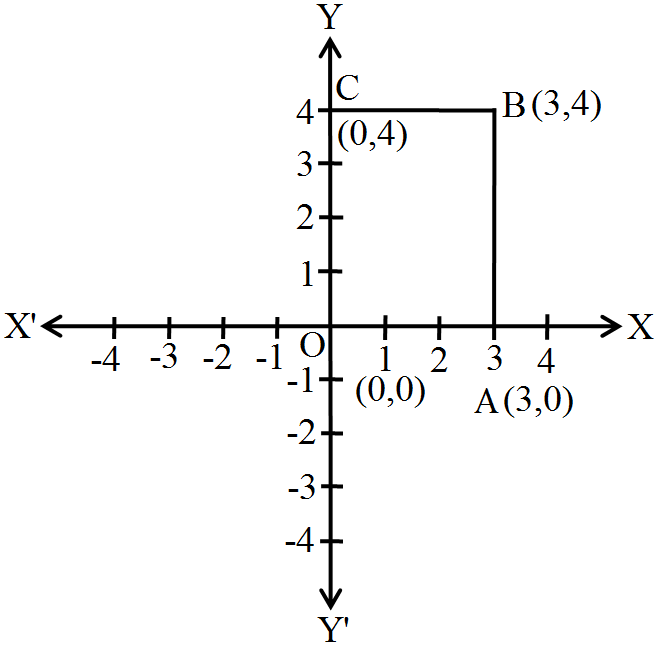
If O(0, 0), A(3, 0), B(3, 4) and C(0, 4) are the vertices of a quadrilateral OABC, then OABC is:
  • A
    Trapezium.
  • B
    Rectangle.
  • C
    Square.
  • D
    Rhombus.
Answer
  1. Rectangle.
    Solution:
    As O(0, 0) and A(3, 0)
    So, Length of side OA = 3 units
    As A(3, 0) and B(3, 4)
    So, Length of side AB = 4 units
    As O(0, 0) and C(0, 4)
    So, Length of side OC = 4 units
    As B(3, 4) and C(0, 4)
    So, Length of side BC = 3 units
    As O(0, 0) and B(3, 4)
    So, Length of diagonal OB = 5 units
    As A(3, 0) and C(0, 4)
    So, Length of diagonal AC = 5 units
    In a quadrilateral opposite sides are equal and diagonals are also equal then it is a rectangle.
    Therefore, OABC is a rectangle.
View full question & answer
MCQ 351 Mark
Point (-7, 0) lies.
  • A
    On the negative direction of x-axis.
  • B
    On the negative direction of y-axis.
  • C
    In the III quadrant.
  • D
    In the IV quadrant.
Answer
  1. On the negative direction of x-axis.
    Solution:
    Point (-7, 0) lies on negative direction of the x-axis as its x co-ordinate is negative and y co-ordinate is zero.
View full question & answer
MCQ 361 Mark
The point which lies on x-axis at a distance of 3 units in the positive direction of x-axis is:
  • A
    (0, -3)
  • B
    (-3, 0)
  • C
    (0, 3)
  • D
    (3, 0)
Answer
  1. (3, 0)
    Solution:
    Since it lies on x-axis so ordinate will be zero because the value of the y-coordinate in the x-axis is equal to zero.
    Thus point will be (3, 0).
View full question & answer
MCQ 371 Mark
Ordinate of all points on the x-axis is:
  • A
    Any number.
  • B
    2
  • C
    0
  • D
    1
Answer
  1. 0
    Solution:
    In cartesian plane any point P is written as P(x, y) when the value of Y co-ordinate is equal to zero then the point P lies on x-axis.
    So, for any point on x-axis, ordinate = 0
View full question & answer
MCQ 381 Mark
Which of the points P(0, 3), Q(1, 0), R(0, -1), S(-5, 0), T(1, 2) do not lie on the x-axis?
  • A
    P, R and T
  • B
    Q, S and T
  • C
    Q and S only
  • D
    P and R only
Answer
  1. P, R and T
    Solution:
    We know that, if a point is of the form (x, 0) i.e., its y-coordinate is zero, then it will lie on X-axis otherwise not.
    Here, y-coordinates of points P(0, 3), R(0, -1) and T(1, 2) are not zero, so these points do not lie on the X-axis.
View full question & answer
MCQ 391 Mark
In the which quadrant does the point (-7, -4) lie?
  • A
    IV
  • B
    II
  • C
    III
  • D
    None of these.
Answer
  1. III
    Solution:
    Since, both the coordinates of given point are negative, it lies in Quadrant III.
View full question & answer
MCQ 401 Mark
The points in which the abscissa and the ordinate have different signs will lie in.
  • A
    Quadrant IV only
  • B
    Quadrants I and III
  • C
    Quadrants II and IV
  • D
    Quadrant II only
Answer
  1. Quadrants II and IV
    Solution:
    In 2nd quadrant and 4th quadrant sign of abscissa and ordinate both is opposite i.e, one is negative and other is positive.
    In 2nd quadrant sign of co-ordinate are(-, +),
    And in 4th quadrant sign of co-ordinate are (+, -)
View full question & answer
MCQ 411 Mark
A point both of whose co-ordinates are positive lies in:
  • A
    Quadrant I and III
  • B
    Quadrant III only
  • C
    Quadrant I only
  • D
    Quadrant II and IV
Answer
  1. Quadrant I only
    Solution:
    In 1st quadrant only the sign of x and y coordinate is +ve. i.e, (+, +)
View full question & answer
MCQ 421 Mark
The radius of a circle whose radius is 5 units and whose centre lies on the origin. The co-ordinates of any point lies on the circle and on the y-axis are:
  • A
    (5, 0) only
  • B
    (0, 5) only
  • C
    (5, 0) or (-5, 0)
  • D
    (0, 5) or (0, -5)
Answer
  1. (0, 5) or (0, -5)
    Solution:
    Since point lies on the y-axis so it can lie in two-point one in positive direction and another is negative direction of y-axis.
    So point will be (0, 5) or (0, -5).
View full question & answer
MCQ 431 Mark
Write the correct answer in the following:
On plotting the points O(0, 0), A(3, 0), B(3, 4), C(0, 4) and joining OA, AB, BC and CO which of the following figure is obtained?
  • A
    Square.
  • B
    Rectangle.
  • C
    Trapezium.
  • D
    Rhombus.
View full question & answer
MCQ 441 Mark
Which of the following point does not lie on the line y = 2x + 3?
  • A
    (-5, -7)
  • B
    (3, 7)
  • C
    (-1, 1)
  • D
    (3, 9)
Answer
  1. (3, 7)
    Solution:
    Let us put x = 3 in the give equation,
    Then, y = 2(3) + 3
    y = 6 + 3 = 9
    So, the point will be (3, 9)
    For x = 3, y = 9. But in the given option, y = 7
    So, the given point (3, 7) will not lie on the line y = 2x + 3.
View full question & answer
MCQ 471 Mark
Write the correct answer in the following:
If the coordinates of the two points are P(-2, 3) and Q(-3, 5), then (abscissa of P) – (abscissa of Q) is:
  • A
    -5
  • B
    1
  • C
    -1
  • D
    -2
Answer
  1. 1
    Solution:
    We have, points P(-2, 3) and Q(-3, 5)
    Here, abscissa of P i.e., x-coordinate of P is -2 and abscissa of Q i.e., x-coordinate of Q is -3.
    So, (Abscissa of P) - (Abscissa of Q)
    = -2 - (-3) = -2 + 3 = 1
View full question & answer
MCQ 481 Mark
Ordinate of all points on the y-axis is.
  • A
    Any number.
  • B
    -1
  • C
    0
  • D
    1
Answer
  1. Any number.
    Solution:
    In the cartesian plane any point P is written as p(x, y) when the value of x co-ordinate is equal to zero then the point P lies on y axis,
    So, Ordinate of any point on y-axis can be any number but abscissa will be zero.
View full question & answer
MCQ 491 Mark
The name of the vertical line drawn to determine the position of any point in the Cartesian plane is:
  • A
    x-axis
  • B
    y-axis
  • C
    Cartesian line.
  • D
    None of these.
Answer
  1. y-axis
    Solution:
    In the Cartesian plane, there are two axes. One is a horizontal line, that is called the x-axis and other is a vertical line, that is called y-axis.
View full question & answer
MCQ 501 Mark
If x > 0 and y > 0, then the point (x, y) lies in which quadrant?
  • A
    III Quadrant.
  • B
    I Quadrant.
  • C
    II Quadrant.
  • D
    IV Quadrant.
Answer
  1. I Quadrant.
    Solution:
    Since, x > 0 and y > 0
    So, both x and y co-ordinate are +ve,
    And we know that in 1st quadrant value of both Abscissa and Ordinate is +ve so, the point will lie in 1st quadrant.
View full question & answer
M.C.Q - Maths STD 9 Questions - Vidyadip