Questions

M.C.Q

🎯

Test yourself on this topic

22 questions · timed · auto-graded

Question 11 Mark
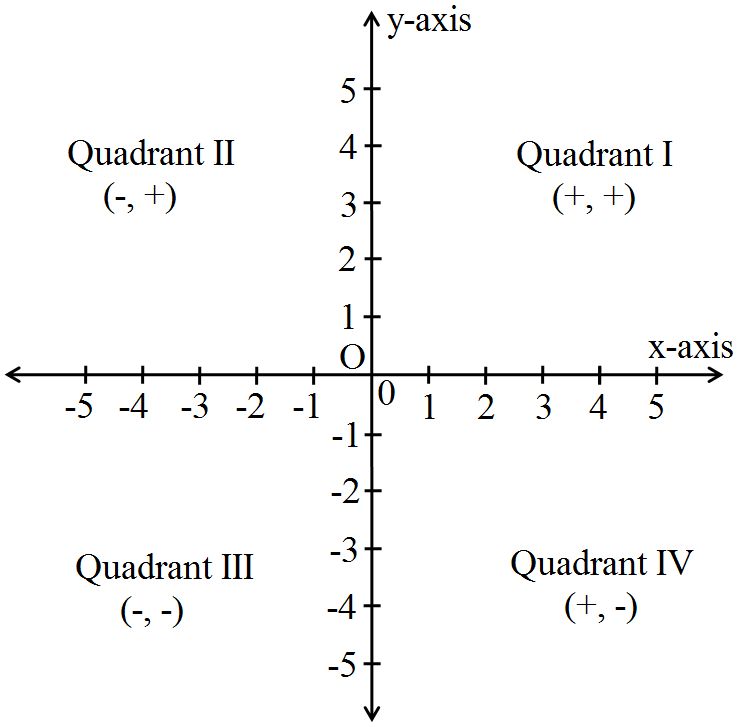
If a > 0 and b > 0 then the point (a, b) lies in quadrant.
  1. IV
  2. II
  3. III
  4. None of these.
Answer
  1. II

Solution:

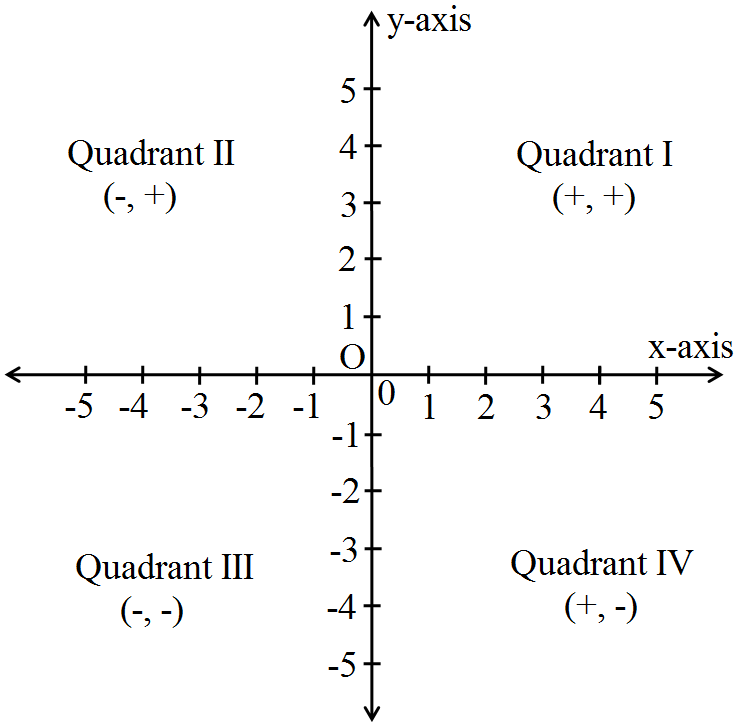
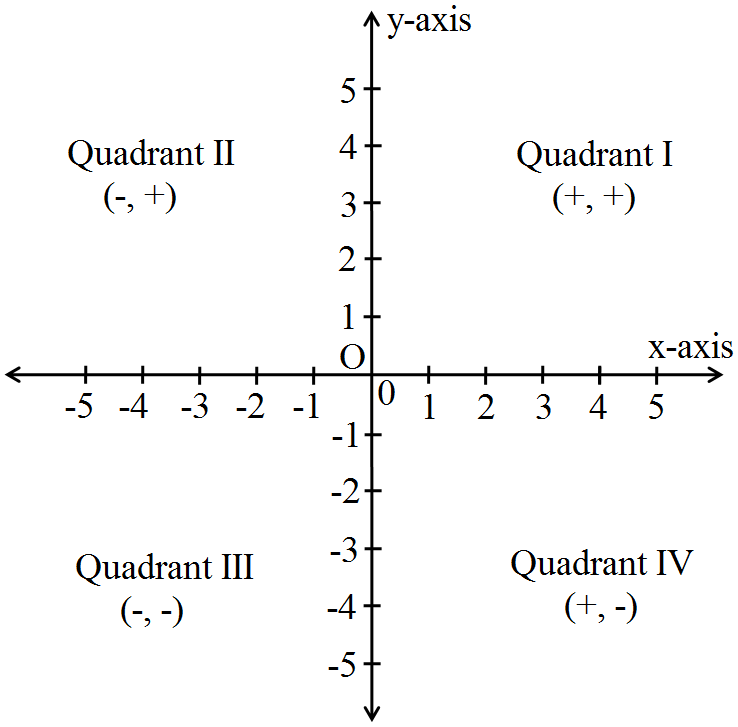
Since, x co-ordinate is negative and y co-ordinate is positive, the given point lies in Quadrant II.

View full question & answer
Question 21 Mark
The ordinate of every point on the x-axis is:
  1. 1
  2. -1
  3. 0
  4. Any real numbers.
Answer
  1. 0

Solution:

The ordinate (y co-ordinate) of every point on the x-axis is 0. 

View full question & answer
Question 31 Mark
A point both of whose coordinates are negative lies in quadrant.
  1. I
  2. II
  3. III
  4. IV
Answer
  1. III

Solution:

A point both of whose coordinates are negative, that is, of the from (-, -) lies in quadrant III.

View full question & answer
Question 41 Mark
The point at which the two coordinate axes meet is called the:
  1. Abscissa.
  2. Ordinate.
  3. Origin.
  4. Quadrant.
Answer
  1. Origin.

Solution:

The point at which the two coordinate axes meet is called the origin.

View full question & answer
Question 51 Mark
Abcissa of a point is positive in:
  1. I and II quadrant.
  2. I and IV quadrant.
  3. I quadrant only.
  4. II quadrant only.
Answer
  1. I and IV quadrant.

Solution:

Absissa of a point is positive when the points are of the form (+, +) and (+, -).

So, the absissa of the point is positive in quadrant I and IV.

View full question & answer
Question 61 Mark
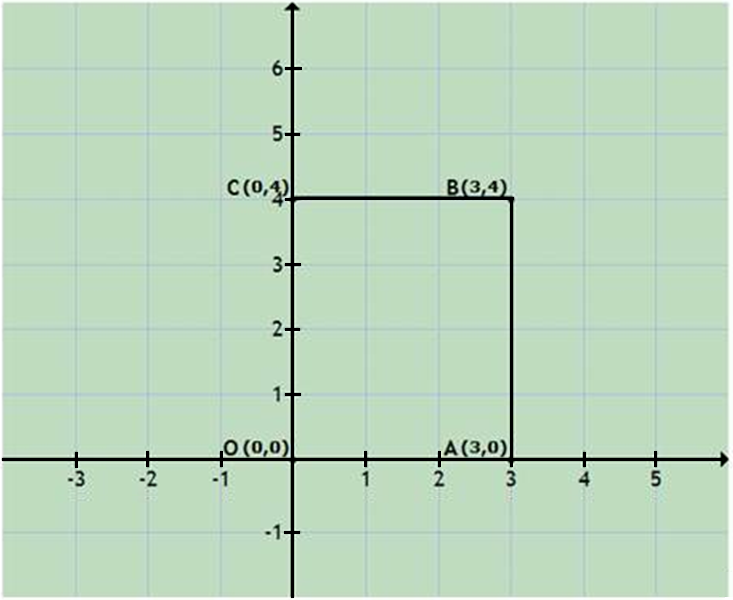
If O(0, 0), A(3, 0), B(3, 4), C(0, 4) are four given points then the figure OABC is a:
  1. Square.
  2. Rectangle.
  3. Trapezium.
  4. Rhombus.
Answer
  1. Rectangle.

Solution:

By plotting the given points, we find that figure OABC is a rectangle.

View full question & answer
Question 71 Mark
Which of the following points does not lie in any quadrant?
  1. (1, 7)
  2. (2, 10)
  3. (-1, 1)
  4. (4, 12)
Answer
  1. (4, 12)

Solution:

For the point to lie on the line y = 3x + 4, it has to satisfy the equation of the line.

Putting x = 1, in y = 3x + 4, we get y = 3(1) + 4 ⇒ y = 7

So, the point satisfies the equation and hence lies on the given line.

Putting x = 2, in y = 3x + 4, we get y = 3(2) + 4 ⇒ y = 10

So, the point satisfies the equation and hence lies on the given line.

Putting x = 1, in y = 3x + 4, we get y = 3(-1) + 4 ⇒ y = 1

So, the point satisfies the equation and hence lies on the given line.

Putting x = 4, in y = 3x + 4, we get y = 3(4) + 4 ⇒ y = 16

But y = 12.

So, the point not satisfy the equation and hence lies on the given line.

View full question & answer
Question 81 Mark
Point (-7, 0) lies.
  1. On the negative direction of x-axis.
  2. On the negative direction of y-axis.
  3. In the III quadrant.
  4. In the IV quadrant.
Answer
  1. On the negative direction of x-axis.

Solution:

Point (-7, 0) lies on negative direction of the x-axis as its x co-ordinate is negative and y co-ordinate is zero. 

View full question & answer
Question 91 Mark
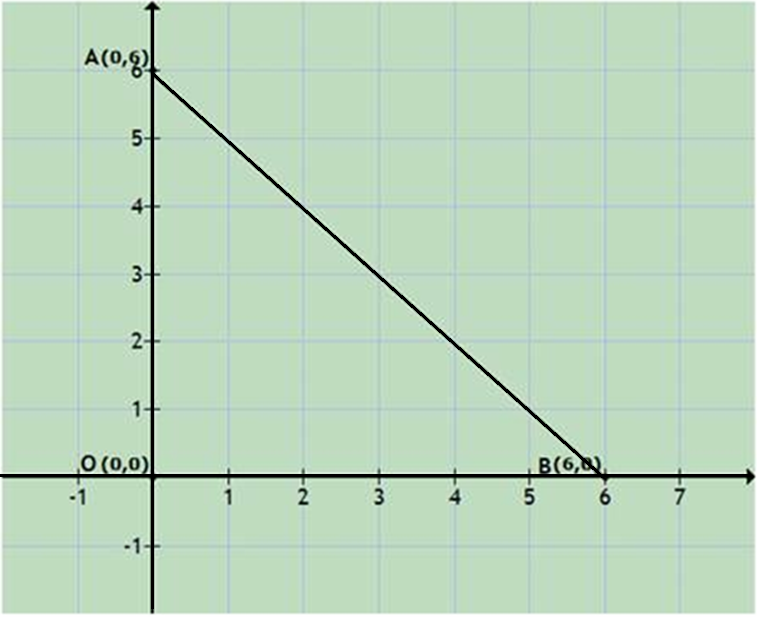
The area of $\triangle\text{AOB}$ having vertices A(0, 6), O(0, 0) and B(6, 0) is:
  1. 12sq units.
  2. 36sq units.
  3. 18sq units.
  4. 24sq units.
Answer
  1. 18sq units.

Solution:

Clearly, $\triangle\text{AOB}$ is a right-angled triangle.

$\therefore$ Area of $\triangle\text{AOB}=\frac{1}{2}\times\text{Base}\times\text{Height}$

$=\frac{1}{2}\times\text{OB}\times\text{OA}$

$=\frac{1}{2}\times6\times6$

= 18 square units.

View full question & answer
Question 101 Mark
Points (1, -1), (2, -2), (-3, -4), (4, -5)
  1. All lie in the II quadrant.
  2. All in the III quadrant.
  3. All lie in the IV quadrant.
  4. Do not lie in the same quadrant.
Answer
  1. Do not lie in the same quadrant.

Solution:

Points (1, -1), (2, -2) and (4, -5) lie in Quadrant IV, but point (-3, -4) lies in Quadrant III.

Hence, all the given points do not lie in the same quadrant.

View full question & answer
Question 111 Mark
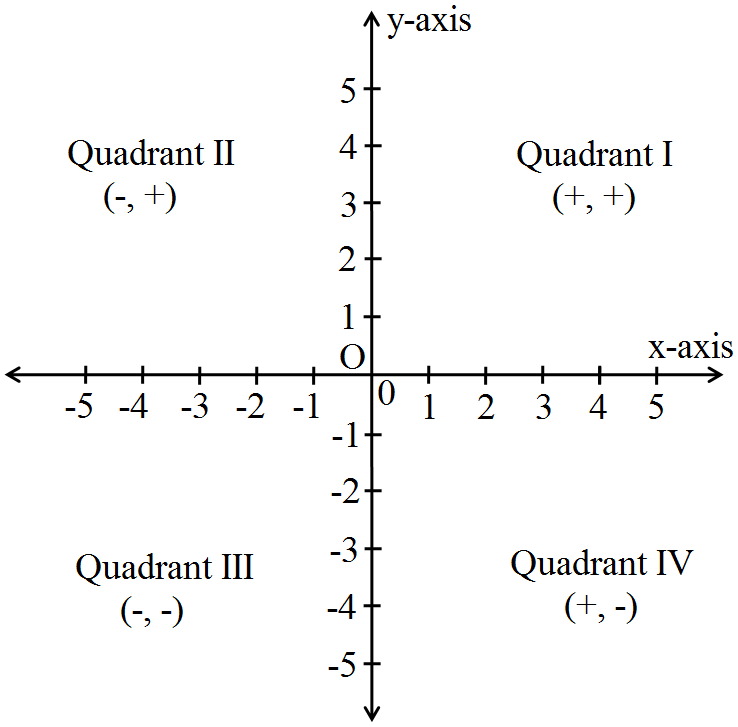
In the which quadrant does the point (-7, -4) lie?
  1. IV
  2. II
  3. III
  4. None of these.
Answer
  1. III

Solution:

Since, both the coordinates of given point are negative, it lies in Quadrant III.

View full question & answer
Question 121 Mark
The point (other than origin) for which abscissa is equal to the ordinate will lie in quadrant.
  1. I only
  2. I or II
  3. I or III
  4. II or IV
Answer
  1. I or III

Solution:

The points are same when they are of the form (m, m) or (-n, -n).

This happens only in quadrant I and quadrant III.

So, the points (other than the origin) for which the abscissa is equal to the ordinate lie in quadrant I and quadrant III.

View full question & answer
Question 131 Mark
If A (-2, 3) and B(-3, 5) are two given points then (abscissa of A) - (abscissa of B) = ?
  1. -2
  2. 1
  3. -1
  4. 2
Answer
  1. 1

Solution:

Abscissa of A - Abscissa of B

= -2 - (-3)

= -2 + 3

= 1 

View full question & answer
Question 141 Mark
The point which lies on the y-axis at a distance of 5 units in the negative direction of the y-axis is:
  1. (-5, 0)
  2. (0, -5)
  3. (5, 0)
  4. (0, 5)
Answer
  1. (0, -5)

Solution:

The point which lies on the y-axis at a distance of 5 units in the negative direction of the y-axis is (0, -5).

View full question & answer
Question 151 Mark
Which of the following points lies on the line y = 2x + 3?
  1. (2, 8)
  2. (3, 9)
  3. (4, 12)
  4. (5, 15)
Answer
  1. (3, 9)

Solution:

For the point to lie on the line y = 2x + 3, it has to satisfy the equation of the line.

Putting x = 2, in y = 2x + 3, we get y = 2(2) + 3 ⇒ y = 7

But y = 8.

So, the point does not satisfy the equation and hence does not lie on the given line.

Putting x = 3, in y = 2x + 3, we get y = 2(3) + 3 ⇒ y = 9

So, the point satisfies the equation and hence lies on the given line.

Putting x = 4, in y = 2x + 3, we get y = 2(4) + 3 ⇒ y = 11

But y = 12.

So, the point does not satisfy the equation and hence does not lie on the given line.

Putting x = 5, in y = 2x + 3, we get y = 2(5) + 3 ⇒ y = 13

But y = 15.

So, the point does not satisfy the equation and hence does not lie on the given line.
View full question & answer
Question 161 Mark
If x > 0 and y < 0 then the point (x, y) lies in quadrant.
  1. I
  2. III
  3. II
  4. IV
Answer
  1. IV

Solution:

Points of the type (+, -) lie in the 4th quadrant.

Since x > 0 and y < 0, the point (x, y) lies in quadrant IV.

View full question & answer
Question 171 Mark
If the y-coordinate of a point is zero then this point always lies.
  1. On the y-axis.
  2. On the x-axis.
  3. In the I quadrant.
  4. In the IV quadrant.
Answer
  1. On the x-axis.

Solution:

If the y-coordinate of a point is zero then this point always lies on the x-axis. 

View full question & answer
Question 181 Mark
The points (-5, 3) and (3, -5) lie in the.
  1. same quadrant
  2. II and III quadrants respectively.
  3. II and IV quadrants respectively.
  4. IV and II quadrants respectively.
Answer
  1. II and IV quadrants respectively

Solution:

For point (-5, 3), the x co-ordinate is negative and the y co-ordinate is positive. Hence, it lies in Quadrant II.

For point (3, -5), the x co-ordinate is positive and the y co-ordinate is negative. Hence, it lies in Quadrant IV.

View full question & answer
Question 191 Mark
The point at whose ordinate is 3 and which lies on the y-axis is:
  1. (3, 0)
  2. (0, 3)
  3. (3, 3)
  4. (1, 3)
Answer
  1. (0, 3)

Solution:

If a point lies on y-axis, then its abscissa is 0.

Hence, the point whose ordinate is 3 and which lies on the y-axis is (0, 3).

View full question & answer
Question 201 Mark
Point (0, -8) lies.
  1. In the II quadrant.
  2. In the IV quadrant.
  3. On the x-axis.
  4. On the y-axis.
Answer
  1. On the y-axis.

Solution:

Point (0, -8) lies on y-axis as its x co-ordinate is 0.

View full question & answer
Question 211 Mark
Which of the following points does not lie in any quadrant?
  1. (3, -6)
  2. (-3, 4)
  3. (5, 7)
  4. (0, 3)
Answer
  1. (0, 3)

Solution:

The abscissa of point (0, 3) is 0. Hence, it lies on y-axis. 

View full question & answer
Question 221 Mark
The perpendicular distance of the point A(3, 4) from the y-axis is:
  1. 3
  2. 4
  3. 5
  4. 7
Answer
  1. 3

Solution:

The perpendicular distance of the point A(3, 4) from the y-axis is 3 units. 

View full question & answer
M.C.Q - Maths STD 9 Questions - Vidyadip