Questions

4 Marks Questions

🎯

Test yourself on this topic

38 questions · timed · auto-graded

Question 14 Marks
x4 - 2x3 - 7x2 + 8x + 12.
Answer
Let f(x) = x4 - 2x3 - 7x2 + 8x + 12
The factors of constant term in f(x) are $\pm1,\pm2,\pm3,\pm4,\pm6$ and $\pm12.$
We have,
f(1) = 1 - 2 - 7 + 8 + 12 = 12
⇒ (x - 1) is not a factor of f(x)
f(-1) = 1 + 2 - 7 - 8 + 12 = 0
⇒ (x + 1) is a factor of f(x)
f(2) = 16 - 16 - 28 - 16 + 12 = 0
⇒ (x - 2) is a factor of f(x)
f(-2) = 16 + 16 - 28 - 16 + 12 = 0
⇒ (x + 2) is a factor of f(x)
f(3) = 81 - 54 - 63 + 24 + 12 = 0
⇒ (x - 3) is a factor of f(x)
Since f(x) is a polynomial of degree 4. So, it cannot have more than 4 linear factors.
Thus, factors of f(x) are (x +1), (x - 2), (x + 2) and (x - 3).
Therefore,
f(x) = k(x + 1)(x + 2)(x - 2)(x - 3)
x4 - 2x3 - 7x2 + 8x + 12 = k(x + 1)(x + 2)(x - 2)(x - 3) ...(1)
Putting x = 0 on both sides, we get,
12 = k(1)(2)(-2)(-3)
12 = 12k
k = 1
Substituting k = 1 in (1), we get,
x4 - 2x3 - 7x2 + 8x + 12 = k(x + 1)(x + 2)(x - 2)(x - 3)
View full question & answer
Question 24 Marks
x4 + 10x3 + 35x2 + 50x + 24.
Answer
Let f(x) = x4 + 10x3 + 35x2 + 50x + 24
Now, putting x = -1, we get
f(-1) = (-1)4 + 10(-1)3 + 35(-1)2 + 50(-1) + 24
= 1 - 10 + 35 - 50 + 24 = 60 - 60
= 0
Therefore, (x + 1) is a factor of polynomial f(x).
Now,
f(x) = x3(x + 1) + 9x2(x + 1) + 26(x + 1) + 24(x + 1)
= (x + 1)(x3 + 9x2 + 26x + 24)
= (x + 1)g(x) ...(1)
Where g(x) = x3 + 9x2 + 26x + 24
Putting x = -2, we get:
g(-2) = (-2)3 + 9(-2)2 + 26x(-2) + 24
= -8 + 36 - 52 + 24 = 60 - 60
= 0
Therefore, (x + 2) is the factor of g(x).
Now,
g(x) = x2(x + 2) + 7x(x + 2) + 12(x + 2)
= (x + 2)(x2 + 7x + 12)
= (x + 2)(x2 + 4x + 3x + 12)
= (x + 2)(x + 3)(x + 4) ...(2)
From equation (1) and (2), we get:
f(x) = (x + 1)(x + 2)(x + 3)(x + 4)
Hence,
(x + 1), (x + 2), (x + 3) and (x + 4) are the factors of polynomial f(x).
View full question & answer
Question 34 Marks
What must be added to x3 - 3x2 - 12x + 19 so that the result is exactly divisibly by x2 + x - 6?
Answer
Let p(x) = x3 - 3x2 - 12x + 19 and q(x) = x2 + x - 6
When p(x) is divided q(x) then the remainder is a linear equation, r(x).
Let r(x) = ax + b when added to p(x) we get an expression which is divisible by q(x).
f(x) = p(x) + r(x)
f(x) = x3 - 3x2 - 12x + 19 + ax + b
= x3 - 3x2 - 12x + ax + 19 + b
= x3 - 3x2 - x(12 - a) + 19 + b
Now,
q(x) = x2 + x - 6 = x2 + 3x - 2x - 6 = (x + 3)(x - 2)
Also,
f(x) is divisible q(x)
$\therefore$ f(-3) = 0, f(2) = 0
f(-3) = (-3)3 - 3(-3)2 - 12(-3) + 19 + a(-3) + b = 0
⇒ -27 + 27 + 36 + 19 - 3a + b = 0
⇒ b = 3a + 27 + 27 - 36 - 19
⇒ b = 3a - 1 ...(1)
f(2) = 23 - 3(2)2 - 12(2) + 19 + 2a + b = 0
⇒ 8 - 12 - 24 + 19 + 2a + b = 0
⇒ b = 9 - 2a ...(2)
Equating (1) and (2)
3a - 1 = 9 - 2a
⇒ 5a = 10
⇒ a = 2
$\therefore$ b = 3a - 1 3(2) - 1 = 5 [Substituting b = 5, in equation 1]
Hence,
ax + b = 2x + 5
View full question & answer
Question 44 Marks
Verify whether the indicated numbers are zeros of the polynomials corresponding to them in the following case:
p(x) = x3 - 6x2 + 11x - 6, x = 1, 2, 3
Answer
p(x) = x3 - 6x2 + 11x - 6, x = 1, 2, 3
We know that,
p(x) = x3 - 6x2 + 11x - 6
given that the values of x are 1, 2 , 3
substitute x = 1 in p(x)
p(1) = 1- 6(1)2 + 11(1) - 6
= 1 - (6 × 1) + 11 - 6
= 1 - 6 + 11 - 6
= 0
Now, substitute x = 2 in p(x)
P(2) = 23 - 6(2)2 + 11(2) - 6
= (2 × 3) - (6 × 4) + (11 × 2) - 6
= 8 - 24 - 22 - 6
= 0
Now, substitute x = 3 in p(x)
P(3) = 3- 6(3)2 + 11(3) - 6
= (3 × 3) - (6 × 9) + (11 × 3) - 6
= 27 - 54 + 33 - 6
= 0
Since, the result is 0 for x = 1, 2, 3 these are the roots of x3 - 6x2 + 11x - 6
View full question & answer
Question 54 Marks
Using factor theorem, factorize the following polynomials:
y3 - 7y + 6
Answer
Let f(y) = y3 - 7y + 6
The factors of constant term in f(y) are $\pm1,\pm,2,\pm3$ and $\pm6.$
We have,
f(1) = 1 - 7 + 6 = 0
⇒ (y - 1) is a factor of f(y)
f(-1) = -1 + 7 + 6 = 12
⇒ (y + 1) is a factor of f(y)
f(2) = 8 - 14 + 6 = 0
⇒ (y - 2) is a factor of f(y)
f(-2) = -8 + 14 + 6 = 12
⇒ (y + 2) is not a factor of f(y)
f(3) = 27 - 21 + 6 = 12
⇒ (y - 3) is not a factor of f(y)
f(-3) = -27 + 21 + 6 = 0
⇒ (y + 3) is a factor of f(y)
Since f(y) is a polynomial of degree 3. So, it cannot have more than 3 linear factors.
Thus, factors of f(y) are (y - 1)(y - 2) and (y + 3).
Therefore,
f(y) = k(y - 1)(y - 2)(y + 3)
y3 - 7y + 6 = k(y - 1)(y - 2)(y + 3) ...(1)
Putting y = 0 on both sides, we get,
6 = k(-1)(-2)(3)
6 = 6k
k = 1
Substituting k = 1 in (1), we get,
y3 - 7y + 6 = (y - 1)(y - 2)(y + 3)
View full question & answer
Question 64 Marks
Using factor theorem, factorize the following polynomials:
y3 - 2y2 - 29y - 42
Answer
Let f(y) = y3 - 2y2 - 29y - 42 be the given polynomial.
Now, putting y = -2, we get
f(-2) = (-2)3 - 2(-2)2 - 29(-2) - 42
= -8 - 8 + 58 - 42
= -58 + 58 = 0
Therefore, (y + 2) is a factor of polynomial f(y).
Now,
f(y) = y2(y + 2) + 4y(y + 2) - 2(y + 2)
= (y + 2)(y2 - 4y - 21)
= (y + 2)(y2 - 7y + 3y - 21)
= (y + 2)(y + 3)(y - 7)
Hence (y + 2), (y + 3) and (y - 7) are the factors of polynomial f(y).
View full question & answer
Question 74 Marks
Using factor theorem, factorize the following polynomials:
x4 - 7x3 + 9x2 + 7x - 10
Answer
Let f(x) = x4 - 7x3 + 9x2 + 7x - 10
The factors of constant term in f(x) are $\pm1,\pm2,\pm5$ and $\pm10.$
We have,
f(1) = 1 - 7 + 9 + 7 - 10 = 0
⇒ (x - 1) is a factor of f(x)
f(-1) = 1 + 7 + 9 - 7 - 10 = 0
⇒ (x + 1) is a factor of f(x)
f(2) = 16 - 56 + 36 + 14 - 10 = 0
⇒ (x - 2) is a factor of f(x)
f(-2) = 16 + 56 - 36 - 14 - 10 = 10
⇒ (x + 2) is not a factor of f(x)
f(5) = 625 - 875 + 225 + 35 - 10 = 0
⇒ (x - 5) is a factor of f(x)
Since f(x) is a polynomial of degree 4. So, it cannot have more than 4 linear factors.
Thus, factors of f(x) are (x - 1), (x + 1), (x - 2) and (x - 5).
Therefore,
f(x) = k(x - 1)(x + 1)(x - 2)(x - 5)
 x4 - 7x3 + 9x2 + 7x - 10 = k(x - 1)(x + 1)(x - 2)(x - 5) ...(1)
Putting x = 0 on both sides, we get,
-10 = k(-1)(1)(-2)(-5)
-10 = -10k
k = 1
Substituting k = 1 in (1), we get,
x4 - 7x3 + 9x2 + 7x - 10 = (x - 1)(x + 1)(x - 2)(x - 5)
View full question & answer
Question 84 Marks
Using factor theorem, factorize the following polynomials:
x3 - 6x2 + 3x + 10
Answer
Let x = 2
f(2) = 23 + 6(2)2 + 3(2) + 10 = 8 - 24 + 6 + 10 = 0
$\therefore$ x = 2 is a solution f(x)
i. e (x - 2) is a factor of f(x)

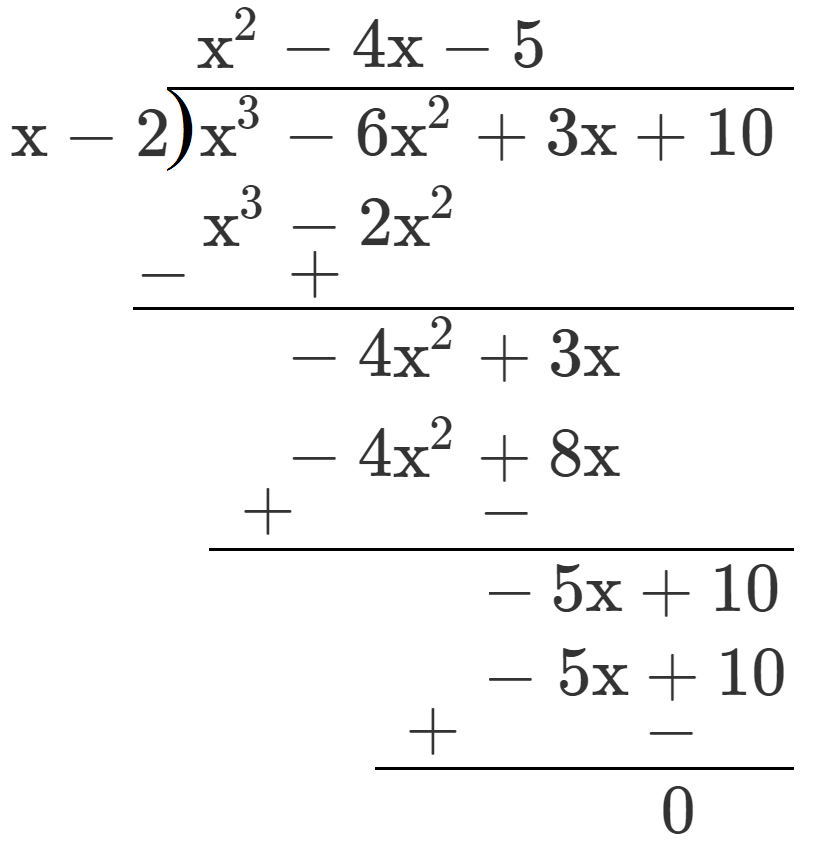
By division algorithm
x3 - 6x2 + 3x + 10 = (x - 2)(x2 - 4x - 5)
= (x - 2)(x2 - 5x + x - 5)
= (x - 2)(x(x - 5) + 1(x - 5))
= (x - 2)(x - 5)(x + 1)
$\therefore$ x3 - 6x2 + 3x + 10 = (x - 2)(x - 5)(x + 1)
View full question & answer
Question 94 Marks
Using factor theorem, factorize the following polynomials:
x3 + 6x2 + 11x + 6
Answer
Let x = 1
$\text{f(1)}=1^3+6(2)^2+11(1)+6\neq0$
Let x = -1
f(-1) = (-1)3 + 6(-1)2 + 11(-1) + 6 = 12 - 12 = 0
$\therefore$ x = -1 is a solution
⇒ x + 1 = 0
i. e (x + 1) is a factor of f(x)

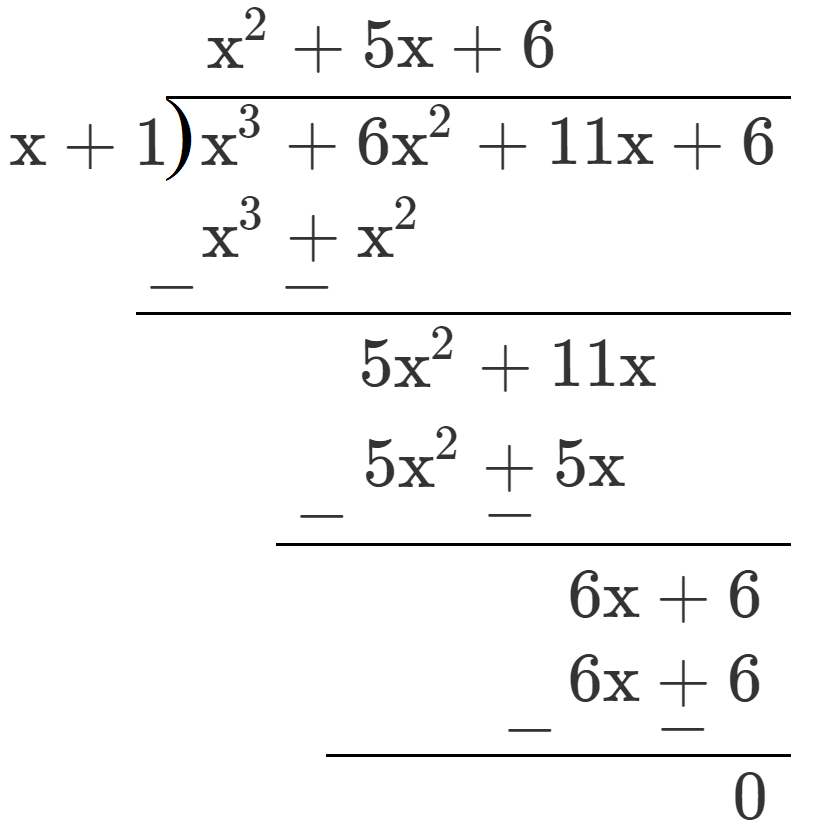
By division algorithm
x3 + 6x2 + 11x + 6 = (x + 1)(x2 + 5x + 6)
= (x + 1)(x2 + 2x + 3x + 6)
= (x + 1)(x(x + 2) + 3(x + 2))
= (x + 1)(x + 2)(x + 3)
$\therefore$ x3 + 6x2 + 11x + 6 = (x + 1)(x + 2)(x + 3)
View full question & answer
Question 104 Marks
Using factor theorem, factorize the following polynomials:
x3 - 3x2 - 9x - 5
Answer
Let p(x) = x3 - 3x2 - 9x - 5
The factors of 5 are $\pm1,\pm5.$
By hit and trial method
p(-1) = (-1)3 - 3(-1)2 - 9(-1) - 5
= -1 - 3 + 9 - 5 = 0
So x + 1 is a factor of this polynomial p(x).
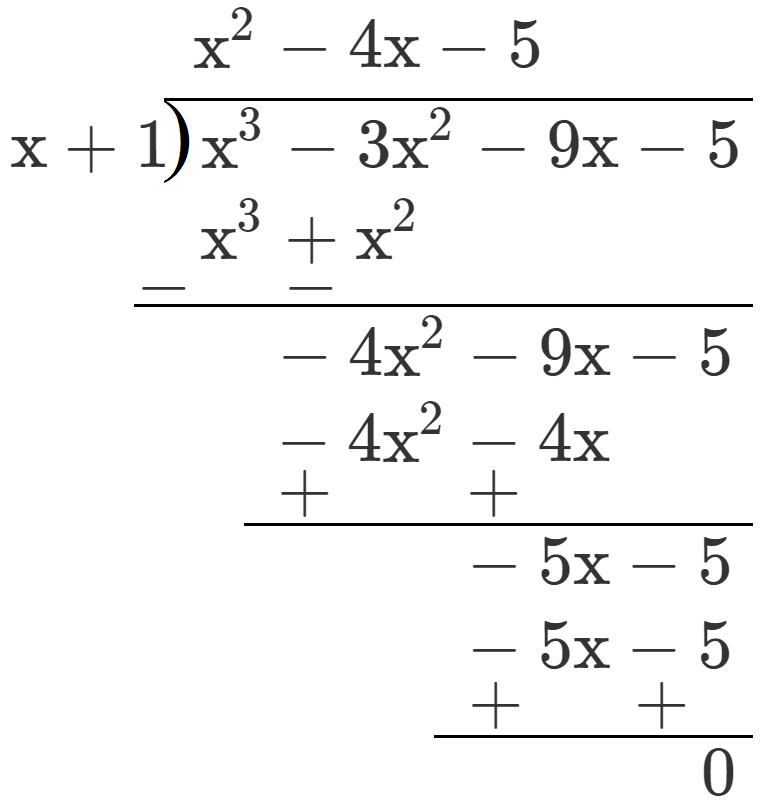
Let us find the quotient while dividing x3 - 3x2 - 9x - 5 by x + 1
By long division

Now,
Dividend = Divisor × Quotient + Remainder
$\therefore$ x3 - 3x2 - 9x - 5 = (x + 1)(x2 - 4x - 5) + 0
= (x + 1)(x2 - 5x + x - 5)
= (x + 1)[x(x - 5) + 1(x - 5)]
= (x + 1)(x - 5)(x + 1)
= (x - 5)(x + 1)(x + 1)
View full question & answer
Question 114 Marks
Using factor theorem, factorize the following polynomials:
x3 - 2x2 - x + 2
Answer
Let f(x) = x3 - 2x2 - x + 2
The factors of constant term in f(x) are $\pm1,\pm2.$
We have 
f(1) = 1 - 2 - 1 + 2 = 0
⇒ (x - 1) is a factor of f(x)
f(-1) = -1 - 2 + 1 + 2 = 0
⇒ (x + 1) is a factor of f(x)
f(2) = 8 - 8 - 2 + 2 = 0
⇒ (x - 2) is a factor of f(x)
Since f(x) is a polynomial of degree 3. So, it cannot have more than 3 linear factors.
Thus, factors of f(x) are (x - 1), (x + 1) and (x - 2).
Therefore,
f(x) = k(x - 1)(x + 1)(x - 2)
x3 - 2x2 - x + 2 = k(x - 1)(x + 1)(x - 2) ...(1)
Putting x = 0 on both sides, we get,
2 = k(-1)(1)(-2)
2 = 2k
k = 1
Substituting k = 1 in (1), we get,
x3 - 2x2 - x + 2 = (x - 1)(x + 1)(x - 2)
View full question & answer
Question 124 Marks
Using factor theorem, factorize the following polynomials:
x3 + 2x2 - x - 2
Answer
Let x = 1
f(1) = 13 + 2(1)2 - 1 - 2 = 0
$\therefore$ x = 1 is a solution
⇒ x - 1 = 0
i. e (x - 1) is a factor of f(x)

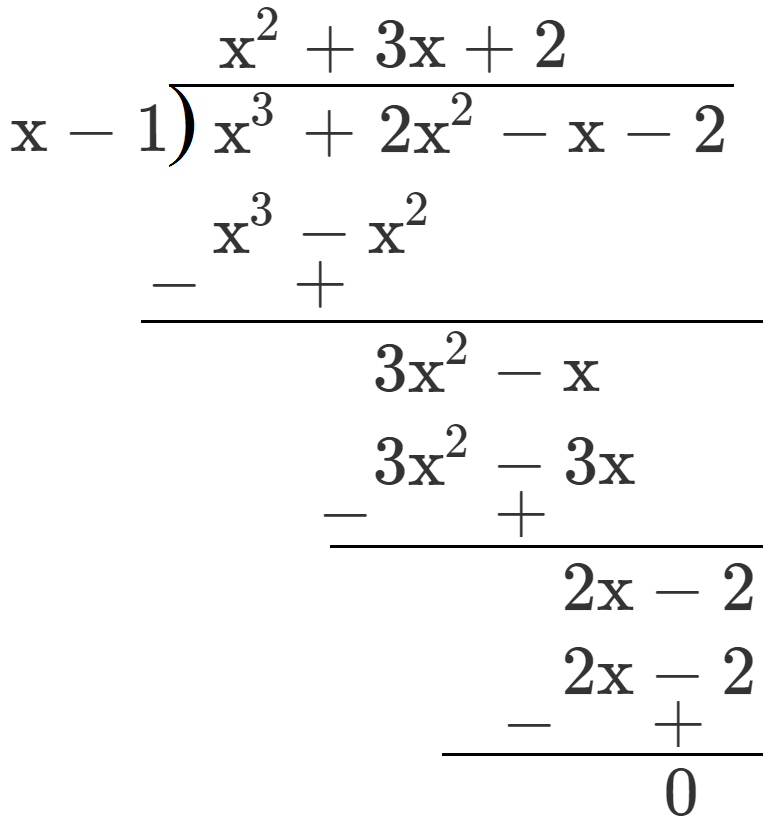
By division algorithm
x3 + 2x2 - x - 2 = (x - 1)(x2 + 3x + 2)
= (x - 1)(x2 + 2x + x + 2)
= (x - 1)(x(x + 2) + 1(x + 2))
= (x - 1)(x + 2)(x + 1)
$\therefore$ x3 + 2x2 - x - 2 = (x - 1)(x + 2)(x + 1)
View full question & answer
Question 134 Marks
Using factor theorem, factorize the following polynomials:
x3 - 23x2 + 142x - 120
Answer
Let p(x) = x3 - 23x2 + 142x - 120
We shall now look for all the factors of -120. Some of these are $1,\pm2,\pm3,\pm,\pm4,\pm5,\pm6,\pm8\\\pm12,\pm15,\pm20,\pm24,\pm30,\pm,60$
By trial, we find that p(1) = 0.
So x - 1 is a factor of p(x).
Now, we see that x3 - 23x2 + 142x - 120 = x3 - x- 22x2 + 22x +120x - 120
= x2(x - 1) - 22x(x - 1) + 120(x - 1)
= (x - 1)(x2 - 22x + 120) [Taking (x - 1) common]
We could have also got this by dividing p(x) by x - 1.
Now x2 - 22x + 120 can be factorised either by splitting the middle term or by using the factor theorem.
By splitting the middle term, we have:
x2 - 22x + 120 = x2 - 12x - 10x+ 120
= x(x - 12) - 10(x - 12)
= (x - 12)(x - 10)
So, 
x3 - 23x2 + 142x - 120 = (x - 1)(x - 10)(x - 12)
View full question & answer
Question 144 Marks
Using factor theorem, factorize the following polynomials:
x3 + 13x2 + 32x + 20
Answer
Let p(x) = x3 + 13x+ 32x + 20
The factors of 20 are $\pm1,\pm2,\pm4,\pm5\dots$
By hit and trial method
p(-1) = (-1)3 + 13(-1)2 + 32(-1) + 20
= -1 + 13 - 32 + 20
= 33 - 33 = 0
As p(-1) is zero, so x + 1 is a factor of this polynomial p(x).
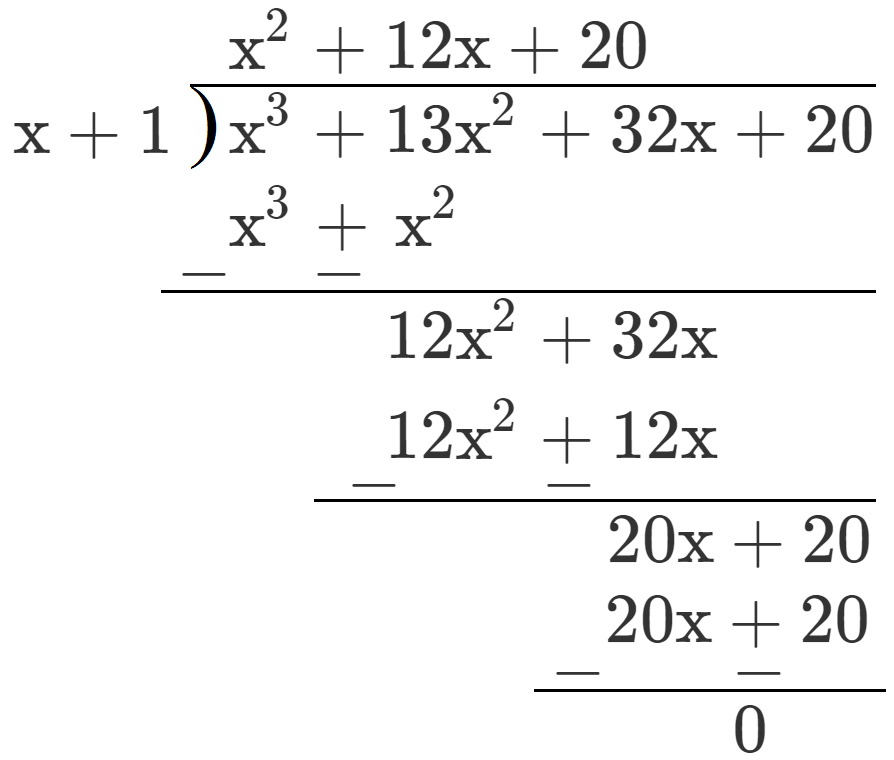
Let us find the quotient while dividing x3 + 13x2 + 32x + 20 by (x + 1)
By long division

We know that
Dividend = Divisor × Quotient + Remainder
x3 + 13x2 + 32x + 20 = (x + 1)(x2 + 12x + 20) + 0
= (x + 1)(x2 + 10x + 2x + 20)
= (x + 1)[x(x + 10) + 2(x + 10)]
= (x + 1)(x + 10)(x + 2)
= (x + 1)(x + 2)(x + 10)
View full question & answer
Question 154 Marks
Using factor theorem, factorize the following polynomials:
x3 - 10x2 - 53x - 42
Answer
Let f(x) = x3 - 10x2 - 53x - 42 be the given polynomial.
Now, putting x = -1, we get
f(-1) = (-1)3 - 10(-1)2 - 53(-1) - 42
= -1 - 10 + 53 - 42
= -53 + 53 = 0
Therefore, (x + 1) is a factor of polynomial f(x).
Now,
f(x) = x2(x + 1) - 11x(x + 1) - 42(x + 1)
= (x + 1)(x2 - 11x - 42)
= (x + 1)(x2 - 14x + 3x - 42)
= (x + 1)(x + 3)(x - 14)
Hence (x + 1), (x + 3) and (x - 14) are the factors of polynomial f(x).
View full question & answer
Question 164 Marks
Using factor theorem, factorize the following polynomials:
3x3 - x2 - 3x + 1
Answer
Let f(x) = 3x3 - x2 - 3x + 1
The factor of the coefficient of x3 is 3. So, the possible rational roots of f(x) are $\pm1$ and $\pm\frac{1}{3}$
We have,
f(1) = 3 - 1 - 3 + 1 = 0
⇒ (x - 1) is a factor of f(x)
f(-1) = -3 - 1 + 3 + 1
⇒ (x + 1) is a factor of f(x)
So, (x - 1) and (x + 1) are factors of f(x)
⇒ (x - 1)(x + 1) is a also a factor of f(x)
⇒ x2 - 1 is a factor of f(x).
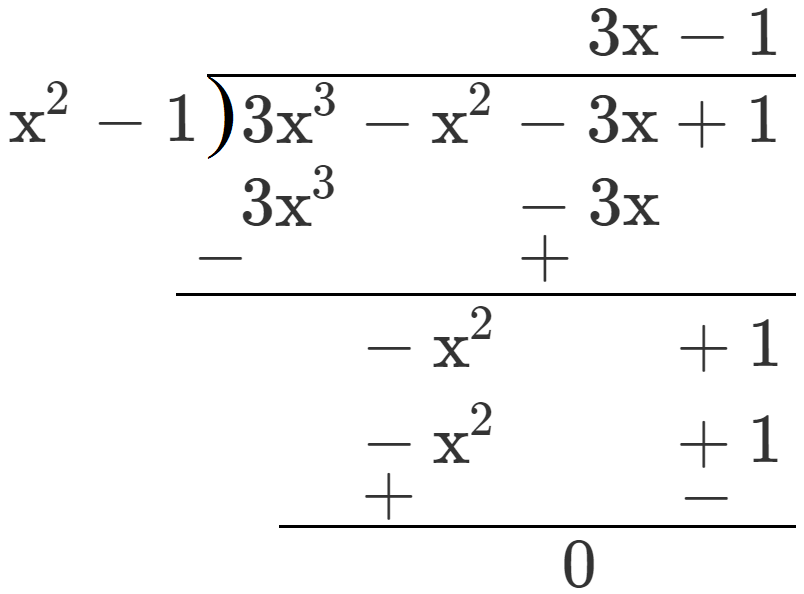
Let us now divide f(x) = 3x3 - x2 - 3x + 1 by x2 - 1 to get the other factors of f(x).
By long division, we have:

Therefore,
3x3 - x2 - 3x + 1 = (x2 - 1)(3x - 1)
Now,
(x2 - 1) = (x - 1)(x + 1)
Hence,
3x3 - x2 - 3x + 1 = (x - 1)(x + 1)(3x - 1)
View full question & answer
Question 174 Marks
Using factor theorem, factorize the following polynomials:
2y3 + y2 - 2y - 1
Answer
Let p(y) = 2y3 + y2 - 2y - 1
By hit and trial method
p(1) = 2(1)3 + (1)2 - 2(1) - 1
= 2 + 1 - 2 - 1 = 0
So, y -1 is a factor of this polynomial.

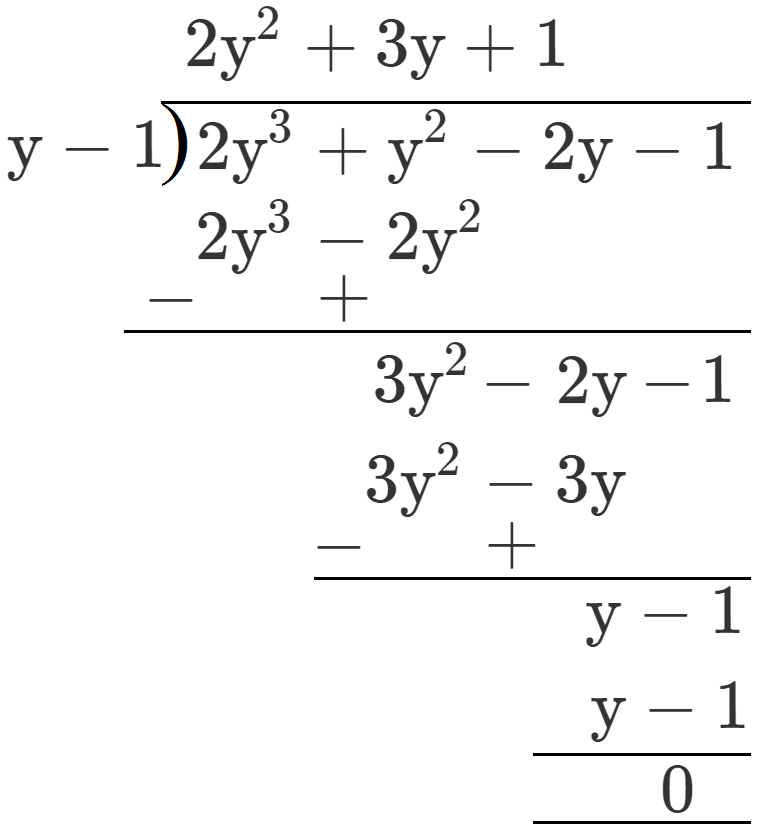
Now,
By long division method,
$\therefore$ 2y3 + y2 - 2y - 1 = (y - 1)(2y2 + 3y + 1)
= (y - 1)(2y2 + 2y + y + 1)
= (y - 1)[2y(y + 1) + 1(y + 1)]
= (y - 1)(y + 1)(2y + 1)
View full question & answer
Question 184 Marks
Using factor theorem, factorize the following polynomials:
2y3 - 5y2 - 19y + 42
Answer
Let f(y) = 2y3 - 5y2 - 19y + 42 be the given polynomial.
Now, putting y = 2, we get
f(2) = 2(2)3 - 5(2)2 - 19(2) + 42
= 16 - 20 - 38 + 42
= -58 + 58 = 0
Therefore, (y - 2) is a factor of polynomial f(y).
Now,
f(y) = 2y2(y - 2) - y(y - 2) - 21(y - 2)
= (y - 2)(2y2 - y - 21)
= (y - 2)(2y2 - 7y + 6y - 21)
= (y - 2)(y + 3)(2y - 7)
Hence (y - 2), (y + 3) and (2y - 7) are the factors of polynomial f(y).
View full question & answer
Question 194 Marks
Show that (x - 2), (x + 3) and (x - 4) are factors of x3 - 3x2 - 10x + 24.
Answer
F(x) = x3 - 3x2 - 10x + 24
Let,
x - 2 = 0
⇒ x = 2
f(2) = 23 - 3(2)2 - 10(2) + 24
= 8 - 12 - 20 + 24
= 32 - 32 = 0
Let,
x + 3 = 0
⇒ x = -3
f(-3) = (-3)3 - 3(-3)2 - 10(-3) + 24
= -27 - 3(9) + 30 + 24
= -27 - 27 + 30 + 24
= -54 + 54 = 0
Let,
x - 4 = 0
⇒ x = 4
f(4) = 43 - 3(4)2 - 10(4) + 24
= 64 - 3(16) - 40 + 24
= 64 - 48 - 40 + 24
= 88 - 88 = 0
$\because$ f(2) = 0, f(-3) = 0, f(4) = 0
$\therefore$ By factore theoram (x - 2), (x + 3) and (x - 4) are factors of x3 - 3x2 - 10x + 24.
View full question & answer
Question 204 Marks
 In the following, using the remainder theorem, find the remainder when f(x) is divided by g(x) and verify the by actual division:
$\text{f(x)}=3\text{x}^4+2\text{x}^3-\frac{\text{x}^3}{3}-\frac{\text{x}}{9}+\frac{2}{27},$ $\text{g(x)}=\text{x}+\frac{2}{3}$
Answer
 Here,
$\text{f(x)}=3\text{x}^4+2\text{x}^3-\frac{\text{x}^3}{3}-\frac{\text{x}}{9}+\frac{2}{27},$
$\text{g(x)}=\text{x}+\frac{2}{3}$
From, the remainder theorem when f(x) is divided by $\text{g(x)}=\text{x}-\Big(-\frac{2}{3}\Big),$ the remainder will be equal to $\text{f}\Big(-\frac{2}{3}\Big)$
Substitute the value of x in f(x)
$\text{f}\Big(-\frac{2}{3}\Big)=3\Big(-\frac{2}{3}\Big)^4+2\Big(-\frac{2}{3}\Big)^3\\-\frac{\Big(-\frac{2}{3}\Big)^3}{3}-\Bigg[\frac{\big(-\frac{2}{3}\big)}{9}+\frac{22}{7}\Big(\frac{2}{27}\Big)\Bigg]$
$=3\Big(\frac{16}{81}\Big)+2\Big(\frac{-8}{27}\Big)-\frac{4}{(9\times3)}-\Big(\frac{-2}{(9\times3)}\Big)+\frac{2}{27}$
$=\Big(\frac{16}{27}\Big)-\Big(\frac{16}{27}\Big)-\frac{4}{27}+\Big(\frac{2}{27}\Big)+\frac{2}{27}$
$=\Big(\frac{4}{27}\Big)-\Big(\frac{4}{27}\Big)$
$=0$
Therefore, the remainder is 0. 
View full question & answer
Question 214 Marks
 In the following, using the remainder theorem, find the remainder when f(x) is divided by g(x) and verify the by actual division:
f(x) = x4 - 3x2 + 4, g(x) = x - 2
Answer
Here,
f(x) = x4 - 3x2 + 4
g(x) = x - 2
From, the remainder theorem when f(x) is divided by g(x) = x - 2 the remainder will be equal to f(2)
Let, g(x) = 0
⇒ x - 2 = 0
⇒ x = 2
Substitute the value of x in f(x)
f(2) = 24 - 3(2)2 + 4
= 16 - (3 × 4) + 4
= 16 - 12 + 4
= 20 - 12
= 8
Therefore, the remainder is 8.
View full question & answer
Question 224 Marks
 In the following, using the remainder theorem, find the remainder when f(x) is divided by g(x) and verify the by actual division:
f(x) = x3 + 4x2 - 3x + 10, g(x) = x + 4
Answer
Here,
f(x) = x3 + 4x2 - 3x + 10
g(x) = x + 4
From, the remainder theorem when f(x) is divided by g(x) = x - (-4) the remainder will be equal to f(-4)
Let, g(x) = 0
⇒ x + 4 = 0
⇒ x = -4
Substitute the value of x in f(x)
f(-4) = (-4)3 + 4(-4)- 3(-4) + 10
= - 64 + (4 × 16) + 12 + 10
= - 64 + 64 + 12 + 10
= 12 + 10
= 22
Therefore, the remainder is 22.
View full question & answer
Question 234 Marks
 In the following, using the remainder theorem, find the remainder when f(x) is divided by g(x) and verify the by actual division:
f(x) = 9x3 - 3x2 + x - 5, $\text{g(x)}=\text{x}-\frac{2}{3}$
Answer
 Here,

f(x) = 9x3 - 3x2 + x - 5,

$\text{g(x)}=\text{x}-\frac{2}{3}$

From, the remainder theorem when f(x) is divided by $\text{g(x)}=\text{x}-\frac{2}{3}$ the remainder will be equal to $\text{f}\Big(\frac{2}{3}\Big)$

Let, g(x) = 0

$\Rightarrow\ \text{x}-\frac{2}{3}=0$

$\Rightarrow\ \text{x}=\frac{2}{3}$

Substitute the value of x in f(x)

$\text{f}\Big(\frac{2}{3}\Big)=9\Big(\frac{2}{3}\Big)-3\Big(\frac{2}{3}\Big)^2+\Big(\frac{2}{3}\Big)-5$

$=9\Big(\frac{8}{27}\Big)-3\Big(\frac{4}{9}\Big)+\frac{2}{3}-5$

$=\Big(\frac{8}{3}\Big)-\Big(\frac{4}{3}\Big)+\frac{2}{3}-5$

$=\frac{8-4+2-15}{3}$

$=\frac{10-19}{3}$

$=\frac{-9}{3}$

$=-3$

Therefore, the remainder is -3. 

View full question & answer
Question 244 Marks
 In the following, using the remainder theorem, find the remainder when f(x) is divided by g(x) and verify the by actual division:
f(x) = 4x4 - 3x3 - 2x2 + x - 7, g(x) = x - 1
Answer
Here,
f(x) = 4x4 - 3x3 - 2x2 + x -7
g(x) = x - 1
From, the remainder theorem when f(x) is divided by g(x) = x - (-1) the remainder will be equal to f(1)
Let, g(x) = 0
⇒ x - 1 = 0
⇒ x = 1
Substitute the value of x in f(x)
f(1) = 4(1)- 3(1)- 2(1)2 + 1 - 7
= 4 - 3 - 2 + 1 - 7
= 5 - 12
= -7
Therefore, the remainder is 7.
View full question & answer
Question 254 Marks
 In the following, using the remainder theorem, find the remainder when f(x) is divided by g(x) and verify the by actual division:
f(x) = 2x4 - 6x3 + 2x2 - x + 2, g(x) = x + 2
Answer
Here,
f(x) = 2x4 - 6x3 + 2x2 - x + 2
g(x) = x + 2
From, the remainder theorem when f(x) is divided by g(x) = x - (-2) the remainder will be equal to f(-2)
Let, g(x) = 0
⇒ x + 2 = 0
⇒ x = -2
Substitute the value of x in f(x)
f(-2) = 2(-2)4 - 6(-2)3 + 2(-2)2 - (-2) + 2
= (2 × 16) - (6 × (-8)) + (2 × 4) + 2 + 2
= 32 + 48 + 8 + 2 + 2
= 92
Therefore, the remainder is 92.
View full question & answer
Question 264 Marks
In the following, use factor theorem to find whether polynomial g(x) is a factor of polynomial f(x) or, not:
f(x) = x3 - 6x2 + 11x - 6, g(x) = x2 - 3x + 2
Answer
g(x) = x2 - 3x + 2
= x2 - 2x - x + 2
= x(x - 2) - 1(x - 2)
= (x - 2)(x - 1)
Let g(x) = 0
⇒ (x - 2)(x - 1) = 0
If x - 2 = 0 ⇒ x = 2
If x - 1 = 0 ⇒ x = 1
f(2) = 23 - 6(2)2 + 11(2) - 6
= 8 - 24 + 22 - 6
= 30 - 30
= 0
f(1) = 13 - 6(1)2 + 11(1) - 6
= 1 - 6 + 11 - 6
= 0
$\because$ f(2) = 0 and f(1) = 0, by factor theorem, (x - 2) and (x - 1) both are factors of f(x).
Hence, (x - 2)(x - 1) is a factor of f(x).
View full question & answer
Question 274 Marks
If x = 0 and x = -1 are the roots of the polynomial f(x) = 2x- 3x2 + ax + b, Find the of a and b.
Answer
We know that, f(x) = 2x- 3x2 + ax + b
Given, the values of x are 0 and -1
Substitute x = 0 in f(x)
f(0) = 2(0)- 3(0)2 + a(0) + b
= 0 - 0 + 0 + b
= b ...(1)
Substitute x = (-1) in f(x)
f(-1) = 2(-1)- 3(-1)2 + a(-1) + b
= -2 - 3 - a + b
= -5 - a + b ...(2)
We need to equate equations 1 and 2 to zero
b = 0 and -5 - a + b = 0
since, the value of b is zero
substitute b = 0 in equation 2
⇒ -5 - a = -b
⇒ -5 - a = 0
a = -5
the values of a and b are -5 and 0 respectively.
View full question & answer
Question 284 Marks
If the polynomials ax3 + 3x2 − 13 and 2x3 − 5x + a, when divided by (x - 2) leave the same remainder, Find the value of a.
Answer
Here,
The polynomials are:
f(x) =  ax3 + 3x2 − 13
p(x) = 2x3 − 5x + a
equate, x - 2 = 0
x = 2
substitute the value of x in f(x) and p(x)
f(2) = (2)3 + 3(2)2 − 13
= 8a + 12 - 13
= 8a - 1 ...(1)
p(2) = 2(2)3 - 5(2) + a
= 16 - 10 + a
= 6 + a ...(2)
f(2) = p(2)
⇒ 8a - 1 = 6 + a
⇒ 8a - a = 6 + 1
⇒ 7a = 7
⇒ a = 1
The value of a = 1.
View full question & answer
Question 294 Marks
If the polynomial 2x3 + ax2 + 3x - 5 and x3 + x2 - 4x + a leave the same remainder when divided by x - 2, Find the value of a.
Answer
Given, the polymials are:
f(x) = 2x3 + ax2 + 3x - 5
p(x) = x3 + x2 - 4x + a
The remainders are f(2) and p(2) when f(x) and p(x) are divided by x - 2
We know that,
f(2) = p(2)  (given in problem)
we need to calculate f(2) and p(2)
for, f(2)
substitute (x = 2) in f(x)
f(2) = 2(2)3 + a(2)+ 3(2) - 5
= (2 × 8) + 4a + 6 - 5
= 16 + 4a + 1
= 4a + 17 ...(1)
for, p(2)
substitute (x = 2) in p(x)
p(2) = 23 + 2- 4(2) + a
= 8 + 4 - 8 + a
= 4 + a ...(2)
Since, f(2) = p(2)
Equate equation 1 and 2
⇒ 4a + 17 = 4 + a
⇒ 4a - a = 4 - 17
⇒ 3a = -13
$\Rightarrow\ \text{a}=\frac{-13}{3}$
The value of $\text{a}=\frac{-13}{3}.$
View full question & answer
Question 304 Marks
If x3 + ax2 - bx + 10 is divisible by x2 - 3x + 2, find the values of a and b.
Answer
Let,
p(x) = x3 + ax2 - bx + 10
g(x) = x2 - 3x + 2
Let g(x) = 0
⇒ x2 - 3x + 2 = 0
⇒ x2 - 2x - x + 2
⇒ x(x - 2) - 1(x - 2) =0
⇒ x - 2 = 0, x - 1 = 0
$\therefore$ x = 2, x = 1
Since x2 - 3x + 2 is a factor of p(x)
$\therefore$ (x - 2)(x - 1) is a factor of p(x)
Hence,
p(2) = 0, p(1) = 0
p(2) = 23 + a(2)2 - b(2) + 10 = 0
⇒ 8 + 4a - 2b + 10 = 0
⇒ 4a - 2b + 18 = 0
⇒ 4a = -18 + 2b
$\Rightarrow\ \text{a}=\frac{-18+2\text{b}}{4}=\frac{2(-9+\text{b})}{4}=\frac{-9+\text{b}}{2}\dots(1)$
p(1) = 13 + a(1)2 - b(1) + 10 = 0
⇒ a - b + 11 = 0
⇒ a = b - 11 ...(2)
Equadting (1) and (2)
$\frac{-9+\text{b}}{2}=\text{b}-11$
⇒ -9 + b = 2b - 22
⇒ -9 + 22 = 2b - b
⇒ 13 = b
Subsitituting b = 13 in equation (2)
a = b - 11 = 13 - 11 = 2
$\therefore$ a = 2, b = 13
View full question & answer
Question 314 Marks
If $\text{x}=-\frac{1}{2}$ is zero of the polynomial p(x) = 8x3 - ax2 - x + 2, Find the value of a.
Answer
We know that, p(x) = 8x3 - ax2 - x + 2
Given that the value of $\text{x}=-\frac{1}{2}$
Substitute the value of x in f(x)
$\text{p}\Big(-\frac{1}{2}\Big)=8\Big(-\frac{1}{2}\Big)^3-\text{a}\Big(-\frac{1}{2}\Big)^2-\Big(-\frac{1}{2}\Big)+2$
$=-8\Big(\frac{1}{8}\Big)-\text{a}\Big(\frac{1}{4}\Big)+\Big(\frac{1}{2}\Big)+2$
$=-1-\Big(\frac{\text{a}}{4}+\frac{1}{2}+2\Big)$
$=1-\Big(\frac{\text{a}}{4}+\frac{1}{2}\Big)$
$=\frac{3}{2}-\frac{\text{a}}{4}$
To, find the value of a, equal $\text{p}\Big(-\frac{1}{2}\Big)$ to zero
$\text{p}\Big(-\frac{1}{2}\Big)=0$
$\frac{3}{2}-\frac{\text{a}}{4}=0$
On taking L.C.M
$\frac{6-\text{a}}{4}=0$
$\Rightarrow6-\text{a}=0$
$\Rightarrow\text{a}=6$
View full question & answer
Question 324 Marks
If both x + 1 and x - 1 are factors of ax3 + x2 - 2x + b, find the values of a and b.
Answer
Let,
x + 1 = 0
x = -1
$\because$ (x + 1) is a factor of p(x) = ax3 + x2 - 2x + b
$\therefore$ p(-1) = 0
p(-1) = a(-1)3 + (-1)2 - 2(-1) + b = 0
⇒ -a + 1 + 2 + b = 0
⇒ -a + 3 + b = 0
⇒ a = 3 + b ...(1)
Let,
x - 1 = 0
x = 1
$\because$ (x - 1) is a factor of p(x)
$\therefore$ p(1) = 0
p(1) = a(1)3 + 12 -2(1) + b = 0
⇒ a + 1 - 2 + b = 0
⇒ a = -b + 1 ...(2)
Equating (1) and (2)
⇒ 3 + b = -b + 1
⇒ b + b = 1 - 3
⇒ 2b = -2
⇒ b = -1
Substituting b = -1 in equation (2)
a = -(-1) + 1 = 1 + 1 = 2
$\therefore$ a = 2, b = -1
View full question & answer
Question 334 Marks
Find the values of a and b, if x2 - 4 is a factor of ax4 + 2x3 - 3x2 + bx - 4.
Answer
Let g(x) = x2 - 4 is, f(x) = ax4 + 2x3 - 3x2 + bx - 4.
Let g(x) = 0
⇒ x2 - 4 = 0
⇒ x2 = 4, 
$\Rightarrow \text{x}=\pm2$
Since (x2 - 4) is a factor of f(x).
$\therefore$ f(2) = 0 and f(-2) = 0
f(2) = a(2)4 + 2(2)3 - 3(2)2 + b(2) - 4 = 0
⇒ 16a + 16 - 12 + 2b - 4 = 0
⇒ 16a + 2b = 0
⇒ 16a = -2b
$\Rightarrow\ \text{a}=\frac{-2\text{b}}{16}=\frac{-\text{b}}{8}\dots(1)$
Also, f(-2) = 0
f(-2) = a(-2)4 + 2(-2)3 - 3(-2)2 + b(-2) - 4 = 0
⇒ 16a - 16 - 12 - 2b - 4 = 0
⇒ 16a - 2b - 32 = 0
⇒ 16a = 2b + 32
$\Rightarrow\ \frac{2\text{b}+32}{16}\dots(2)$
Equating equations (1) and (2)
$\Rightarrow\ \frac{-\text{b}}{8}=\frac{2\text{b}+32}{16}$
$\Rightarrow\ \frac{-16\text{b}}{8}=2\text{b}+32$
⇒ -2b = 2b + 32
⇒ -4b = 32
⇒ b = -8
Substituting b = -8 in equation (1)
$\text{a}=\frac{-\text{b}}{8}=\frac{-(-8)}{8}=\frac{8}{8}=1$
$\therefore\text{a}=1,\text{b}=-8$
View full question & answer
Question 344 Marks
Find the value of a, if x + 2 is a factor of 4x4 + 2x3 - 3x2 + 8x + 5a.
Answer
Let g(x) = x + 2, f(x) = 4x4 + 2x3 - 3x2 + 8x + 5a.
Let g(x) = 0
⇒ x + 2 = 0
⇒ x = -2, 
$\because$ g(x) is a factor of f(x)
$\therefore$ f(-2) = 0
f(-2) = 4(-2)4 + 2(-2)3 - 3(-2)2 + 8(-2) + 5a = 0
⇒ 4(16) + 2(-8) - 3(4) + 8(-2) + 5a = 0
⇒ 64 - 16 - 12 - 16 + 5a = 0
⇒ 20 + 5a = 0
⇒ 5a = -20
$\Rightarrow\ \text{a}=\frac{-20}{5}=-4$
$\therefore\ \text{a}=-4$
View full question & answer
Question 354 Marks
Find the rational roots of the polynomial f(x) = 2x3 + x2 - 7x - 6
Answer
Given that f(x) = 2x3 + x2 - 7x - 6
f(x) is a cubic polynomial with an integer coefficient. If the rational root in the form of $\frac{\text{p}}{\text{q}},$ the values of p are limited to factors of 6 which are ±1, ±2, ±3, ±6 and the values of q are limited to the highest degree coefficient i.e 2 which are ±1, ±2
here, the possible rational roots are $±1, ±2, ±3, ±6, ±\frac{1}{2}, ±\frac{3}{2}$
Let, x = -1
f(-1) = 2(-1)3 +(-1)- 7(-1) - 6
= -2 + 1 + 7 - 6
= -8 + 8
= 0
Let, x = 2
f(-2) = 2(2)3 + (2)- 7(2) - 6
= (2 × 8) + 4 - 14 - 6
= 16 + 4 -14 - 6
= 20 - 20
= 0
Let, $\text{x}=-\frac{3}{2}$
$\text{f}=\Big(-\frac{3}{2}\Big)=2\Big(-\frac{3}{2}\Big)^3+\Big(-\frac{3}{2}\Big)^2-7\Big(-\frac{3}{2}\Big)-6$
$=2\Big(-\frac{27}{4}\Big)+\frac{9}{4}-7\Big(-\frac{3}{2}\Big)-6$
$=2\Big(-\frac{27}{4}\Big)+\frac{9}{4}-\Big(-\frac{21}{2}\Big)-6$
$=-6.75+2.25+10.5-6$
$=12.75-12.75$
$=0$
But from all the factors only -1, 2 and $-\frac{3}{2}$ gives the result as zero
So, the rational roots of 2x3 + x2 - 7x - 6 are -1, 2 and $-\frac{3}{2}$
View full question & answer
Question 364 Marks
Find the integral roots of the polynomial f(x) = x+ 6x2 + 11x + 6
Answer
Given, that f(x) = x3 + 6x2 + 11x + 6
Clearly we can say that, the polynomial f(x) with an integer coefficient and the highest degree term coefficient which is known as leading factor is 1.
So, the roots of f(x) are limited to integer factor of 6, they are ±1, ±2, ±3, ±6
Let x = -1
f(-1) = (-1)3 + 6(-1)2 + 11(-1) + 6
= -1 + 6 - 11 + 6
= 0
Let x = -2
f(-2) = (-2)3 + 6(-2)2 + 11(-2) + 6
= -8 - (6 × 4) - 22 + 6
= -8 + 24 - 22 + 6
= 0
Let x = -3
f(-3) = (-3)3 + 6(-3)2 + 11(-3) + 6
= -27 - (6 × 9) - 33 + 6
= –27 + 54 - 33 + 6
= 0
But from all the given factors only -1, -2, -3 gives the result as zero.
So, the integral multiples of x3 + 6x2 + 11x + 6 are -1, -2, -3.
View full question & answer
Question 374 Marks
Factorize the following polynomials:
x3 + 13x2 + 31x - 45 given that x + 9 is a factor.
Answer
Let f(x) = x3 + 13x2 + 31x - 45 be the given polynomial.
Therefore, (x + 9) is a factor of the polynomial f(x).
Now,
f(x) = x2(x + 9) + 4x(x + 9) - 5(x + 9)
= (x + 9)(x2 + 4x - 5)
= (x + 9)(x2 +5x - x - 5)
= (x + 9)(x - 1)(x + 5)
Hence (x - 1), (x + 5) and (x + 9) are the factors of polynomial f(x).
View full question & answer
Question 384 Marks
2x4 - 7x3 - 13x2 + 63x - 45
Answer
Let f(x) = 2x4 - 7x3 - 13x2 + 63x - 45 be the given polynomial.
Now, putting x = 1, we get
f(1) = 2(1)4 - 7(1)3 - 13(1)2 + 63(1) - 45
= 2 - 7 - 13 + 63 - 45 = 65 - 65
= 0
Therefore, (x - 1) is a factor of polynomial f(x).
Now,
f(x) = 2x3(x - 1) - 5x2(x - 1) - 18x(x - 1) + 45(x - 1)
= (x - 1)(2x3 - 5x2 - 18x + 45)
= (x - 1)g(x) ...(1)
Where g(x) = 2x3 - 5x2 - 18x + 45
Putting x = 3, we get:
g(3) = 2(3)3 - 5(3)2 - 18(3) + 45
= 54 - 45 - 54 + 45
= 0
Therefore, (x - 3) is the factor of g(x).
Now,
g(x) = 2x2(x - 3) + x(x - 3) - 15(x - 3)
= (x - 3)(2x2 + x - 15)
= (x - 3)(2x2 + 6x - 5x - 15)
= (x - 3)(x + 3)(2x - 5) ...(2)
From equation (1) and (2), we get:
f(x) = (x - 1)(x - 3)(x + 3)(2x - 5)
Hence,
(x - 1), (x - 3), (x + 3) and (2x - 5) are the factors of polynomial f(x).
View full question & answer
4 Marks Questions - Maths STD 9 Questions - Vidyadip