Questions

Assertion (A) & Reason (B) MCQ

🎯

Test yourself on this topic

12 questions · timed · auto-graded

MCQ 11 Mark
Statement-1 (A): The area of the isosceles triangle is $\frac{5}{4} \sqrt{11} cm^2$, if the perimeter is 11 cm and the base is 5 cm.
Statement-2 (R): The area of the equilateral triangle is $20 \sqrt{3} cm^2$ whose each side is 8 cm.
  • A
    Statement-1 and Statement-2 are True; Statement-2 is a correct explanation for Statement-1.
  • B
    Statement-1 and Statement-2 are True; Statement-2 is not a correct explanation for Statement-1.
  • Statement-1 is True, Statement-2 is False.
  • D
    Statement-1 is False, Statement-2 is True.
Answer
Correct option: C.
Statement-1 is True, Statement-2 is False.
(c)
We have base $(a)=5 cm$. Let the length of each equal side be $b cm$. Then,
$\text { Perimeter }=11 cm \Rightarrow a+b+a=11 \Rightarrow 2 b+5=11 \Rightarrow 2 b=6\Rightarrow b=3 cm$
$\therefore$ $\text { Area }=\frac{a}{4} \sqrt{4 b^2-a^2}=\frac{5}{4} \sqrt{4 \times 9-25}=\frac{5}{4} \sqrt{11}cm^2$
So, statement-1 is true.
The area of the equilateral triangle whose each side is 8 cm is
$A=\frac{\sqrt{3}}{4} \times 8^2 cm^2=16 \sqrt{3} cm^2$
So, statement-2 is not true. Hence, option (c) is correct.
View full question & answer
MCQ 21 Mark
Statement-1 (A): The area of an isosceles triangle having base 24 cm and each of the equall sidies equal to 13 cm is $60 cm^2$.
Statement-2 (R): The area of an isosceles triangle with base $a$ and each equal side $b$ is $\frac{b}{4} \sqrt{4 a^2-b^2}.$
  • A
    Statement-1 is true, Statement-2 is true; Statement-2 is a correct explanation for Statement-2
  • B
    Statement-1 is true, Statement-2 is true: Statement-2 is not a correct explanation for Statement-1.
  • Statement-1 is true. Statement-2 is false.
  • D
    Statement-1 is false, Statement-2 is true.
Answer
Correct option: C.
Statement-1 is true. Statement-2 is false.
C
View full question & answer
MCQ 31 Mark
Statement-1 (A): The area of an isosceles triangle each of whose equal side is 13 cm and whose base is 24 cm is $60 cm^2$.
Statement-2 (R): The area of an isosceles triangle having base $a$ and each equal side $b$ is $\frac{b}{4} \sqrt{4 a^2-b^2}$
  • A
    Statement-1 and Statement-2 are True; Statement-2 is a correct explanation for Statement-1.
  • B
    Statement-1 and Statement-2 are True; Statement-2 is not a correct explanation for Statement-1.
  • Statement-1 is True, Statement-2 is False.
  • D
    Statement-1 is False, Statement-2 is True.
Answer
Correct option: C.
Statement-1 is True, Statement-2 is False.
(c)
Statement-2 is not true, because the area of an isosceles triangle having base a and each cqual side b is $\frac{a}{4} \sqrt{4 b^2-a^2}$. Putting $a=24$ and $b=13$, we obtain
$\text { Area }=\frac{24}{4} \sqrt{4 \times 13^2-24^2}=6 \sqrt{676-576}=6 \times 10=60 cm^2$
So, statement-1 is true. Hence, option (c) is correct.
View full question & answer
MCQ 41 Mark
Statement-1 (A): The area of an equilateral triangle with each side a is $\Delta=\frac{\sqrt{3}}{4} a^2$ sq. units.
Statement-2 (R) : The area of a triangle with perimeter $2 s$ and sides a, b, c is given by $\Delta=\sqrt{s(s-a)(s-b)(s-c)}$.
  • Statement-1 and Statement-2 are True; Statement-2 is a correct explanation for Statement-1.
  • B
    Statement-1 and Statement-2 are True; Statement-2 is not a correct explanation for Statement-1.
  • C
    Statement-1 is True, Statement-2 is False.
  • D
    Statement-1 is False, Statement-2 is True.
Answer
Correct option: A.
Statement-1 and Statement-2 are True; Statement-2 is a correct explanation for Statement-1.
(a)
Statement-2 is the standard Heron's formula. So, statement-2 is true. For an equilateral triangle, we have,
$a=b=c$ and $s=\frac{3 a}{2}$ sq. units
$\therefore$ $\Delta=\sqrt{\frac{3 a}{2}\left(\frac{3 a}{2}-a\right)\left(\frac{3 a}{2}-a\right)\left(\frac{3 a}{2}-a\right)}=\sqrt{\frac{3 a}{2} \times \frac{a}{2} \times \frac{a}{2} \times \frac{a}{2}}=\frac{\sqrt{3}}{4} a^2$
Thus, statement- 1 is also true. Clearly, statement- 1 is a direct consequence of statement- 2 .
Hence, option (a) is correct.
View full question & answer
MCQ 51 Mark
Statement-1 (A): The area of an equilateral triangle the length of whose each side is positive integer, is an irrational number.
Statement-2 (R): The area of an equilateral triangle having each side equal to a is $\frac{\sqrt{3}}{4} a^2$.
  • Statement-1 and Statement-2 are True; Statement-2 is a correct explanation for Statement-1.
  • B
    Statement-1 and Statement-2 are True; Statement-2 is not a correct explanation for Statement-1.
  • C
    Statement-1 is True, Statement-2 is False.
  • D
    Statement-1 is False, Statement-2 is True.
Answer
Correct option: A.
Statement-1 and Statement-2 are True; Statement-2 is a correct explanation for Statement-1.
(a)
Statement-2 is true, It a is a positive integer, then so is $a^2$ and hence $\frac{a^2}{4}$ is a rational number. Consequently $\frac{\sqrt{3}}{4} a^2$ is an irrational number. Thus, statement-1 is true and statement-2 is a orrot explanation for statement-1. Hence, option (a) is correct.
View full question & answer
MCQ 61 Mark
Statement-1 (A):The area of an equilateral triangle the length of whose altitude is 6 cm is $12 \sqrt{3} cm^2$.
Statement-2 (R): The area of an equilateral triangle with altitude p is $\Delta=\frac{p^2}{\sqrt{3}}.$
  • Statement-1 is true, Statement-2 is true; Statement-2 is a correct explanation for Statement-2
  • B
    Statement-1 is true, Statement-2 is true: Statement-2 is not a correct explanation for Statement-1.
  • C
    Statement-1 is true. Statement-2 is false.
  • D
    Statement-1 is false, Statement-2 is true.
Answer
Correct option: A.
Statement-1 is true, Statement-2 is true; Statement-2 is a correct explanation for Statement-2
A
View full question & answer
MCQ 71 Mark
Statement-1 (A): The area of a given triangle obtained by doubling its sides are in the ratio 1 : 2.
Statement-2 (R): If a, b, c are lens the of the sides of a triangle with semi-perimeter s, then its area A is given by $A =\sqrt{s(s-a)(s-b)(s-c)}$.
  • A
    Statement-1 and Statement-2 are True; Statement-2 is a correct explanation for Statement-1.
  • B
    Statement-1 and Statement-2 are True; Statement-2 is not a correct explanation for Statement-1.
  • C
    Statement-1 is True, Statement-2 is False.
  • Statement-1 is False, Statement-2 is True.
Answer
Correct option: D.
Statement-1 is False, Statement-2 is True.
(d)
Statement- 2 is true. Let $s^{\prime}$ be the semi-perimeter of triangle of sides 2 a, 2 b, 2 c and $\Delta^{\prime}$ be its area. Then,
$s=\frac{2 a+2 b+2 c}{2}=a+b+c=2 s$
and. $\quad I^{\prime}=\sqrt{2 s(2 s-2 a)(2 s-2 b)(2 s-2 c)}=4 \sqrt{s(s-a)(s-b)(s-c)}=4 \Delta \Rightarrow \frac{\Delta}{\Delta^{\prime}}=\frac{1}{4}$
So, statement- 1 is not true. Hence, option (d) is correct.
View full question & answer
MCQ 81 Mark
Statement-1 (A): The area $\Delta$ of an isosceles triangle with base and each equal side è is given by $\Delta=\frac{a}{4} \sqrt{4 b^2-a^2}$
Statement-2 (R): The area $\Delta$ of a triangle with semi-perimeters and sides a, b and e is given by $\Delta=\sqrt{s(s-a)(s-b)(s-c)}$.
  • Statement-1 is true, Statement-2 is true; Statement-2 is a correct explanation for Statement-2
  • B
    Statement-1 is true, Statement-2 is true: Statement-2 is not a correct explanation for Statement-1.
  • C
    Statement-1 is true. Statement-2 is false.
  • D
    Statement-1 is false, Statement-2 is true.
Answer
Correct option: A.
Statement-1 is true, Statement-2 is true; Statement-2 is a correct explanation for Statement-2
A
View full question & answer
MCQ 91 Mark
Statement-1 (A):  The altitude p of an equilateral triangle having each side a is given by $p=\frac{\sqrt{3}}{2} a$.
Statement-2 (R): if p is the altitude of an equilateral triangle, then its area A is given by $\Delta=\frac{p^2}{\sqrt{3}}.$
  • A
    Statement-1 is true, Statement-2 is true; Statement-2 is a correct explanation for Statement-2
  • Statement-1 is true, Statement-2 is true: Statement-2 is not a correct explanation for Statement-1.
  • C
    Statement-1 is true. Statement-2 is false.
  • D
    Statement-1 is false, Statement-2 is true.
Answer
Correct option: B.
Statement-1 is true, Statement-2 is true: Statement-2 is not a correct explanation for Statement-1.
B
View full question & answer
MCQ 101 Mark
Statement-1 (A): If the side of a rhombus is 10 cm and one diagonal is 16 cm , the area of the rhombus is $96 cm^2$.
Statement-2 (R): The base and the corresponding altitude of a parallelogram are 10 cm ans 3.5 cm respectively. The area of the parallelogram is $30 cm^2$.
  • A
    Statement-1 is true, Statement-2 is true; Statement-2 is a correct explanation for Statement-2
  • B
    Statement-1 is true, Statement-2 is true: Statement-2 is not a correct explanation for Statement-1.
  • Statement-1 is true. Statement-2 is false.
  • D
    Statement-1 is false, Statement-2 is true.
Answer
Correct option: C.
Statement-1 is true. Statement-2 is false.
C
View full question & answer
MCQ 111 Mark
Statement-1 (A):If the area of an equilateral triangle is $36 \sqrt{3} cm^2$, then its perimeter is $36 . cm ^2$
Statement-2 (R): If the perimeter of an equilateral triangle is 72 cm , then its altitude is $8 \sqrt{3} cm$.
  • A
    Statement-1 is true, Statement-2 is true; Statement-2 is a correct explanation for Statement-2
  • B
    Statement-1 is true, Statement-2 is true: Statement-2 is not a correct explanation for Statement-1.
  • Statement-1 is true. Statement-2 is false.
  • D
    Statement-1 is false, Statement-2 is true.
Answer
Correct option: C.
Statement-1 is true. Statement-2 is false.
C
View full question & answer
MCQ 121 Mark
  • A
    Statement-1 and Statement-2 are True; Statement-2 is a correct explanation for Statement-1.
  • Statement-1 and Statement-2 are True; Statement-2 is not a correct explanation for Statement-1.
  • C
    Statement-1 is True, Statement-2 is False.
  • D
    Statement-1 is False, Statement-2 is True.
Answer
Correct option: B.
Statement-1 and Statement-2 are True; Statement-2 is not a correct explanation for Statement-1.
(b)
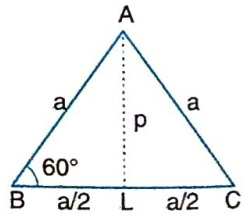
Let ABC be an equilateral triangle such that $A B=A C=B C=a$. Draw $A L \perp B C$. In triangle ALB, we obtain
$A B^2=A L^2+B L^2 \Rightarrow a^2=p^2+\frac{a^2}{4} \Rightarrow p^2=\frac{3 a^2}{4}\Rightarrow p=\frac{\sqrt{3} a}{2}$
So, statement-1 is true.
$\Delta=\frac{1}{2} \text { Base } \times \text { Height }=\frac{1}{2}(B C \times p)=\frac{1}{2}\left(a\times \frac{\sqrt{3}}{2} a\right)=\frac{\sqrt{3}}{4} a^2$
So, statement-2 is also true.
Thus, both the statements are true. Hence, option (b) is correct.
View full question & answer
Assertion (A) & Reason (B) MCQ - Maths STD 9 Questions - Vidyadip