Questions · Page 1 of 4

M.C.Q

🎯

Test yourself on this topic

50 questions · timed · auto-graded

MCQ 11 Mark
The area of the rhombus is 96 sq m. If one of its diagonals is 16cm, then the length of its another diagonal is:
  • A
    12cm
  • B
    5cm
  • C
    10cm
  • D
    8cm
Answer
  1. 12cm
    Solution:
    Area of rhombus $=\frac{1}{2}\text{d}_1\text{d}_2$
    $96=\frac{1}{2}\times16\times\text{d}_2$
    $\text{d}_2=\frac{96\times2}{16}$
    $\text{d}_2=6\times2=12\text{cm}$
View full question & answer
MCQ 21 Mark
The sides of a triangle are 56cm, 60cm and 52cm long. Then the area of the triangle is:
  • A
    1311cm2
  • B
    1344cm2
  • C
    1322cm2
  • D
    1392cm2
Answer
  1. 1344cm2
    Solution:
    $\text{s}=\frac{56+60+52}{2}=\frac{168}{2}=84\text{cm}$
    Area of triangle $=\sqrt{\text{s}(\text{s}-\text{a})(\text{s}-\text{b})(\text{s}-\text{c})}$
    $=\sqrt{84(84-56)(84-60)(84-52)}$
    $=\sqrt{84\times28\times24\times32}$
    $=\sqrt{12\times7\times7\times4\times12\times2\times16\times2}$
    $=12\times7\times2\times2\times4$
    $=1344\text{cm}^2$
  2. View full question & answer
    MCQ 31 Mark
    Write the correct answer in the following:
    The area of an isosceles triangle having base 2cm and the length of one of the equal sides 4cm, is:
    • A
      $\sqrt{15}\text{cm}^2$
    • B
      $\sqrt{\frac{15}{2}}\text{cm}^2$
    • C
      $2\sqrt{15}\text{cm}^2$
    • D
      $4\sqrt{15}\text{cm}^2$
    Answer
    1. $\sqrt{15}\text{cm}^2$

    Solution:

    Here, $\text{s}=\frac{4+4+2}{2}=5\text{cm}$

    Area of $\triangle=\sqrt{5(5-2)(5-4)(5-4)}$

    $=\sqrt{5\times3\times1\times1}=\sqrt{15}\text{cm}^2$

    View full question & answer
    MCQ 41 Mark
    Area of the triangle is equal to :
    • A
      $\text{Base}\times \text{Height}$
    • B
      $\text{2(Base}\times \text{Height})$
    • C
      $\frac{1}{2}\text{(Base}\times \text{height})$
    • D
      $\frac{1}{2}\text{(Base}+ \text{Height})$
    Answer
    1. $\frac{1}{2}\text{(Base}\times \text{height})$
    View full question & answer
    MCQ 51 Mark
    If the height of a parallelogram having 500cm2 as area is 20cm, then its base is of length.
    • A
      50cm
    • B
      25cm
    • C
      20cm
    • D
      15cm
    Answer
    1. 25cm
      Solution:
      Area of parallelogram = Base × Height
      ⇒ 500 = Base × 20
      ⇒ Base = 25cm
    View full question & answer
    MCQ 61 Mark
    The area of quadrilateral ABCD whose diagonals are perpendicular and of lengths 12cm, 8cm is:
    • A
      192cm2
    • B
      96cm2
    • C
      48cm2
    • D
      36cm2
    Answer
    1. 48cm2
      Solution:
      Since in the quadrilateral ABCD, the diagonals are perpendicular.
      Area of quadrilateral $=\frac{1}{2}\times$ Product of diagonals
      $=\frac{1}{2}\times12\times8=48\text{sq}.\text{cm}.$
    View full question & answer
    MCQ 71 Mark
    If the area of an equilateral triangle is $16\sqrt{3}\text{cm}^2$ then the perimeter of the triangle is:
    • A
      12cm
    • B
      24cm
    • C
      48cm
    • D
      306cm
    Answer
    1. 24cm
      Solution:
      Area of equilateral triangle $=\frac{\sqrt{3}}{4}(\text{Side})^2$
      $\Rightarrow\frac{\sqrt{3}}{4}(\text{Side})^2=16\sqrt{3}$
      ⇒ (Slide)2 = 64
      ⇒ Side = 8cm
      Perimeter of equilateral triangle = 3 × side = 3 × 8 = 24cm
    View full question & answer
    MCQ 81 Mark
    The edges of a triangular board are 6cm, 8 cm and 10cm. The cost of painting it at the rate of 9 paise per cm2 is:
    • A
      Rs 2.00
    • B
      Rs 2.16
    • C
      Rs 2.48
    • D
      Rs 3.00
    Answer
    1. Rs 2.16
      Solution:
      Given: a = 6cm, b = 8cm, c = 10cm.
      $\text{s}=(\frac{6+8+10}{2})=12\text{cm}$
      Hence, by using Heron’s formula, we can write:
      $\text{A}=\sqrt{12(12-6)(12-8)(12-10)}=\sqrt{(12)(6)(4)(2)}=\sqrt{576=24\text{cm}^2}$
      $\text{Therefore, the cost of painting at a rate of 9 paise per cm}^2=24\times9\text{paise}=\text{Rs.2.16}$
    View full question & answer
    MCQ 91 Mark
    The area of an isosceles right angled triangle of equal side 30cm, is given as:
    • A
      $225\sqrt{3}\text{cm}^2$
    • B
      900cm2
    • C
      450cm2
    • D
      45cm2
    Answer
    1. 450cm2

    Solution:

    Area of triangle $=\frac{1}{2}\times\text{Base}\times\text{Height}$

    $=\frac{1}{2}\times30\times30=450\text{ sq.cm}$

    View full question & answer
    MCQ 101 Mark
    The perimeter of an isosceles triangle is 32cm. the ratio of the equal side to its base is 3 : 2. Then area of the triangle is:
    • A
      $32\text{cm}^2$
    • B
      $16\text{cm}^2$
    • C
      $32\sqrt{2}\text{cm}^2$
    • D
      $16\sqrt{2}\text{cm}^2$
    Answer
    1. $32\sqrt{2}\text{cm}^2$

    Solution:

    Let each of the equal sides of given triangle be x cm. Then the third side is (32 - 2x)cm,

    According to quesiton, $\frac{\text{x}}{32-2\text{x}}=\frac{3}{2}$

    According to quesiton, x 32 - 2x = 32

    ⇒ 2x = 96 - 6x

    ⇒ 8x = 96

    ⇒ x = 12cm

    Therefore, the sides are 12cm, 12cm and 8cm

    Area $=\sqrt{\text{s}(\text{s}-\text{a})(\text{s}-\text{b})(\text{s}-\text{c})}$

    $=\sqrt{16(16-12)(16-12)(16-3)}$

    $=\sqrt{16\times4\times4\times8}$

    $=32\sqrt{2}\text{sq}.\text{cm.}$

    View full question & answer
    MCQ 111 Mark
    The sides of a triangle are in the ratio of 3: 5: 7 and its perimeter is 300cm. Its area will be:
    • A
      $1000\sqrt{3}\text{sq}.\text{cm}$
    • B
      $1500\sqrt{3}\text{sq}.\text{cm}$
    • C
      $1700\sqrt{3}\text{sq}.\text{cm}$
    • D
      $1900\sqrt{3}\text{sq}.\text{cm}$  
    Answer
    1. $1500\sqrt{3}\text{sq}.\text{cm}$
      Solution:
      The ratio of the sides is 3: 5: 7
      Perimeter = 300 cm
      Let the sides of the triangle be 3x, 5x and 7x.
      Hence,
      3x + 5x + 7x = 300cm
      15x = 300cm
      x = 20
      Therefore,
      a = 3x = 3 × 20 = 60
      b = 5x = 5 × 20 = 100
      c = 7x = 7 × 20 = 140
      $\text{semiperimeter,s}=\frac{300}{2}=150\text{cm}$
      Using Heron’s formula:
      $\text{A}=\sqrt{\text{s}(\text{s}-{a})(\text{s}-{b})(\text{s}-{c})}$
      $=\sqrt{150(150-60)(150-100)(150-40)}$
      $=\sqrt{(150\times90\times50\times10)}$
      $=1500\sqrt{3\text{sq.cm}}$
    View full question & answer
    MCQ 121 Mark
    Write the correct answer in the following:
    An isosceles right triangle has area 8cm2. The length of its hypotenuse is:
    • A
      $\sqrt{32}\text{cm}$
    • B
      $\sqrt{16}\text{cm}$
    • C
      $\sqrt{48}\text{cm}$
    • D
      $\sqrt{24}\text{cm}$
    View full question & answer
    MCQ 131 Mark
    The area of a regular hexagon of side 4cm is:
    • A
      $4\sqrt{3}\text{cm}^2$
    • B
      $10\sqrt{3}\text{cm}^2$
    • C
      $6\sqrt{3}\text{cm}^2$
    • D
      $24\sqrt{3}\text{cm}^2$
    Answer
    1. $24\sqrt{3}\text{cm}^2$

    Solution:

    Area of regular hexagon $=\frac{3\sqrt{3}}{2}(\text{Side})^2$

    $=\frac{3\sqrt{3}}{2}\times4\times4$

    $=24\sqrt{3}\text{cm}^2$

    View full question & answer
    MCQ 141 Mark
    The area of an isosceles triangle having base 24cm and length of one of the equal sides 20cm is:
    • A
      480cm2
    • B
      240cm2
    • C
      196cm2
    • D
      192cm2
    Answer
    1. 192cm2

    Solution:

    $\text{S}=\frac{(24+20+20)}{2}=32\text{cm}$

    $\text{Area}=\sqrt{\text{s}(\text{s}-\text{a})(\text{s}-\text{b})(\text{s}-\text{c})}$

    $=\sqrt{32(32-24)(32-20)(32-20)}$

    $=192\text{sq}.\text{cm}.$

    View full question & answer
    MCQ 151 Mark
    The base of a right triangle is 8cm and hypotenuse is 10cm. Its area will be:
    • A
      40cm2
    • B
      80cm2
    • C
      24cm2
    • D
      48cm2
    Answer
    1. 24cm2

    Solution:

    Perpendicular $=\sqrt{10^2-8^2}=\sqrt{100-64}=6\text{cm}$

    Area of triangle $=\frac{1}{2}\times\text{Base}\times\text{Height}$

    $=\frac{1}{2}\times8\times6=24\text{ sq.cm}$

    View full question & answer
    MCQ 161 Mark
    In a four-sided field, the length of the longer diagonal is 128m. The lengths of the perpendiculars from the opposite vertices upon this diagonal are 22.7m and 17.3m. Then area of the field is:
    • A
      2560m2
    • B
      2530m2
    • C
      2360m2
    • D
      2460m2
    Answer
    1. 2560m2

    Solution:

    According to the question,

    Area of the field $=\frac{1}{2}\times128\times17.3+\frac{1}{2}\times128\times22.7$

    $=\frac{1}{2}\times128(17.3+22.7)$

    $=2560\text{ sq.m}$

    View full question & answer
    MCQ 171 Mark
    The area of one triangular part of a rhombus ABCD is given as 125cm2. The area of rhombus ABCD is:
    • A
      625cm2
    • B
      1250cm2
    • C
      500cm2
    • D
      2500cm2
    Answer
    1. 500cm2
      Solution:
      Since diagonals of a rhombus divide it into 4 triangles of equal area. Therefore,
      Area of rhombus = 4 × Area of triangle
      = 4 × 125 = 500 sq.cm
    View full question & answer
    MCQ 181 Mark
    In a $\triangle\text{ABC,}$ it is given that base = 12cm and height = 5cm. Its area is:
    • A
      60cm2
    • B
      30cm2
    • C
      $15\sqrt{3}\text{cm}^2$
    • D
      45cm2
    Answer
    1. 30cm2
      Solution:
      Area of triangle $=\frac{1}{2}\times\text{Base}\times\text{Height}$
      Area of $\triangle\text{ABC}=\frac{1}{2}\times12\times5=30\text{cm}^2$
    View full question & answer
    MCQ 191 Mark
    The base of an isosceles triangle is 8cm long and each of its equal sides measures 6cm. The area of the triangle is:
    • A
      $16\sqrt5\text{cm}^2$
    • B
      $8\sqrt3\text{cm}^2$
    • C
      $16\sqrt3\text{cm}^2$
    • D
      $8\sqrt5\text{cm}^2$
    Answer
    1. $8\sqrt5\text{cm}^2$
      Solution:
      Area of isosceles triangle $=\frac{\text{b}}{4}\sqrt{4\text{a}^2-\text{b}^2}$
      Here,
      a = 6cm and b = 8cm
      Thus, we have
      $\frac{8}{4}\times\sqrt{4(6)^2-8^2}$
      $=\frac{8}{4}\times\sqrt{144-64}$
      $=\frac{8}{4}\times\sqrt{80}$
      $=\frac{8}{4}\times4\sqrt{5}$
      $=8\sqrt{5}\text{cm}^2$
    View full question & answer
    MCQ 201 Mark
    The lengths of the three sides of a triangular field are 40m, 24m and 32m respectively. The area of the triangle is:
    • A
      480m2
    • B
      320m2
    • C
      384m2
    • D
      360m2
    Answer
    1. 384m2

    Solution:

    Let:

    a = 40m, b = 24m and c = 32m

    $\text{s}=\frac{\text{a}+\text{b}+\text{c}}{2}=\frac{40+24+32}{2}=48\text{m}$

    Byu Heron's formula, we have:

    Area of triangle $=\sqrt{\text{s}(\text{s}-\text{a})(\text{s}-\text{b})(\text{s}-\text{c})}$

    $=\sqrt{48(48-40)(48-24)(48-32)}$

    $=\sqrt{48\times8\times24\times16}$

    $=\sqrt{24\times2\times8\times24\times8\times2}$

    $=24\times8\times2$

    $=384\text{m}^2$ 

    View full question & answer
    MCQ 211 Mark
    The area of a triangle is 150cm2 and its sides are in the ratio 3 : 4 : 5. What is its perimeter?
    • A
      40cm
    • B
      60cm
    • C
      50cm
    • D
      70cm
    Answer
    1. 60cm
    View full question & answer
    MCQ 221 Mark
    Each equal side of an isosceles triangle is 13cm and its base is 24cm Area of the triangle is:
    • A
      $40\sqrt{3}\text{cm}^2$
    • B
      $25\sqrt{3}\text{cm}^2$
    • C
      $60\text{cm}^2$
    • D
      $50\sqrt{3}\text{cm}^2$
    Answer
    1. $60\text{cm}^2$
      Solution:
      $\text{s}=\frac{13+13+24}{2}=25\text{cm}$
      Area of triangle $=\sqrt{\text{s}(\text{s}-\text{a})(\text{s}-\text{b})(\text{s}-\text{c})}$
      $\sqrt{25(25-13)(25-13)(25-24)}$
      $=\sqrt{25\times12\times12\times1}$
      $60\text{cm}^2$
    View full question & answer
    MCQ 241 Mark
    The area of equilateral triangle of side 'a' is $4\sqrt{3}\text{cm}^2.$ Its height is given by:
    • A
      $\frac{2}{\sqrt{3}}\text{cm}$
    • B
      $2\sqrt{3}\text{cm}$
    • C
      $\frac{1}{3}\text{cm}$
    • D
      $\sqrt{3}\text{cm}$
    Answer
    1. $2\sqrt{3}\text{cm}$
      Solution:
      Area of equilateral triangle $=\frac{\sqrt{3}}{4}(\text{Side})^2$
      $\Rightarrow\frac{\sqrt{3}}{4}(\text{Side})^2=4\sqrt{3}$
      $\Rightarrow(\text{Side})^2=4^2$
      $\Rightarrow\text{Side}=4\text{cm}$
      Area of triangle $=\frac{1}{2}\times\text{Base}\times\text{Height}$
      $\Rightarrow4\sqrt{3}=\frac{1}{2}\times4\times\text{Height}$
      $\Rightarrow\text{Height}=2\sqrt{3}\text{cm}$
    View full question & answer
    MCQ 251 Mark
    If the sides of a triangle are doubled, then its area:
    • A
      Becomes four times.
    • B
      Becomes doubled.
    • C
      Remains the same.
    • D
      Becomes three times.
    Answer
    1. Becomes four times.
      Solution:
      Area of triangle with sides a, b and c.
      $(\text{A})=\sqrt{\text{s}(\text{s}-\text{a})(\text{s}-\text{b})(\text{s}-\text{c})}$
      New sides are 2a, 2b and 2c
      $\text{s}'=\frac{2\text{a}+2\text{b}+2\text{c}}{2}=\text{a}+\text{b}+\text{c}=2\text{s}\ ....(\text{i})$
      New area $=\sqrt{\text{s}'(\text{s}'-2\text{a})(\text{s}'-2\text{b})(\text{s}'-2\text{c})}$
      $=\sqrt{2\text{s}(2\text{s}-2\text{a})(2\text{s}-2\text{b})(2\text{s}-2\text{c})}$ [From eq.(i)]
      $=4\sqrt{\text{s}(\text{s}-\text{a})(\text{s}-\text{b})(\text{s}-\text{c})}$
      $=4\text{A}$
      Therefore, the new area will be four times the old area
    View full question & answer
    MCQ 261 Mark
    The area of a right-angled triangle is 20m2 and one of the sides containing the right triangle is 4cm. Then the altitude on the hypotenuse is:
    • A
      $10\text{cm}$
    • B
      $\frac{10}{\sqrt{41}}\text{cm}$
    • C
      $\frac{20}{\sqrt{29}}\text{cm}$
    • D
      $8\text{cm}$
    Answer
    1. $\frac{20}{\sqrt{29}}\text{cm}$
      Solution:
      Area of right angle triangle = 20 sq. m
      $\Rightarrow\frac{1}{2}\times\text{Base}\times\text{Height} = 20 $
      $\Rightarrow\frac{1}{2}\times\text{Base}\times4=20$
      $\Rightarrow\text{Base}=10\text{cm}$
      Then, Hypotenuse $=\sqrt{10^2+4^2}=2\sqrt{29}\text{m}$
      If the altitude drawn to the hypotenuse of a right-angle triangle, then the length of required altitude $=\frac{10\times4}{2\sqrt{29}}=\frac{20}{\sqrt{29}}\text{cm}$
    View full question & answer
    MCQ 271 Mark
    If side of equilateral triangle is 25m. Its area is:
    • A
      $5\sqrt{3}\text{ sq.cm}$
    • B
      $\frac{625}{4}\sqrt{3}\text{ sq.cm}$
    • C
      $54\sqrt{3}\text{ sq.cm}$
    • D
      $\sqrt{3}\text{ sq.cm}$
    Answer
    1. $\frac{625}{4}\sqrt{3}\text{ sq.cm}$
      Solution:
      Arrea of equilateral triangle $=\frac{\sqrt{3}}{4}(\text{Side})^2$
      $=\frac{\sqrt{3}}{4}(25)^2$
      $=\frac{625\sqrt{3}}{4}\text{ sq.cm}$
    View full question & answer
    MCQ 281 Mark
    The length of each side of an equilateral triangle of area $4\sqrt{3}\text{cm}^2,$ is:
    • A
      $4\text{cm}$
    • B
      $\frac{4}{\sqrt{3}}\text{cm}$
    • C
      $\frac{\sqrt{3}}{4}\text{cm}$
    • D
      $3\text{cm}$
    Answer
    1. $\frac{4}{\sqrt{3}}\text{cm}$
      Solution:
      If side of an equilateral triangle is 'a', then its
      Area $=\frac{\sqrt{3}}{4}\text{a}^2$
      Now, $\frac{\sqrt{3}}{4}\text{a}^2=4\sqrt{3}$
      ⇒ a2 = 42
      ⇒ a = 4cm
      Hence, correct option is (a).
    View full question & answer
    MCQ 291 Mark
    The diagonals of a rhombus measure 4cm and 6cm respectively. Its area in sq.cm is:
    • A
      24 sq.cm
    • B
      12 sq.cm
    • C
      8 sq.cm
    • D
      6 sq.cm
    Answer
    1. 12 sq.cm
      Solution:
      Area of rhombus $=\frac{1}{2}\times\text{Product of diagonals}$
      $=\frac{1}{2}\times4\times6$
      $=12\text{ sq.cm}$
    View full question & answer
    MCQ 301 Mark
    The difference of semi-perimeter and the sides of $\triangle\text{ABC}$ are 8, 7 and 5cm respectively. Its semi-perimeter ‘s’ is:
    • A
      5cm
    • B
      15cm
    • C
      10cm
    • D
      20cm
    Answer
    1. 20cm
      Solution:
      Given: s - a = 8cm, s - b = 7cm and s - c = 5cm
      Adding all equations,
      s - a + s - b + s - c = 8 + 7 + 5
      $\Rightarrow3\text{s}-(\text{a+b+c})=20\Big[\text{s}=\frac{\text{a+b+c}}{2}\Big]$
      $\Rightarrow3\text{s}-2\text{s}=20$
      $\Rightarrow\text{s}=20\text{cm}$
    View full question & answer
    MCQ 311 Mark
    The area of an equilateral triangle with side $2\sqrt{3}\text{cm}$ is:
    • A
      0.866cm2
    • B
      1.732cm2
    • C
      5.196cm2
    • D
      3.496cm2
    Answer
    1. 5.196cm2
      Solution:
      Area of equilateral triangle $=\frac{\sqrt{3}}{4}(\text{Side})^2$
      $=\frac{\sqrt{3}}{4}\times2\sqrt{3}\times2\sqrt{3}$
      $=3\sqrt{3}$
      $=3\times1.732=5.196\text{sq.cm}$
    View full question & answer
    MCQ 321 Mark
    The sides of a triangle are 4cm, 8cm and 6cm. The length of the perpendicular from the opposite vertex to the longest side is:
    • A
      $4\sqrt{15}\text{cm}$
    • B
      $\frac{3}{4}\sqrt{15}\text{cm}$
    • C
      $3\sqrt{15}\text{cm}$
    • D
      $\frac{4}{3}\sqrt{15}\text{cm}$
    Answer
    1. $\frac{3}{4}\sqrt{15}\text{cm}$
      Solution:
      $\text{s}=\frac{4+8+6}{2}=9\text{cm}$
      Area of triangle $=\sqrt{\text{s}(\text{s}-\text{a})(\text{s}-\text{b})(\text{s}-\text{c})}$
      $=\sqrt{9(9-4)(9-8)(9-6)}$
      $=\sqrt{9\times5\times1\times3}$
      $=3\sqrt{15}\text{ sq.cm}$
      Area of triangle taking base as longest side $=\frac{1}{2}\times8\times\text{h}$
      $\Rightarrow \frac{1}{2}\times8\times\text{h}=3\sqrt{15}$
      $\Rightarrow\text{h}=\frac{3}{4}\sqrt{15}\text{cm}$
    View full question & answer
    MCQ 331 Mark
    Each side of an equilateral triangles is 2x cm. If $\text{x}\sqrt{3}=\sqrt{48},$ then area of the triangle is:
    Answer
    1. $16\sqrt{3}\text{cm}^2$
      Solution:
      Here, $\text{x}\sqrt{3}=\sqrt{48}$
      $\Rightarrow\text{x}=\sqrt{16}$
      Side = 2x
      Area of equilateral triangle $=\frac{\sqrt{3}}{4}(\text{Side})^2$
      $=\frac{\sqrt{3}}{4}(2\text{x})^2$
      $=\sqrt{3}\text{x}^2\text{ sq.cm}$
      $=\sqrt{3}(\sqrt{16})^2=16\sqrt{3}\text{cm}$
    View full question & answer
    MCQ 341 Mark
    The product of difference of semi-perimeter and respective sides of $\triangle\text{ABC}$ are given as 13200m3. The area of $\triangle\text{ABC},$ if its semi-perimeter is 132m, is given by:
    • A
      1320m2
    • B
      13200m2
    • C
      132m2
    • D
      $20\sqrt{33}\text{m}^2$
    Answer
    1. 1320m2
      Solution:
      Given: (s - a)(s - b)(s - c) = 13200m and s = 132m
      Area of triangle $=\sqrt{\text{s}(\text{s}-\text{a})(\text{s}-\text{b})(\text{s}-\text{c})}$
      $=\sqrt{13200\times132}$
      $1320\text{m}^2$
    View full question & answer
    MCQ 351 Mark
    Write the correct answer in the following:
    The area of an equilateral triangle with side $2\sqrt{3}\text{cm}$ is:
    • A
      5.196cm2
    • B
      0.866cm2
    • C
      3.496cm2
    • D
      1.732cm2
    Answer
    1. 5.196cm2
      Solution:
      Area of equilateral $\triangle=\frac{\sqrt{3}}{4}(\text{side})^2$
      $=\frac{\sqrt{3}}{4}\big(2\sqrt{3}\big)^2=3\sqrt{3}=3\times1.732$
      $=5.196\text{cm}^2$
    View full question & answer
    MCQ 361 Mark
    The area of the the triangle having sides 1m, 2m and 2m is:
    • A
      $\frac{\sqrt{15}}{4}\text{m}^2$
    • B
      $\frac{\sqrt{15}}{2}\text{m}^2$
    • C
      $\frac{15}{4}\text{m}^2$
    • D
      $4\sqrt{15}\text{m}^2$
    Answer
    1. $\frac{\sqrt{15}}{4}\text{m}^2$

    Solution:

    $\text{s}=\frac{1+2+2}{2}=\frac{5}{2}\text{m}$

    Area of triangle $=\sqrt{\text{s}(\text{s}-\text{a})(\text{s}-\text{b})(\text{s}-\text{c})}$

    $=\sqrt{\frac{5}{2}(\frac{5}{2}-1)(\frac{5}{2}-2)(\frac{5}{2}-2)}$

    $=\sqrt{\frac{5}{2}\times\frac{3}{2}\times\frac{1}{2}\times\frac{1}{2}}$

    $=\frac{\sqrt{15}}{4}\text{ sq.m}$

    View full question & answer
    MCQ 371 Mark
    Two adjacent side of a parallelogram are 74cm and 40cm one of Its diagonals is 102cm. area of the ||gram is:
    • A
      4869 sq. m
    • B
      2448 sq. cm
    • C
      1224 sq. m
    • D
      612 sq. m
    Answer
    1. 2448 sq. cm

    Solution:

    Let the two adjacent sides of the parallelogram be a = 74cm, b = 40cm

    Let the length of diagonal be c = 102cm

    These two sides and the diagonal forms a triangle

    semi perimeter, $\text{s}= \frac{(\text{a} + \text{b} + \text{c})}{2}$​​​​​​​

    $\text{s}=\frac{(74+40+102)}{2}$

    $=\frac{216}{2}$

    $=108\text{cm}$

    By Heron's formula, we have area of triangle $=\sqrt{\text{s}(\text{s}-\text{a})(\text{s}-\text{b})(\text{s}-\text{c})}$

    Area of triangle $=\sqrt{108(108-74)(108-40)(108-102)}$

    $=1224\text{cm}^2$

    therefore, area of parallelogram = 1224 × 2

    = 2448 sq. cm

    View full question & answer
    MCQ 381 Mark
    Each sides of an equilateral triangle measures 8cm. The area of the triangle is:
    • A
      $8\sqrt{3}\text{cm}^2$
    • B
      $16\sqrt{3}\text{cm}^2$
    • C
      $32\sqrt{3}\text{cm}^2$
    • D
      $48\text{cm}^2$
    Answer
    1. $16\sqrt{3}\text{cm}^2$

    Solution:

    Area of quadrilateral triangle $=\frac{\sqrt{3}}{4}\times(\text{side})^2$

    $=\frac{\sqrt{3}}{4}\times(8)^2$

    $=\frac{\sqrt{3}}{4}\times64$

    $=16\sqrt{3}\text{cm}^2$

    View full question & answer
    MCQ 391 Mark
    The sides of a triangle are 7cm, 9cm and 14cm. Its area is:
    • A
      $12\sqrt{5}\text{cm}^2$
    • B
      $12\sqrt{3}\text{cm}^2$
    • C
      $24\sqrt{5}\text{cm}^2$
    • D
      $63\text{cm}^2$
    Answer
    1.  $12\sqrt{5}\text{cm}^2$

    Solution:

    Let a = 7cm, b = 9cm, c = 14cm

    Semi-perimeter = $\text{s}=\frac{\text{a}+\text{b}+\text{c}}{2}=\frac{7+9+14}{2}=15\text{cm}$

    s - a = 15 -7 = 8cm, s - b = 15 - 9 = 6cm and s - c = 15 - 14 = 1cm

    Area of a triangle $=\sqrt{\text{s}(\text{s}-\text{a})(\text{s}-\text{b})(\text{s}-\text{c})}$

    $=\sqrt{15\times8\times6\times1}$

    $=\sqrt{5\times3\times4\times2\times3\times2}$

    $=2\sqrt{5}\text{cm}^2$

    Hence, correct option is (a).

    View full question & answer
    MCQ 401 Mark
    Each side an equilateral triangle is 10cm long. The height of the triangle is:
    • A
      $10\sqrt{3}\text{cm}$
    • B
      $5\sqrt{3}\text{cm}$
    • C
      $10\sqrt{2}\text{cm}$
    • D
      $​​5\text{cm}$
    Answer
    1. $5\sqrt{3}\text{cm}$

    Solution:

    Height of equilateral triangle $=\frac{\sqrt{3}}{2}\times\text{Side}$

    $=\frac{\sqrt{3}}{2}\times10$

    $=5\sqrt{3}\text{cm}$

    View full question & answer
    MCQ 411 Mark
    The base of an isosceles triangle is 6cm and each of its equal sides is 5cm. The height of the triangle is:
    • A
      $8\text{cm}$
    • B
      $4\text{cm}$
    • C
      $\sqrt{11}\text{cm}$
    • D
      $\sqrt{30}\text{cm}$
    Answer
    1. $4\text{cm}$
      Solution:
      Height of isosceles triangle $=\frac{1}{2}\sqrt{4\text{a}^2-\text{b}^2}$
      $=\frac{1}{2}\sqrt{4(5)^2-6^2}$ (a = 5cm and b = 6cm)
      $=\frac{1}{2}\times\sqrt{100-36}$
      $=\frac{1}{2}\times\sqrt{64}$
      $=\frac{1}{2}\times8$
      $=4\text{cm}$
    View full question & answer
    MCQ 421 Mark
    The area of a rhombus is 96cm2. If one of its diagonals is 16cm, then the length of its side is:
    • A
      10cm
    • B
      12cm
    • C
      8cm
    • D
      6cm
    Answer
    1. 10cm

    Solution:

    Area of rhombus $=\frac{1}{2}\times$ Product of diagonal

    $\Rightarrow96=\frac{1}{2}(16\times\text{d}_2)$

    $\Rightarrow\text{d}_2=\frac{96\times2}{16}=12\text{cm}$

    Since diagonals of a rhombus bisect each other at a right angle.

    Therefore, the side of the rhombus is the hypotenuse of a triangle.

    Side $=\sqrt{8^2+6^2}=10\text{cm}.$

    View full question & answer
    MCQ 431 Mark
    Find the length of each side of an equilateral triangle having area of 9 root 3cm square:
    • A
      36cm
    • B
      5cm
    • C
      15cm
    • D
      6cm
    Answer
    1. 6cm
    View full question & answer
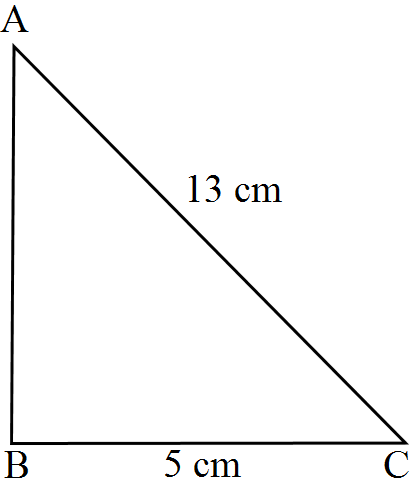
    MCQ 441 Mark
    • A
      78cm2
    • B
      60cm2
    • C
      30cm2
    • D
      32.5cm2
    Answer
    1. 30cm2

    Solution:

    In the given triangle,

    $\text{Base}(\text{BC})=\sqrt{13^2-12^2}=\sqrt{169-144}=5\text{cm}$

    Area of triangle ABC $=\frac{1}{2}\times\text{BC}\times\text{AB}$

    $=\frac{1}{2}\times5\times12$

    $=30\text{ sq.cm}$

    View full question & answer
    MCQ 451 Mark
    One of the diagonals of a rhombus is 12cm and the area is 96 sq.cm. The perimeter of the rhombus is:
    • A
      $\sqrt[3]{10}\text{cm}$
    • B
      $7\text{cm}$
    • C
      $40\text{cm}$
    • D
      $\sqrt[6]{10}\text{cm}$
    Answer
    1. $40\text{cm}$

    Solution:

    $\text{d}_2=\frac{\text{Area}\times2}{\text{d}_1}$

    $=\frac{96\times2}{12}$

    $=16\text{cm}$

    length of side of rhombus $=\sqrt{6^2+8^2}=10\text{cm}$

    peimeter of rhombus = 4 × side

    =4 × 10 = 40cm

    View full question & answer
    MCQ 461 Mark
    Write the correct answer in the following:
    The perimeter of an equilateral triangle is 60m. The area is:
    • A
      $10\sqrt{3}\text{m}^2$
    • B
      $15\sqrt{3}\text{m}^2$
    • C
      $20\sqrt{3}\text{m}^2$
    • D
      $100\sqrt{3}\text{m}^2$
    Answer
    1. $100\sqrt{3}\text{m}^2$

    Solution:

    Perimeter of triangle = 3a

    Now, $3\text{a}=60$

    $\Rightarrow\text{ a}=60\div3=20\text{m}$

    Area of equilateral $\triangle=\frac{\sqrt{3}}{4}(\text{side})^2$

    $=\frac{\sqrt{3}}{4}\times(20)^2=100\sqrt{3}\text{m}^2$

    View full question & answer
    MCQ 471 Mark
    Two adjacent sides of a parallelogram are 74cm and 40cm and one of its diagonals is 102cm. Area of the parallelogram is:
    • A
      2448 sq.cm
    • B
      4896 sq.cm
    • C
      612 sq.cm
    • D
      1224 sq.cm
    Answer
    1. 2448 sq.cm

    Solution:

    Let the two adjacent sides of the parallelogram be a = 74cm, b = 40cm

    Let the length of diagonal be c = 102cm

    These two sides and the diagonal forms a triangle

    semi perimeter, $\text{s}=\frac{\text{a}+\text{b}+\text{c}}{2}$

    $\text{s}=\frac{74+40+102}{2}$

    $=\frac{216}{2}$

    = 108cm

    By Heron's formula, we have area of triangle $=\sqrt{\text{s}(\text{s}-\text{a})(\text{s}-\text{b})(\text{s}-\text{c})}$

    Area of triangle $=\sqrt{108(108-74)(108-40)(108-102)}$

    = 1224cm2

    therefore, area of parallelogram = 1224 × 2

    = 2448 sq.cm

    View full question & answer
    MCQ 491 Mark
    The area of an equilateral triangle of side 6cm is:
    • A
      $18^{\text{cm}^2}$
    • B
      $9\sqrt3^{\text{cm}^2}$
    • C
      $56\sqrt3^{\text{cm}^2}$
    • D
      $58\sqrt3^{\text{cm}^2}$
    Answer
    1. $9\sqrt3^{\text{cm}^2}$
    View full question & answer
    MCQ 501 Mark
    If the perimeter of an equilateral triangle is 24m, then its area is:
    • A
      $8\sqrt{3}\text{m}^2$
    • B
      $20\sqrt{3}\text{m}^2$
    • C
      $24\sqrt{3}\text{m}^2$
    • D
      $16\sqrt{3}\text{m}^2$
    Answer
    1. $16\sqrt{3}\text{m}^2$

    Solution:

    $\text{Side}=\frac{24}{3}=8\text{m}$

    $\text{Area}=\frac{\sqrt{3}}{4}\times8\times8$

    $=16\sqrt{3}\text{m}^2.$

    View full question & answer