Question 14 Marks
Raghvan claims that the magnitude of the angle $ABC$ is greater than the magnitude of the area of the right triangle $PQR.$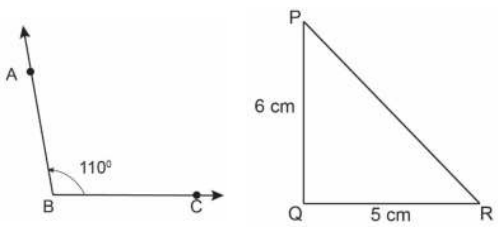
$7.$ Is his claim correct$?$ Why$?$
$8.$ Two lines intersect at a point $P.$
Which of the following is true for the distance between the two lines as they travel beyond point $P?$
$A.$ The distance becomes constant.
$B.$ The distance increases continuously.
$C.$ The distance decreases continuously.
$D.$ The distance increases and decreases depending upon the intersection point.
$9. $ Balan says, ‘The measure of all right angles cannot be equal as their arms can be of different lengths.’
Why is Balan’s statement not true$?$
$A.$ The measure of an angle depends upon its orientation.
$B.$ The measure of an angle depends upon the instrument used to measure it.
$C.$ The measure of an angle depends on the length of its angle arms.
$D.$ The measure of an angle depends upon the rotation of one arm on another.
$10.$ TAB is a straight line. $C$ is the mid-point of $AB. D$ is the mid-point of $AC.$
Which of the following shows the relation between the line segments?
$A. AD =\frac{1}{2} AB$
$B. AD =\frac{1}{2} CB$
$C. AD =2 AC$
$D. AD =2 DC$
$7.$ Is his claim correct$?$ Why$?$
$8.$ Two lines intersect at a point $P.$
Which of the following is true for the distance between the two lines as they travel beyond point $P?$
$A.$ The distance becomes constant.
$B.$ The distance increases continuously.
$C.$ The distance decreases continuously.
$D.$ The distance increases and decreases depending upon the intersection point.
$9. $ Balan says, ‘The measure of all right angles cannot be equal as their arms can be of different lengths.’
Why is Balan’s statement not true$?$
$A.$ The measure of an angle depends upon its orientation.
$B.$ The measure of an angle depends upon the instrument used to measure it.
$C.$ The measure of an angle depends on the length of its angle arms.
$D.$ The measure of an angle depends upon the rotation of one arm on another.
$10.$ TAB is a straight line. $C$ is the mid-point of $AB. D$ is the mid-point of $AC.$
Which of the following shows the relation between the line segments?
$A. AD =\frac{1}{2} AB$
$B. AD =\frac{1}{2} CB$
$C. AD =2 AC$
$D. AD =2 DC$
Answer
View full question & answer→7. No, with an explanation involving reasoning about magnitudes.
● No, the measure of an angle cannot be compared to the area of a triangle.
8. B. The distance increases continuously.
9. D. The measure of an angle depends upon the rotation of one arm with respect to the other.
10. B. $A D=\frac{1}{10} C B$
● No, the measure of an angle cannot be compared to the area of a triangle.
8. B. The distance increases continuously.
9. D. The measure of an angle depends upon the rotation of one arm with respect to the other.
10. B. $A D=\frac{1}{10} C B$