- Triangles.
- Squares.
- Trapeziums.
- Polygons.
- Triangles.
Solution:
The side faces of a pyramid are triangles.
27 questions · timed · auto-graded
Solution:
The side faces of a pyramid are triangles.
Solution:
In option (a), infinite number of line can be drawn to pass through a given point. So, it is not a true statement.
In option (b), only one line can be drawn to pass through two given points. So, it is not a true statement.
In option (c),
'If two circles are equal, then their radii are equal' is the true statement.
In option (d), A line has no end points. A line has an indefinite length. So, it is not a true statement.
Solution:
Squares and circular altars were used for household rituals.
Whereas altars having shapes as combinatiotanglens of recs, triangles and trapeziums were used for public worship.
Solution:
A statement that requires a proof is called a theorem.
Solution:
Two lines are said to be parallel, if they have no point in common.
Options (a), (b) and (d) have a common point, hence they are not parallel.
In option (c), the floor and the ceiling of a room are parallel to each other is a true statement.
Solution:
Euclid stated that 'All right angles are equal to each other' in the form of a postulate.
This is Euclid's Postulate 4.
Note: The answer in the book is option (a). But if you have a look at the Euclid's postulate, the answer is a postulate.
Solution:
If direction ratios of three vectors a, b, c are proportional then they are collinear.
Solution:
Option (a) is true, since we can pass an infinite number of lines through a given point.
Option (b) is true, since a unique line can be drawn to pass through two given points.
Consider option (c).
A ray is a line segment that extends indefinitely in one direction as shown below.
$\text{Ray }\overrightarrow{\text{AB}}=\text{ray}\ \overrightarrow{\text{BA}}$ is a false statement since clearly the lines extend indefinitely.
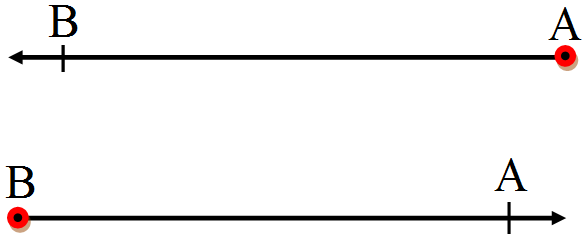
As shown in the above diagram, a ray has only one end-point. So, option (d) is true.
Hence, the only false statement is option (c).

Solution:
Boundaries of solids are surfaces.
Solution:
The number of planes passing through three non-collinear points is 1.
Solution:
A point C is called the midpoint of a line segment $\overline{\text{AB}},$ if C is an interior point of AB such that $\overline{\text{AC}}=\overline{\text{CB}}.$

Solution:
Axioms are assumed as universal truths in all branches of mathematics because they are taken for granted, without proof.
Solution:
In Indus Valley Civilization (about 300 BC) the bricks used for construction work were having dimensions in the ratio is 4 : 2 : 1.
Solution:
The famous treatise 'The Elements' was divided into 13 chapters by Euclid.
Solution:
Boundaries of surfaces are curves.
Solution:
Euclid's first axiom states that 'Things which are equal to the same thing are equal to one another'.
That is,
A's age = B's age and C's age = B' age
⇒ A's age = C's age
Solution:
A pyramid is a solid figure, whose base is any polygon.
Solution:
A surface has 2 dimensions.
Solution:
Euclid belongs to the country, Greece.
Solution:
A solid has 3 dimensions.
Solution:
Pythagoras was a student of Thales.
Solution:
A point is an exact location. A fine dot represents a point. So, a point has 0 dimensions.
Solution:
Thales belongs to the country, Greece.
Solution:
The Sriyantra consists of nine interwoven isosceles triangles.
Solution:
In ancient India, altars with combination of shapes like rectangles, triangles and trapeziums were used for public rituals.
Solution:
Euclid's second axiom states that 'If equals are added to equals, the wholes are equal'.
Hence, when x + y = 15, then x + y + z = 15 + z.
Solution:
Lines are parallel if they do not intersect' is started in the form of a definition.