Questions

2 Marks Questions

Take a timed test

10 questions · self-marked practice — reveal the answer and mark yourself.

Question 12 Marks
Study the following statement: "Two intersecting lines cannot be perpendicular to the same line". Check whether it is an equivalent version to the Euclid’s fifth postulate. [Hint: Identify the two intersecting lines l and m and the linen in the above statement]
Answer
Two intersecting lines cannot be both perpendicular to the same line because if two lines l and m are perpendicular to the same line n, then l and m must be parallel. The given statement is not an equivalent version of Euclid’s fifth postulate.
View full question & answer
Question 22 Marks
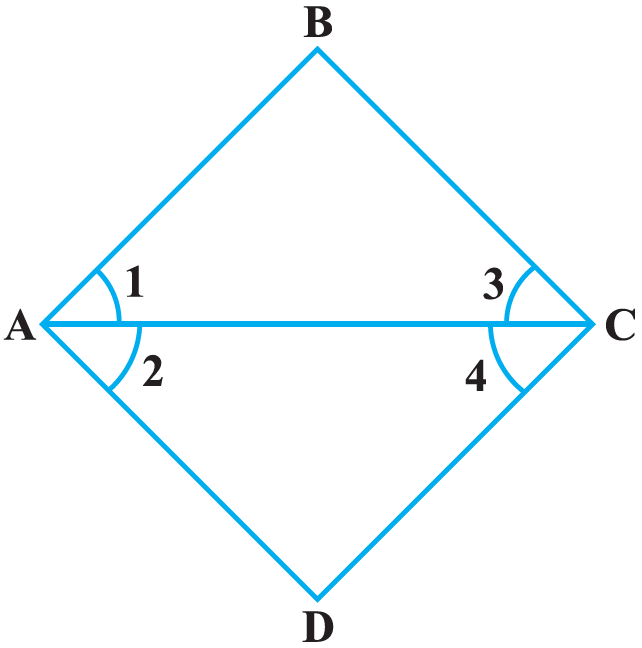
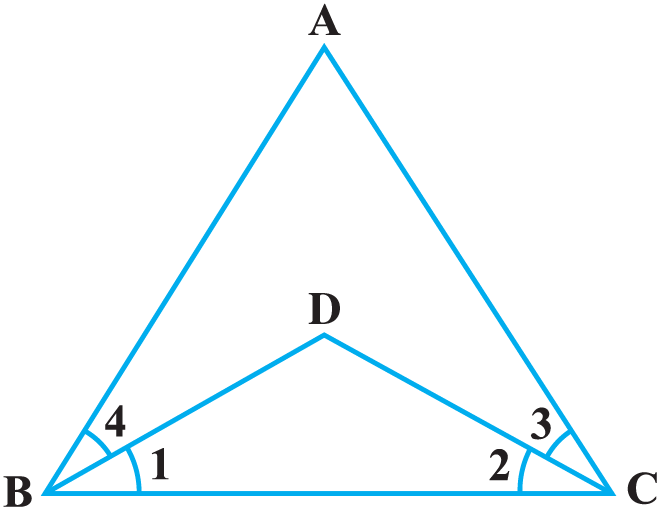
In the we have $\angle\text{ABC}=\angle\text{ACB},\angle3=\angle4$ Show that $\angle1=\angle2$
Answer
Given, $\angle\text{ABC}=\angle\text{ACB}\ ...(\text{i})$ And $\angle4=\angle3\ ...(\text{iii})$
According to Eulid’s axiom, if equals are subtracted from equals, then remainders are also equal. On subtracting Eq. $(ii)$ from Eq. $(i),$
we get $\angle\text{ABC}-\angle4=\angle\text{ACB}-\angle3$
$\Rightarrow\angle1=\angle2$
Now, in $ABCD$, $\angle1=\angle2$
$\Rightarrow\text{DC}=\text{BD}$ [sides opposite to equal angles are equal] $\text{BD}=\text{DC}$
View full question & answer
Question 32 Marks
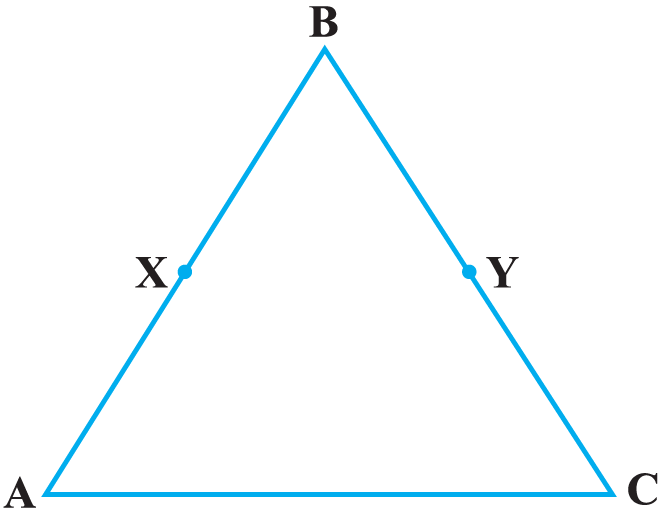
In the we have $AB = BC, BX = BY$. Show that $AX = CY.$
Answer
We have $A B=B C \ldots$...$(i)$ [Given] And $B X=B Y \ldots$...$(ii)$ [Given] Subtracting $(ii)$ from $(i)$, we get $A B-B X=B C=B Y$ Now, $B y$ Euclid axiom $3$, we have If equals are subtracted from equals, the remainder are equal. Hence, $AX = CY$
View full question & answer
Question 42 Marks
Solve the following question using appropriate Euclid’s axiom: It is known that $x + y = 10$ and that $x = z$. Show that $z + y = 10?$
Answer
It is known that $x + y = 10$ and that $x = z$
$\therefore\ \text{x}+\text{y}=\text{z}+\text{y}$
$\big[\because$ By Euclid's axiom $2$, if equals are added to equals, the wholes are equal$\big]$
$\Rightarrow10=\text{y}+\text{z}$
$\big[\text{Using}(1),\text{ x}+\text{y}=10\big]$ Hence, $\text{z}+\text{y}=10$
View full question & answer
Question 52 Marks
Read the following statements which are taken as axioms:
$i.$ If a transversal intersects two parallel lines, then corresponding angles are not necessarily equal.
$ii.$ If a transversal intersect two parallel lines, then alternate interior angles are equal.
Is this system of axioms consistent? Justify your answer.
Answer
No, this system of axioms is not consistent because if a transversal intersects two parallel lines and if corresponding angles are not equal, then alternate interior angles cannot be equal.
$[$Note: If a transversal intersects two parallel lines then corresponding angles and alternate interior angles are always equal$]$
View full question & answer
Question 62 Marks
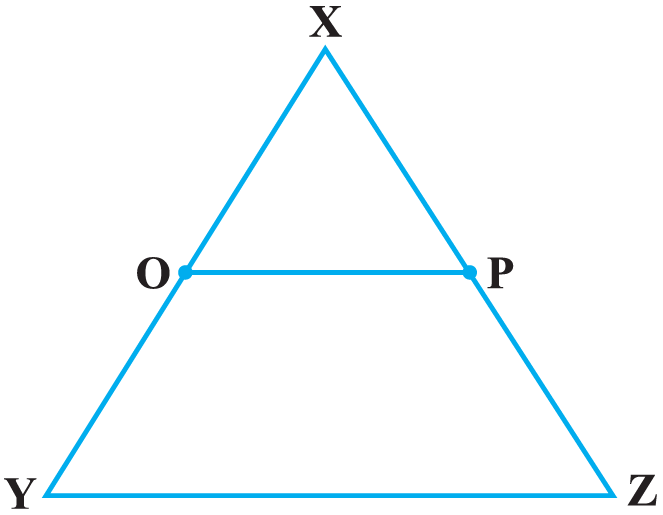
In the if $\text{OX}=\frac{1}{2}\text{XY},\text{ PX}=\frac{1}{2}\text{XZ}$ and $OX = PX$, show that $XY = XZ.$
Answer
We have $OX = PX$ [Given]
Now, $\text{OX}=\frac{1}{2}\text{XY}$ (Given) and $\text{PX}=\frac{1}{2}\text{XZ}$ [Given] $\therefore\ \frac{1}{2}\text{XY}=\frac{1}{2}\text{XZ}$
$\big[\because$ Thing which are halves of the same thing are equal to one another (Euclid's axiom 7)$\big]$
$\therefore\ \text{XY}=\text{XZ}$
$\big[\because$ Things which are double of the same thing are equal to one another (Euclid's axiom 6)$\big]$
View full question & answer
Question 72 Marks
In the we have $\angle1=\angle2,\angle2=\angle3.$ Show that $\angle1=\angle=3$
Answer
We have, $\angle1=\angle2$ [Given] $\angle2=\angle3$ [Given]
Now, by Euclid's axiom $1$, things which are equal to the same thing are equal to one other.
Hence, $\angle1=\angle3$
View full question & answer
Question 82 Marks
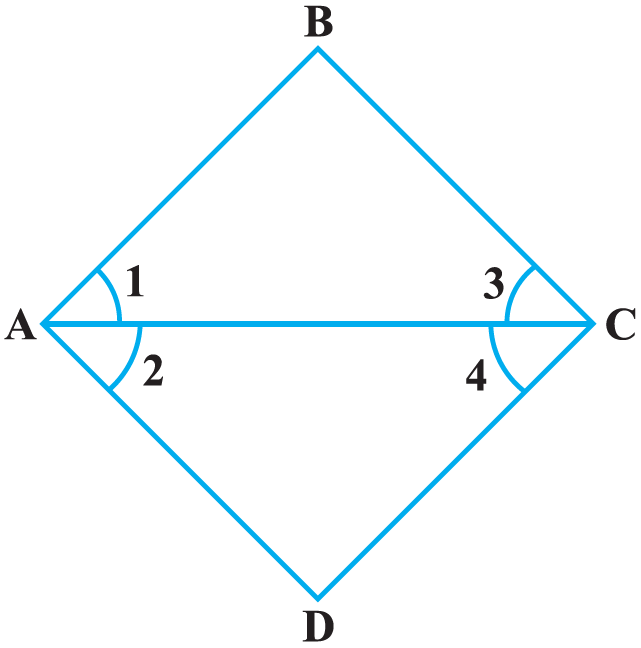
In the we have $\angle1=\angle3$ and $\angle2=\angle4.$ Show that $\angle\text{A}=\angle\text{C}.$
Answer
We have $\angle1=\angle3\ ...(\text{i})$ [Given] And $\angle2=\angle4\ ...(\text{ii})$ [Given]
Now, by Euclid's axiom 2, we have if equal are added to equals, the whole are equal. Adding $(i)$ and $(ii)$
we get $\angle1+\angle2=\angle3+\angle4$
Hence, $\angle\text{A}=\angle\text{C}$
View full question & answer
Question 92 Marks
Look at the show that length AH > sum of lengths of $AB + BC + CD.$
Answer
From the given figure, we have $AB + BC + CD = AD [AB, SC$ and $CD$ are the parts of $AD]$
Here, $AD$ is also the parts of $AH$. According to Euclid’s axiom, the whole is greater than the part. i.e., $AH > AD.$
So, length $AH >$ sum of lengths of $AB + BC + CD.$
View full question & answer
Question 102 Marks
Read the following two statements which are taken as axioms:
$i.$ If two lines intersect each other, then the vertically opposite angles are not equal.
$ii.$ If a ray stands on a line, then the sum of two adjacent angles so formed is equal to $180^\circ .$
Is this system of axioms consistent? Justify your answer.
Answer
The given system of axioms is not consistent because if a ray stands on a line and the sum of two adjacent angles so formed is equal to $180^\circ $ then for two lines which intersect each other, the vertically opposite angles becomes equal.
View full question & answer