MCQ 11 Mark
x = 2 y = - 1 is a solution of the linear equation
- ✓x + 2y = 0
- Bx + 2y = 4
- C2x + y = 0
- D2x + y = 5
Answer
View full question & answer→Correct option: A.
x + 2y = 0
a
50 questions · timed · auto-graded
x = 2, y = -1 is a solution of the linear equation:
Solution:
Substituting x = 2 and y = -1 in the following equations:
L.H.S. = x + 2y = 2 + 2(-1) = 2 - 2 = 0 = R.H.S.
L.H.S. = x + 2y = 2 + 2(-1) = 2 - 2 = 0 ≠ 4 ≠ R.H.S.
L.H.S. = 2x + y = 2(2) + (-1) = 4 - 1 = 3 ≠ 0 ≠ R.H.S.
L.H.S. = 2x + y = 2(2) + (-1) = 4 - 1 = 3 ≠ 5 ≠ R.H.S.
Hence, correct option is (a).
The graph of the linear equation 2x - y = 4 cuts x-axis at:
Solution:
On x-axis, the y-co-ordinate is always 0.
So, 2x - y = 4 will cut the x-axis where y = 0
i.e. 2x = 4
i.e. x = 2
Thus, 2x - y = 4 will cut the x-axis at (2, 0).
Hence, correct option is (a).
The equation x - 2 = 0 on number line is represented by:
Solution:
The equation x - 2 = 0 is represented by a point on the number line.
Therefore, the correct answer is (b).
The distance between the graphs of the equations y = -1 and y = 3 is:
Solution:
The distance between given two graphs
= 3 - (-1)
= 3 + 1
= 4
Hence, correct option is (b).
The distance between the graph of the equations x = -3 and x = 2 is:
Solution:
The distance between the graph of the equations x = -3 and x = 2
= 2 - (-3)
= 2 + 3
= 5
Hence, correct option is (d).
lf the graph of the equation 4x + 3y = 12 cuts the coordinate axes at A and B, then hypotenuse of right triangle AOB is of length:
Solution:
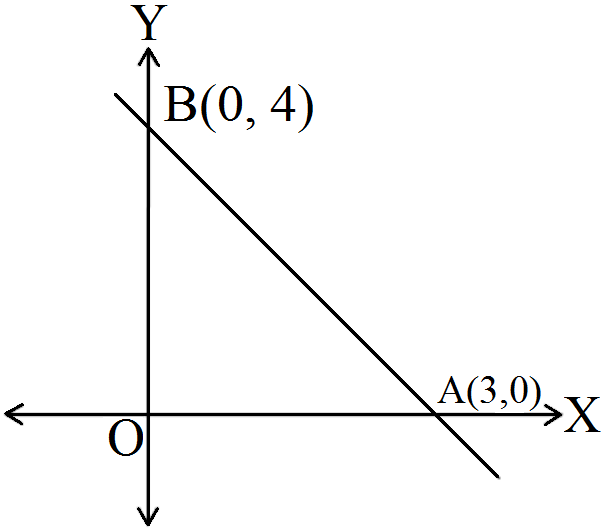
4x + 3y = 12
At x = 0, 3y = 12 ⇒ y = 4 units
At y = 0, 4x = 12 ⇒ x = 3 units
The triangle formed is $\triangle\text{AOB},$ where
OB = 4 units
OA = 3 units
Hypotenuse $=\text{AB}=\sqrt{\text{OB}^2+\text{OA}^2}=\sqrt{16+9}=5\text{ units}$
Hence, correct option is (c).
If (a, 4) lies on the graph of 3x + y = 10, then the value of a is:
Solution:
3x + y = 10
If (a, 4) lies on its graph, then it must satisfy the equation.
Thus, we have
3(a) + 4 = 10
i.e. 3a = 6
i.e. a = 2
Hence, correct option is (c).
If (4, 19) is a solution of the equation y = ax + 3, then a =
Solution:
y = ax + 3
If (4, 19) is its solution, then it must satisfy the equation.
Thus, we have
19 = a × 4 + 3
i.e. 4a = 16
i.e. a = 4
Hence, correct option is (b).
If (2k - 1, k) is a solution of the equation 10x - 9y = 12, then k =
Solution:
If (2k - 1, k) is solution of equation 10x - 9y = 12, then it must satisfy this equation.
Thus, we have
10(2k - 1) - 9k = 12
20k - 10 - 9k = 12
11k = 22
k = 2
Hence, correct option is (b).
How many linear equations are satisfied by x = 2 and y = -3?
Solution:
From Point (2, -3) there are infinitely many lines passing in every-direction.
So (2, -3) is satisfied with infinite linear equations.
Hence, correct option is (d).