Question 15 Marks
Draw the graphs of linear equations $y = x$ and $y = -x$ on the same Cartesian plane. What do you observe$?$
Answer
View full question & answer→The given equation is $y = x$. To draw the graph of this equations, we need atleast two points lying on the given line.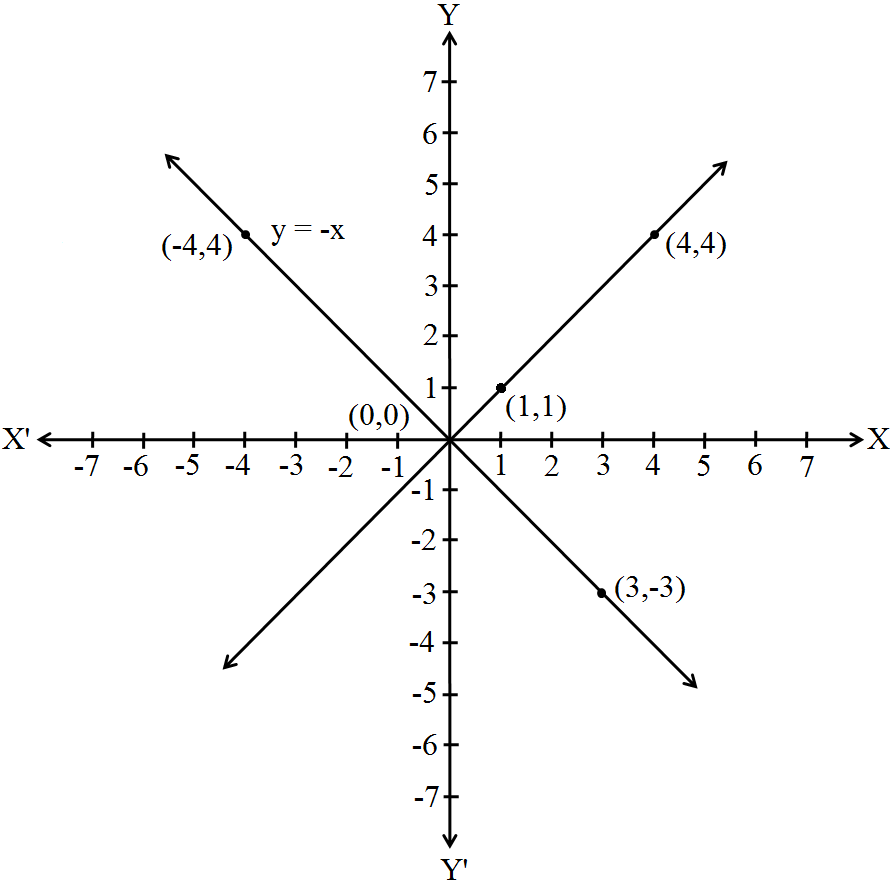
For $x = 1, y = 1,$ therefore $(1, 1)$ satisfies the linear equation $y = x.$ For $x = 4, y = 4,$
therefore $(4, 4)$ satisfies the linear equation $y = x.$
By plotting the points $(1, 1)$ and $(4, 4)$ on the graph paper and joining them by a line,
we obtain the graph of $y = x.$
The given equation is $y = – x.$ To draw the graph of this equation,
we need atleast two points lying on the given line.
For $x = 3, y = -3,$ therefore, $(3, -3)$ satisfies the linear equation $y = -x.$ For $x = -4, y = 4,$
therefore, $(-4, 4)$ satisfies the linear equation $y = -x.$
By plotting the points $(3, –3)$ and $(-4, 4)$ on the graph paper and joining them by a line,
we obtain the graph of $y = -x.$ We observe that,
the line $y = x$ and $y = -x$ intersect at the point $O(0, 0).$
For $x = 1, y = 1,$ therefore $(1, 1)$ satisfies the linear equation $y = x.$ For $x = 4, y = 4,$
therefore $(4, 4)$ satisfies the linear equation $y = x.$
By plotting the points $(1, 1)$ and $(4, 4)$ on the graph paper and joining them by a line,
we obtain the graph of $y = x.$
The given equation is $y = – x.$ To draw the graph of this equation,
we need atleast two points lying on the given line.
For $x = 3, y = -3,$ therefore, $(3, -3)$ satisfies the linear equation $y = -x.$ For $x = -4, y = 4,$
therefore, $(-4, 4)$ satisfies the linear equation $y = -x.$
By plotting the points $(3, –3)$ and $(-4, 4)$ on the graph paper and joining them by a line,
we obtain the graph of $y = -x.$ We observe that,
the line $y = x$ and $y = -x$ intersect at the point $O(0, 0).$