Questions · Page 1 of 5

M.C.Q

🎯

Test yourself on this topic

50 questions · timed · auto-graded

MCQ 21 Mark
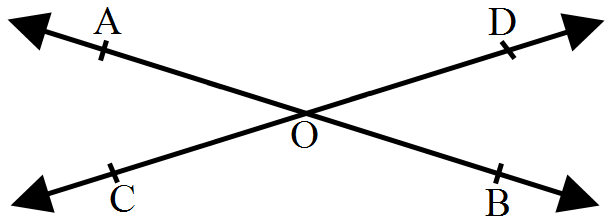
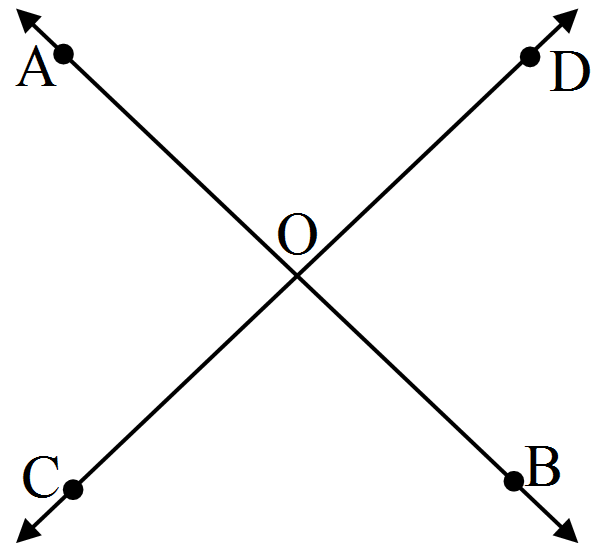
Two straight lines AB and CD intersect one another at the point O. If​​ $\angle\text{AOC}+​​\angle\text{COB}+​​\angle\text{BOD}=274^\circ, $ then $\angle\text{AOD}=$
  • A
    86º
  • B
    137º
  • C
    90º
  • D
    94º
Answer
  1. 86º
    Solution:
    Given,
    $\angle\text{AOC}+\angle\text{COB}+\angle\text{BOD}=274^\circ\text{ (i)}$
    $\angle\text{AOD}+\angle\text{AOC}+\angle\text{COB}+\angle\text{BOD}=360^\circ$ (Angles at a point)
    $\angle\text{AOD}+274^\circ=360^\circ$
    $\angle\text{AOD}=86^\circ.$
View full question & answer
MCQ 31 Mark
The number of line segments determined by three given non-collinear points is:
  • A
    Four.
  • B
    Infinitely many.
  • C
    Two.
  • D
    Three.
Answer
  1. Three.
    Solution:
    Three because non-collinear points means the point does not lies in a same line.
View full question & answer
MCQ 41 Mark
  • A
    115º
  • B
    125º
  • C
    110º
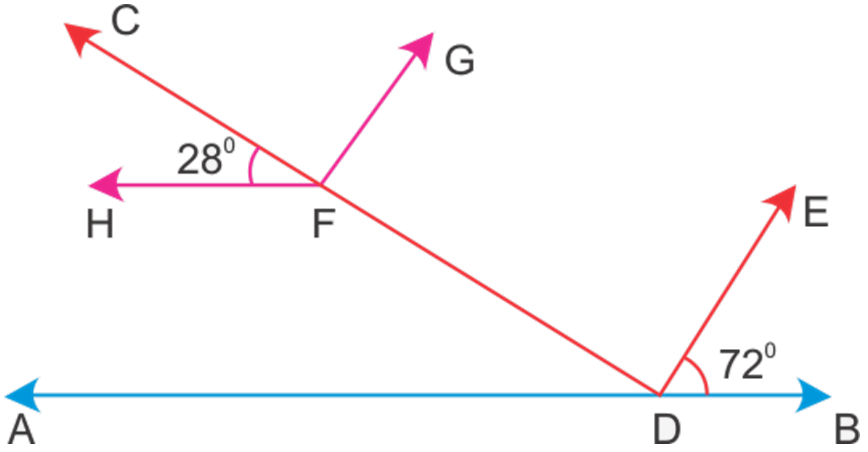
  • D
    65º
Answer
  1. 115º
    Solution:
    We have,
    $\angle\text{AOC}=\angle\text{BOD}$ [Vertically-Opposite Angles]
    $\therefore\angle\text{AOC}+\angle\text{BOD}=130^\circ$
    $\Rightarrow\angle\text{AOC}+\angle\text{AOC}=130^\circ [\therefore\angle\text{AOC}=\angle\text{BOD}]$
    $\Rightarrow2\angle\text{AOC}=130^\circ$
    $\Rightarrow\angle\text{AOC}=65^\circ$
    Now,
    $\angle\text{AOC}+\angle\text{AOD}=180^\circ$ [$\because$ COD is a straight line]
    $\Rightarrow65^\circ+\angle\text{AOD}=180^\circ$
    $\Rightarrow\angle\text{AOC}=115^\circ.$
View full question & answer
MCQ 61 Mark
  • A
    36
  • B
    54
  • C
    63
  • D
Answer
  1. 54
    Solution:
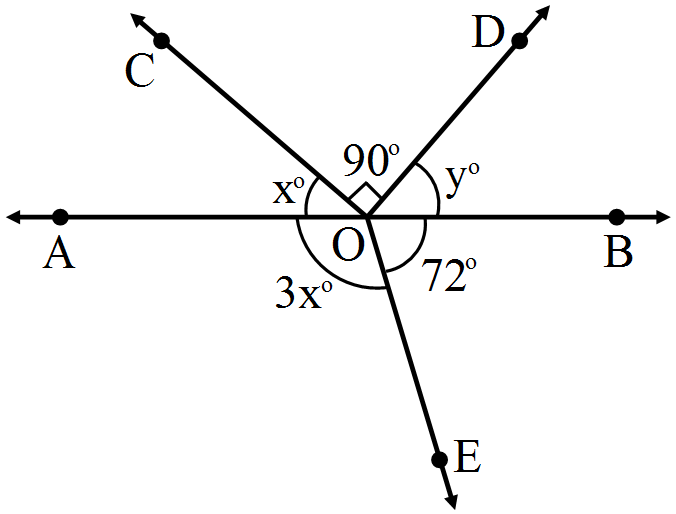
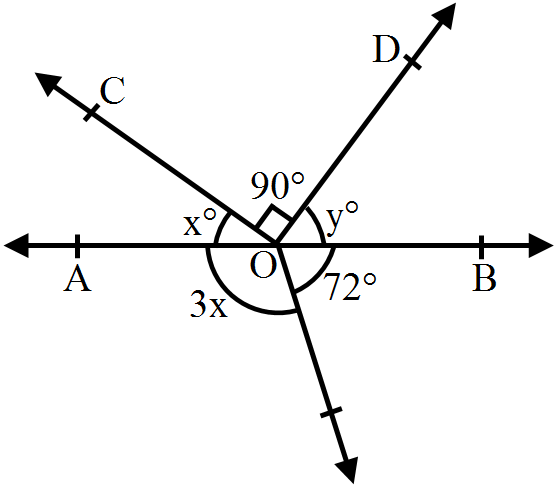
    AOB is a straight line.
    $\therefore$ xº + yº 90º = 180º
    ⇒ x + y = 90 .....(i)
    Since the angles around a point sum up to 360º,
    ⇒ xº + 90º + yº + 72º + 3xº = 360º
    ⇒ 4x + y = 198 .....(ii)
    Subtracting (i) from (ii), we get
    3x = 108 ⇒ x = 36º
    Substituting in (i), we get
    y = 54º
View full question & answer
MCQ 71 Mark
  • A
    70º
  • B
    60º
  • C
    50º
  • D
View full question & answer
MCQ 81 Mark
The angles of a triangle are in the ratio 2 : 3 : 4. The largest angle of the triangle is:
  • A
    60º
  • B
    100º
  • C
    12º
  • D
    80º
Answer
  1. 80º
    Solution:
    Suppose $\triangle\text{ABC}$ such that $\angle\text{A}:\angle\text{B}:\angle\text{C} = 2 : 3 : 4$
    Let $\angle\text{A}=2\text{k},\angle\text{B}=3\text{k}$ and $\angle\text{C} = 4\text{k}$ where k is some constant
    In $\triangle\text{ABC},$
    $\angle\text{A}+\angle\text{B}+\angle\text{C}=180^\circ$ (Angle sum property)
    ⇒ 2k + 3k + 4k = 180º
    ⇒ 9k = 180º
    ⇒ k = 20º.
View full question & answer
MCQ 101 Mark
Consider the following statement:
When two straight lines intersect:
  1. Adjacent angles are complementary
  2. Adjacent angles are supplementary
  3. Opposite angles are equal
  4. Opposite angles are supplementary
Of these statements
    • A
      (i) and (ii) are correct
    • B
      (ii) and (iii) are correct
    • C
      (i) and (iv) are correct
    • D
      (ii) and (iv) are correct
    View full question & answer
    MCQ 111 Mark
    The complement of (90º - a) is:
    • A
    • B
      -aº
    • C
      90º + a
    • D
      90º - a
    Answer

    1. Solution:
      Two angles, whose sum is 90º, are called the complementary angle.
      Let x is a complimentary angle of (90º - a)
      x + (90º - a) = 90º
      x = 90º - (90º - a)
      x = 90º - 90º + a
      x = aº.
    View full question & answer
    MCQ 121 Mark
    Two straight lines AB and CD cut each other at O. If ​​$\angle\text{BOD}=63^\circ,$ then​​ $\angle\text{BOC}=$
    • A
      153º
    • B
      17º
    • C
      117º
    • D
      63º
    Answer
    1. 117º
      Solution:
      $\angle\text{BOD}+\angle\text{BOC}=180^\circ$ (Linear pair)
      $63^\circ+\angle\text{BOC}=180^\circ$
      $\text{BOC}=117^\circ.$
    View full question & answer
    MCQ 131 Mark
    The angle which is equal to 8 times its complement is:
    • A
      88º
    • B
      72º
    • C
      80º
    • D
      90º
    Answer
    1. 80º
      Solution:
      We know that two angles, whose sum is 90º, are called the complementary angle.
      Let one angle be x then its complementary angle be 8x,
      x + 8x = 90º
      9x = 90º
      x = 10º
      Its complementary angle is 8 × 10 = 80º.
    View full question & answer
    MCQ 141 Mark
    View full question & answer
    MCQ 161 Mark
    • A
      15°
    • B
      25°
    • C
      70°
    • D
    View full question & answer
    MCQ 181 Mark
    An exterior angle of a triangle is $80^\circ$ and the interior opposite angles are in the ratio 1 : 3. Measure of each interior opposite angle is:
    • A
      20º, 60º
    • B
      40º, 120º
    • C
      30º, 90º
    • D
      30º, 60º3
    Answer
    1. 20º, 60º
      Solution:
      Let the common ratio is x
      The ratio of interior angles are 1 : 3
      So angles are x and 3x
      x + 3x = 80
      4x = 80
      $\text{x}=\frac{80}{4}$
      x = 20
      So angles are 20º and 60º.
    View full question & answer
    MCQ 231 Mark
    • A
      130º
    • B
      120º
    • C
      100º
    • D
      115º
    Answer
    1. 115º
      Solution:
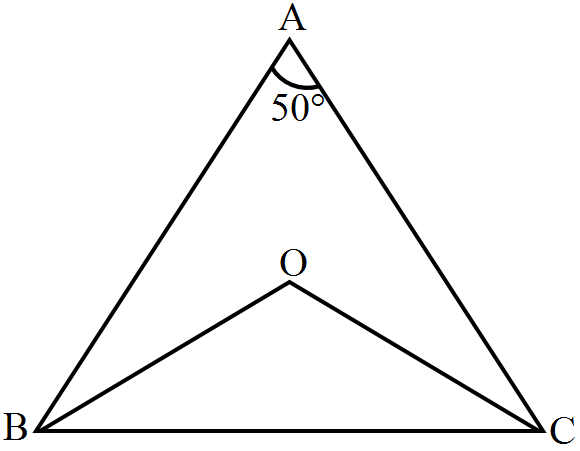
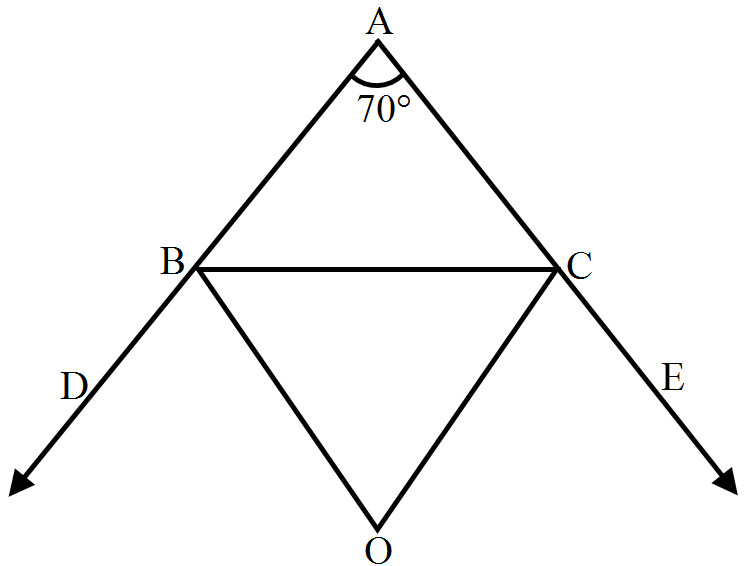
      In$\triangle\text{ABC}$
      $\text{2x}+\text{2y}+\angle\text{A}=180^\circ$ (Angle sum property)
      $\text{x}+\text{y}+(\frac{\angle\text{A}}{2})=90^\circ$
      $\text{x}+\text{y}=90^\circ-(\frac{\text{A}}{2})$(1)
      In$\triangle\text{BOC},$ we have
      $\text{x}+\text{y}+\angle\text{BOC}=180^\circ$
      $90^\circ- (\frac{\angle\text{A}}{2})+\angle\text{BOC}=180^\circ$ [From (1)]
      $\text{BOC}=180^\circ-90^\circ+(\frac{\text{A}}{2})$
      $\angle\text{BOC}=90^\circ+(\frac{\text{A}}{2})$
      $\angle\text{BOC}=90^\circ+25^\circ=115^\circ.$
    View full question & answer
    MCQ 241 Mark
    The measure of an angle is five times its complement. The angle measures.
    • A
      25º
    • B
      75º
    • C
      65º
    • D
      35º
    Answer
    1. 75º
      Solution:
      Let the measure of the required angle be xº
      Then, the measure of its complement will be (90 − x)º
      Therefore, x = 5 (90 - x)
      ⇒ x = 450 - 5x
      ⇒ 6x = 450
      ⇒ x = 75º.
    View full question & answer
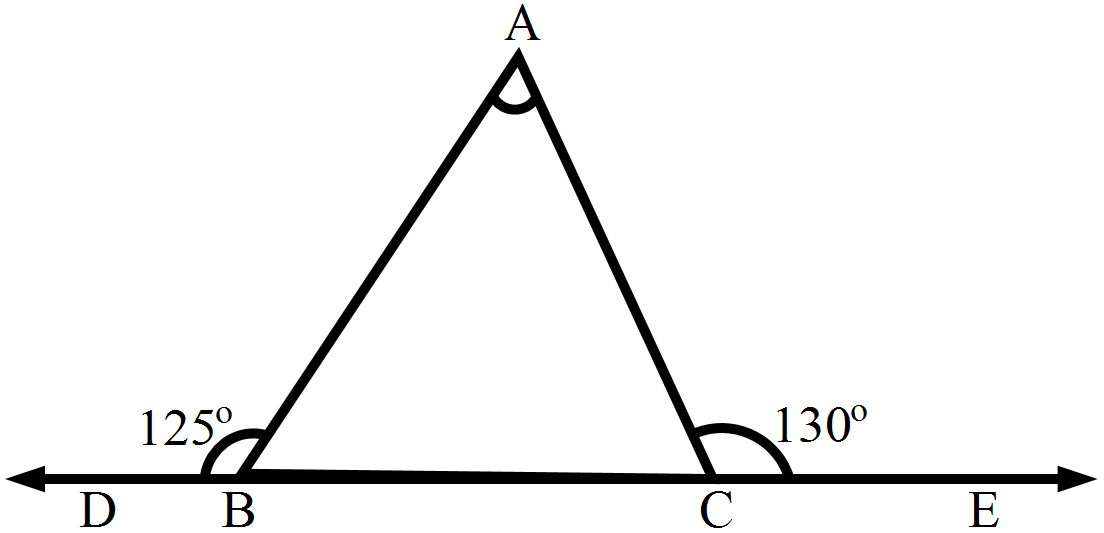
    MCQ 251 Mark
    • A
      55°
    • B
      50°
    • C
      75°
    • D
      65°
    Answer
    1. 75°
      Solution:
      $\angle\text{ABD}+\angle\text{ABC}=180^\circ$(Linear Pair)
      $\angle\text{ABC}=180^\circ-125^\circ=55^\circ$
      $\angle\text{ACE}+\angle\text{ACB}=180^\circ$(Linear Pair)
      $\angle\text{ACB}=180^\circ-130^\circ=50^\circ$
      In $\triangle\text{ABC}$
      $\angle\text{ABC}+\angle\text{ACB}+\angle\text{BAC}=180^\circ$(Angle sum property)
      $\angle\text{BAC}=180^\circ-50^\circ-55^\circ$
      $\angle\text{BAC}=75^\circ$
    View full question & answer
    MCQ 261 Mark
    Each angle of an equilateral triangle is:
    • A
      45º
    • B
      30º
    • C
      60º
    • D
      90º
    Answer
    1. 60º
      Solution:
      Let the angle of an equilateral triangle be xo
      x + x + x = 180º (Angle sum property)
      3x = 180º
      x = 60º.
    View full question & answer
    MCQ 271 Mark
    Which of the following pairs of angles are complementary?
    • A
      25º, 65º
    • B
      32.1º, 47.9º
    • C
      70º, 110º
    • D
      30º, 70º
    Answer
    1. 25º, 65º
      Solution:
      Complementary angles always add up to 90º
      25º + 65º = 90º
      Therefore this is the right option (by substitution).
    View full question & answer
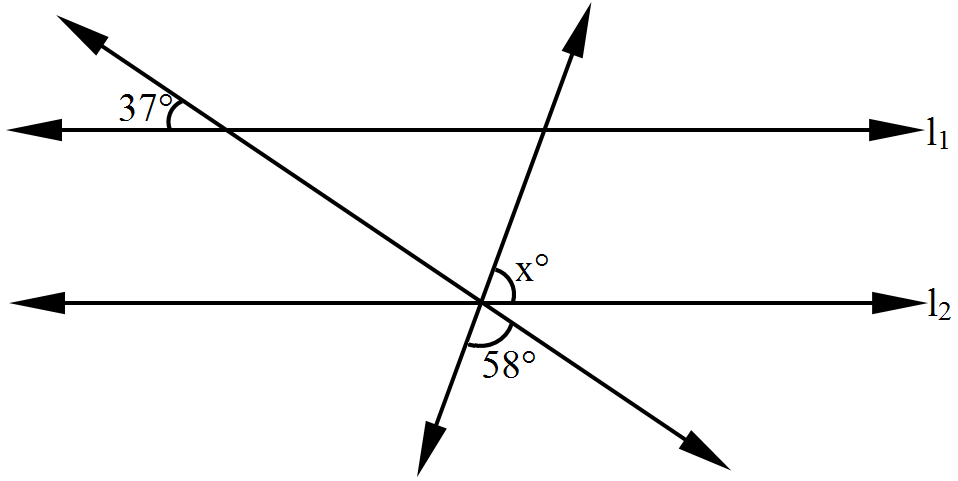
    MCQ 281 Mark
    • A
      85º
    • B
      90º
    • C
      70º
    • D
      75º
    Answer
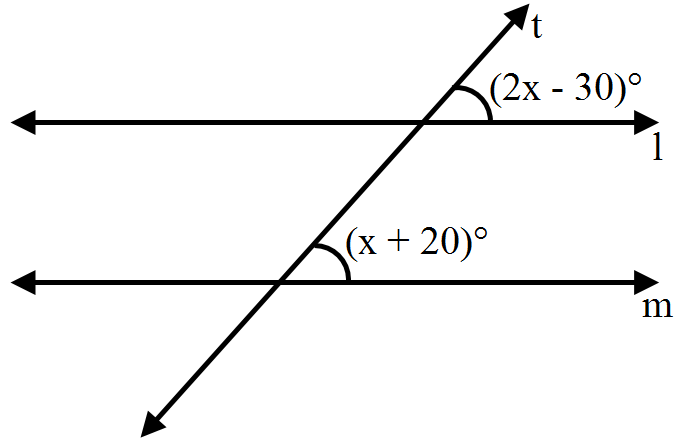
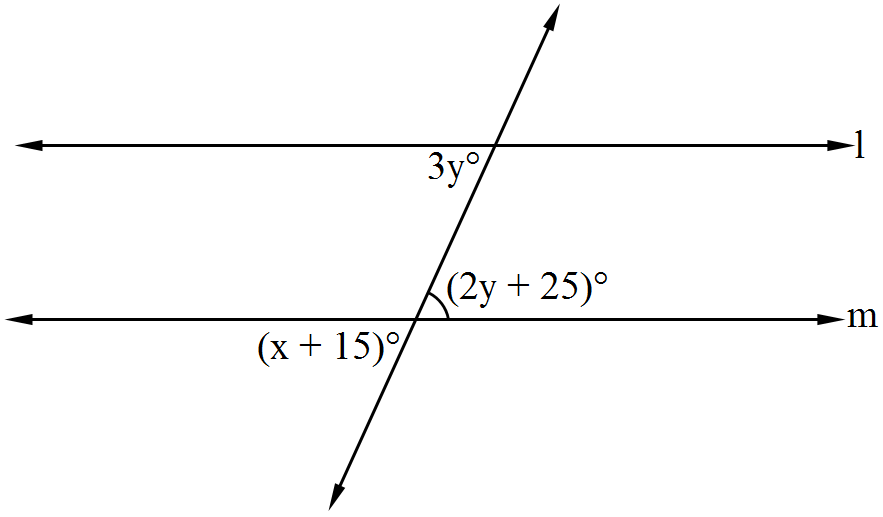
    1. 85º
      Solution:
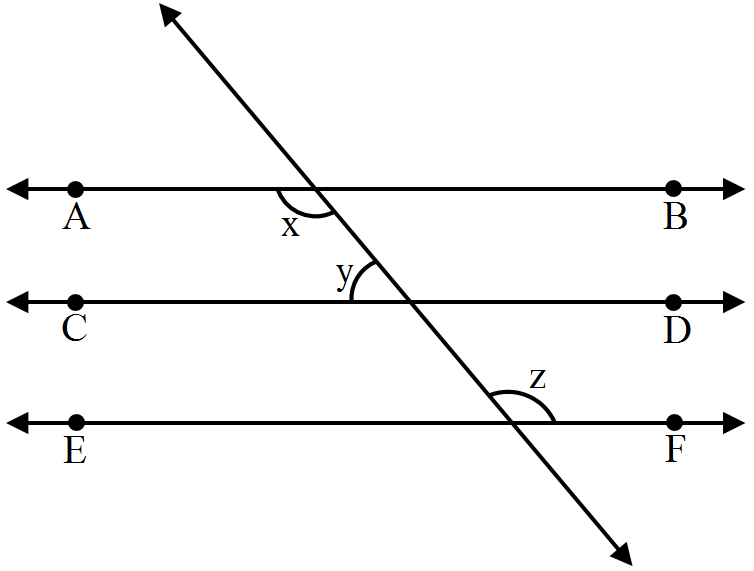
      Given that,
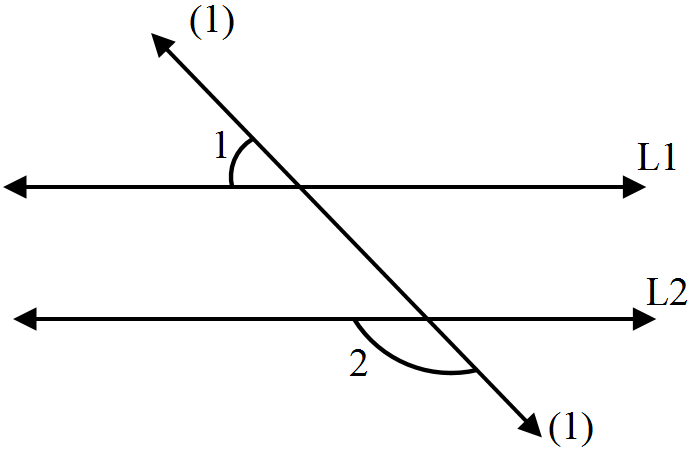
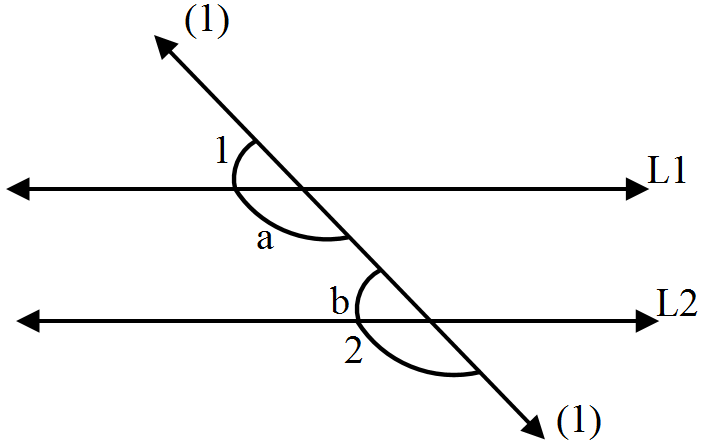
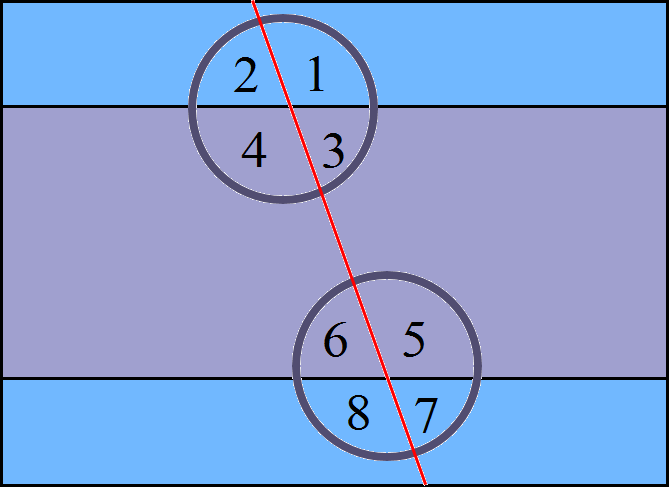
      l1 || l2
      Let transversal P and Q cuts them
      $\angle1=37^\circ$
      $\angle4=58^\circ$
      $\angle5=\text{x}^\circ$
      $\angle1=\angle2=37^\circ$(Corresponding angles) (i)
      $\angle2=\angle3$ (Vertically opposite angle)
      $\angle3=37^\circ$
      $\angle3+\angle4+\angle5=180^\circ$(Linear pair)
      37º + 58º + x = 180º
      x = 85º.
    View full question & answer
    MCQ 291 Mark
    The measure of an angle is five times its comlement. The angle measure.
    • A
      25º
    • B
      35º
    • C
      65º
    • D
      75º
    Answer
    1. 75º
      Solution:
      Let the measure of the angle be xº,
      So, its complement = (90 - x)º
      According to the given condition,
      x = 5(90 - x)
      ⇒ x = 450 - 5x
      ⇒ 6x = 450
      ⇒ x = 75º
      So, the angle measures 75º.
    View full question & answer
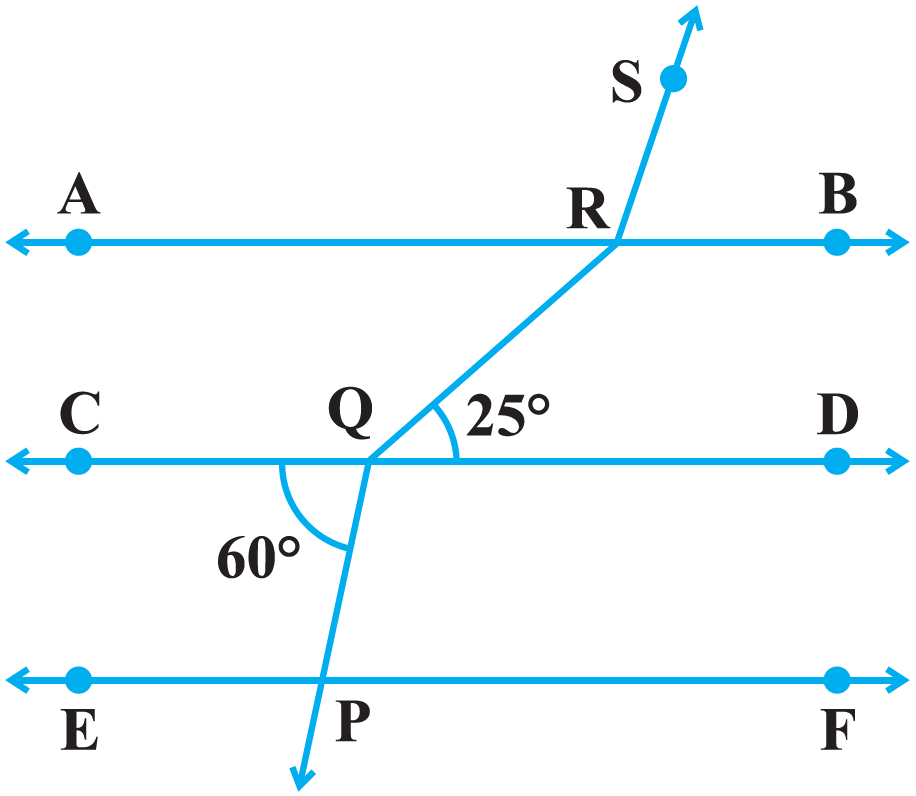
    MCQ 301 Mark
    • A
      85°
    • B
      135°
    • C
      145°
    • D
      110°
    Answer
    1. 145°
      Solution:
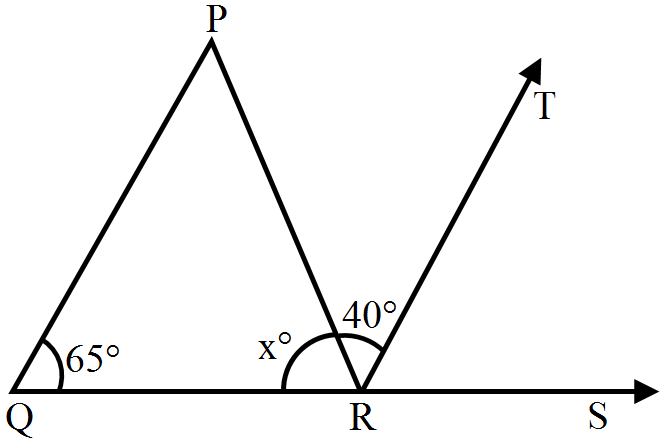
      Given, $\text{PQ}||\text{RS}$
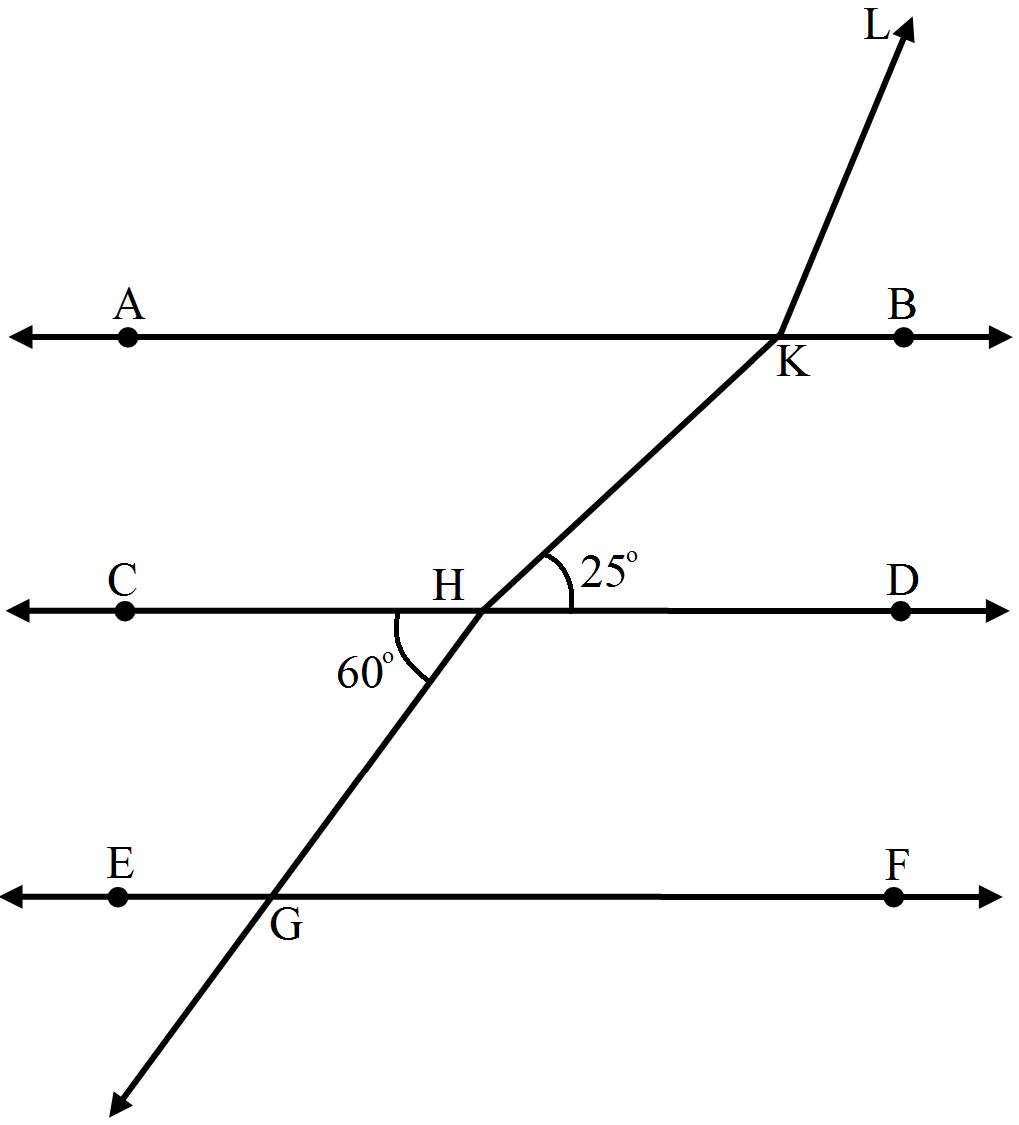
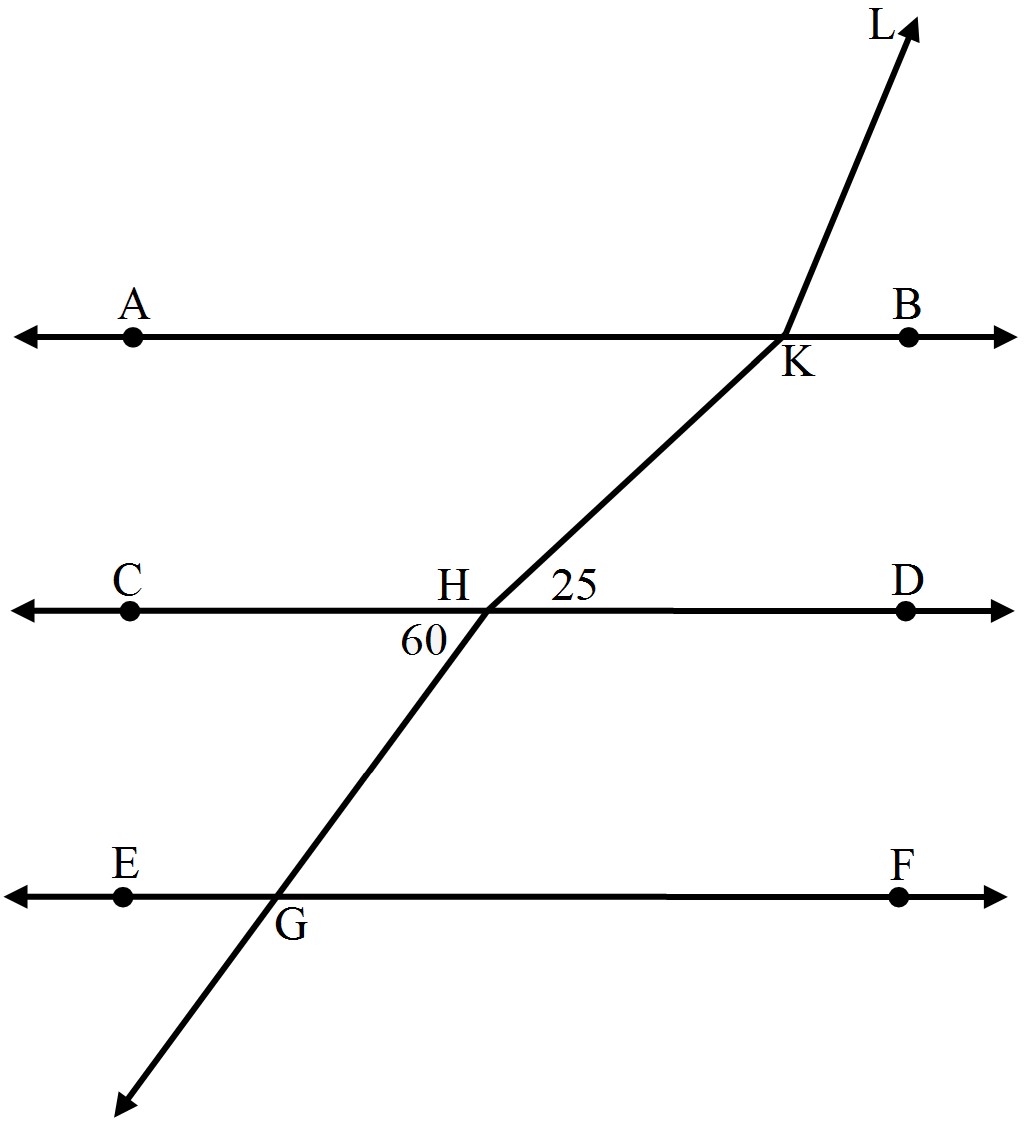
      $\angle\text{PQC}=\angle\text{BRC}=60^\circ$$\big[$alternate exterior angles and $\angle\text{PQC}=60^\circ$ (given)$\big]$ and $\angle\text{DQR}$
      $=\angle\text{QRA}=25^\circ$ [alternate interior angles]
      $$$\big[\angle\text{DQR}=25^\circ,\text{(given)}\big]$
      $\angle\text{QRS}=\angle\text{QRA}+\angle\text{ARS}$
      $=\angle\text{QRA}+\big(180^\circ-\angle\text{BRS}\big)$ [linear pair axiom]
      $=25^\circ+180^\circ-60^\circ=205^\circ-60^\circ=145^\circ$
    View full question & answer
    MCQ 311 Mark
    A, B, C are the three angles of a triangle. If A - B = 15º and B - C = 30º, then angles A, B, C are respectively:
    • A
      80º, 65º, 35º
    • B
      65º, 80º, 35º
    • C
      80º, 35º, 65º
    • D
      35º, 65º, 80º
    Answer
    1. 80º, 65º, 35º
      Solution:
      Since ABC is a triangle
      A + B + C = 180º (Angle sum property) (i)
      A - B = 15º
      A = 15º + B (ii)
      B - C = 30º
      C = B - 30º (iii)
      From (i) equation
      15º + B + B + B - 30º = 180º
      B = 65º
      From equation (ii) and (iii)
      A = 15º + B = 15º + 65º = 80º
      C = B - 30º = 65º - 30º = 35º.
    View full question & answer
    MCQ 331 Mark
    Write the correct answer in the following:
    The angles of a triangle are in the ratio 5 : 3 : 7 The triangle is.
    • A
      An acute angled triangle.
    • B
      An obtuse angled triangle.
    • C
      A right triangle.
    • D
      An isosceles triangle.
    Answer
    1. An acute angled triangle.
      Solution:
      Let the angles of the triangle be 5x, 3x and 7x.
      As the sum of the angles of a triangle is 180° then
      5x + 3x + 7x = 180°
      ⇒ 15x = 180° ⇒ x = 180° ÷ 15 = 12°
      Therefore, the angle of the triangle are:
      5 × 12°, 3 × 12° and 7 × 12°, i.e., 60°, 36° and 84°
      As the measure of each angle of the triangle is less than 90°, so the angles of triangle are acute angles.
      Therefore, the triangle is an acute angled triangle.
      Hence, (a) is the correct answer.
    View full question & answer
    MCQ 341 Mark
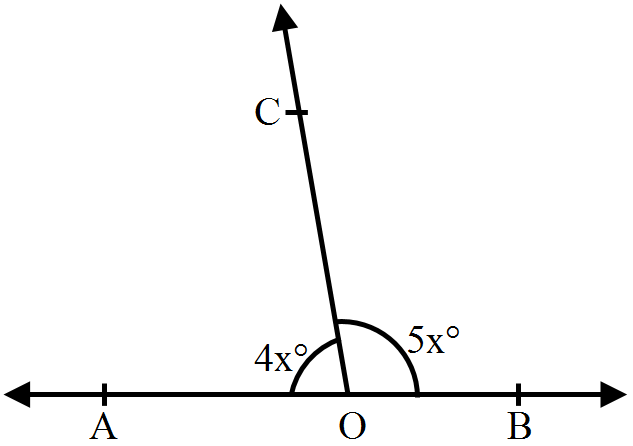
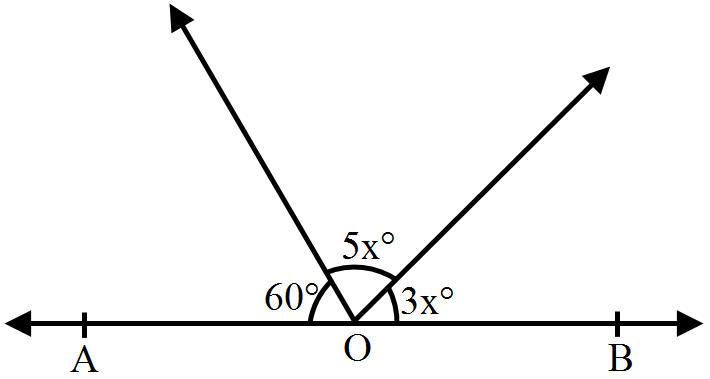
    Given​​ $\angle\text{POR}=3\text{x}$ and​​ $\angle\text{QOR}=2\text{x}+10^\circ.$ If ​​$\angle\text{POQ}$ is a straight line, then the value of x is:
    • A
      30º
    • B
      36º
    • C
      34º
    • D
      None of these
    Answer
    1. 34º
      Solution:
      Given,
      POQ is a straight line
      $\angle\text{POR}+\angle\text{QOR}=180^\circ$ (Linear pair)
      3x + 2x + 10º = 180º
      5x = 170º
      x = 34º.
    View full question & answer
    MCQ 371 Mark
    • A
      36º
    • B
      63º
    • C
      72º
    • D
      54º
    Answer
    1. 54º
      Solution:
      We have,
      3x + 72 = 180º [$\because$ AOB is a straight line]
      ⇒ 3x = 108
      ⇒ x = 36
      Also,
      $\angle\text{AOC}+\angle\text{COD}+\angle\text{BOD}=180^\circ$ [$\because$ AOB is a straight line]
      ⇒ 36º + 90º + y = 180º
      ⇒ y = 54º.
    View full question & answer
    MCQ 391 Mark
    • A
      140º
    • B
      130º
    • C
      120º
    • D
      110º
    Answer
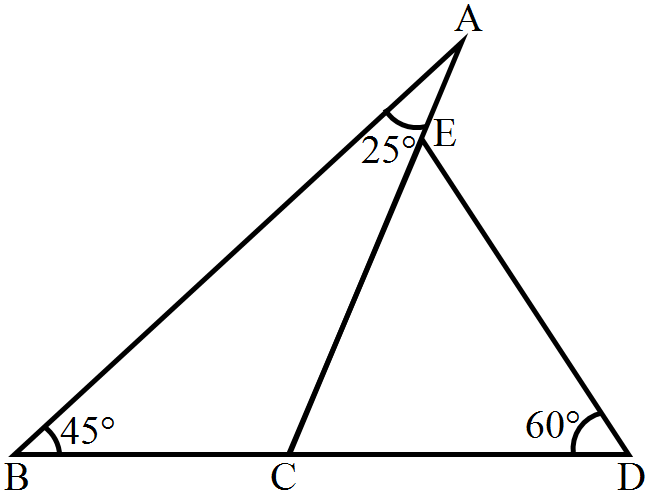
    1. 130º
      Solution:
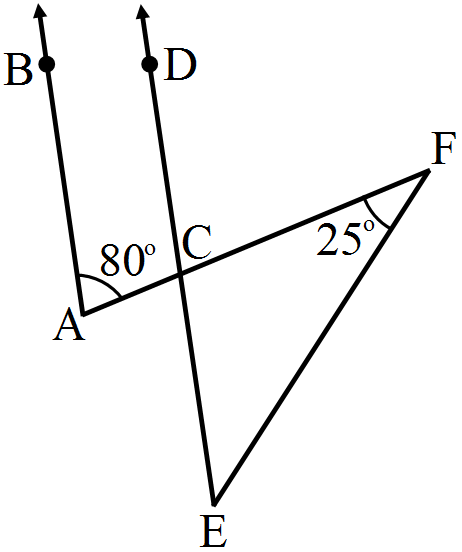
      In $\triangle\text{ABC}$
      $\angle\text{ABC}+\angle\text{ACB}+\angle\text{BAC}=180^\circ$ (Angle sum property)
      $\angle\text{ACB}=180^\circ-25^\circ-45^\circ$
      $\angle\text{ACB}=110^\circ$
      $\angle\text{ACB}+\angle\text{ACD}=180^\circ$ (Linear pair)
      $\angle\text{ACD}=180^\circ-110^\circ=70^\circ$
      In $\triangle\text{CED}$
      $\angle\text{AED}+\angle\text{EDC}+\angle\text{EDC}$ (Exterior angle is equal to sum of its two interior opposite angles)
      $\angle\text{AED}=60^\circ+75^\circ=130^\circ.$
    View full question & answer
    MCQ 401 Mark
    • A
      50º
    • B
      60º
    • C
      80º
    • D
      40º
    Answer
    1. 80º
      Solution:
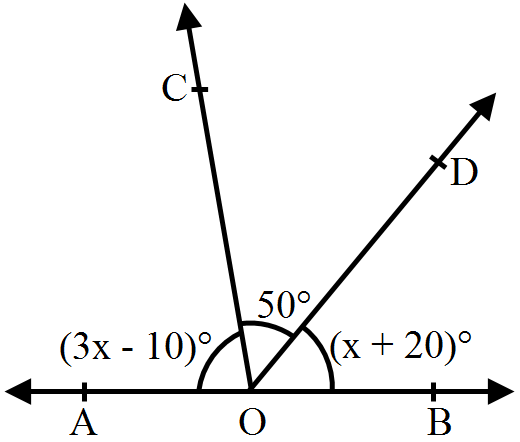
      We have,
      $\angle\text{AOC}+\angle\text{COD}+\angle\text{BOD}=180^\circ$ [Since AOB is a straight line]
      ⇒ 3x - 10 + 50 + x + 20 = 180
      ⇒ 4x = 120
      ⇒ x = 30
      $\therefore\angle\text{AOC}=[3\times30−10]^\circ$
      $\Rightarrow\angle\text{AOC}=80^\circ.$
    View full question & answer
    MCQ 421 Mark
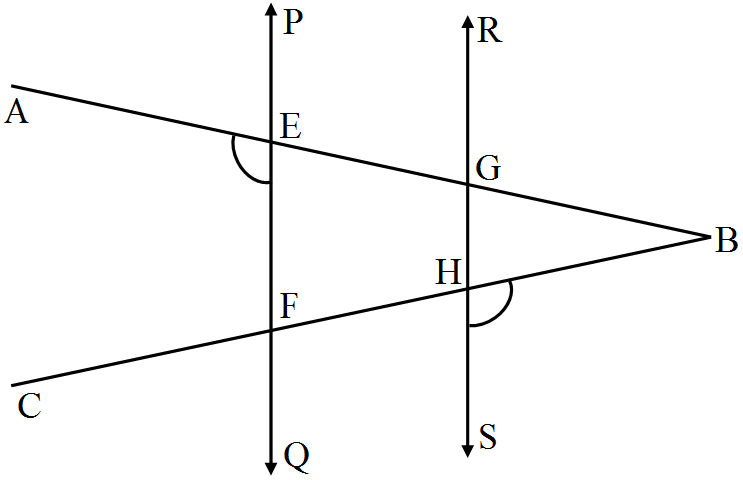
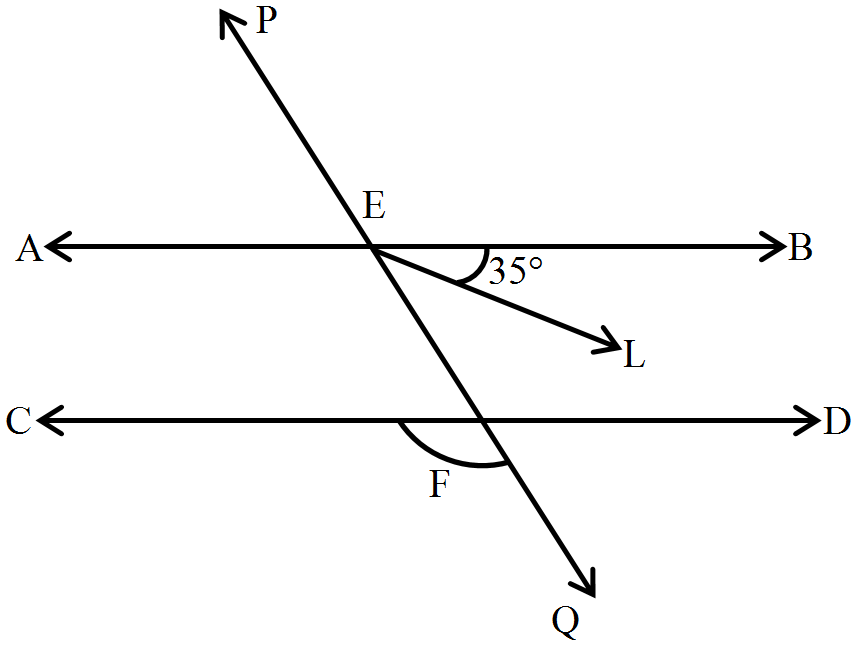
    AB and CD are two parallel lines. PQ cuts AB and CD at E and F respectively. EL is the bisector of $\angle\text{FEB}.$ If $\angle\text{LEB}=35^\circ,$ then $\angle\text{CFQ}$ will be:
    • A
      130º
    • B
      70º
    • C
      110º
    • D
      55º
    View full question & answer
    MCQ 451 Mark
    • A
      45º
    • B
      55º
    • C
      35º
    • D
      65º
    Answer
    1. 65º
      Solution:
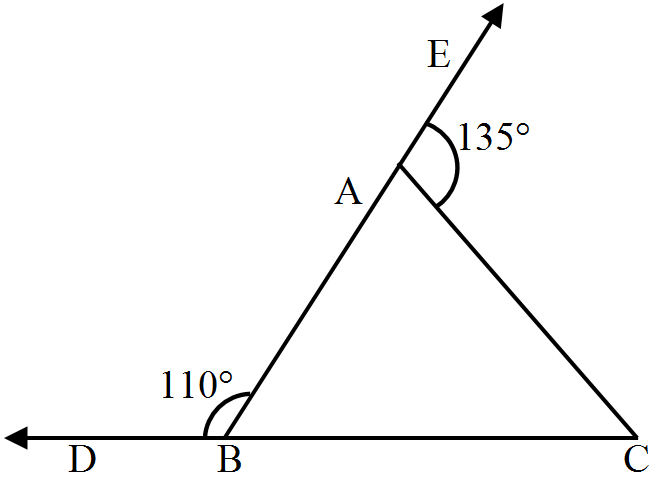
      $\angle\text{EAC}+\angle\text{BAC}=180^\circ$ (Linear Pair)
      $\angle\text{EAC}=135^\circ$
      $135^\circ+\angle\text{BAC}=180^\circ$
      $\angle\text{BAC}=180^\circ-135^\circ$
      $\angle\text{BAC}=45^\circ$
      $\angle\text{ABD}+\angle\text{ABC}=180^\circ$(Linear Pair)
      $\angle\text{ABD}=110^\circ$
      $110^\circ+\angle\text{ABC}=180^\circ$
      $\text{ABC}=180^\circ-110^\circ$
      $\angle\text{ABC}=70^\circ$
      In $\triangle\text{ABC}$
      $\angle\text{BAC}+\angle\text{ABC}+\angle\text{ACB}=180^\circ$
      $45^\circ+70^\circ+\angle\text{ACB}=180^\circ$
      $115^\circ+\angle\text{ACB}=180^\circ$
      $\angle\text{ACB}=180^\circ-115^\circ$
      $\angle\text{ACB}=65^\circ.$
    View full question & answer
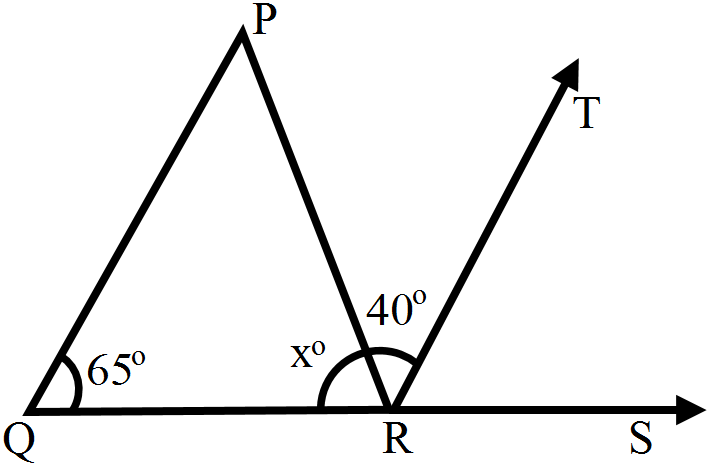
    MCQ 461 Mark
    • A
      x = 63º, y = 27º
    • B
      x = 37º, y =53º
    • C
      x = 43º, y = 47º
    • D
      x = 53º, y = 37º
    Answer
    1. x = 53º, y = 37º
      Solution:
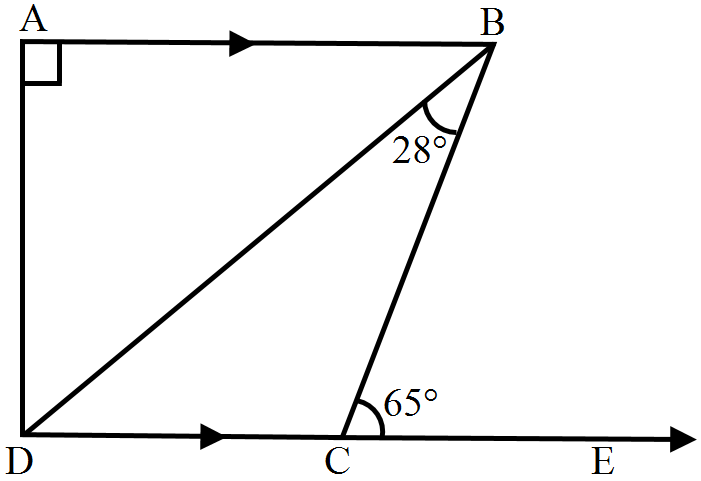
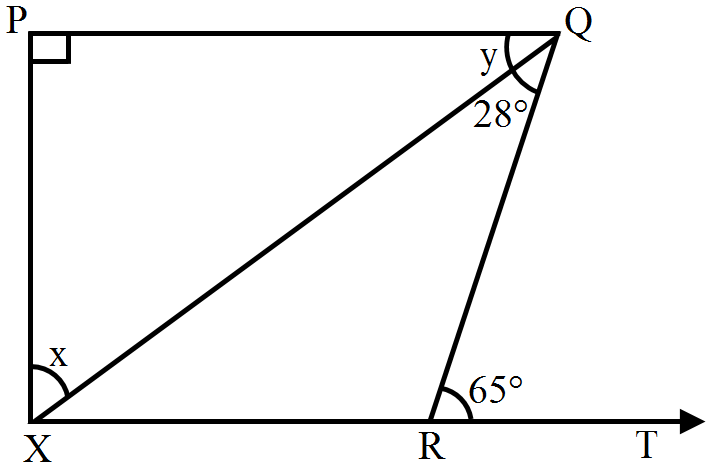
      In $\triangle\text{QXR}$
      $28^\circ+\angle\text{QXR}=\angle\text{QRT}$ (Exterior angle property)
      $\text{QXR}=65^\circ-28^\circ=37^\circ$
      $\text{y}=\angle\text{QSR}=37^\circ$ (Alternate interior angles)
      In $\triangle\text{PQX}$
      $\angle\text{PQX}+\angle\text{QXP}+\angle\text{QPX}=180^\circ$ (Angle sum property)
      37º + x + 90º = 180º
      x = 53º.
    View full question & answer
    MCQ 471 Mark
    An exterior angle of a triangle is 110º and its two interior opposite angles are equal. Each of these equal angles is:
    • A
      $70^\circ$
    • B
      $55^\circ$
    • C
      $35^\circ$
    • D
      $27\frac{1^\circ}{2}$
    Answer
    1. $55^\circ$
      Solution:
      Let each interior opposite angle be x.
      Then, x + x = 110° (Exterior angle property of a triangle)
      ⇒ 2x = 110°
      ⇒ x = 55°
    View full question & answer
    MCQ 491 Mark
    The angles of a triangle are in the ration 3 : 5 : 7. The triangle is:
    • A
      Acute-angled.
    • B
      Obtuse-angled.
    • C
      Right-angled.
    • D
      An isosceles triangle.
    Answer
    1. Acute-angled.
      Solution:
      Let the angles measure (3x)º, (5x)º and (7x)º.
      Then,
      3x + 5x + 7x = 180º
      ⇒ 15x = 180º
      ⇒ x = 12º
      Therefore, the angles are 3(12)º = 36º, 5(12)º = 60º and 7(12)º = 84º.
      Hence, the triangle is acute-angled.
    View full question & answer
    M.C.Q - Maths STD 9 Questions - Vidyadip