Question 14 Marks
Two lines are respectively perpendicular to two parallel lines. Show that they are parallel to each other.
Answer
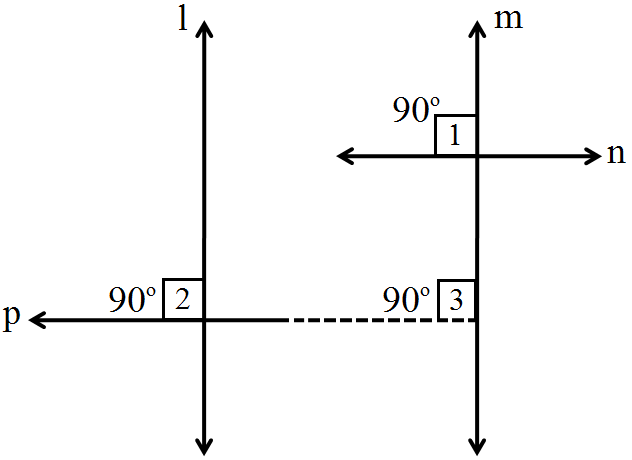
View full question & answer→ Two lines p and n are respectively perpendicular to two parallel line l and m, i.e., $\text{p}\perp\text{l}$ and $\text{n}\perp\text{m}$
We have to show that p is parallel to n.
As $\text{n}\perp\text{m},$ So $\angle1=90^\circ....(1)$
Again, $\text{p}\perp\text{l},$ So $\angle2=90^\circ.$
But, l is parallel to m, so
$\angle1=\angle3$ $[\text{corres}.\angle\text{s}]$
$\therefore\angle2=\angle90^\circ...(2)$ $[\because\angle2=90^\circ]$
From (1) and (2), we get
$\Rightarrow\angle1=\angle3$ $[\text{Each}=90^\circ]$
angles.
Hence, p||n.
But, these are corresponding.
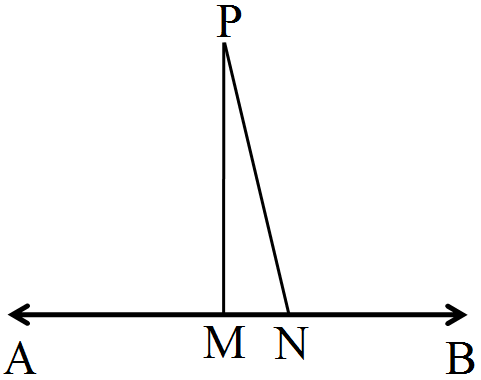 Hence, through a given point, we can draw only one perpendicular to a given line.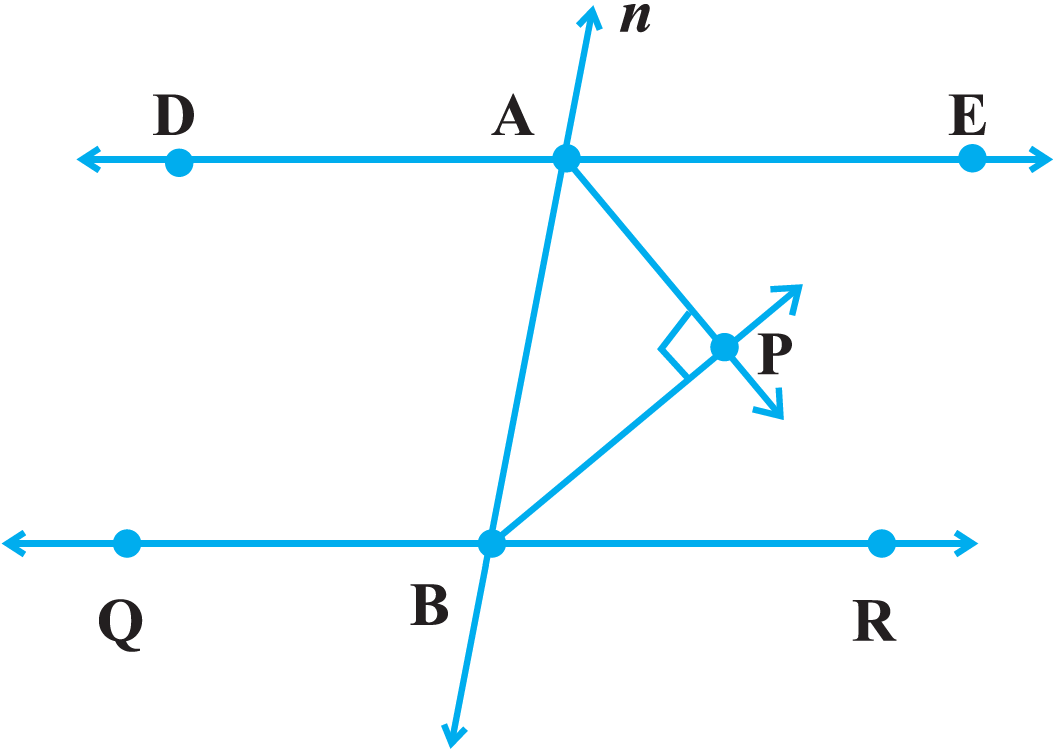
 So, alternate interior angles are equal.