Questions

2 Marks Questions

Take a timed test

11 questions · self-marked practice — reveal the answer and mark yourself.

Question 12 Marks
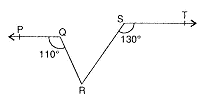
In figure, if $P Q \| S T, \angle P Q R=110^{\circ}$ and $\angle R S T=130^{\circ}$. Find $\angle Q R S$.
Answer
Draw a line $RU$ parallel to $ST$ through point $R.$
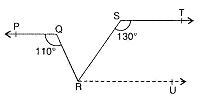
$\angle RST+\angle SRU=180^{\circ}$
$\therefore 130^{\circ}+\angle SRU=180^{\circ}$
$\therefore \angle SRU=180^{\circ}-130^{\circ}=50^{\circ} \ldots \text (1)$
$\angle QRU=\angle PQR=110^{\circ} \ldots$ [Alternate interior angles]
$\therefore \angle QRS+\angle SRU=110^{\circ}$
$\therefore \angle QRS+50^{\circ}=110^{\circ} \ldots[\text { Using (1)] }$
$\therefore \angle QRS=110^{\circ}-50^{\circ}=60^{\circ}$
View full question & answer
Question 22 Marks
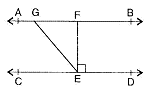
In figure, if $A B \| C D, E F \perp C D$ and $\angle G E D=126^{\circ}$. Find $\angle \mathrm{AGE}, \angle \mathrm{GEF}$ and $\angle \mathrm{FGE}$.
Answer
$\angle \mathrm{AGE}=\angle \mathrm{GED}=126^{\circ} \ldots[\text { [Alternate interior angles }]$
$\angle \mathrm{GED}=126^{\circ}$
$\therefore \angle \mathrm{GEF}+\angle \mathrm{FED}=126^{\circ}$
$\therefore \angle \mathrm{GEF}+90^{\circ}=126^{\circ} \ldots\left[\mathrm{As} \mathrm{EF} \perp \mathrm{CD} \therefore \angle \mathrm{FED}=90^{\circ}\right]$
$\therefore \angle \mathrm{GEF}=126^{\circ}-90^{\circ}=36^{\circ}$
$\angle \mathrm{GEC}+\angle \mathrm{GEF}+\angle \mathrm{FED}=180^{\circ}$
$\angle \mathrm{GEC}+36^{\circ}+90^{\circ}=180^{\circ}$
$\angle \mathrm{GEC}+126^{\circ}=180^{\circ}$
$\angle \mathrm{GEC}=180^{\circ}-126^{\circ}=54^{\circ}$
$\angle \mathrm{FGE}=\angle \mathrm{GEC}=54^{\circ} \ldots[\text { [Alternate interior angles }]$
View full question & answer
Question 32 Marks
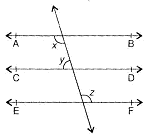
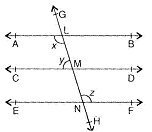
In figure, if $AB \| CD, CD \| EF$ and $y : z = 3 : 7$, find $x.$
Answer


As $AB || CD$ and $CD || EF$
$\therefore AB || EF$
$\therefore$ x = z . . . . [Alternate interior angles]$ . . . (1)$
$x + y = 180^o . . . (2)$
$z + y = 180^o . . .$ [From $(1)$ and $(2)]$
$y : z = 3 : 7$
Sum of the ratios $= 3 + 7 = 10$
$\therefore$ $y={3\over10}\times180^0=54^0\ and \ z={7\over10}\times180^0=126^0$
$\therefore x = z = 126^o$
View full question & answer
Question 42 Marks
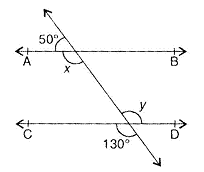
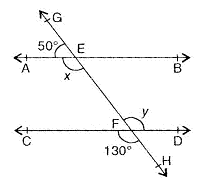
In figure, find the values of $x$ and $y$ and then show that $AB \| CD.$
Answer

$\angle A E G+\angle A E H=180^{\circ} \ldots[\text { Linear pair }]$
$\therefore 50^{\circ}+x=180^{\circ}$
$\therefore x=180^{\circ}-50^{\circ}=130^{\circ} \ldots(1)$
$y=130^{\circ} \ldots$ [Vertically opposite angles]$ ... (2)$
$x=y \ldots[$ From $(1)$ and $(2)]$
But $x$ and $y$ are alternate interior angles and they are equal.
$\therefore A B \| C D$
View full question & answer
Question 52 Marks
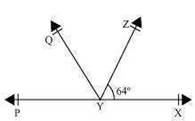
If the $\angle X Y Z=64^{\circ}$ and $X Y$ is produced to point $P$ . Draw a figure from the given information. If ray $YQ$ bisects $\angle Z Y P$, find $\angle$ $X Y Q$ and reflex $\angle QYP$.
Answer
We are given that $\angle X Y Z=64^{\circ}, X Y$ is produced to $P$ and $Y Q$ bisects $\angle Z Y P$ We can conclude the given below figure for the given situation:

We need to find $\angle X Y Q$ and reflex $\angle Q Y P$
From the given figure, we can conclude that $\angle X Y Z$ and $\angle Z Y P$ form a linear pair.
We know that sum of the angles of a linear pair is $180^{\circ}$.
$\angle X Y Z+\angle Z Y P=180^{\circ}$
$\text { But } \angle X Y Z=64^{\circ}$
$\Rightarrow 64^{\circ}+\angle Z Y P=180^{\circ}$
$\Rightarrow \angle Z Y P=116^{\circ}$
Ray YQ bisects $\angle Z Y P$, or
$\angle QYZ=\angle QYP=\frac{116^{\circ}}{2}=58^{\circ}$
$\angle XYQ=\angle QYZ+\angle XYZ$
$=58^{\circ}+64^0=122^{\circ} .$
$\text { Reflex } \angle QYP=360^{\circ}-\angle QYP$
$=360^{\circ}-58^{\circ}$
$=302^{\circ} .$
Therefore, we can conclude that $\angle X Y Q=122^{\circ}$ and Reflex $\angle Q Y P=302^{\circ}$
View full question & answer
Question 62 Marks
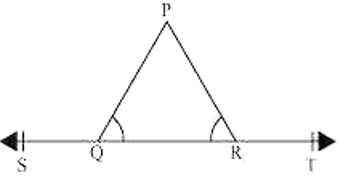
In the given figure, $\angle PQR =\angle PRQ$, then prove that $\angle PQS =\angle PRT$
Answer
We need to prove that $\angle PQS =\angle PRT$
We are given that $\angle PQR =\angle PRQ$
From the given figure, we can conclude that $\angle PQS$ and $\angle PQR$, and $\angle PRQ$ and $\angle PRT$ form a linear pair.
We know that sum of the angles of a linear pair is $180^{\circ}$
We know that sum of the angles of a linear pair is ${180^\circ }$
$\therefore \angle PQS + \angle PQR = {180^\circ },$ and $...(i)$
$\angle PRQ + \angle PRT = {180^\circ }....(ii)$
From equation $(i)$ and $(ii)$, we can conclude that
$\angle P Q S+\angle P Q R=\angle P R Q+\angle P R T$
$\text { But, } \angle PQR=\angle PRQ$
$\therefore \angle PQS=\angle PRT$
Hence, proved.
View full question & answer
Question 72 Marks
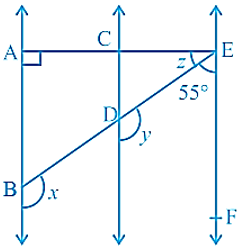
Fig., $A B \| C D$ and $C D \| E F$. Also, $E A \perp A B$. If $\angle B E F=55^{\circ}$, find the values of $x, y$, and $z$.
Answer
Since corresponding angles are equal.
$\therefore x=y \ldots \text { (i) }$
We know that the interior angles on the same side of the transversal are supplementary.
$\therefore y+55^{\circ}=180^{\circ}$
$\Rightarrow y=180^{\circ}-55^{\circ}=125^{\circ}$
$\text { So, } x=y=125^{\circ}$
Since $A B \| C D$ and $C D \| E F$.
$\therefore A B \| E F$
$\Rightarrow \angle E A B+\angle F E A=180^{\circ}[\because$ Interior angles on the same side of the transversal $EA$ are supplementary ]
$\Rightarrow 90^{\circ}+z+55^{\circ}=180^{\circ}$
$\Rightarrow z=35^{\circ}$
View full question & answer
Question 82 Marks
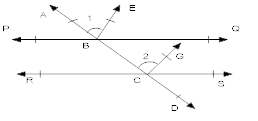
If a transversal intersects two lines such that the bisectors of a pair of corresponding angles are parallel, then prove that the two lines are parallel.
Answer
Given $AD$ is transversal intersect two lines $PQ$ and $RS$
To prove $PQ \parallel RS$
Proof: $BE$ bisects $ABQ$
$\angle 1=\angle A B E=\angle E B Q=\frac{1}{2} \angle A B Q ...(i)$
Similarity $CG$ bisects $\angle B C S$
$\therefore \angle 2=\frac{1}{2} \angle B C S ...(ii)$
But $B E \| C G$ and $A D$ is the transversal
$\therefore {\text{ }}\angle {\text{1 = }}\angle {\text{2}}$
$\therefore {\text{ }}\frac{1}{2}\angle ABQ = \frac{1}{2}\angle BCS$ [by $(i)$ and $(ii)]$
$\Rightarrow {\text{ }}\angle {\text{ABQ = }}\angle {\text{BCS}}$ [$\because$ corresponding angles are equal]
$\therefore PQ \parallel RS$
View full question & answer
Question 92 Marks
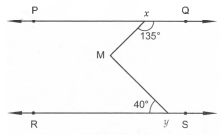
In Fig.,if $P Q \| R S, \angle M X Q=135^{\circ}$ and $\angle M Y R=40^{\circ}$, find $\angle X M Y$.
Answer
Through point $M$ draw a line $A B$ parallel to the line $P Q$ as shown in Fig. Thus, we have
$A B \| P Q$ and $P Q \| R S$
$\Rightarrow AB \| RS$
Now, $A B \| P Q$ and $\angle Q X M$ and $\angle X M B$ are interior angles on the same side of the transversal $X M$.
$\therefore \angle QXM+\angle XMB=180^{\circ}$
$\Rightarrow 135^{\circ}+\angle XMB=180^{\circ}$
$\Rightarrow \angle MMB=180^{\circ}-135^{\circ}=45^{\circ}$
Now, $AB \| RS$ and $\angle BMY$ and $\angle MYR$ are alternate angles.
$\therefore \angle BMY=\angle MYR$
$\Rightarrow \angle BMY=40^{\circ}$
Hence, $\angle XMY =\angle XMB +\angle BMY =45^{\circ}+40^{\circ}=85^{\circ}$
View full question & answer
Question 102 Marks
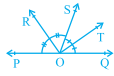
In figure ray $OS$ stands on a line $POQ$ , ray $OR$ and ray $OT$ are angle bisector of $\angle POS$ and $\angle SOQ$ respectively. If $\angle$ POS $=x$, find $\angle R O T$.
Answer
Ray $OS$ stands on the line $POQ$
$ \therefore {\text{ }}\angle {\text{POS + }}\angle {\text{SOQ = 18}}{{\text{0}}^0}$
But $\angle PQS = X$
$\therefore$ x + $\angle SOQ = 180^\circ $
$\angle SOQ = 180^\circ - x$
Now ray $OR$ bisects $\angle POS,$
Therefore $ \angle {\text{ROS = }}\frac{1}{2} \times \angle POS$
$ {\text{ = }}\frac{1}{2} \times x = \frac{x}{2}$
Similarly, $ \angle {\text{ SOT = }}\frac{1}{2} \times \angle SOQ$
$ {\text{ = }}\frac{1}{2} \times ({180^0} - x) = {90^ \circ } - \frac{x}{2}$
$ \angle ROT = \angle ROS + \angle SOT$
$ {\text{ = }}\frac{x}{2} + {90^ \circ } - \frac{x}{2} = {90^0}$
View full question & answer
Question 112 Marks
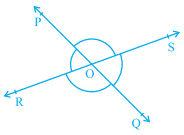
In figure lines, $PQ$ and $RS$ intersect with each other at point $O$. If$ \angle POR:\angle ROQ = 5:$7 Find all the angles.
Answer
$\angle POR + \angle ROQ = {180^0}$ [linear pair]
But,$ \angle {\text{POR: }}\angle ROQ$ = 5:7 [Given]
$\therefore {\text{ }}\angle {\text{ POR = }}\frac{5}{{12}} \times {\text{18}}{{\text{0}}^0}{\text{ = 7}}{{\text{5}}^0}{\text{ }}$
Similarly, $\angle {\text{ROQ = }}\frac{7}{{12}} \times {\text{18}}{{\text{0}}^0}{\text{ = 10}}{{\text{5}}^0}$
Now $\angle {\text{POS = }}\angle {\text{ROQ = 10}}{{\text{5}}^0}$ [vertically opposite angle]
And $\angle {\text{SOQ = }}\angle {\text{POR = 7}}{{\text{5}}^0}$ [vertically opposite angle]
View full question & answer
2 Marks Questions - Maths STD 9 Questions - Vidyadip