Prove that the line segment joining the mid-points of two sides of a triangle is parallel to the third side.
Answer
Given $\triangle A B C$ in which $E$ and $F$ are mid points of side $A B$ and $A C$ respectively. To prove: $EF \| BC$ Construction: Produce EF to D such that EF = FD. Join CD Proof: In $\triangle A E F$ and $\triangle C D F$ $AF = FC [\because F$ is mid - point of $A C]$ $\angle 1=\angle 2$ [vertically opposite angles] EF=FD [By construction] $\therefore \triangle A E F \cong \triangle C D F[B y S A S]$ And $\therefore A E=C D[B y C P C T]$ $AE = BE [\because E$ is the mid-point $]$ And $\therefore B E=c d$ $A B \| C D[\therefore \angle B A C=\angle A C D]$ $\therefore B C D E$ is a paralle $\log$ ram $E F \| B C$ Henceproved
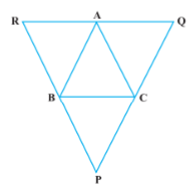
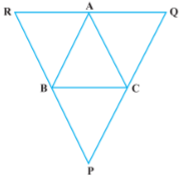
Through A, B and C, lines RQ, PR and QP have been drawn, respectively parallel to sides BC, CA and AB of a $\triangle ABC$ as shown in Fig., Show that $BC =\frac{1}{2} QR$
Answer
Given, $PQ \| AB , PR \| AC$ and $RQ \| BC$. In quadrilateral BCAR, $BR \| CA$ and $BC \| RA$ $\therefore$ BCAR is a parallelogram $\therefore B C=A R \ldots( i )$ Now, in quadrilateral BCQA,; $BC \| AQ$ and $AB \| QC$ $\therefore B C Q A$ is a parallelogram $\therefore B C=A Q \ldots$ (ii) Adding Eqn. (i) and (ii), we get 2BC = AR + AQ 2BC = RQ $BC =\frac{ QR }{2}$ Hence proved.
Write linear equation 3x + 2y =18 in the form of ax + by + c = 0. Also write the values of a, b and c. Are (4, 3) and (1, 2) solution of this equation?
Answer
We have the equation as 3x + 2y = 18 In standard form 3x + 2y - 18 = 0 or 3x + 2y + (-18) =0 But standard linear equation is ax + by + c = 0 on comparison we get, a = 3, b = 2, c = -18 If (4, 3) lie on the line, i.e., solution of the equation LHS=RHS $\therefore 3(4)+2(3)=18$ 12 + 6 = 18 18 = 18 As LHS = RHS, Hence (4, 3) is the solution of given equation. Again for (1,2) 3x + 2y = 18 $\therefore 3(1)+2(2)=18$ 3 + 4 = 18 7 = 18 LHS $\neq$ RHS Hence (1, 2) is not the solution of given equation. Therefore (4,3) is the point where the equation of the line 3x + 2y = 18 passes through where as the line for the equation 3x + 2y=18 does not pass through the point (1,2).
The triangular side walls of a flyover have been used for advertisements. The sides of the walls are $13 m, 14 m$ and $15 m$. The advertisements yield an earning of $Rs\ 2000$ per $m ^2$ a year. A company hired one of its walls for $6$ months. How much rent did it pay?
Answer
The sides of triangular side walls of flyover which have been used for advertisements are $13 m, 14 m, 15 m.$
$s=\frac{13+14+15}{2}=\frac{42}{2}=21 m$
$=\sqrt{21(21-13)(21-14)(21-15)}$
$=\sqrt{21 \times 8 \times 7 \times 6}$
$=\sqrt{7 \times 3 \times 2 \times 2 \times 2 \times 7 \times 3 \times 2}$
$=7 \times 3 \times 2 \times 2=84 m^2$
It is given that the advertisement yield an earning of $₹ 2,000$ per $m^2$ a year.
$\therefore$ Rent for $1 m^2$ for 1 year $= ₹\ 2000$
So, rent for $1 m^2$ for $6$ months or $\frac{1}{2}$ year $=R s\left(\frac{1}{2} \times 2000\right)= ₹\ 1,000 $.
$\therefore$ Rent for $84 m^2$ for $6$ months $=$ ₹ $(1000 \times 84)=$ ₹ $84,000$.
We know that $x^3+y^3+z^3-3 x y z=(x+y+z)\left(x^2+y^2+z^2-x y-y z-z x\right)$ $\left(\right.$ Using Identity $\left.a^3+b^3+c^3-3 a b c=(a+b+c)\left(a^2+b^2+c^2-a b-b c-c a\right)\right)$ $=(0)\left(x^2+y^2+z^2-x y-y z-z x\right)(\because x+y+z=0)$ $=0$ $\Rightarrow x^3+y^3+z^3=3 x y z$