Questions

5 Marks Questions

Take a timed test

6 questions · self-marked practice — reveal the answer and mark yourself.

Question 15 Marks
Using factor theorem, factorize the polynomial: $x^3-6 x^2+3 x+10$
Answer
Let, $f(x)=x^3-6 x^2+3 x+10$
The constant term in $f(x)$ is $10$
The factors of $10$ are $\pm 1, \pm 2, \pm 5, \pm 10$
Let, $x+1=0$
$\Rightarrow x=-1$
Substitute the value of $x$ in $f(x)$
$f(-1)=(-1)^3-6(-1)^2+3(-1)+10$
$=-1-6-3+10$
$=0$
Similarly, $(x – 2)$ and $(x – 5)$ are other factors of $f(x)$
Since, $f(x)$ is a polynomial having a degree $3,$ it cannot have more than three linear factors.
$\therefore f(x)=k(x+1)(x-2)(x-5)$
Substitute $x = 0$ on both sides
$\Rightarrow x ^3-6 x ^2+3 x +10= k ( x +1)( x -2)( x -5)$
$\Rightarrow 0-0+0+10= k (1)(-2)(-5)$
$\Rightarrow 10= k (10)$
$\Rightarrow k =1$
Substitute $k=1$ in $f(x)=k(x+1)(x-2)(x-5)$
$f(x)=(1)(x+1)(x-2)(x-5)$
so, $x^3-6 x^2+3 x+10=(x+1)(x-2)(x-5)$
This is the required factorisation of $f(x)$
View full question & answer
Question 25 Marks
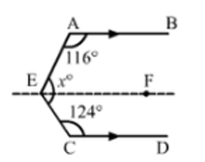
In each of the figures given below, $A B \| C D$. Find the value of $x^{\circ}$ in each other case.
Image
Answer

Image
Draw $EF \| AB \| CD$
Then, $\angle A E F+\angle C E F=x^{\circ}$
Now, $EF \| AB$ and $AE$ is the transversal
$\therefore \angle A E F+\angle B A E=180^{\circ}\ [$Consecutive Interior Angles$]$
$\Rightarrow \angle A E F+116=180$
$\Rightarrow \angle A E F=64^{\circ}$
Again, $EF \| CD$ and $CE$ is the transversal.
$\angle C E F+\angle E C D=180^{\circ} \ [$Consecutive Interior Angles$]$
$\Rightarrow \angle C E F+124=180$
$\Rightarrow \angle C E F=56^{\circ}$
Therefore,
$x^{\circ}=\angle A E F+\angle C E F$
$x ^{\circ}=(64+56)^{\circ}$
$x ^{\circ}=120^{\circ}$
View full question & answer
Question 35 Marks
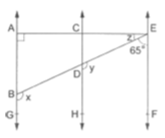
In the given figure, $AB \| CD \| EF , \angle D B G=x, \angle E D H=y, \angle A E B=z, \angle E A B=90^{\circ}$ and $\angle B E F=65^{\circ}$. Find the values of $x , y$ and $z$ .
Image
Answer
$EF \| CD$ and $ED$ is the transversal.
$\therefore \angle F E D+\angle E D H=180^{\circ} \ [$co $-$ interior angles$]$
$\Rightarrow 65^{\circ}+y=180^{\circ}$
$\Rightarrow y=\left(180^{\circ}-65^{\circ}\right)=115^{\circ}$
Now $CH \| AG$ and $DB$ is the transversal
$\therefore x = y =115^{\circ}\ [$corresponding angles$]$
$\therefore \angle A B E+\angle E B G=180^{\circ} \ [$sum of linear pair of angles is $180^{\circ}]$
$\Rightarrow \angle A B E+x=180^{\circ}$
$\Rightarrow \angle A B E+115^{\circ}=180^{\circ}$
$\Rightarrow \angle A B E=\left(180^{\circ}-115^{\circ}\right)=65^{\circ}$
We know that the sum of the angles of a triangle is $180^{\circ}$.
From $\triangle E A B$, we get
$\angle E A B+\angle A B E+\angle B E A=180^{\circ}$
$\Rightarrow 90^{\circ}+65^{\circ}+ z =180^{\circ}$
$\Rightarrow z =\left(180^{\circ}-155^{\circ}\right)=25^{\circ}$
$\therefore x =115^{\circ}, y =115^{\circ} $ and  $z =25^{\circ}$
View full question & answer
Question 45 Marks
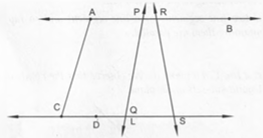
In Fig, name the following:  
Image
i. Five line segments
ii. Five rays
iii. Four collinear points
iv. Two pairs of non-intersecting line segments
Answer
i. Five line segments are: $\overline{ PQ }, \overline{ PN }, \overline{ RS }, \overline{ ND }, \overline{ TL }$
ii. Five rays are: $\overrightarrow{Q C}$,$\overrightarrow{P M}, \overrightarrow{R B}$,$\overrightarrow{D F}, \overrightarrow{L H}$
iii. Four Collinear points are: A, P, R, B
iv. Two pairs of non-intersecting line segments are: PN, RS and PQ, TL
View full question & answer
Question 55 Marks
If $x=2-\sqrt{3}$, find the value of $\left(x-\frac{1}{x}\right)^3$.
Answer
Here $x=2-\sqrt{3}$
$\therefore \frac{1}{x}=\frac{1}{2-\sqrt{3}} \times \frac{2+\sqrt{3}}{2+\sqrt{3}^3}=\frac{2+\sqrt{3}}{2^2-\sqrt{3}^2}=\frac{2+\sqrt{3}}{4-3}=2+\sqrt{3}$
$\Rightarrow x-\frac{1}{x}$
$=(2-\sqrt{3})-(2+\sqrt{3})$
$=2-\sqrt{3}-2-\sqrt{3}$
$=-2 \sqrt{3}$
Hence, $\left(x-\frac{1}{x}\right)^3=(-2 \sqrt{3})^3=-24 \sqrt{3}$
View full question & answer
Question 65 Marks
If $x$ is a positive real number and exponents are rational numbers, simplify
$\left(\frac{x^b}{x^c}\right)^{b+c-a} \cdot\left(\frac{x^c}{x^a}\right)^{c+a-b} \cdot\left(\frac{x^a}{x^b}\right)^{a+b-c}$
Answer
Given.
$\left(\frac{x^b}{x^c}\right)^{b+c-a} \cdot\left(\frac{x^c}{x^c}\right)^{c+a-b} \cdot\left(\frac{x^a}{x^b}\right)^{a+b-c}$
$=\left(\frac{x^{b^2+b c-a b}}{x^{b c+c^2-a c}}\right) \cdot\left(\frac{x^{c^2+a c-c c}}{x^{a c+a^2-a b}}\right) \cdot\left(\frac{x^{a^2+a b-a c}}{x^{a b+b^2-a c}}\right)$
$=\left(x^{b^2+b c-a b-b c-c^2+a c}\right)\left(x^{c^2+a c-b c-a c-a^2+a b}\right)\left(x^{a^2+a b-a c-a b-b^2+b c}\right)$
$=\left(x^{b^2-a b-c^2+a c}\right)\left(x^{c^2-b c-a^2+a b}\right)\left(x^{a^2-a c-b^2+b c}\right)$
$=x^{b^2-a b-c^2+a c+c^2-b c-a^2+a b+a^2-a c-b^2+b c}$
$=x^0$
$=1$
View full question & answer
5 Marks Questions - Maths STD 9 Questions - Vidyadip