Questions

M.C.Q

Take a timed test

18 questions · auto-graded multiple-choice test.

MCQ 11 Mark
The number of spherical bullets each $5\ dm$ in diameter which can be cast from a rectangular block of lead $11 m$ long, $10 m$ broad and $5$ high is
  • $8400$
  • B
    $5600$
  • C
    $6300$
  • D
    $4200$
Answer
Correct option: A.
$8400$
Here, radius of spherical bullets $=2.5\  dm$ or $0.25 m(1 dm =0.1 m)$
Let the number of bullets be $n$
Now, volume of $n$ number of bullets $=$ volume of rectangular block
$ n \times \frac{4}{3} \pi r ^3= l \times b \times h$
$n \times \frac{4}{3} \times \frac{22}{7} \times 0.25 \times 0.25 \times 0.25=11 \times 10 \times 5$
$n =\frac{11 \times 10 \times 5 \times 21}{88 \times 0.25 \times 0.25 \times 0.25}$
$n =8400$
View full question & answer
MCQ 21 Mark
To draw a histogram to represent the following frequency distribution :
Class interval5-1010-1515-2525-4545-75
Frequency61210815
The adjusted frequency for the class 25-45 is
  • A
    6
  • B
    5
  • 2
  • D
    3
Answer
Correct option: C.
2
(c) 2
Explanation: Adjusted frequency $=\left(\frac{\text { frequency of the class }}{\text { width of the class }}\right) \times 5$
Therefore, Adjusted frequency of $25-45=\frac{8}{20} \times 5=2$
View full question & answer
MCQ 31 Mark
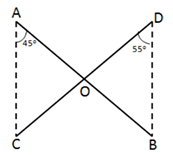
Line sgements $AB$ and $CD$ intersect at $O$ such that $AC \| DB$. If $\angle CAB =45^{\circ}$ and $\angle CDB =55^{\circ}$, then $\angle BOD =$
  • A
    $135^{\circ}$
  • $80^{\circ}$
  • C
    $100^{\circ}$
  • D
    $90^{\circ}$
Answer
Correct option: B.
$80^{\circ}$
Image
$AC\|BD$
And, $AB$ is transverse to these parallel lines
$\text { So } \angle CAB =\angle ABD \text   ($Alternate angles$)$
$\Rightarrow \angle ABD =45^{\circ}$
Now In $\triangle BOD$
$\angle BOD +\angle ODB +\angle DBA =180^{\circ}$
$\angle DBA =\angle ABD =45^{\circ}, \angle ODB =55^{\circ}$
$\text { So } \angle B O D=180^{\circ}-45^{\circ}-55^{\circ}$
$=80^{\circ}$
View full question & answer
MCQ 41 Mark
If a linear equation has solutions $(1, 2), (-1, -16)$ and $(0, -7)$, then it is of the form
  • $y=9 x-7$
  • B
    $9 x-y+7=0$
  • C
    $x-9 y=7$
  • D
    $x=9 y-7$
Answer
Correct option: A.
$y=9 x-7$
(a) $y=9 x-7$
Explanation:Since all the given co- ordinate $(1,2),(-1,-16)$ and $(0,-7)$ satisfy the given line $y=9 x-7$
For point (1, 2)
y = 9x - 7
2 = 9(1) - 7
2 = 9 - 7
2 = 2
Hence (2, 1) is a solution.
For point (-1, -16)
y = 9x - 7
-16 = 9(-1) - 7
-16 = -9 - 7
-16 = -16
Hence (-1, -16) is a solution.
For point (0,-7)
y = 9x - 7
-7 = 9(0) -7
-7 = -7
Hence (0, -7) is a solution.
View full question & answer
MCQ 51 Mark
The simplest rationalising factor of $\sqrt[3]{500}$, is
  • A
    $\sqrt{3}$
  • $\sqrt[3]{2}$
  • C
    $2 \sqrt{3}$
  • D
    $\sqrt[3]{5}$
Answer
Correct option: B.
$\sqrt[3]{2}$
$\sqrt[3]{500}$
$=\sqrt[3]{5 \times 2 \times 5 \times 2 \times 5}$
$=\sqrt[3]{5 \times 5 \times 5 \times 2 \times 2}$
$=5 \sqrt[3]{2 \times 2}$
$=5 \sqrt[3]{4}$
The simplest rationalising factor of $\sqrt[3]{500}$, is $\sqrt[3]{2}$
View full question & answer
MCQ 61 Mark
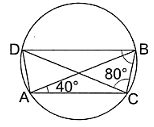
In the given figure, $A B$ and $C D$ are two intersecting chords of a circle. If $\angle C A B=40^{\circ}$ and $\angle B C D=80^{\circ}$, then $\angle C B D=?$
Image
  • $60^{\circ}$
  • B
    $50^{\circ}$
  • C
    $70^{\circ}$
  • D
    $80^{\circ}$
Answer
Correct option: A.
$60^{\circ}$
(a) $60^{\circ}$
Explanation:We have:
$\angle CDB =\angle CAB =40^{\circ}$ (Angles in the same segment of a circle)
In $\triangle CBD$, we have:
$\angle CDB +\angle BCD +\angle CBD =180^{\circ}$ (Angle sum property of a triangle $)$
$\Rightarrow 40^{\circ}+80^{\circ}+\angle CBD =180^{\circ}$
$\Rightarrow \angle CBD =\left(180^{\circ}-120^{\circ}\right)=60^{\circ}$
$\Rightarrow \angle C B D=60^{\circ}$
View full question & answer
MCQ 71 Mark
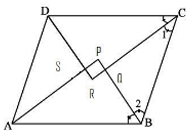
If bisector of $\angle A$ and $\angle B$ of a quadrilateral $\text{ABCD}$ intersect each other at $p , \angle B$ and $\angle C$ at $Q , \angle C$ and $\angle D$ at R and, $\angle D$ and $\angle A$ at S then $\text{PQRS}$ is a
  • Rectangle
  • B
    Parallelogram
  • C
    Rhombus
  • D
    Quadrilateral whose opposite angles are supplementary
Answer
Correct option: A.
Rectangle
Let's assume our quadrilateral $\text{ABCD}$ as a parallelogram :
Image
we know
$\angle DCB +\angle ABC =180^{\circ} \ ($Co $-$ interior angles of parallelogram are supplementary$)$
$\Rightarrow \frac{1}{2} \angle DCB +\frac{1}{2} \angle ABC =90^{\circ}  \ ($ Both sides divide by $2 )$
$\Rightarrow \angle 1+\angle 2=90^{\circ}.........(1)$
In, $\triangle CQB$ we know
$\Rightarrow \angle 1+\angle 2+\angle CQB =180^{\circ} \ldots(2)$
From eq $(1)$ and eq $(2),$ We get
$\Rightarrow \angle CQB =180^{\circ}-90^{\circ}$
$\Rightarrow \angle CQB =90^{\circ}$
$\Rightarrow \angle PQR =90^{\circ} (\because \angle CQB =\angle PQR ,$ vertically opposite angles $)$
Similarly, it can be shown
$\angle QPS =\angle PSR =\angle SRQ =90^{\circ}$
So, quadrilateral $\text{PQRS}$ is a rectangle.
View full question & answer
MCQ 81 Mark
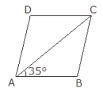
$\text{ABCD}$ is a parallelogram in which diagonal $AC$ bisects $\angle BAD$. If $\angle BAC =35^{\circ}$, then $\angle ABC =$
  • A
    $70^{\circ}$
  • B
    $120^{\circ}$
  • $110^{\circ}$
  • D
    $90^{\circ}$
Answer
Correct option: C.
$110^{\circ}$
Given,
$\text{ABCD}$ is a parallelogram
Diagonal $\text{AC}$ bisects $\angle BAD$
Image
$\angle B A C=35^{\circ}$
$\because \angle A +\angle B =180^{\circ} \ldots (i) [$ angle sum property of quadrilateral$]$
$\angle A =2 \angle BAC =2 \times 35^{\circ}=70^{\circ}$
Putting value of $\angle A$ in equation $(i)$
$70^{\circ}+\angle B=180^{\circ}$
$\angle B=180^{\circ}-70^{\circ}=110^{\circ}$
$\angle A B C=110^{\circ}$
View full question & answer
MCQ 91 Mark
Any solution of the linear equation $2x + 0y + 9 = 0$ in two variables is of the form
  • $\left(-\frac{9}{2}, m\right)$
  • B
    $(-9,0)$
  • C
    $\left(0,-\frac{9}{2}\right)$
  • D
    $\left(n,-\frac{9}{2}\right)$
Answer
Correct option: A.
$\left(-\frac{9}{2}, m\right)$
(a) $\left(-\frac{9}{2}, m\right)$
Explanation: $2 x +9=0$
$\Rightarrow x=\frac{-9}{2}$ and $y = m$, where m is any real number
Hence, $\left(-\frac{9}{2}, m\right)$ is the solution of the given equation.
View full question & answer
MCQ 101 Mark
$\left(x^2-4 x-21\right)=?$
  • $(x - 7) (x + 3)$
  • B
    $( x - 7) ( x - 3)$
  • C
    $(x + 7) (x + 3)$
  • D
    $(x + 7) (x - 3)$
Answer
Correct option: A.
$(x - 7) (x + 3)$
$\left(x^2-4 x-21\right)=x^2-7 x+3 x-21$
$=x(x-7)+3(x-7)$
$=(x-7)(x+3)$
View full question & answer
MCQ 111 Mark
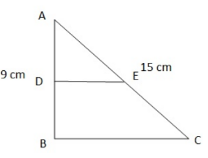
In Triangle ABC which is right angled at B. Given that AB = 9cm, AC = 15cm and D, E are the mid-points of the sides AB and AC respectively. Find the length of BC?
  • A
    13cm
  • B
    $13.5cm$
  • 12cm
  • D
    15cm
Answer
Correct option: C.
12cm
(c) 12 cm
Explanation:
Image
Applying pythagoras theorem in $\triangle ABC$
$AC ^2= AB ^2+ BC ^2$
$15^2=9^2+B C^2$
$225=81+ BC ^2$
$225-81= BC ^2$
$B C^2=144$
$BC =12$
View full question & answer
MCQ 121 Mark
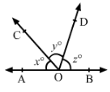
In the adjoining figure, $A O B$ is a straight line. If $x: y: z=4: 5: 6$, then $y= ?$
Image
  • A
    $72^{\circ}$
  • B
    $48^{\circ}$
  • $60^{\circ}$
  • D
    $80^{\circ}$
Answer
Correct option: C.
$60^{\circ}$
Image
Let
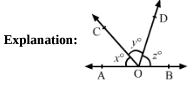
$\angle A O C=x^{\circ}=(4 a)^{\circ}, \angle C O D=y^{\circ}=(5 a)^{\circ}$ and $\angle B O D=z^{\circ}=(6 a)^{\circ}$
Then, we have
$\angle A O C+\angle C O D+\angle B O D=180^{\circ} [$Since $AOB$ is a straight line$]$
$\Rightarrow 4 a +5 a +6 a =180^{\circ}$
$\Rightarrow 15 a =180^{\circ}$
$\Rightarrow a =12^{\circ}$
$\therefore y=5 \times a=5 \times 12^{\circ}$
$=60^{\circ}$
View full question & answer
MCQ 131 Mark
The basic facts which are taken for granted, without proof, are called
  • A
    theorems
  • axioms
  • C
    propositions
  • D
    lemmas
Answer
Correct option: B.
axioms
(b) axioms
Explanation: An axiom is a proposition regarded as self-evidently true without proof
View full question & answer
MCQ 141 Mark
The equation $x - 2 = 0$ on number line is represented by
  • A
    infinitely many lines
  • B
    two lines
  • a point
  • D
    a line
Answer
Correct option: C.
a point
(c) a point
Explanation:$x -2=0$
$x =2$ is a point on the number line
View full question & answer
MCQ 151 Mark
A histogram is a pictorial representation of the grouped data in which class intervals and frequency are respectively taken along
  • A
    horizontal axis only
  • horizontal axis and vertical axis
  • C
    vertical axis and horizontal axis
  • D
    vertical axis only
Answer
Correct option: B.
horizontal axis and vertical axis
(b) horizontal axis and vertical axis
Explanation:In a histogram the class limits are marked on the horizontal axis and the frequency is marked on the vertical axis. Thus, a rectangle is constructed on each class interval.
View full question & answer
MCQ 161 Mark
In which quadrant does the point $(-7, -4)$ lie?
  • A
    IV
  • B
    I
  • C
    II
  • III
Answer
Correct option: D.
III
(d) III
Explanation: Recall that (+ ,+ ) lies in I quadrant, (- ,+) lies in II quadrant, (-, -) lies in III quadrant, (+,-) lies in IV quadrant. Since, both the coordinates of given point are negative, it lies in Quadrant III.
View full question & answer
MCQ 171 Mark
If the line represented by the equation $3 x+k y=9$ passes through the points $(2,3),$ then the value of $k$ is
  • A
    $2$
  • $1$
  • C
    $3$
  • D
    $4$
Answer
Correct option: B.
$1$
If the line represented by the equation $3 x+k y=9$ passes through the points $(2,3)$ then $(2,3)$ will satisy the equation $3 x+k y=9$
$3(2)+3 k=9$
$\Rightarrow 6+3 k=9$
$\Rightarrow 3 k=9-6$
$\Rightarrow 3 k=3$
$\Rightarrow k=1$
View full question & answer
MCQ 181 Mark
$(125)^{-1 / 3}=?$
  • A
    $-\frac{1}{5}$
  • B
    $-5$
  • $\frac{1}{5}$
  • D
    $5$
Answer
Correct option: C.
$\frac{1}{5}$
$(125)^{-1 / 3}$
$=\left(5^3\right)^{-1 / 3}$
$=5^{-1}$
$\frac{1}{5}$
View full question & answer
M.C.Q - Maths STD 9 Questions - Vidyadip