Questions

3 Marks Question

Take a timed test

7 questions · self-marked practice — reveal the answer and mark yourself.

Question 13 Marks
If both $( x -2)$ and $\left(x-\frac{1}{2}\right)$ are factors of $p x^2+5 x+r$, Show that $p = r$.
Answer
Suppose, $p(x)=p x^2+5 x+r$
As $(x-2)$ is a factor of $p(x)$
$\therefore p(2)=0$
$\Rightarrow p(2)^2+5(2)+r=0$
$\Rightarrow 4 p+10+r=0 \ldots(1)$
Again, $\left(x-\frac{1}{2}\right)$ is factor of $p(x)$.
$\therefore p\left(\frac{1}{2}\right)=0$
Now, $p\left(\frac{1}{2}\right)=p\left(\frac{1}{2}\right)^2+5\left(\frac{1}{2}\right)+r$
$=\frac{1}{4} p+\frac{5}{2}+r$
$\therefore p\left(\frac{1}{2}\right)=0$
$\Rightarrow \frac{1}{4} p+\frac{5}{2}+r=0 \ldots(2)$
From equation $(1),$ we have $4 p+r=-10$
From equation $(2),$ we have $p+10+4 r=0$
$\Rightarrow p+4 r=-10$
$\therefore 4 p+r=p+4 r[\because \text { Each }=-10]$
$\therefore 3 p=3 r$
$\Rightarrow p=r$
Hence, proved.
View full question & answer
Question 23 Marks
Answer
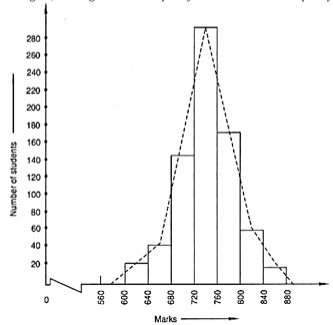
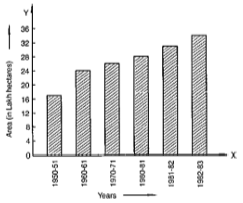
i. It gives the information about the areas (in lakh hectors) under sugarcane crop during different years in India.
ii. The areas under the sugarcane crops were the maximum and minimum in 1982-83 and 1950-51 respectively.
iii. The area under sugarcane crop in the year 1982-83= 34 lakh hectares.
The area under sugarcane crop in the year 1950-51= 17 lakh hectares.
Clearly, the area under sugarcane crop in the year 1982-83 is not 3 times that of the year 1950-51 So, the given statement is false.
View full question & answer
Question 33 Marks
View full question & answer
Question 43 Marks
Find the solution of the linear equation $x + 2y = 8$ which represents a point on
$i.$ The $x-$axis
$ii.$ The $y-$axis
Answer
$i.$ On $x-$axis $y = 0$
$\Rightarrow x+2 \times 0=8$
$\Rightarrow x=8$
Therefore, the required point is $(8, 0).$
$ii.$ On $y-$axis $x = 0$
$\Rightarrow 0+2 y=8$
$\Rightarrow y=\frac{8}{2}$
$\Rightarrow y=4$
Thus, the required point is $(0, 4).$
View full question & answer
Question 53 Marks
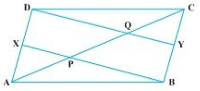
In Fig. X and Y are respectively the mid-points of the opposite sides AD and BC of a parallelogram ABCD. Also, BX and DY intersect AC at P and Q, respectively. Show that AP = PQ = QC.
Image
Answer
$AD = BC$ (Opposite sides of a parallelogram)
Therefore, $DX = BY \left(\frac{1}{2} AD =\frac{1}{2} B C\right)$
Also, $DX \| BY ( As AD \| BC )$
So, XBYD is a parallelogram (A pair of opposite sides equal and parallel) i.e., PX || QD
Therefore, $A P=P Q$ (From $\triangle A Q D$ where $X$ is mid-point of $A D\ldots(1)$ 
Similarly, from $\triangle C P B, C Q=P Q\ldots(2)$
Thus, AP = PQ = CQ [From (1) and (2)]
View full question & answer
Question 63 Marks
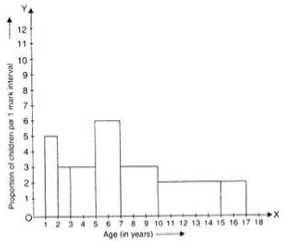
A random survey of the number of children of various age groups playing in a park was found as follows :
Age (in years)Number of children
1-25
2-33
3-56
5-712
7-109
10-1510
15-174
Draw a histogram to represent the data above.
View full question & answer
Question 73 Marks
Locate $\sqrt{10}$ on the number line.
Answer
We can write $10$ as
$10=9+1=3^2+1^2$
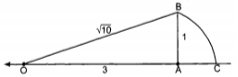
Draw $OA =3$ units, on the number line
Draw $BA =1$ unit, perpendicular to $OA .$
Join $OB$
Figure:
Image

Now, by Pythagoras theorem,
$\ce{OB^2=AB^2 + OA^2}$
$OB^2=1^2+3^2=10$
$\Rightarrow OB=\sqrt{10}$
Taking $O$ as centre and $OB$ as a radius, draw an arc which intersects the number line at point $C.$
Clearly, $OC$ corresponds to $\sqrt{10}$ on the number line.
View full question & answer
3 Marks Question - Maths STD 9 Questions - Vidyadip