Question 14 Marks
Read the following text carefully and answer the questions that follow:
Rohan draws a circle of radius $10 \ cm$ with the help of a compass and scale. He also draws two chords, $AB$ and $CD$ in such a way that the perpendicular distance from the center to $AB$ and $CD$ are $6 \ cm$ and $8 \ cm$ respectively. Now, he has some doubts that are given below.
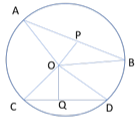
$i.$ Show that the perpendicular drawn from the Centre of a circle to a chord bisects the chord.
$ii.$ What is the length of $CD?$
$iii.$ What is the length of $AB?$
OR
How many circles can be drawn from given three noncollinear points?
Rohan draws a circle of radius $10 \ cm$ with the help of a compass and scale. He also draws two chords, $AB$ and $CD$ in such a way that the perpendicular distance from the center to $AB$ and $CD$ are $6 \ cm$ and $8 \ cm$ respectively. Now, he has some doubts that are given below.
$i.$ Show that the perpendicular drawn from the Centre of a circle to a chord bisects the chord.
$ii.$ What is the length of $CD?$
$iii.$ What is the length of $AB?$
OR
How many circles can be drawn from given three noncollinear points?
Answer
View full question & answer→$i.$ In $\ce{\Delta AOP}$ and $\ce{\Delta BOP}$
$\ce{\angle APO =\angle BPO}($ Given $)$
$\text{OP = OP} ($Common $)$
$\ce{AO = OB} ($ radius of circle $)$
$\ce{\Delta AOP \cong \Delta BOP}$
$\ce{AP = BP (CPCT)}$
$ii.$ In right $\ce{\Delta COQ}$
$\ce{CO^2=OQ^2 + C Q^2}$
$\Rightarrow 10^2=8^2+CQ^2$
$\Rightarrow CQ^2=100-64=36$
$\Rightarrow CQ=6$
$\ce{CD=2CQ}$
$\Rightarrow CD=12 \ cm$
$iii.$ In right $\Delta A O B$
$\ce{AO^2 = OP^2 + AP^2}$
$\Rightarrow 10^2=6^2+A P^2$
$\Rightarrow AP^2=100-36=64$
$\Rightarrow AP =8$
$\ce{AB =2 AP}$
$\Rightarrow AB =16 \ cm$
OR
There is one and only one circle passing through three given non$-$collinear points.
$\ce{\angle APO =\angle BPO}($ Given $)$
$\text{OP = OP} ($Common $)$
$\ce{AO = OB} ($ radius of circle $)$
$\ce{\Delta AOP \cong \Delta BOP}$
$\ce{AP = BP (CPCT)}$
$ii.$ In right $\ce{\Delta COQ}$
$\ce{CO^2=OQ^2 + C Q^2}$
$\Rightarrow 10^2=8^2+CQ^2$
$\Rightarrow CQ^2=100-64=36$
$\Rightarrow CQ=6$
$\ce{CD=2CQ}$
$\Rightarrow CD=12 \ cm$
$iii.$ In right $\Delta A O B$
$\ce{AO^2 = OP^2 + AP^2}$
$\Rightarrow 10^2=6^2+A P^2$
$\Rightarrow AP^2=100-36=64$
$\Rightarrow AP =8$
$\ce{AB =2 AP}$
$\Rightarrow AB =16 \ cm$
OR
There is one and only one circle passing through three given non$-$collinear points.