Question 14 Marks
Read the following text carefully and answer the questions that follow:
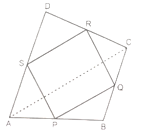
Modern curricula include several problem$-$solving strategies. Teachers model the process, and students work independently to copy it. Sheela Maths teacher of class $9^{th}$ wants to explain the properties of parallelograms in a creative way, so she gave students colored paper in the shape of a quadrilateral and then ask the students to make a parallelogram from it by using paper folding.
$i.$ How can a parallelogram be formed by using paper folding?
$ii.$ If $\angle RSP =30^{\circ}$, then find $\angle RQP$.
$iii.$ If $\angle RSP =50^{\circ}$, then find $\angle SPQ$ ?
OR
If $SP =3 cm$, Find the $RQ.$
Modern curricula include several problem$-$solving strategies. Teachers model the process, and students work independently to copy it. Sheela Maths teacher of class $9^{th}$ wants to explain the properties of parallelograms in a creative way, so she gave students colored paper in the shape of a quadrilateral and then ask the students to make a parallelogram from it by using paper folding.
$i.$ How can a parallelogram be formed by using paper folding?
$ii.$ If $\angle RSP =30^{\circ}$, then find $\angle RQP$.
$iii.$ If $\angle RSP =50^{\circ}$, then find $\angle SPQ$ ?
OR
If $SP =3 cm$, Find the $RQ.$
Answer
View full question & answer→$i.$ By joining mid points of sides of a quadrilateral one can make parallelogram.
$S$ and $R$ are mid points of sides $A D$ and $C D$ of $\Delta A D C, P$ and $Q$ are mid points of sides $A B$ and $B C$ of $\Delta A B C$, then by mid point theorem $SR \| AC$ and $SR =\frac{1}{2} AC$ similarly $PQ \| AC$ and $PQ =\frac{1}{2} AC$.
Therefore $S R \| P Q$ and $S R=P Q$
A quadrilateral is a parallelogram if a pair of opposite sides is equal and parallel.
Hence $PQRS$ is parallelogram.
$ii. \ \angle RQP .=30^{\circ}$, Opposite angles of a parallelogram are equal.
$iii.$ Adjacent angles of a parallelogram are supplementary.
Thus, $\angle RSP +\angle SPQ =180^{\circ}$
$50^{\circ}+\angle SPQ =180^{\circ}$
$\angle SPQ =180^{\circ}-50^{\circ}$
$=130^{\circ}$
OR
$RQ = 3 \ cm$
Opposite side of a parallelogram are equal.
$S$ and $R$ are mid points of sides $A D$ and $C D$ of $\Delta A D C, P$ and $Q$ are mid points of sides $A B$ and $B C$ of $\Delta A B C$, then by mid point theorem $SR \| AC$ and $SR =\frac{1}{2} AC$ similarly $PQ \| AC$ and $PQ =\frac{1}{2} AC$.
Therefore $S R \| P Q$ and $S R=P Q$
A quadrilateral is a parallelogram if a pair of opposite sides is equal and parallel.
Hence $PQRS$ is parallelogram.
$ii. \ \angle RQP .=30^{\circ}$, Opposite angles of a parallelogram are equal.
$iii.$ Adjacent angles of a parallelogram are supplementary.
Thus, $\angle RSP +\angle SPQ =180^{\circ}$
$50^{\circ}+\angle SPQ =180^{\circ}$
$\angle SPQ =180^{\circ}-50^{\circ}$
$=130^{\circ}$
OR
$RQ = 3 \ cm$
Opposite side of a parallelogram are equal.