Questions

3 Marks Question

🎯

Test yourself on this topic

8 questions · timed · auto-graded

Question 13 Marks
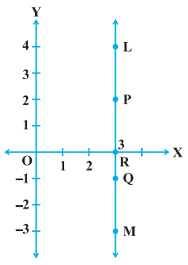
In Figure, LM is a line parallel to the y-axis at a distance of 3 units. 
Image

i. What are the coordinates of the points P, R and Q?
ii. What is the difference between the abscissa of the points L and M?
Answer
Given LM is a line parallel to the Y-axis and its perpendicular distance from Y-axis is 3 units.
i. Coordinate of point P = (3, 2)
Coordinate of point Q = (3,-1)
Coordinate of point R = (3, 0) [since its lies on X-axis, so its y coordinate is zero].
ii. Abscissa of point L = 3, abscissa of point M=3
$\therefore $ Difference between the abscissa of the points L and M = 3 – 3 = 0
View full question & answer
Question 23 Marks
View full question & answer
Question 33 Marks
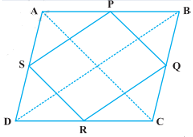
Show that the quadrilateral formed by joining the mid-points the sides of a rhombus, taken in order, form a rectangle.
View full question & answer
Question 43 Marks
Find solutions of the form $x = a, y = 0$ and $x = 0, y = b$ for the following pairs of equations. Do they have any common such solution$?\ 3x + 2y = 6$ and $5x + 2y = 10$
Answer
$3x + 2y = 6$
Put $y = 0,$ we get
$3x + 2(0) = 6$
$\Rightarrow 3 x =6$
$\Rightarrow x=\frac{6}{3}=2$
$\therefore(2,0)$ is a solution.
$3x + 2y = 6$
put $x = 0,$ we get
$3(0) + 2y = 6$
$\Rightarrow 2 y =6$
$\Rightarrow y=\frac{6}{2}=3$
$\therefore(0,3)$ is a solution.
$5 x+2 y=10$
Put $y=0$, we get
$5 x+2(0)=10$
$\Rightarrow 5 x =10$
$\Rightarrow x=\frac{10}{5}=2$
$\therefore(2,0)$ is a solution.
$5 x +2 y =10$
Put $x=0$, we get
$5(0)+2 y=10$
$\Rightarrow 2 y =10$
$\Rightarrow y=\frac{10}{2}=5$
$\therefore(0,5)$ is a solution.
The given equations have a common solution $(2,0)$.
View full question & answer
Question 53 Marks
The triangular side walls of a flyover have been used for advertisements. The sides of the walls are $13\  m, 14\  m$ and $15\  m$. The advertisements yield an earning of $Rs.2000$ per $m^2$ a year. A company hired one of its walls for $6$ months. How much rent did it pay?
Answer
The sides of triangular side walls of flyover which have been used for advertisements are $13\  m, 14\  m, 15\  m$.
$s=\frac{13+14+15}{2}=\frac{42}{2}=21 m$
$=\sqrt{21(21-13)(21-14)(21-15)}$
$=\sqrt{21 \times 8 \times 7 \times 6}$
$=\sqrt{7 \times 3 \times 2 \times 2 \times 2 \times 7 \times 3 \times 2}$
$=7 \times 3 \times 2 \times 2=84 m^2$
It is given that the advertisement yield an earning of $Rs. 2,000$ per $m ^2$ a year.
$\therefore$ Rent for $1 m^2$ for $1$ year $= Rs. 2000$
So, rent for $1 m^2$ for $6$ months or $\frac{1}{2}$ year $= Rs\left(\frac{1}{2} \times 2000\right)= Rs. 1,000 $.
$\therefore$ Rent for $84 m^2$ for $6$ months $= Rs. (1000 \times 84)= Rs. 84,000$.
View full question & answer
Question 63 Marks
From a point in the interior of an equilateral triangle, perpendiculars are drawn on the three sides. The lengths of the perpendiculars are $14 \ cm, 10 \ cm$ and $6 \ cm.$ Find the area of the triangle.
Answer
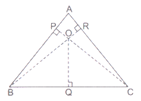
Let $\text{ABC}$ be an equilateral triangle, $O$ be the interior point and $\text{OQ, OR}$ and $\text{OC}$ are the perpendicular drawn from points $O.$ Let the sides of an equilateral triangle be a $m.$
Image
Area of $\Delta A O B=\frac{1}{2} \times A B \times O P$
$\left[\because\right.$ Area of a triangle $=\frac{1}{2} \times($ base $\times$ height $\left.)\right]$
$=\frac{1}{2} \times a \times 14=7 a \ cm^2 \ldots(1)$
Area of $\Delta O B C=\frac{1}{2} \times B C \times O Q=\frac{1}{2} \times a \times 10$
$=\text { 5a } \ cm ^2 \ldots(2)$
Area of $\Delta O A C=\frac{1}{2} \times A C \times O R=\frac{1}{2} \times a \times 6$
$=\text { 3a } \ cm ^2 \ldots \text { (3) }$
$\therefore$ Area of an equilateral $\Delta A B C$
Area of $(\Delta O A B+\Delta O B C+\Delta O A C)$
$=(7 a +5 a +3 a ) \ cm ^2$
$=15 a \ cm ^2 \ldots(4)$
We have, semi$-$perimeter $s=\frac{a+a+a}{2}$
$\Rightarrow s=\frac{3 a}{2} \ cm$
$\therefore$ Area of an equilateral $\Delta A B C=\sqrt{s(s-a)(s-b)(s-c)} [$ By Heron's formula $]$
$=\sqrt{\frac{3 a}{2}\left(\frac{3 a}{2}-a\right)\left(\frac{3 a}{2}-a\right)\left(\frac{3 a}{2}-a\right)}$
$=\sqrt{\frac{3 a}{2} \times \frac{a}{2} \times \frac{a}{2} \times \frac{a}{2}}$
$=\frac{\sqrt{3}}{4} a^2\ldots(5)$
From equations $(4)$ and $(5),$ we get
$\frac{\sqrt{3}}{4} a^2=15 a$
$\Rightarrow a=\frac{15 \times 4}{\sqrt{3}}=\frac{60}{\sqrt{3}}$
$\Rightarrow a=\frac{60}{\sqrt{3}}=\frac{\sqrt{3}}{\sqrt{3}}=20 \sqrt{3} \ cm$
On putting $a=20 \sqrt{3}$ in equation $(5),$ we get
Area of $\Delta A B C=\frac{\sqrt{3}}{4}(20 \sqrt{3})^2=\frac{\sqrt{3}}{4} \times 400 \times 3=300 \sqrt{3} \ cm^2$
Hence, the area of an equilateral triangle is $300 \sqrt{3} \ cm^2$.
View full question & answer
Question 73 Marks
Find the value of $k ,$ if $x -1$ is a factor of $p(x)$ in case : $p(x)=2 x^2+k x+\sqrt{2}$
Answer
$p(x)=2 x^2+k x+\sqrt{2}$
We know that according to the factor theorem
$p(a)=0$, if $x-a$ is a factor of $p(x)$
We conclude that if $(x-1)$ is a factoro $fp(x)=2 x^2+k x+\sqrt{2}$ then $p(1)=0$
$p(1)=2(1)^2+k(1)+\sqrt{2}=0, \text { or }$
$2+k+\sqrt{2}=0$
$k=-(2+\sqrt{2})$
Therefore, we can conclude that the value of $k$ is $-(2+\sqrt{2})$
View full question & answer
Question 83 Marks
Give three rational numbers between $\frac{1}{3}$ and $\frac{1}{2}.$
Answer
Here $a=\frac{1}{3}, b=\frac{1}{2}, n =3$
$\therefore \frac{b-a}{n+1}=\frac{\frac{1}{2}-\frac{1}{3}}{3+1}=\frac{\frac{3-2}{6}}{4}=\frac{\frac{1}{6}}{4}=\frac{1}{24}$
$\therefore$ Three rational numbers between $\frac{1}{3}$ and $\frac{1}{2}$ are
$\frac{1}{3}+\frac{1}{24}, \frac{1}{3}+2\left(\frac{1}{24}\right), \frac{1}{3}+3\left(\frac{1}{24}\right)$
$\frac{1}{3}+\frac{1}{24}, \frac{1}{3}+\frac{1}{12}, \frac{1}{3}+\frac{1}{8}$
$\frac{3}{8}, \frac{5}{12}, \frac{11}{24}$
View full question & answer
3 Marks Question - Maths STD 9 Questions - Vidyadip