Questions

5 Marks Questions

🎯

Test yourself on this topic

6 questions · timed · auto-graded

Question 15 Marks
Find the values of $a$ and $b$ so that the polynomial $\left(x^4+a x^3-7 x^2-8 x+b\right)$ is exactly divisible by $(x+2)$ as well as $(x+3)$.
Answer
The given polynomial is,
$f(x)=x^4+a x^3-7 x^2-8 x+b$
Now, $x+2=0$
$\Rightarrow x=-2$
By the factor theorem, we can say: $f(x)$ will be exactly divisible by $(x + 2)$ if $f(-2) = 0$
Therefore, we have:
$f(-2)=\left[(-2)^4+a \times(-2)^3-7 \times(-2)^2-8 \times(-2)+b\right]$
$= (16 - 8a - 28 + 16 + b)$
$= (4 - 8a + b)$
$\therefore f(-2)=0$
$\Rightarrow 8 a-b=4 \ldots(i)$
Also, $x+3=0$
$\Rightarrow x=-3$
By the factor theorem, we can say: $f(x)$ will be exactly divisible by $(x + 3)$ if $f(-3) = 0$
Therefore, we have:
$f(-3)=\left[(-3)^4+a \times(-3)^3-7 \times(-3)^2-8 \times(-3)+b\right]$
$=(81-27 a-63+24+b)$
$=(42-27 a+b)$
$\therefore f(-3)=0$
$\Rightarrow 27 a-b=42 \ldots(\text {ii})$
Subtracting $(i)$ from $(ii),$ we have:
$\Rightarrow 19 a=38$
$\Rightarrow a=2$
Putting the value of $a$ we get the value of $b,$
i.e., $12$
$\therefore a=2$ and $b=12$
View full question & answer
Question 25 Marks
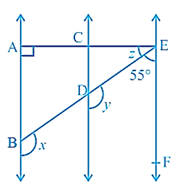
Fig., $A B \| C D$ and $C D \| E F$. Also, $E A \perp A B$. If $\angle B E F=55^{\circ}$, find the values of $x, y$ and $z$.
Image
Answer
Since corresponding angles are equal.
$\therefore x=y \ldots (i)$
We know that the interior angles on the same side of the transversal are supplementary.
$\therefore y+55^{\circ}=180^{\circ}$
$\Rightarrow y=180^{\circ}-55^{\circ}=125^{\circ}$
So, $x=y=125^{\circ}$
Since $A B \| C D$ and $C D \| E F$
$\therefore AB \| EF$
$\Rightarrow \angle EAB +\angle FEA =180^{\circ}[\because$ Interior angles on the same side of the transversal $EA$ are supplementary $]$
$\Rightarrow 90^{\circ}+ z +55^{\circ}=180^{\circ}$
$\Rightarrow z =35^{\circ}$
View full question & answer
Question 35 Marks
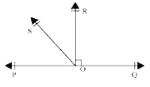
In the given figure, $\text{POQ}$ is a line. Ray $\text{OR}$ is perpendicular to line $\text{PQ. OS}$ is another ray lying between rays $\text{OP}$ and $\text{OR.}$ Prove that $\angle R O S=\frac{1}{2}(\angle Q O S-\angle P O S)$.
Image
Answer
To Prove: $\angle R O S=\frac{1}{2}(\angle Q O S-\angle P O S)$
Given: $\text{OR}$ is perpendicular to $\text{PQ ,}$ or $\angle QOR =90^{\circ}$
From the given figure, we can conclude that $\angle POR$ and $\angle QOR$ form a linear pair.
We know that sum of the angles of a linear pair is $180^{\circ}$.
$\therefore \angle POR +\angle QOR =180^{\circ}$
or $\angle POR =90^{\circ}$
From the figure, we can conclude that
$\angle POR =\angle POS +\angle ROS$
$\Rightarrow \angle POS +\angle ROS =90^{\circ}$
$\Rightarrow \angle ROS =90^{\circ}-\angle POS \ldots( i )$
Again,
$\angle QOS +\angle POS =180^{\circ}$
$\Rightarrow \frac{1}{2}(\angle Q O S+\angle P O S)=90^{\circ}\ldots(ii)$
Substitute $(ii)$ in $(i),$ to get
$\angle R O S=\frac{1}{2}(\angle Q O S+\angle P O S)-\angle P O S$
$=\frac{1}{2}(\angle Q O S-\angle P O S)$
Therefore, the desired result is proved.
View full question & answer
Question 45 Marks
Answer
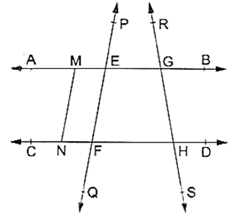
→ Six points : A,B,C,D,E,F
→ Five line segments : $\overline{ EG }, \overline{ FH }, \overline{ EF }, \overline{ GH }, \overline{ MN }$
→ Four rays : $\overrightarrow{ EP }, \overrightarrow{ GR }, \overrightarrow{ GB }, \overrightarrow{ HD }$
→ Four lines : $=\overleftrightarrow{A B}, \overleftrightarrow{C D}, \overleftrightarrow{P Q}, \overleftrightarrow{R S}$
→ Four collinear points : M,E,G,B
View full question & answer
Question 55 Marks
If $p=\frac{3-\sqrt{5}}{3+\sqrt{5}}$ and $q=\frac{3+\sqrt{5}}{3-\sqrt{5}}$, find the value of $p ^2+ q ^2$.
Answer
$p=\frac{3-\sqrt{5}}{3+\sqrt{5}}$
$=\frac{3-\sqrt{5}}{3+\sqrt{5}} \times \frac{3-\sqrt{5}}{3-\sqrt{5}}$
$=\frac{(3-\sqrt{5})^2}{3^2-\sqrt{5}^2}$
$=\frac{9+5-6 \sqrt{5}}{9-5}$
$=\frac{14-6 \sqrt{5}}{4}$
$=\frac{7-3 \sqrt{5}}{2}$
$q=\frac{3+\sqrt{5}}{3-\sqrt{5}}$
$=\frac{3+\sqrt{5}}{3-\sqrt{5}} \times \frac{3+\sqrt{5}}{3+\sqrt{5}}$
$=\frac{(3+\sqrt{5})^2}{3^2-\sqrt{5^2}}$
$=\frac{9+5+6 \sqrt{5}}{9-5}$
$=\frac{14+6 \sqrt{5}}{4}$
$=\frac{7+3 \sqrt{5}}{2}$
$ p ^2+ q ^2$
$=\left(\frac{7-3 \sqrt{5}}{2}\right)^2+\left(\frac{7+3 \sqrt{5}}{2}\right)^2$
$=\frac{49+45-42 \sqrt{5}}{4}+\frac{49+45+42 \sqrt{5}}{4}$
$=\frac{94-42 \sqrt{5}}{4}+\frac{94+42 \sqrt{5}}{4}$
$=\frac{47-21 \sqrt{5}}{2}+\frac{47+21 \sqrt{5}}{2}$
$=\frac{47-21 \sqrt{5}+47+21 \sqrt{5}}{2}$
$=\frac{94}{2}$
$=47$
View full question & answer
Question 65 Marks
Find the values of $a$ and $b$ if $\frac{7+3 \sqrt{5}}{3+\sqrt{5}}-\frac{7-3 \sqrt{5}}{3-\sqrt{5}}=a+b \sqrt{5}$.
Answer
$\ce{LHS}$
$=\frac{7+3 \sqrt{5}}{3+\sqrt{5}}-\frac{7-3 \sqrt{5}}{3-\sqrt{5}}$
$=\frac{7+3 \sqrt{5}}{3+\sqrt{5}} \times \frac{3-\sqrt{5}}{3-\sqrt{5}}-\frac{7-3 \sqrt{5}}{3-\sqrt{5}} \times \frac{3+\sqrt{5}}{3+\sqrt{5}}$
$=\frac{7 \times 3-7 \sqrt{5}+3 \sqrt{5} \times 3-3 \sqrt{5} \times \sqrt{5}}{3^2-\sqrt{5}^2}-\frac{7 \times 3+7 \sqrt{5}-3 \sqrt{5} \times 3-3 \sqrt{5} \times \sqrt{5}}{3^2-\sqrt{5}^2}$
$=\frac{21-7 \sqrt{5}+9 \sqrt{5}-15}{9-5}-\frac{21+7 \sqrt{5}-9 \sqrt{5}-15}{9-5}$
$=\frac{6+2 \sqrt{5}}{4}-\frac{6-2 \sqrt{5}}{4}$
$=\frac{6+2 \sqrt{5}-6+2 \sqrt{5}}{4}$
$=\frac{0+4 \sqrt{5}}{4}$
$=0+\sqrt{5}$
We know that,
$\frac{7+3 \sqrt{5}}{3+\sqrt{5}}-\frac{7-3 \sqrt{5}}{3-\sqrt{5}}=a+b \sqrt{5}$
$0+\sqrt{5}=a+b \sqrt{5}$
$a =0 \text { and } b =1$
View full question & answer
5 Marks Questions - Maths STD 9 Questions - Vidyadip