Questions

3 Marks Question

Take a timed test

7 questions · self-marked practice — reveal the answer and mark yourself.

Question 13 Marks
The polynomials ax $x^3+3 x^2-3$ and $2 x^3-5 x+$ a when divided by $(x-4)$ leave the remainders $R_1$ and $R_2$ respectively. Find the values of a if $R_1+R_2=0$
Answer
The given polynomials are,
$f(x)=a x^3+3 x^2-3$
$p(x)=2 x^3-5 x+a$
Let, $R_1$ is the remainder when $f(x)$ is divided by $x-4Z$
$\Rightarrow R_1=f(4)$
$\Rightarrow R_1=a(4)^3+3(4)^2-3$
$=64 a+48-3$
$= 64a + 45 ....(1)$
Now, let $R_2$ is the remainder when $p(x)$ is divided by $x-4$
$\Rightarrow R_2=p(4)$
$\Rightarrow R_2=2(4)^3-5(4)+a$
$=128-20+a$
$=108+a \ldots .(2)$
Given, $R _1+ R _2=0$
$\Rightarrow 64 a+45+108+a=0$
$\Rightarrow 65 a+153=0$
$\Rightarrow a=-\frac{153}{65}$
This is the required value of $a.$
View full question & answer
Question 43 Marks
Write linear equation $3 x+2 y=18$ in the form of $a x+b y+c=0$. Also write the values of $a, b$ and $c$. Are $(4,3)$ and $(1,2)$ solution of this equation?
Answer
We have the equation as $3x + 2y = 18$
In standard form
$3x + 2y - 18 = 0$
Or $3x + 2y + (-18) =0$
But standard linear equation is
$ax + by + c = 0$
On comparison we get $, a = 3, b = 2, c = -18$
If $(4, 3)$ lie on the line,
i.e., solution of the equation $\text{LHS = RHS}$
$\therefore 3(4)+2(3)=18$
$12+6=18$
$18=18$
As $\text{LHS = RHS,}$
Hence $(4, 3)$ is the solution of given equation.
Again for $ (1, 2)$
$3 x+2 y=18$
$\therefore 3(1)+2(2)=18$
$3+4=18$
$7=18$
$\text { LHS } \neq \text { RHS }$
Hence $(1, 2)$ is not the solution of given equation.
Therefore $(4,3)$ is the point where the equation of the line $3x + 2y = 18$ passes through where as the line for the equation $3x + 2y =18$ does not pass through the point $(1, 2)$.
View full question & answer
Question 53 Marks
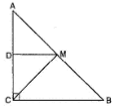
$\text{ABC}$ is a triangle right angled at $C. A$ line through the mid $-$ point $M$ of hypotenuse $AB$ and parallel to $BC$ intersects $AC$ at $D$. Show that
$i. D$ is the mid $-$ point of $AC$
$ii. MD \perp AC$
$iii. CM = MA =\frac{1}{2} AB$
Answer
Given:
$\text{ABC}$ is a triangle right angled at $C. A$ line through the mid $-$ point $M$ of hypotenuse $AB$ and parallels to $BC$ intersects $AC$ at $D$.
Image
To Prove:
$i. D$ is the mid $-$ point of $AC$
$(ii) MD \perp AC$
$ii. C M=M A=\frac{1}{2} A B$
Proof :
$i$. In $\text{ACB},$
As $M$ is the mid $-$ point of $A B$ and MD $\| B C$
$\therefore D$ is the mid $-$ point of $AC \ldots\  [$By converse of mid $-$ point theorem$]$
$ii$. As $MD$
$\| BC$ and $AC$ intersects them
$\angle A D M=\angle A C B \ldots \ [$Corresponding angles$]$
But $\angle ACB =90^{\circ} \ldots\  [$Given$]$
$\therefore \angle ADM =90^{\circ} $
$\Rightarrow MD \perp AC$
$iii$. Now $\angle A D M+\angle C D M=180^{\circ} \ldots \ [$Linear pair axiom$]$
$\angle ADM=\angle CDM=90^{\circ}$
In $\triangle ADM$ and $\triangle CDM$
$AD = CD \ldots \ [ $As $D$ is the mid $-v$ point of $AC ]$
$\angle ADM =\angle CDM \ldots\ [$ Each $90^{\circ}]$
$DM = DM \ldots\ [$ Common$]$
$\therefore \triangle ADM \cong \triangle CDM \ldots\ [$ By $\text{SAS }$ rule$]$
$\therefore MA = MC \ldots \text { [c.p.c.t.] }$
But $M$ is the mid $-$ point of $AB$
$\therefore MA = MB =\frac{1}{2} AB$
$\therefore MA = MC =\frac{1}{2} AB$
$\therefore CM = MA =\frac{1}{2} AB $
View full question & answer
Question 63 Marks
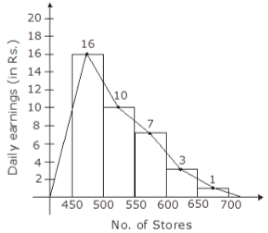
Draw a histogram for the daily earnings of 30 drug stores in the following table:
Daily earnings (in ₹ ):450-500500-550550-600600-650650-700
Number of Stores:1610731
Answer
A histogram for the daily earnings of 30 drug stores
Image
View full question & answer
Question 73 Marks
Represent $\sqrt{4.5}$ on the number line.
Answer
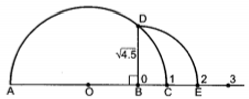
Consider, $AB =4.5$ units.
Extend $AB$ upto point $C$ such that $BC =1$ unit.
$\therefore AC=4.5+1=5.5 \text { units. }$
Now mark $O$ as the midpoint of $AC .$
With $O$ as centre and radius $OC$ draw a semicircle.
Draw perpendicular $BD$ on $AC$ which intersect the semicircle at $D .$
Image
This length $BD =\sqrt{4.5}$ units.
To show $BD$ on the number line, consider line $\text{ABC}$ as number line with point $B$ as zero.
Therefore, $BC=1$ unit.
With $B$ as centre and radius $B D$ draw an arc which intersects number line $\text{ABC}$ at $E.$
So, point $E$ represents $\sqrt{4.5}$
$AB =4.5 \text { units }$
$BC =1 \text { unit }$
$\text{BD=BE}=\sqrt{4.5} \text { units }$
View full question & answer
3 Marks Question - Maths STD 9 Questions - Vidyadip