Questions

M.C.Q

🎯

Test yourself on this topic

18 questions · timed · auto-graded

MCQ 11 Mark
Which one of the following is a polynomial?
  • A
    $\frac{x-1}{x+1}$
  • B
    $\sqrt{2 x}-1$
  • $x^2+\frac{3 x^{\frac{3}{2}}}{\sqrt{x}}$
  • D
    $\frac{x^2}{2}-\frac{2}{x^2}$
Answer
Correct option: C.
$x^2+\frac{3 x^{\frac{3}{2}}}{\sqrt{x}}$
Since the power of the variable of all terms of a polynomial should be a whole number.
Then $x^2+\frac{3 x^{\frac{3}{2}}}{\sqrt{x}}$
$=x^2+3 x^{\frac{3}{2}-\frac{1}{2}}$
$=x^2+3 x^{\frac{2}{2}}$
$=x^2+3 x$
Here the powers of variable are whole numbers.
Therefore the given expression is a polynomial.
View full question & answer
MCQ 21 Mark
How many lines pass through two points?
  • A
    many
  • B
    three
  • C
    two
  • D
    only one
Answer
(d) only one
Explanation: only one because if a line is passing through two points then that two points are solution of a single linear equation
so only one line passes over two given points.
View full question & answer
MCQ 31 Mark
Which of the following points lies on the line $y = 2x + 3$?
  • A
    $(2,8)$
  • B
    $(5,15)$
  • $(3,9)$
  • D
    $(4,12)$
Answer
Correct option: C.
$(3,9)$
Here, $y = 2x + 3$
So, for $x = 3,$ we have
$y=2 \times 3+3$
$=6+3$
$=9$
So, $(3, 9)$ lies on the given line
View full question & answer
MCQ 41 Mark
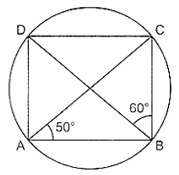
In Fig. $\ce{ABCD}$ is a cyclic quadrilateral. If $\angle BAC=50^{\circ}$ and $\angle DBC=60^{\circ}$ then find $\angle BCD$.
Image
  • A
    $50^{\circ}$
  • B
    $60^{\circ}$
  • $70^{\circ}$
  • D
    $55^{\circ}$
Answer
Correct option: C.
$70^{\circ}$
Here $\angle BDC=\angle BAC=50^{\circ} ($angles in same segment are equal$)$
Image
In $\Delta BCD,$ we have
$\angle BCD=180^{\circ}-(\angle BDC+\angle DBC)$
$=180^{\circ}-\left(50^{\circ}+60^{\circ}\right)$
$=70^{\circ}$
View full question & answer
MCQ 51 Mark
If $\frac{5-\sqrt{3}}{2+\sqrt{3}}=x+y \sqrt{3}$, then
  • A
    $x=-13, y=-7$
  • B
    $x=13, y=-7$
  • $x=-13, y=7$
  • D
    $x=13, y=7$
Answer
Correct option: C.
$x=-13, y=7$
$x+y \sqrt{3}=\frac{5-\sqrt{3}}{2+\sqrt{3}}$
$=\frac{5-\sqrt{3}}{2+\sqrt{3}} \times \frac{2-\sqrt{3}}{2-\sqrt{3}}$
$=\frac{(5-\sqrt{3})(2-\sqrt{3})}{(2)^2-(\sqrt{3})^2}$
$=\frac{5(2-\sqrt{3})-\sqrt{3}(2-\sqrt{3})}{4-3}$
$=\frac{10-5 \sqrt{3}-2 \sqrt{3}+3}{1}$
$=13-7 \sqrt{3}$
$\text { Hence, } x+y \sqrt{3}=13-7 \sqrt{3}$
$\Rightarrow x=13, y=-7$
View full question & answer
MCQ 61 Mark
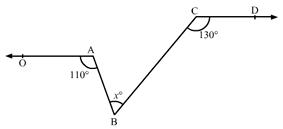
In the given figure, $\angle OAB =110^{\circ}$ and $\angle BCD =130^{\circ}$ then $\angle ABC$ is equal to
Image
  • A
    $50^{\circ}$
  • $60^{\circ}$
  • C
    $40^{\circ}$
  • D
    $70^{\circ}$
Answer
Correct option: B.
$60^{\circ}$
$ 60^{\circ}$
In the given figure, $OA \| CD$.
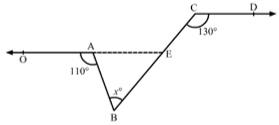
Construction: Extend $OA$ such that it intersects $BC$ at $E$.
Image

Now, $OE \| CD$ and $BC$ is a transversal.
$\therefore \angle AEC =\angle BCD =130^{\circ}\ ($Pair of corresponding angles$)$
Also, $\angle OAB +\angle BAE =180^{\circ} \ ($Linear pair$)$
$\therefore 110^{\circ}+\angle BAE =180^{\circ}$
$\Rightarrow \angle BAE =180^{\circ}-110^{\circ}=70^{\circ}$
In $\triangle ABE$
$\angle AEC =\angle BAE +\angle ABE \ldots \ ($In a triangle, exterior angle is equal to the sum of two opposite interior angles$)$
$\therefore 130^{\circ}=70^{\circ}+x^0$
$\Rightarrow x^0=130^{\circ}-70^{\circ}=60^{\circ}$
Thus, the measure of angle $\angle ABC$ is $60^{\circ}$
View full question & answer
MCQ 71 Mark
The equation x - 2 = 0 on number line is represented by
  • A
    infinitely many lines
  • B
    two lines
  • C
    a point
  • D
    a line
Answer
(c) a point
Explanation: x – 2 = 0
x = 2 is a point on the number line  
View full question & answer
MCQ 81 Mark
$9^3+(-3)^3-6^3=?$
  • A
    $540$
  • $486$
  • C
    $270$
  • D
    $432$
Answer
Correct option: B.
$486$
$9^3+(-3)^3-6^3$
$=729-27-216$
$=729-243$
$=486$
View full question & answer
MCQ 91 Mark
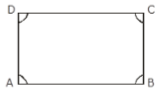
If one angle of a parallelogram is $24^{\circ}$ less than twice the smallest angle, then the measure of the largest angle of the parallelogram is
  • $112^{\circ}$
  • B
    $68^{\circ}$
  • C
    $176^{\circ}$
  • D
    $102^{\circ}$
Answer
Correct option: A.
$112^{\circ}$
$112^{\circ}$
Let angles of parallelogram are $\angle A , \angle B , \angle C , \angle D$
Image
Let smallest angle $=\angle A$
Let largest angle $=\angle B$
$=\angle B =2 \angle A-24^{\circ} \ldots( i )$
$\angle A +\angle B =180^{\circ} \ [$adjacent angle of parallelogram$]$
So $,  \angle A +2 \angle A-24^{\circ}=180^{\circ}$
$=3 \angle A=180^{\circ}+24^{\circ}=204^{\circ}$
$=\angle A =\frac{204^{\circ}}{3}=68^{\circ}$
$=\angle B =2 \times 68^{\circ}-24^{\circ}=112^{\circ}$
View full question & answer
MCQ 101 Mark
The decimal form of $\frac{2}{11}$ is
  • A
    0.018
  • B
    0.18
  • C
    $0 . \overline{18}$
  • D
    $0.0 \overline{18}$
Answer
(c) $0 . \overline{18}$
Explanation: When we divide 2 by 11
We have value $=0.181818$..
Which is $0 . \overline{18}$
View full question & answer
MCQ 111 Mark
The degree of the zero polynomial is
  • A
    $0$
  • B
    any natural number
  • C
    1
  • D
    not defined
Answer
(d) not defined
Explanation: The general form of a polynomial is $a _{ n } x ^{ n }$, where n is a natural number.
For zero polynomial $a_n=0$.
Since the largest value of n for which $a _{ n }$ is non-zero is negative infinity (all the integers are bigger than negative infinity).
Therefore, the degree of zero polynomials is not defined.
View full question & answer
MCQ 121 Mark
If $x = 3$ and $y = -2$ satisfies $5x - y = k,$ then the value of $k$ is
  • A
    $3$
  • $17$
  • C
    $12$
  • D
    $-2$
Answer
Correct option: B.
$17$
If $x = 3$ and $y = -2$ satisfies $5x - y = k$
Then $5x - y = k$
$5 \times 3-(-2)=k$
$15+2=k$
$k=17$
View full question & answer
MCQ 131 Mark
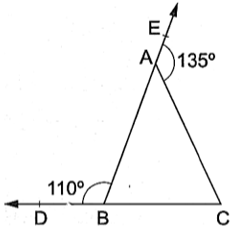
In the given figure, the sides $C B$ and $B A$ of $\triangle A B C$ have been produced to $D$ and $E$ respectively such that $\angle A B D=110^{\circ}$ and $\angle C A E=135^{\circ}$. Then, $\angle A C B=$ ?
Image
  • A
    $35^{\circ}$
  • B
    $45^{\circ}$
  • $65^{\circ}$
  • D
    $55^{\circ}$
Answer
Correct option: C.
$65^{\circ}$
$65^{\circ}$
We can find $\angle CBA$ as follows:
Given that $ \angle EBA =110^{\circ}$
$\angle CBA =180-110 \ldots \ ($linear pair$)$
$=70^{\circ}$
Given $\angle CAD =135^{\circ}$
So, $\angle CAB =180-135 \ldots \ ($linear pair$)$
$=45^{\circ}$
So, $\angle ACB =180-(70+45) \ldots \ ($angle sum property of triangle$)$
$=65^{\circ}$
View full question & answer
MCQ 141 Mark
The product $\sqrt[3]{2} \cdot \sqrt[4]{2} \cdot \sqrt[12]{32}$ is equal to
  • A
    $\sqrt[12]{2}$
  • $2$
  • C
    $\sqrt{2}$
  • D
    $\sqrt[12]{32}$
Answer
Correct option: B.
$2$
$\sqrt[3]{2} \cdot \sqrt[4]{2} \cdot \sqrt[12]{32}$
$=\sqrt[3]{2} \cdot \sqrt[4]{2} \cdot \sqrt[12]{(2)^5}$
$=(2)^{\frac{1}{3}} \cdot(2)^{\frac{1}{4}} \cdot(2)^{\frac{5}{12}}$
$=(2)^{\frac{1}{3}+\frac{1}{4}+\frac{5}{12}}$
$=(2)^{\frac{4+3+5}{12}}$
$=(2)^{\frac{12}{12}}$
$=2$
View full question & answer
MCQ 151 Mark
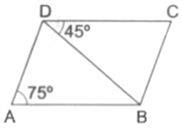
In the given figure $, \text{ABCD}$ is a parallelogram in which $\angle BDC =45^{\circ}$ and $\angle BAD =75^{\circ}$. Then, $\angle CBD =$ ?
Image
  • $60^{\circ}$
  • B
    $45^{\circ}$
  • C
    $75^{\circ}$
  • D
    $55^{\circ}$
Answer
Correct option: A.
$60^{\circ}$
$60^{\circ}$
As per the question
$\angle BAD =\angle BCD =75^{\circ} \ ($opposite angles of parallelogram$)$
Now, in $\triangle B C D$,
$\angle BCD +\angle CBD +\angle BCD =180^{\circ}$
$45^{\circ}+\angle CBD +75^{\circ}=180^{\circ}$
$\angle CBD =60^{\circ}$
View full question & answer
MCQ 161 Mark
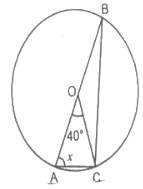
In a figure, $O$ is the centre of the circle with $AB$ as diameter. If $\angle AOC=40^{\circ}$, the value of $x$ is equal to
Image
  • A
    $80^{\circ}$
  • B
    $50^{\circ}$
  • $70^{\circ}$
  • D
    $60^{\circ}$
Answer
Correct option: C.
$70^{\circ}$
Image
$OA = OC ($radii$)$
So, $\angle OAC =\angle OCA = x$
Again, In $\triangle OAC$
$\angle OAC +\angle OCA +\angle AOC =180^{\circ}$
$x + x +\angle AOC =180^{\circ}$
$x + x +40^{\circ}=180^{\circ}$
$2 x =140^{\circ}$
$x=70^{\circ}$
View full question & answer
MCQ 171 Mark
The perimeter of an equilateral triangle is $60 m.$ The area is
  • A
    $10 \sqrt{3} m^2$
  • B
    $20 \sqrt{3} m^2$
  • C
    $15 \sqrt{3} m^2$
  • $100 \sqrt{3} m^2$
Answer
Correct option: D.
$100 \sqrt{3} m^2$
Perimeter of equilateral triangle $=60 m$
$\Rightarrow 3 \times \text { side }=60 m$
$\Rightarrow$ side $=20 m$
Area of equilateral triangle $=\frac{\sqrt{3}}{4}(\text { Side })^2$
$=\frac{\sqrt{3}}{4} 20 \times 20$
$=100 \sqrt{3} sq . m $
View full question & answer
MCQ 181 Mark
The point which lies on y-axis at a distance of 6 units in the positive direction of y-axis is
  • A
    $(-6,0)$
  • B
    $(0,-6)$
  • C
    $(6,0)$
  • D
    $(0,6)$
Answer
(d) (0, 6)
Explanation: Since it lies on the y-axis so it's abscissa x will be zero.
Thus, the point will be (0, 6).  
View full question & answer
M.C.Q - Maths STD 9 Questions - Vidyadip