Questions

M.C.Q

🎯

Test yourself on this topic

18 questions · timed · auto-graded

MCQ 11 Mark
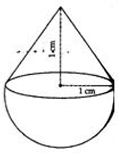
A solid is in the shape of a cone standing on a hemisphere with both their radii being equal to 1cm and the height of the cone is equal to its radius. The volume of the solid is
  • $\pi \ cm ^3$
  • B
    $4 \pi \ cm^3$
  • C
    $2 \pi \ cm^3$
  • D
    $3 \pi \ cm^3$
Answer
Correct option: A.
$\pi \ cm ^3$
Image
Radii of cone $=r=1 \ cm$
Radius of hemisphere $= r =1 \ cm( h )=1 \ cm$
Height of cone $(h)=1 h=1 \ cm$
Volume of solid $=$ Volume of cone $+$ Volume of a hemisphere
$=\frac{1}{3} \pi r^2 h+\frac{2}{3} \pi r^3=\frac{1}{3} \pi r^2(h+2 r)$
$=\frac{1}{3} \times \pi \times(1)^2(1+2 \times 1)$
$=\frac{1}{3} \times \pi \times 3$
$=\pi \ cm ^3$
View full question & answer
MCQ 21 Mark
The value of $\frac{(0.013)^3+(0.007)^3}{(0.013)^2-0.013 \times 0.007+(0.007)^2}$ , is
  • A
    $0.0091$
  • $0.02$
  • C
    $0.006$
  • D
    $0.00185$
Answer
Correct option: B.
$0.02$
Assume $a = 0.013$ and $b = 0.007.$
Then the given expression can be rewritten as
$\frac{a^3+b^3}{a^2-a b+b^2}$
Recall the formula for sum of two cubes
$a^3+b^3=(a+b)\left(a^2-a b+b^2\right)$
Using the above formula, the expression becomes
$\frac{(a+b)\left(a^2-a b+b^2\right)}{a^2-a b+b^2}$
Note that both $a$ and $b$ are positive.
So, neither $a^3+b^3$ nor any factor of it can be zero.
Therefore we can cancel the term $\left(a^2-a b+b^2\right)$ from both numerator and denominator.
Then the expression becomes
$\frac{(a+b)\left(a^2-a b+b^2\right)}{a^2-a b+b^2}=a+b$
$=0.013+0.007$
$=0.02$
View full question & answer
MCQ 31 Mark
In $\triangle P Q R, \angle R=\angle P$ and $Q R=4 cm$ and $P R=5 cm$. Then the length of $P Q$ is
  • A
    2.5 cm
  • B
    4 cm
  • C
    5 cm
  • D
    2 cm
Answer
(b) 4 cm
Explanation: In a triangle, if two of its angles are equal then the sides opposite to equal angles are also equal.
In $\triangle PQR , \angle R =\angle P$
$\Rightarrow QR$ (side opposite to $\angle P$ ) $= PQ$ (side opposite to $\angle R$ )
Given that, QR = 4 cm
$\Rightarrow P Q=4 cm$
View full question & answer
MCQ 41 Mark
The equation of x-axis is
  • A
    y = 0
  • B
    x = 0
  • C
    y = k
  • D
    x = k
Answer
(a) y = 0
Explanation: Since x-axis is a parallel to itself at a distance 0 from it. Let P (x,y) be any point on the x-axis. Then clearly, for all position of P, we shall have the same ordinate 0 or, y = 0. Therefore, the equation of x-axis is y = 0.
View full question & answer
MCQ 51 Mark
The value of $\sqrt[4]{(64)^{-2}}$ is
  • A
    $\frac{1}{2}$
  • $\frac{1}{8}$
  • C
    $\frac{1}{16}$
  • D
    $\frac{1}{4}$
Answer
Correct option: B.
$\frac{1}{8}$
$\sqrt[4]{(64)^{-2}}$
$\Rightarrow(64)^{\frac{-2}{4}}$
$\Rightarrow(64)^{\frac{-1}{2}} \text { or } \frac{1}{\sqrt{64}}$
$\Rightarrow \frac{1}{8}$
View full question & answer
MCQ 61 Mark
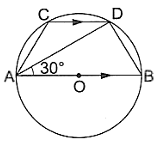
In the given figure, $AOB$ is a diameter of a circle and $CD \| AB$. If $\angle BAD =30^{\circ}$, then $\angle CAD =$ ?
Image
  • A
    $45^{\circ}$
  • B
    $60^{\circ}$
  • C
    $50^{\circ}$
  • $30^{\circ}$
Answer
Correct option: D.
$30^{\circ}$
$\angle ADC =\angle BAD =30^{\circ} ($Alternate angles$)$
$\angle ADB =90^{\circ}$ (Angle in semicircle)
$\therefore \angle C D B=\left(90^{\circ}+30^{\circ}\right)=120^{\circ}$
But $\ce{ABCD}$ being a cyclic quadrilateral, we have:
$\angle BAC +\angle CDB =180^{\circ}$
$\Rightarrow \angle BAD +\angle CAD +\angle CDB =180^{\circ}$
$\Rightarrow 30^{\circ}+\angle CAD +120^{\circ}=180^{\circ}$
$\Rightarrow \angle CAD =\left(180^{\circ}-150^{\circ}\right)=30^{\circ}$
$\Rightarrow \angle CAD =30^{\circ}$
View full question & answer
MCQ 71 Mark
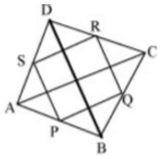
The figure formed by joining the mid-points of the adjacent sides of a rhombus is a
  • A
    trapezium
  • B
    rectangle
  • C
    square
  • D
    Parallelogram
View full question & answer
MCQ 81 Mark
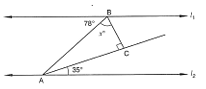
In figure, for which value of $x$ is $I_1 \| l_2$ ?
Image
  • A
    $43$
  • B
    $37$
  • C
    $45$
  • $47$
Answer
Correct option: D.
$47$
Let if $I_1 \| I_2$ and AB is tranverse to it
Then,
$\angle PBA$ should be equal to $\angle BAS ($Alternate angles$)$
So if $I_1 \| I_2$, then $\angle BAS =70^{\circ}$
$\Rightarrow \angle BAC=78^{\circ}-35^{\circ}=43^{\circ}\ldots (i)$
Now, in $\triangle ABC$
$x^0+\angle C+\angle B A C=180^{\circ}$
$\Rightarrow x^0+90^{\circ}+43^{\circ}=180^{\circ}$
$\Rightarrow x^0=180^{\circ}-90^{\circ}=43^{\circ}=47^{\circ}$
$\Rightarrow x^0=47^{\circ}$
So if $x^{\circ}=47^{\circ}$ then $I_1 \| I_2$
View full question & answer
MCQ 91 Mark
If we multiply both sides of a linear equation with a non-zero number, then the solution of the linear equation:
  • A
    Remains the same
  • B
    Changes in case of multiplication only
  • C
    Changes in case of division only
  • D
    Changes
Answer
(a) Remains the same
Explanation: If for any c. where c is any natural number
Like addition and subtraction we can multiply and divide both sides of an equation by a number, c, without changing the equation, where c is any natural number.
View full question & answer
MCQ 101 Mark
The value of $' a\ '$ for which $( x + a )$ is a factor of the polynomial $x^3+a x^2-2 x+a+6$ is
  • A
    $0$
  • B
    $1$
  • C
    $2$
  • $-2$
Answer
Correct option: D.
$-2$
If $(x+a)$ is a factor of the polynomial $x^3+a x^2-2 x+a+6$, then
$p(−a)=0$
$\Rightarrow (-a)^3+a(-a)^2-2(-a)+a+6=0$
$\Rightarrow -a^3+a^3+2 a+a+6=0$
$\Rightarrow 3 a=-6$
$\Rightarrow a=-2$
View full question & answer
MCQ 111 Mark
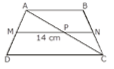
$\ce{ABCD}$ is a trapezium in which $A B \| D C . M$ and $N$ are the mid-points of $A D$ and $B C$ respectively. If $A B=12$
$cm , MN =14 \ cm$, then $CD =$
  • A
    $10\ cm$
  • B
    $14\ cm$
  • C
    $12\ cm$
  • $16\ cm$
Answer
Correct option: D.
$16\ cm$
Image
$\ce{ABCD}$ is a trapezium
$AB \| DC$
$M , N$ are mid points of  $AD\  \& \ BC$
$AB = 12 \ cm, MN = 14 \ cm$
$\because AB \| MN \| \ CD [ M , N$ are mid points of $AD\ \& \ BC ]$
$MP = NP$
By mid point theorem,
$MP =\frac{1}{2} CD$ and $NP =\frac{1}{2} AB$
$\therefore MN =\frac{1}{2}( AB + CD )$
$\Rightarrow 14=\frac{1}{2}(12+ CD )$
$\Rightarrow CD =28-12$
$=16 \ cm$
View full question & answer
MCQ 121 Mark
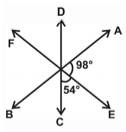
In the figure $AB , CD\ \& \ EF$ are three Straight lines intersecting at $O.$ The measure of $\angle A O F$ is $-$
Image
  • $82^{\circ}$
  • B
    $152^{\circ}$
  • C
    $54^{\circ}$
  • D
    $98^{\circ}$
Answer
Correct option: A.
$82^{\circ}$
$\angle D O F=\angle C O E=54\ldots ($vertically opposite angles$)$
Also,
$\angle A O F+\angle A O E=180$
$\Rightarrow \angle A O F=180-\angle A O E$
$\Rightarrow \angle A O F=180-98$
$\Rightarrow \angle A O F=82$
View full question & answer
MCQ 141 Mark
The force applied on a body is directly proportional to the acceleration produced on it. The equation to represent the above statement is
  • A
    y = kx
  • B
    y = x
  • C
    y + x = 0
  • D
    y - x = 0
Answer
(a) y = kx
Explanation: let force applied  be y and accleration produced be x
The force applied on a body is directly proportional to the acceleration produced on it.
$y \alpha x$
$y=k x$
where k is proportionality constant
View full question & answer
MCQ 151 Mark
In a bar graph if 1 cm represents 30 km , then the length of bar needed to represent 75 km is
  • A
    3.5 cm
  • B
    2.5 cm
  • C
    2 cm
  • D
    3 cm
Answer
(b) 2.5 cm
Explanation: 1 cm = 30 km
So for 75 km
$\frac{75}{30}=2.5 cm$
View full question & answer
MCQ 161 Mark
Point (- 10,0) lies
  • A
    on the negative direction of the y-axis
  • B
    on the negative direction of the X-axis
  • C
    in the third quadrant
  • D
    in the fourth quadrant
Answer
(b) on the negative direction of the X-axis
Explanation: In point (-10, 0) y-coordinate is zero, so it lies on X-axis and its x-coordinate is negative, so the point (-10, 0) lies on the X-axis in the negative direction. 
View full question & answer
MCQ 171 Mark
For the equation $5 x-7 y=35$, if $y=5$, then the value of $'x\ '$ is
  • A
    $12$
  • B
    $-12$
  • C
    $-14$
  • $14$
Answer
Correct option: D.
$14$
For the equation $5x – 7y = 35,$ if $y = 5,$
$5 x-7 y=35$
$y=5$
$5 x-7.5=35$
$5 x-35=35$
$5 x=35+35$
$5 x=70$
$x=\frac{70}{5}=14$
$x=14$
View full question & answer
MCQ 181 Mark
$\sqrt[5]{6} \times \sqrt[5]{6}$ is equal to
  • $\sqrt[5]{36}$
  • B
    $\sqrt[5]{6}$
  • C
    $\sqrt[5]{6 \times 0}$
  • D
    $\sqrt[5]{12}$
Answer
Correct option: A.
$\sqrt[5]{36}$
$\sqrt[5]{6} \times \sqrt[5]{6}$
$=\sqrt[5]{6 \times 6}$
$=\sqrt[5]{36}$
View full question & answer
M.C.Q - Maths STD 9 Questions - Vidyadip