Questions

3 Marks Question

🎯

Test yourself on this topic

7 questions · timed · auto-graded

Question 13 Marks
Factorise: $2 x^3-3 x^2-17 x+30$
Answer
Let $f(x)=2 x^3-3 x^2-17 x+30$ be the given polynomial.
The factors of the constant term $+30$ are $\pm 1, \pm 2, \pm 3, \pm 5, \pm 6, \pm 10, \pm 15, \pm 30$.
The factor of coefficient of $x^3$ is $2 .$
Hence, possible rational roots of $f(x)$ are: $\pm 1, \pm 3, \pm 5, \pm 15, \pm \frac{1}{2}, \pm \frac{3}{2}, \pm \frac{5}{2}, \pm \frac{15}{2}$
We have $f(2)=2(2)^3-3(2)^2-17(2)+30$
$=2(8)-3(4)-17(2)+30$
$=16-12-34+30=0$
And $f(-3)=2(-3)^3-3(-3)^2-17(-3)+30$
$=2(-27)-3(9)-17(-3)+30$
$=-54-27+51+30=0$
So, $(x-2)$ and $(x+3)$ are factors of $f(x)$.
$\Rightarrow x ^2+ x -6$ is a factor of $f ( x )$.
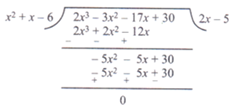
Let us noe divide $f(x)=2 x^3-3 x^2-17 x+30$ by $x^2+x-6$ to get the other factors of $f(x)$.
Factors of $f ( x )$.
By long division, we have
Image
$\therefore 2 x^3-3 x^2-17 x+30=\left(x^2+x-6\right)(2 x-5)$
$\Rightarrow 2 x^3-3 x^2-17 x+30=(x-2)(x+3)(2 x-5)$
Hence, $2 x^3-3 x^2-17 x+30=(x-2)(x+3)(2 x-5)$
View full question & answer
Question 23 Marks
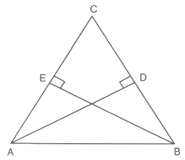
In given figure, $\text{AD}$ and $\text{BE}$ are respectively altitudes of a triangle $\text{ABC}$ such that $\text{AE = BD}$. Prove that $\text{AD = BE}$.
Image
Answer
In $\text{DPDB}$ and $\text{DPEA,}$
$\angle PDB =\angle PEA \ldots[$ Each $90^{\circ}]$
$\angle BPD =\angle APE \ldots[$ Vertically opposite angles $]$
$\text{AE = BD} \ldots[$ Given $]$
$\therefore DPDB \cong DPEA \ldots[$ By $\text{AAS}$ property $]$
$\therefore \text{PA = PB} \ldots[\text { c.p.c.t. }] \ldots \text { (1) }$
$\text{PD = PE} \ldots[\text { c.p.c.t. }] \ldots (2)$
$\text{PA + PD = PB + PE}$
$\Rightarrow \text{AD = BE} \ldots[$ By  adding $(1)$  and $(2)]$
View full question & answer
Question 33 Marks
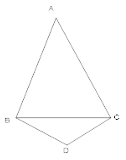
In the given figure, ABC and DBC are two triangles on the same base BC such that $AB = AC$ and $DB = DC$. Prove that $\angle ABD =\angle ACD$,
Image
Answer
In $\triangle ABC$
$AB = AC [$ Given $]$
$\therefore \angle ABC =\angle ACB$ [angles opposite to equal side are equals]
Similarly in, $\triangle DBC , DB = DC$ [Given] ...(1)
$\therefore \angle DBC=\angle DCB \ldots(2)$
Adding (1) and (2)
$\angle ABC+\angle DBC=\angle ACB+\angle DCB$
or $\angle ABD =\angle ACD$
View full question & answer
Question 43 Marks
Find four solutions for the following equation $:12x + 5y = 0$
Answer
$12 x+5 y=0$
$\Rightarrow 5 y=-12 x$
$\Rightarrow y=\frac{-12}{5} x$
Put $x=0$, then $y=\frac{-12}{5}(0)=0$
Put $x=5$, then $y=\frac{-12}{5}(5)=-12$
Put $x=10$, then $y=\frac{-12}{5}(10)=-24$
Put $x=15$, then $y=\frac{-12}{5}(15)=-36$
$\therefore(0,0),(5,-12),(10,-24)$ and $(15,-36)$ are the four solutions of the equation $12 x+5 y=0$
View full question & answer
Question 53 Marks
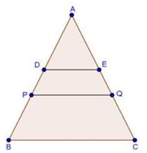
$\text{ABC}$ is a triangle. $D$ is a point on $\text{AB}$ such that $AD =\frac{1}{4} AB$ and $E$ is a point of $AC$ such that $AE =\frac{1}{4} AC$. Prove that $DE =\frac{1}{4} BC$.
Answer
Image
Let $P$ and $Q$ be the mid$-$points of $A B$ and $A C$ respectively.
Then $P Q \| B C$ such that
$P Q=\frac{1}{2} B C \ldots \text { (i) }$
In $\triangle A P Q, D$ and $E$ are mid$-$points of $A P$ and $A Q$ are respectively.
$\therefore DE \| PQ$ and $DE =\frac{1}{2} PQ \ldots (ii)$
From equation $(i)$ and equation $(ii)$, we get
$ DE =\frac{1}{2} PQ =\frac{1}{2}\left[\frac{1}{2} BC \right]$
$\Rightarrow DE =\frac{1}{4} BC $
Hence the required result is proved.
View full question & answer
Question 63 Marks
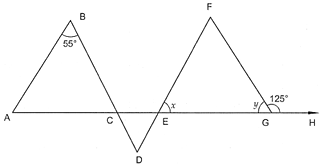
In Fig., if $AB \| DE$ and $BD \| FG$ such that $\angle FGH =125^{\circ}$ and $\angle B =55^{\circ},$ find $x$ and $y$ .
Image
Answer
Here, as $AB \| DE$ and $BD$ is the transversal, so according to the property, "alternate interior angles are equal", we get
$\angle D =\angle B$
$\angle D =55^{\circ} \ldots . .( i )$
Similarly, as $BD \| FG$ and $DF$ is the transversal
$\angle D =\angle F$
$\angle F =55^{\circ} \ ($Using  $i)$
Further, $\text{EGH}$ is a straight line.
So, using the property angles forming a linear pair are supplementary
$\angle FGE +\angle FGH =180^{\circ}$
$\Rightarrow y +125^{\circ}=180^{\circ}$
$\Rightarrow y =180^{\circ}-125^{\circ}$
$\therefore y =55^{\circ}$
Also, using the property, "an exterior angle of a triangle is equal to the sum of the two opposite interior angles",
we get, In $\triangle E F G$ with $\angle F G H$ as its exterior angle
$125^{\circ}=55^{\circ}+x$
$\Rightarrow x=125^{\circ}-55^{\circ}$
$\therefore x=70^{\circ}$
Thus, $x=70^{\circ}$ and $y=55^{\circ}$
View full question & answer
Question 73 Marks
Represent $\sqrt{9.3}$ on the number line.
Answer

Image
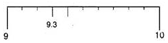
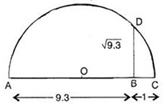
The distance 9.3 from a fixed point $A$ on a given line to obtain a point $B$ such that $A B=9.3$ units. From $B$ mark a distance of 1 unit and mark the new point as C . Find the mid-point of AC and mark that point as O . Draw a semi-circle with centre O and radius OC. Draw a line perpendicular to AC passing through B and interesting the semi-circle at D . Then $BD =\sqrt{9.3}$.
Image
View full question & answer
3 Marks Question - Maths STD 9 Questions - Vidyadip